
全球AI浪潮

Search documents
【宏观】解构日元贬值与日股大涨之谜——《海外非美经济探究》系列第五篇(赵格格/周可)
光大证券研究· 2026-01-20 23:06
Core Viewpoint - Since 2026 (as of January 16), the Japanese yen has depreciated by 0.9% against the US dollar, while the Japanese stock market has surged by 7.1%. This contradiction arises from the inability to explain yen movements solely through traditional frameworks of interest rate differentials, influenced by three factors: the weak sustainability of narrowing interest rate differentials, imbalances in the international balance of payments, and uncertainties in Japan's economic recovery. Conversely, the rise in the Japanese stock market is driven by new fiscal expansion, inflation boosting corporate profits, and the global AI expansion cycle, reflecting differentiated pricing of structural contradictions in the Japanese economy across different asset classes [4]. Group 1: Reasons for Yen Depreciation - The sustainability of narrowing US-Japan interest rate differentials is weak, as the Bank of Japan's guidance on future interest rate paths falls short of market expectations, and the contradiction between Japan's expansive fiscal policy and tight monetary policy raises concerns about fiscal sustainability, potentially slowing the pace of interest rate hikes [5]. - There is a structural imbalance in the international balance of payments, with trade facing challenges, and the yen still has arbitrage opportunities. The US-Japan trade agreement may lead to increased capital outflows due to investments in the US, while foreign capital continues to flow out of Japanese securities [5]. - Although there are signs of recovery in the Japanese economy, structural contradictions remain, and the upward trend is unclear [5]. Group 2: Drivers of Japanese Stock Market Rise - The Nikkei 225 index's rise since 2025 is primarily driven by three factors: high inflation in Japan and moderate economic recovery [6]. - The expectations of the Suga administration's expansive fiscal policy have instilled confidence in the market [6]. - The global AI wave has led to strong exports in related industries [6]. Group 3: Outlook for Japanese Assets in 2026 - The Japanese stock market is expected to maintain high levels, with three areas of focus: a decline in inflation and an increase in real income levels for residents, which may lead to a rebound in the consumer sector [7]. - The global AI expansion phase is still ongoing, and demand for semiconductor equipment is expected to further increase [7]. - The implementation of fiscal policies is favorable for the rise of sectors such as artificial intelligence, semiconductors, shipbuilding, aerospace, and military industries [7]. Group 4: Yen Outlook for 2026 - The yen may continue to face pressure in the first half of the year, with high uncertainty in Japan's economic fundamentals and a slow pace of interest rate hikes. The new fiscal budget review in 2026 may further amplify selling pressure on Japanese bonds, leading to fluctuations at low levels for the yen. However, in the second half of the year, as the Federal Reserve enters a period of intensive rate cuts, the narrowing of US-Japan interest rate differentials may provide slight appreciation potential for the yen [8]. - The yield curve for Japanese government bonds may exhibit a bear steepening trend in the first half of the year, driven by fiscal risk premiums, with long-term yields rising more than short-term yields. In the second half, the curve may shift to bear flattening, dominated by monetary policy tightening, with short-term yields rising more than long-term yields [8].


科创芯片ETF南方(588890.SH)涨1.00%,寒武纪涨2.74%
Jin Rong Jie· 2025-12-23 03:53
Core Viewpoint - The A-share market showed slight gains, with the Sci-Tech Innovation Board leading the rise, driven by advancements in semiconductor materials and AI technologies [1] Group 1: Market Performance - The semiconductor materials sector increased by 1.47%, while the automotive chip sector rose by 0.26%, and domestic chip stocks gained 0.47% [1] - The Sci-Tech Chip ETF (588890.SH) rose by 1.00%, and Cambricon Technologies increased by 2.74% [1] Group 2: Industry Opportunities - AI inference technology is creating structural opportunities in key areas such as storage, ASIC, super nodes, and domestic computing power [1] - The storage sector is experiencing a surge in demand from data centers, coupled with breakthroughs in domestic storage technology (e.g., HBM3/SSD), leading to an upward trend in the industry chain [1] - ASIC chips are benefiting from increased demand for AI inference customization, with domestic CSP manufacturers accelerating their market share growth [1] - Upgrades in infrastructure are supporting the expansion of computing power, driven by demands for high-speed interconnects, liquid cooling, and PCB [1] Group 3: Domestic Computing Power - Improvements in advanced process yield and packaging technology, along with the commercialization of domestic large models, are gradually breaking supply-side bottlenecks [1] - The demand side is expected to see increased volume in training, with innovations at the endpoint such as AI smartphones and smart wearable devices driving upgrades in chip efficiency and integration [1] Group 4: Investment Value - The Sci-Tech Chip ETF (588890.SH) focuses on high-growth sectors such as storage, ASIC, advanced manufacturing, and endpoint innovation, presenting medium to long-term investment value amid accelerated domestic substitution and the global AI wave [1]

万亿资金涌入这三个方向!
Ge Long Hui· 2025-11-13 07:39
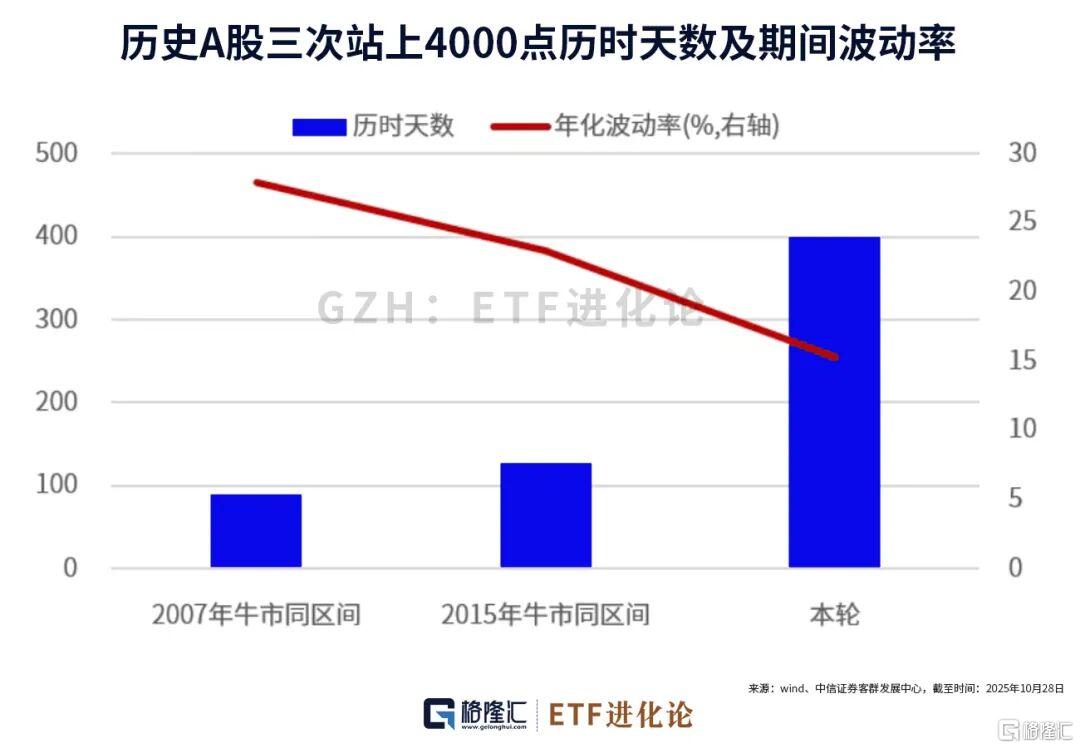
Core Viewpoint - The Shanghai Composite Index has reached the 4000-point mark for the first time in 10 years, indicating significant changes in the A-share market as it approaches the end of 2025 and the commencement of the next five-year plan in China [1] Group 1: Major Changes in the Market - Change One: Slow Bull Market - The Shanghai Composite Index rose from 2748 points on September 24, 2022, to surpass 4000 points on October 28, 2023, taking 400 days with an annualized volatility of 15.28%. In comparison, previous surges in 2007 and 2015 took only 89 and 127 days, respectively, with higher volatilities of 27.94% and 23.01% [1] - Change Two: Shift in A-share Pricing Power - By Q3 2024, the scale of passive equity funds, particularly stock ETFs, has surpassed that of actively managed equity funds for the first time, with the current ETF market reaching 5 trillion yuan, indicating a significant shift in pricing power within the A-share market [4] - Change Three: Leading Themes in the Current Market - The current bull market is primarily driven by sectors such as communication, electronics, and power equipment, reflecting a broader trend towards technological self-sufficiency and the global AI wave, alongside the narrative of revaluation of Chinese assets [5] Group 2: Fund Flows and Investment Trends - Significant Capital Inflows - Since September 24, 2022, the ETF market has seen a net inflow of 1.17 trillion yuan, with major inflows directed towards core A-share assets, technology innovation, and cyclical sectors [11][12] - Performance of Key ETFs - The Double Innovation Leader ETF tracking the Sci-Tech Innovation 50 Index has risen by 57.63% this year, while the Tianhong Growth ETF tracking the ChiNext Index has increased by 45.78% [8] - Year-End Capital Rotation - Following six months of continuous growth, A-shares have seen a rotation of capital, with significant inflows into ETFs tracking sectors like technology, securities, and consumer goods, particularly in the context of the upcoming "15th Five-Year Plan" [14][18]
【机构策略】预计四季度A股市场震荡上行的方向未发生改变
Zheng Quan Shi Bao Wang· 2025-10-17 01:28
Group 1 - A-share market experienced slight fluctuations with strong performance in banking, automotive, communication equipment, and coal sectors, while precious metals, small metals, wind power equipment, and steel sectors underperformed [1] - Market policy expectations are rising, and the potential for interest rate cuts by the Federal Reserve this year is expected to support the market [1] - The upcoming third-quarter reports are anticipated to show a rebound in profit growth across most industries due to a low base from last year, which will strengthen market confidence [1] Group 2 - A-share market saw a pullback after reaching highs, with increased recession expectations in the U.S. due to government "shutdown" and missing key economic data, raising the probability of interest rate cuts in October [2] - Domestic indicators show a continuous expansion in the core CPI for five months, and a decline in social financing and credit growth compared to last year, indicating signs of economic weakness in Q3 [2] - The market is expected to maintain an upward trend amidst a backdrop of improving economic fundamentals in Q4, although recent trading volumes have decreased, suggesting a cautious shift in funding [2] Group 3 - A-share market showed reduced trading volume and fluctuations, with a focus on dividend stocks, while the storage chip sector remained active despite adjustments in other sectors like precious metals and semiconductors [3] - The ongoing global AI investment trend, domestic "anti-involution" leading to performance improvement expectations, and increased liquidity from household savings entering the market are key factors supporting the current bull market [3] - The expectation for the A-share market to trend upwards in Q4 remains unchanged, bolstered by improved global liquidity conditions from potential Federal Reserve rate cuts [3]
【机构策略】在结构优化中把握A股市场机会
Zheng Quan Shi Bao Wang· 2025-10-15 01:19
Group 1 - The A-share market experienced fluctuations on October 14, with strong performance in sectors such as finance, liquor, photovoltaic equipment, and coal, while semiconductor, small metals, communication equipment, and battery sectors underperformed [1][2] - Market expectations for policy support are rising, alongside the potential for interest rate cuts by the Federal Reserve, which may bolster market confidence [1][2] - The upcoming third-quarter earnings reports are anticipated to show a rebound in profit growth across most industries due to a low base from the previous year, which is expected to strengthen market fundamentals [1] Group 2 - The A-share market opened high but closed lower, indicating a lack of continuation in the recovery trend, influenced by uncertainties surrounding U.S.-China trade issues and a recent pullback in technology stocks [2] - All three major indices fell below the 10-day moving average, suggesting a more ambiguous overall market trend and increased short-term risks [2] - Despite short-term caution, the medium-term outlook remains positive due to sustained interest in technology investments driven by the global AI wave, improved liquidity from household savings entering the market, and favorable global liquidity conditions from potential Federal Reserve rate cuts [2]