
科技自主

Search documents
2026年3月PMI分析:需求回暖强于生产,价格波动明显放大
Yin He Zheng Quan· 2026-03-31 11:39
Economic Indicators - The manufacturing PMI for March 2026 is 50.4%, up 1.4 percentage points from the previous month, indicating expansion[1] - The production index recorded 51.4%, an increase of 1.8 percentage points, while the new orders index reached 51.6%, up 3.0 percentage points, marking the first time in 23 months that new orders exceeded production[3] Demand and Supply Dynamics - Demand recovery is stronger than production, with new orders showing significant improvement driven by high-tech manufacturing, equipment manufacturing, and consumer goods[1][4] - New export orders increased by 4.1 percentage points to 49.1%, the highest since May 2024, indicating resilient external demand despite geopolitical tensions[3] Price Trends - The main raw materials purchase price index rose to 63.9%, a significant increase of 9.1 percentage points, while the factory price index increased to 55.4%, up 4.6 percentage points[4][6] - Brent crude oil averaged $98.71 per barrel in March, up 42% month-on-month, contributing to rising costs in logistics and raw materials[6] Inventory and Procurement - The procurement index rose to 50.9%, indicating a return to expansion, while raw materials inventory index remained at 47.7%, indicating a cautious approach to inventory replenishment[7] - Finished goods inventory index decreased to 46.7%, reflecting limited recovery in stock levels despite improved procurement activities[7] Sector Performance - The PMI for high-tech manufacturing reached 52.1%, while equipment manufacturing and consumer goods sectors recorded PMIs of 51.5% and 50.8%, respectively, indicating broad-based sectoral recovery[4][8] - Small and medium enterprises showed marginal improvement, with PMIs of 49.3% and 49.0%, respectively, still below the expansion threshold[8]
北交所策略周报:情绪进入冰点期,静待反弹时间窗口-20260322
Shenwan Hongyuan Securities· 2026-03-22 13:42
Group 1 - The market sentiment has reached a freezing point, with the North Exchange 50 index dropping by 5.76% and average daily trading volume decreasing by 19.37% [11][16][27] - The North Exchange ERP indicator has returned to within -1 standard deviation, and the proportion of strong stocks has fallen to a historical low of 5.6% [11][12][16] - The market's overall risk appetite continues to decline, with small-cap, low-price, and loss-making indices leading the decline, while high-quality indices show slight gains [11][12] Group 2 - The North Exchange has entered a high-quality expansion phase, with 16 new stocks issued since the beginning of 2026, maintaining a weekly issuance pace of about 2 stocks [13] - The report highlights investment opportunities in new and newly listed stocks, with a projected total issuance of 60 stocks for the year [13] - Key stocks to watch include those in the energy and power equipment supply chain, semiconductor self-control, and technology sectors such as AI and commercial aerospace [13] Group 3 - The North Exchange's PE (TTM) average is 82.21 times, with a median of 41.60 times, indicating a decline compared to previous periods [28][26] - The trading volume for the week was 3.584 billion shares, with a trading value of 79.534 billion yuan, both showing a decrease from the previous week [27][16] - The North Exchange has seen 11 stocks rise and 289 stocks fall, with a rise-to-fall ratio of 0.04 [41]
3/23 上海 | CINNO创始人陈丽雅受邀参加“电子化工新材料产业高质量发展论坛”圆桌对话
CINNO Research· 2026-03-19 23:03
Core Viewpoint - The article emphasizes the significant transformation in the global geopolitical landscape and supply chains, shifting from "efficiency-first" to "resilience-focused," highlighting the strategic importance of key materials as national assets [2] Group 1: Industry Trends - The electronic materials sector is experiencing structural and trend changes, driven by AI computing power demands, leading to a new growth cycle in integrated circuits [2] - There is a surge in demand for HBM (High Bandwidth Memory) and accelerated innovation in advanced packaging materials [2] - The penetration rate of OLED in new display technologies continues to rise, creating new material demands [2] Group 2: Government Policy and Strategic Direction - The recent National Two Sessions in 2026 established clear directions for the development of technology and materials industries, with integrated circuits identified as the leading emerging pillar industry [2] - The government report emphasizes the need to "create a new form of intelligent economy," with "reform" and "innovation" being key themes, indicating that material innovation is now a national strategic issue [2] Group 3: Expert Dialogue and Perspectives - A roundtable forum featuring five experts from various fields will discuss the electronic chemical new materials industry's response to downstream changes and the transformation potential of AI [12] - The forum aims to explore how to leverage innovation, autonomy, and intelligence to navigate the current era of uncertainty and change [12] Group 4: Key Discussion Topics - The roundtable will cover five core topics, including the trends in integrated circuits and new material demands, the competition in new display technologies, and the new demands for materials driven by AI server growth [15] - The discussions will also focus on the transformation of material R&D from trial-and-error to predictive methodologies due to AI advancements [15]


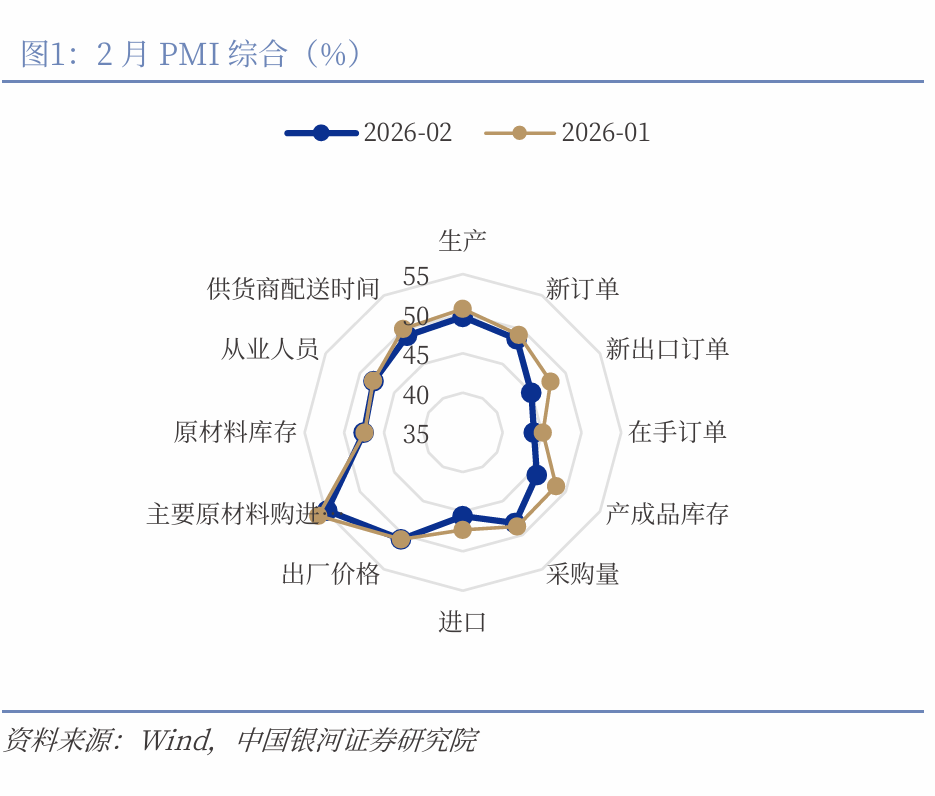
2026年2月PMI分析:PMI季节性回落,一季度力争开门稳
Yin He Zheng Quan· 2026-03-04 07:37
Group 1: PMI Overview - In February 2026, the Manufacturing Purchasing Managers' Index (PMI) was 49.0%, a decrease of 0.3 percentage points from the previous month[1] - The Construction Business Activity Index was 48.2%, down from 48.8%[1] - The Services Business Activity Index was 49.7%, slightly up from 49.5%[1] Group 2: Seasonal Factors and Trends - The decline in PMI is attributed to seasonal factors such as the Spring Festival, with both supply and demand showing temporary slowdowns[2] - The production index fell to 49.6% from 50.6%, and the new orders index dropped to 48.6% from 49.2%[3] - The operating rate decreased by 3.49 percentage points to 39.51%, while the electric furnace capacity utilization rate fell by 17.41 percentage points to 36.34%[3] Group 3: Price and Inventory Dynamics - The factory price index remained stable at 50.6%, while the purchasing price index decreased by 1.3 percentage points to 54.8%[4] - The gap between purchasing prices and factory prices narrowed to 4.2 percentage points, indicating some relief in cost pressures for enterprises[4] - Finished goods inventory index decreased by 2.8 percentage points to 45.8%, while raw materials inventory increased slightly by 0.1 percentage points to 47.5%[4] Group 4: Future Outlook - Manufacturing production activity is expected to recover in March as the effects of the Spring Festival dissipate, with production and new orders indices anticipated to rise[2] - External demand remains resilient, supported by OECD leading indicators pointing to a mild upward trend in exports through June[2] - Domestic demand relies on further policy support and improvements in terminal consumption and investment needs[2]
【中国银河宏观】PMI季节性回落,一季度力争开门稳——2026年2月PMI分析
Xin Lang Cai Jing· 2026-03-04 06:33
Core Viewpoint - The overall decline in February PMI is primarily influenced by seasonal factors such as the Spring Festival holiday, with both supply and demand experiencing a temporary slowdown. Production activities and order indicators have declined in tandem, but the extent of the decline is consistent with historical seasonal patterns. [2] Group 1: PMI and Economic Activity - The manufacturing PMI for February is reported at 49.0%, a decrease of 0.3 percentage points from the previous month. The construction business activity index is at 48.2% (previously 48.8%), and the service business activity index is at 49.7% (previously 49.5%) [1] - The production index for February is at 49.6% (previously 50.6%), and the new orders index is at 48.6% (previously 49.2%), indicating a decline in both supply and demand [3] - The operating rate has decreased due to the holiday impact, with the high-frequency data showing a drop in the rebar operating rate by 3.49 percentage points to 39.51%, and the electric furnace capacity utilization rate declining by 17.41 percentage points to 36.34% [3] Group 2: Price and Cost Dynamics - The factory price index remains unchanged at 50.6%, while the raw material purchase price has decreased by 1.3 percentage points to 54.8%, indicating a reduction in upstream cost pressures [4] - The gap between purchase prices and factory prices is currently 4.2 percentage points, suggesting that corporate profits are still under some cost pressure, although this gap has shown signs of narrowing [4] Group 3: Inventory Trends - The finished goods inventory index has decreased by 2.8 percentage points to 45.8%, while the raw material inventory has increased slightly by 0.1 percentage points to 47.5%. The purchasing index has declined by 0.5 percentage points to 48.2% [4] - Companies are adopting a cautious "production based on sales" strategy, leading to a relatively tight balance in overall inventory levels [4] Group 4: Future Outlook - As the effects of the Spring Festival gradually dissipate, manufacturing production activities are expected to recover in March, with both the production index and new orders index anticipated to rise [2] - External demand remains resilient, as indicated by the OECD composite leading indicators pointing towards a mild upward trend in exports year-on-year until June [2]

华安基金总经理助理、首席指数投资官许之彦:创业板50 ETF配置价值突出
Xin Lang Cai Jing· 2026-02-11 07:56
Core Viewpoint - The ETF market in China is experiencing rapid growth, with the scale of domestic ETFs increasing over 20 times in less than a decade, driven by the maturation of the capital market, the upgrading of wealth management needs, and industrial development [1][6] Group 1: Market Dynamics - The core advantages of ETFs include high transparency, low costs, and good liquidity, making them important vehicles for institutional investors and long-term capital in A-shares [1][6] - The industry faces challenges such as intensified homogenization competition, with many fund companies crowding into popular sectors, leading to an increase in ETFs tracking the same index, which complicates investor choices [1][6] - The focus of competition in the ETF industry is shifting from scale to quality, with differentiation becoming the core competitive advantage [1][6] Group 2: Product Innovation - Product innovation should address demand pain points rather than simply replicate indices, focusing on enhancing liquidity and trading efficiency in mainstream broad-based sectors and making forward-looking investments in niche areas like new productivity, technological independence, and green transformation [2][6] - The service model is evolving from "selling products" to "assisting in allocation," where ETF managers should provide clear strategic logic, regular portfolio reviews, and advisory solutions to help investors avoid impulsive trading behaviors [2][7] Group 3: Future Growth Potential - The current proportion of A-share ETFs to total market capitalization is only 3% to 4%, significantly lower than the 13% in the U.S. and 11% in Japan, indicating substantial growth potential [7] - By 2035, the domestic ETF scale is expected to reach between 12 trillion to 18 trillion yuan, supported by the expansion of bond, commodity, and cross-border categories, as well as the development of smart beta and other innovative products [7] Group 4: Investment Focus - The market is expected to see structural differentiation in earnings realization, with opportunities concentrated in sectors with visible orders, improved cash flow, and clear global competitiveness [8][9] - The ChiNext 50 ETF is highlighted for its configuration value, with its top ten weighted stocks having an average overseas revenue share of 49%, and sectors like optical modules, power batteries, and innovative pharmaceuticals entering the earnings realization phase [9] - The ChiNext 50 index has a significant focus on strategic emerging industries, with over 99% representation, and a combined weight of over 85% in information technology and new energy, making it suitable for investors looking for long-term growth in China's technology sector [9][10] Group 5: Alternative Investment Options - Besides the ChiNext 50 ETF, gold and dividend ETFs are also seen as having good configuration value, supported by factors such as continued liquidity easing from the Federal Reserve's interest rate cuts, weakened dollar credit, and ongoing global central bank gold purchases [10]

信达国际控股港股晨报-20260205
Xin Da Guo Ji Kong Gu· 2026-02-05 02:13
Market Overview - The Hang Seng Index is expected to hold at 26,000 points, influenced by the hawkish stance of the newly appointed Federal Reserve Chairman and a rebound in the US dollar index, which has led to market adjustments in commodities [2] - The Chinese GDP growth target for 2026 is anticipated to be set between 4.5% and 5%, lower than the previous target of around 5% for 2025, as local governments have begun to lower their GDP targets ahead of the Two Sessions [2] - Regulatory measures have been implemented to cool the market, including increased financing margin ratios on the Shanghai and Shenzhen stock exchanges, which has led to a collective reduction in leverage across the three markets [2] Sector Focus - Macau gaming stocks are favored in the short term due to January's gambling revenue exceeding expectations, with the upcoming Spring Festival serving as a catalyst for growth [3] Macro Focus - China's January RatingDog services PMI rose to 52.3, indicating an acceleration in service sector expansion, with new export orders showing strong growth [7] - The People's Bank of China emphasizes the need to support domestic demand and technological innovation in its 2026 credit market work [7] - The US ADP reported a lower-than-expected increase of 22,000 private sector jobs in January, indicating potential labor market weaknesses [7] Company News - Walden Materials (9981) is launching an IPO to raise approximately HKD 28 billion, with a share price capped at HKD 20.09 [9] - Baidu Group (9888) plans to repurchase USD 5 billion in shares and will announce its first dividend this year [9] - Meituan (3690) and Tencent (0700) are taking measures to regulate promotional activities on their platforms, reflecting a tightening of marketing practices [9] - BYD (1211) reported a tenfold increase in electric vehicle sales in Germany, significantly outperforming Tesla [9] - Tesla (TSLA.US) saw a 9.3% increase in electric vehicle sales in China but a 57% drop in the UK market [9]


每日投资策略:关税战恐重燃,市场续观望-20260121
Guodu Securities Hongkong· 2026-01-21 01:55
Group 1: Market Overview - The report indicates that the market is currently cautious due to the potential resurgence of trade wars between the US and Europe, leading to a soft performance in A-shares and a continuation of weakness in Hong Kong stocks, particularly in technology sectors [3][4] - The Hang Seng Index closed down 76 points or 0.29%, at 26,487 points, marking a four-day decline totaling 512 points or 1.9% [3] - The total market turnover was 237.766 billion, with a net inflow of 3.662 billion from northbound trading [3] Group 2: Investment Insights - UBS forecasts a 15% upside potential for the Hong Kong and China stock markets this year, favoring H-shares over A-shares due to a positive outlook on Hong Kong-listed Chinese tech stocks, with expected average earnings growth of 25% or more in the coming years [7] - The report highlights interesting investment themes in Chinese stocks, including technology autonomy, healthcare, new consumption, and high-yield financial stocks, despite a muted overall economic growth outlook for China [7] - UBS anticipates a 4.5% economic growth for China this year, with real estate investment expected to decline by 17% year-on-year, posing a significant economic risk [8] Group 3: Company-Specific Developments - China Duty Free Group plans to acquire DFS Group's Greater China retail business for up to $395 million (approximately 3.081 billion HKD), with the acquisition funded by internal resources [12] - The acquisition will involve issuing new H-shares at a price of 77.21 HKD, which represents an 11.66% discount to the closing price of 87.4 HKD [12] - China Duty Free Group aims to establish a strategic partnership with LVMH in retail sectors, enhancing cooperation in product sales, store openings, brand promotion, and customer experience [12] Group 4: Sector Analysis - China International Capital Corporation predicts a 40% increase in gold prices this year, making gold a more attractive investment amid rising geopolitical tensions and expectations of lower US interest rates [9] - The report emphasizes that central banks and insurance companies are increasing their gold holdings, with a significant rise in gold purchases in 2022, which is expected to continue in 2023 and 2024 [9]
瑞银财富:预计2026年港股和A股有15%上升空间
Zhi Tong Cai Jing· 2026-01-20 07:20
Core Viewpoint - UBS Wealth Management's Chief Investment Officer for Asia Pacific, Chen Minlan, anticipates a 15% upside potential for Hong Kong and A-shares this year [1] Group 1: Market Outlook - The firm is optimistic about European, Chinese, and Japanese stock markets, with a preference for H-shares over A-shares due to a positive outlook on Chinese tech stocks listed in Hong Kong [1] - The expected average earnings growth for Chinese tech stocks over the next few years is projected to reach 25% or more [1] Group 2: Investment Themes - There are interesting "bottom-up" investment themes within Chinese stocks, particularly in areas such as technology autonomy, which includes companies related to artificial intelligence, automation, and robotics [1] - The firm also expresses optimism for sectors such as healthcare, new consumption, and high-yield financial stocks [1]
20cm速递|关注创业板人工智能ETF国泰(159388)投资机会,关注科技自主与AI产业趋势
Mei Ri Jing Ji Xin Wen· 2026-01-20 03:26
Group 1 - The core viewpoint of the article highlights the recent decline of over 2% in the ChiNext AI ETF Guotai (159388) and emphasizes the trends in technology autonomy and the AI industry [1] - According to Guojin Securities, the AI and cloud sector is witnessing significant advancements, with Qianwen App integrating with Alibaba's ecosystem to launch AI Agent capabilities and test AI shopping [1] - Internationally, OpenAI and Google are actively investing in the AI + healthcare sector, indicating a rapid acceleration in corporate AI investments, with over 90% of companies committed to long-term investments and some planning to double their AI investments by 2026 [1] Group 2 - The ChiNext AI ETF Guotai (159388) tracks the ChiNext AI Index (970070), which has a daily price fluctuation limit of 20% and selects listed companies involved in AI technology development and application from the ChiNext market [1] - This index covers various fields, including software and hardware development and intelligent services, reflecting the overall performance of listed companies related to AI on the ChiNext market, showcasing high growth and innovation characteristics [1]