
慢牛行情

Search documents
可转债市场周观察:百元溢价率暂时企稳
Orient Securities· 2026-03-24 12:45
Report Industry Investment Rating - The report does not provide a specific industry investment rating. Core Viewpoints of the Report - The premium rate of convertible bonds with a face value of 100 yuan has temporarily stabilized. If the equity market does not break down further, the callback space for the premium rate of 100 - yuan convertible bonds is relatively controllable. If the equity market continues to break down, some convertible bonds may enter a stage of being wrongly sold. If the convertible bond market adjusts further, some undervalued high - quality bottom - position varieties will present layout opportunities. It is recommended to focus on band trading opportunities and shorten the holding period appropriately [7][10]. - There is no need to overly worry about the impact of the second - generation solvency regulatory assessment on the "fixed - income +" market. The regulatory rules are not new policies, and the industry has had nearly four years to adjust and adapt [7][11]. - In the medium - term, there is no need to be overly pessimistic about the A - share market. The pattern of a slow - bull market has not changed. The funds at both ends of market risk preference are converging towards the middle. Mid - cap blue - chip stocks are expected to become the backbone of the market, and the cyclical and high - end manufacturing sectors have a high cost - performance ratio for allocation [7][11]. Summary According to the Directory 1. Convertible Bond Viewpoint: The Premium Rate of 100 - yuan Bonds is Temporarily Stable, and Both Convertible Bonds and Equities are at Key Points - The convertible bond market has been continuously adjusting following the equity market, and the central value of the conversion premium rate has been passively raised. However, the premium rate of 100 - yuan convertible bonds has shown signs of stabilization. The callback amplitude of the premium rate of 100 - yuan convertible bonds in this adjustment is close to 6 percentage points, the largest in previous adjustments. This is due to the higher overall valuation of convertible bonds compared to the same period in history and the long - lasting slow - bull market in the equity market [7][10]. - Considering the resilience of the configuration demand for "fixed - income +" products and the unchanged support logic of the slow - bull expectation of the equity market for the convertible bond market sentiment, if the equity market does not break down further, the callback space for the premium rate of 100 - yuan convertible bonds is relatively controllable. If the equity market continues to break down, some convertible bonds may be wrongly sold. Currently, the convertible bond index has given back all its annual gains, and convertible bonds below 130 yuan have significantly adjusted, indicating that some institutional funds that entered the market at the beginning of the year have taken profits and left the market to wait and see. If the convertible bond market further adjusts, some undervalued high - quality bottom - position varieties will present layout opportunities. It is recommended to focus on band trading opportunities and shorten the holding period appropriately [7][10]. 2. Convertible Bond Review: The Trading Volume of Convertible Bonds Declined, and the Central Value of the Premium Rate was Passively Raised 2.1 Market Overall Performance: Most Equity Indexes Closed Lower, and the Trading Volume Slightly Shrunk - Last week, the equity market significantly adjusted. The Shanghai Composite Index closed at 3957 points, and only the ChiNext Index closed higher. The ChiNext Index rose 1.26%, while the CSI 300 fell 2.19%, the SSE 50 fell 2.47%, the Shenzhen Component Index fell 2.90%, the CSI Convertible Bond Index fell 3.15%, the Shanghai Composite Index fell 3.38%, the STAR 50 fell 4.03%, the CSI 1000 fell 5.25%, the CSI 2000 fell 5.70%, the Beijing Stock Exchange 50 fell 5.76%, and the CSI 500 fell 5.82%. In terms of industries, only the communication and banking sectors closed higher, while the non - ferrous metals, basic chemicals, and steel sectors led the decline. The average daily trading volume decreased by 287.811 billion yuan to 2.21 trillion yuan [16]. - The top ten convertible bonds in terms of gains last week were Yubang Convertible Bond, Hongbai Convertible Bond, Jinhong Convertible Bond, Haiyou Convertible Bond, Songlin Convertible Bond, Jingzhuang Convertible Bond, Huayi Convertible Bond, Titan Convertible Bond, Aowei Convertible Bond, and Jinlang Convertible Bond 02. In terms of trading volume, Baichuan Convertible Bond 2, Sanfang Convertible Bond, Tongyu Convertible Bond, Jinhong Convertible Bond, Dazhong Convertible Bond, Tianhao Convertible Bond, Weidao Convertible Bond, Outong Convertible Bond, Aofei Convertible Bond, and Jinneng Convertible Bond were relatively active [16]. 2.2 The Trading Volume of Convertible Bonds Declined, and High - priced and Medium - Low - Rated Convertible Bonds Led the Decline - Last week, the convertible bond market significantly adjusted, and market activity declined. The average daily trading volume dropped to 63.345 billion yuan. The CSI Convertible Bond Index fell 3.15% in a single week, the median conversion parity of convertible bonds fell 5.1% to 102.7 yuan, and the median conversion premium rate rose 2.6 percentage points to 30.0%. In terms of style performance, the decline of dual - low strategy targets and large - cap convertible bonds was relatively controllable, while high - priced and medium - low - rated convertible bonds adjusted more significantly [24].
瑞达期货股指期货全景日报-20260316
Rui Da Qi Huo· 2026-03-16 09:59
1. Report Industry Investment Rating - No relevant information provided 2. Core Viewpoints - After the closing of the Two Sessions, the market has gradually realized the policy benefits brought by the National Two Sessions, and the subsequent market will shift to the fact - verification stage [2] - The domestic economic fundamentals in February were strong, and the macro - fundamentals remained stable, providing support for the stock market. Although external shocks had a short - term impact on the domestic market, after the negative impact of rising oil prices was digested, the A - share market was still expected to continue the slow - bull market [2] 3. Summary by Relevant Catalogs 3.1 Futures Disk - IF main contract (2603) latest price was 4662.8, up 3.0; IF sub - main contract (2606) latest price was 4589.0, up 1.6 [2] - IH main contract (2603) latest price was 2952.0, down 7.6; IH sub - main contract (2606) latest price was 2942.2, down 6.0 [2] - IC main contract (2603) latest price was 8178.4, down 51.4; IC sub - main contract (2606) latest price was 8003.4, down 45.0 [2] - IM main contract (2603) latest price was 8187.0, down 17.0; IM sub - main contract (2606) latest price was 7952.8, down 14.0 [2] - IF - IH current - month contract spread was 1710.8, up 9.8; IC - IF current - month contract spread was 3515.6, down 40.2 [2] - IM - IC current - month contract spread was 8.6, up 35.4; IC - IH current - month contract spread was 5226.4, down 30.4 [2] - IM - IF current - month contract spread was 3524.2, down 4.8; IM - IH current - month contract spread was 5235.0, up 5.0 [2] - IF quarterly - current - month was - 73.8, up 0.6; IF next - quarter - current - month was - 152.8, down 3.2 [2] - IH quarterly - current - month was - 9.8, up 1.4; IH next - quarter - current - month was - 46, up 4.4 [2] - IC quarterly - current - month was - 175.0, up 8.0; IC next - quarter - current - month was - 339.6, up 10.8 [2] - IM quarterly - current - month was - 234.2, up 1.6; IM next - quarter - current - month was - 444.2, down 3.2 [2] 3.2 Futures Position - IF top 20 net position was 29,362.00, down 954.0; IH top 20 net position was 20,657.00, up 920.0 [2] - IC top 20 net position was 27,819.00, up 1844.0; IM top 20 net position was 56,018.00, up 624.0 [2] 3.3 Spot Price - CSI 300 was 4671.56, up 2.4; IF main contract basis was - 8.8, up 2.4 [2] - SSE 50 was 2,954.1, down 2.8; IH main contract basis was - 2.1, down 2.2 [2] - CSI 500 was 8,185.2, down 54.7; IC main contract basis was - 6.8, up 19.3 [2] - CSI 1000 was 8,211.4, down 2.9; IM main contract basis was - 24.4, up 2.9 [2] 3.4 Market Sentiment - A - share trading volume (daily, billion yuan) was 23,399.03, down 773.72; margin trading balance (previous trading day, billion yuan) was 26,517.11, down 129.47 [2] - Northbound trading total (previous trading day, billion yuan) was 2952.45, down 9.33; reverse repurchase (maturity volume, operation volume, billion yuan) was - 6485.0, up 6373.0 [2] - Main - force funds (yesterday, today, billion yuan) were - 774.10 and - 430.85; MLF (roll - over volume, net injection, billion yuan) had no data [2] - Rising stock ratio (daily, %) was 51.48, up 24.09; Shibor (daily, %) was 1.320, down 0.001 [2] - IO at - the - money call option closing price (2603) was 40.60, down 7.00; IO at - the - money call option implied volatility (%) was 13.83, down 2.55 [2] - IO at - the - money put option closing price (2603) was 26.40, down 13.60; IO at - the - money put option implied volatility (%) was 13.82, down 2.56 [2] - CSI 300 index 20 - day volatility (%) was 13.35, down 0.17; trading volume PCR (%) was 75.76, up 12.81 [2] - Position PCR (%) was 71.57, up 0.02 [2] 3.5 Wind Market Strength and Weakness Analysis - All A - shares were 5.00, up 1.60; technical aspect was 5.20, up 2.50 [2] - Capital aspect: from January to February, the added value of industrial enterprises above designated size increased by 6.3% year - on - year. In February, it increased by 0.83% month - on - month [2] - From January to February, the total retail sales of consumer goods were 86079 billion yuan, a year - on - year increase of 2.8%. From January to February, the national fixed - asset investment (excluding rural households) was 52721 billion yuan, a year - on - year increase of 1.8%. Among them, private fixed - asset investment decreased by 2.6% year - on - year. In February, fixed - asset investment (excluding rural households) increased by 0.39% month - on - month [2] - From January to February, the national real estate development investment was 9612 billion yuan, a year - on - year decrease of 11.1%. From January to February, the floor area under construction of real estate development enterprises decreased by 11.7% year - on - year, the newly started floor area decreased by 23.1%, and the completed floor area decreased by 27.9%. From January to February, the sales area of newly built commercial housing decreased by 13.5% year - on - year, and the sales volume decreased by 20.2% [2] 3.6 Industry News - The central bank announced that in the first two months of this year, RMB loans increased by 5.61 trillion yuan; the increment of social financing scale was 9.6 trillion yuan, an increase of 3162 billion yuan year - on - year. At the end of February, M2 increased by 9% year - on - year, and the stock of social financing scale increased by 8.2% year - on - year [2] - US President Trump said that Iran had expressed its willingness to negotiate a cease - fire, but the current conditions were "not good enough", so the US would not reach an agreement to end the war with Iran for the time being. Iranian Foreign Minister Araqchi said that Iran had never requested a cease - fire and would continue to defend until President Trump recognized it as an "illegal and unwinnable war" [2] - A - share major indices closed with mixed results, with the three major indices showing differentiation. The Shenzhen market was stronger than the Shanghai market. At the close, the Shanghai Composite Index fell 0.26%, the Shenzhen Component Index rose 0.19%, and the ChiNext Index rose 1.41%. The trading volume of the Shanghai and Shenzhen stock markets decreased slightly. Industry sectors rose and fell mixed, with the steel and non - ferrous metal sectors weakening significantly, and the food and beverage sector leading the gains [2] - Overseas, the conflict between the US and Iran continued, and the latest statements of both sides were tough, which pushed up the geopolitical risk premium of crude oil. On March 16, during the Asian trading session, Brent crude oil reached $105 and fluctuated repeatedly [2] - Domestically, in terms of economic fundamentals, from January to February 2026, the added value of domestic industrial enterprises above designated size, fixed - asset investment, social retail sales, imports and exports, and inflation data all rebounded significantly compared with the previous values, only the real - estate demand side remained weak, and the national economy in 2026 had a good start [2] - In terms of financial data, the growth rate of M2 in February was flat compared with the previous value, the growth rate of M1 accelerated significantly, the gap between M1 and M2 further narrowed, and the activation degree of funds increased. In addition, the gap between household deposits and M2 increased, indicating that the pace of household deposits flowing into the stock market slowed down, but since the gap was still in the negative range, it showed that the transfer of household deposits continued [2] 3.7 Key Concerns - On March 18 at 20:30, the US February PPI and core PPI data will be released [3] - On March 19 at 2:00, the Federal Reserve will announce its interest - rate decision [3] - On March 19 at 20:00, the Bank of England will announce its interest - rate decision [3] - On March 19 at 21:15, the European Central Bank will announce its interest - rate decision [3]

复盘投融资平衡周期,如何看待本轮“慢牛”的持续性?
Changjiang Securities· 2026-03-13 01:10
Investment Rating - The report maintains a "Positive" investment rating for the investment banking and brokerage industry [8] Core Insights - The balance of investment and financing is a key regulatory goal in capital markets, with financing cycles generally lagging behind investment cycles, influencing market investment styles and rhythms [3][5] - The report reviews historical financing cycles in the A-share market, focusing on the turning points of financing cycles and the interaction between financing regulation and market styles, while providing outlooks based on the current regulatory environment [5][14] Summary by Sections Historical Financing Cycle Review - The report categorizes past financing regulatory cycles into six stages, each lasting approximately 2-4 years: 1. 2008-2009 (Crisis-driven counter-cyclical easing) 2. 2010-2013 (Regulatory tightening) 3. 2014-2015.06 (Market-oriented reform easing) 4. 2015.07-2018 (Risk prevention tightening) 5. 2019-2023.07 (Registration system reform easing) 6. 2023.08 to present (Coordinated balance counter-cyclical adjustment) [6][15] Financing Cycle Turning Points - Easing turning points are often triggered by market distress, such as liquidity tightening during economic crises or the need for market reforms to meet financing demands [33] - Tightening turning points arise from the need for risk prevention and regulatory order, often following market overheating or significant downturns [36][38] Current Regulatory Environment - The current regulatory environment is characterized by stronger coordination and execution, with a focus on improving the stability of the market through enhanced regulatory mechanisms [7] - The financing policies are in the early stages of structural easing, with expectations for a sustained "slow bull" market due to the gradual improvement of the financing environment [7][30] Policy Coordination and Adjustment Rhythm - The report emphasizes that regulatory adjustments typically begin with IPO controls, which have the most direct impact on the secondary market, followed by refinements in other financing methods [40] - The coordination among IPO, refinancing, and mergers and acquisitions is crucial for achieving the regulatory goals of stabilizing the market and supporting the real economy [42][43]
复盘投融资平衡周期,如何看待本轮慢牛的持续性?
Changjiang Securities· 2026-03-12 08:59
Investment Rating - The report maintains a "Positive" investment rating for the investment banking and brokerage industry [10] Core Insights - The balance of investment and financing is a key regulatory goal in capital markets, with financing cycles generally lagging behind investment cycles, influencing market investment styles and rhythms [4][16] - The report reviews historical financing cycles in the A-share market, focusing on the turning points of financing cycles and the interaction between financing regulation and market styles, while providing an outlook based on the current regulatory environment [7][16] Summary by Sections Historical Financing Regulatory Cycles - The report categorizes historical financing regulatory cycles into six phases, each lasting approximately 2-4 years: 1. 2008-2009: Crisis-driven counter-cyclical easing 2. 2010-2013: Regulatory tightening 3. 2014-2015.06: Market-oriented reform easing 4. 2015.07-2018: Risk prevention tightening 5. 2019-2023.07: Registration system reform easing 6. 2023.08 to present: Coordinated balance counter-cyclical adjustment [8][17] Turning Points in Financing Regulation - Easing turning points are often triggered by market distress, such as liquidity crises or economic pressures, necessitating regulatory responses to support the market [31] - Tightening turning points arise from the need for risk prevention and regulatory order, often in response to overheating markets or significant market downturns [34][36] Policy Coordination and Adjustment Rhythm - The report emphasizes that regulatory adjustments typically begin with IPO controls, which have the most direct impact on the secondary market, followed by refinements in other financing methods [38] - The coordination of IPOs, refinancing, and mergers and acquisitions is crucial for adapting to macroeconomic conditions and market performance [40] Current Market Outlook - The current regulatory environment is characterized by stronger coordination and execution, with a focus on enhancing market stability and improving the financing structure for high-quality enterprises [9][27] - The report suggests that the ongoing "slow bull" market is likely to continue, supported by a gradual structural easing of financing policies [9][27]
招商证券首席策略分析师张夏:慢牛行情有望延续 盈利增速产生动力
Shen Zhen Shang Bao· 2026-02-26 18:14
Group 1 - The core viewpoint is that the A-share market is expected to continue a slow bull market in 2026, with a projected earnings growth rate of 5% to 10% for non-financial and oil companies, which will drive the market upward [1] - The overall A-share market is anticipated to be in a phase of recovering earnings growth and moderate valuation expansion, with the Shanghai Composite Index expected to rise between 10% and 15% [1] - The current upward cycle of A-shares is transitioning from a liquidity-driven phase to a profitability improvement-driven phase, with key indicators such as PPI recovery marking substantial corporate profit improvements [1] Group 2 - On the funding supply side, public funds are expected to continue their recovery trend, with potential improvements in active fund redemptions if they can overcome loss-making resistance [2] - Insurance funds are projected to see improved premium income, supported by policies encouraging increased stock market investment, making them a significant source of stable incremental capital [2] - The appreciation of the RMB is likely to attract foreign capital inflows, supporting A-share valuation expansion during this net inflow phase [2]

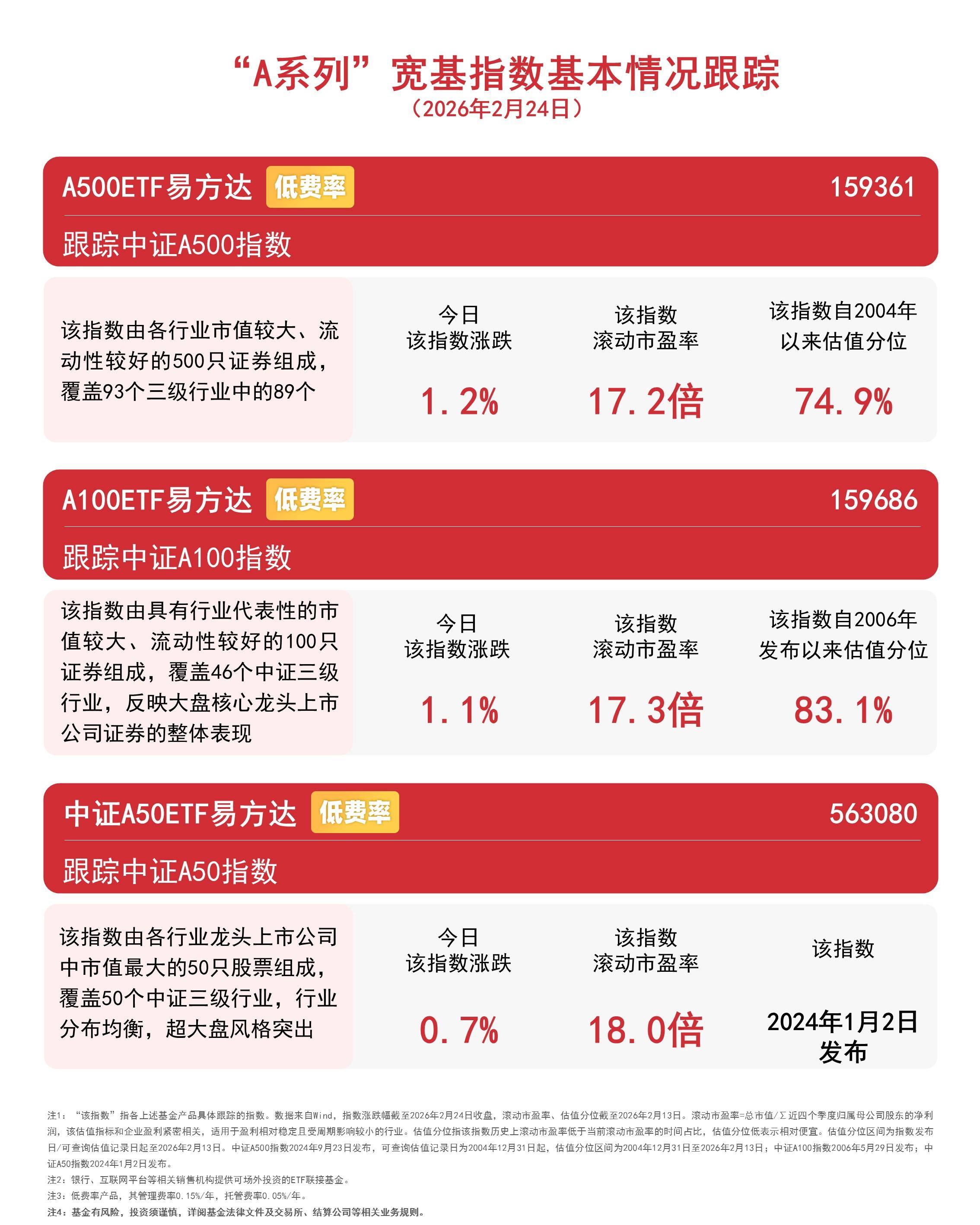
中证A500指数涨1.2%,机构称节后慢牛行情更加稳健,A500ETF易方达(159361)助力布局A股核心资产
Sou Hu Cai Jing· 2026-02-24 12:30
Group 1 - The core viewpoint of the articles indicates a positive market trend, with the CSI A500 index rising by 1.2%, the CSI A100 index by 1.1%, and the CSI A50 index by 0.7% [1] - China Galaxy Securities suggests that post-holiday, with the opening of policy windows and a rebound in risk appetite, market focus may shift back to growth sectors with industrial catalysts and earnings certainty, such as AI applications, high-end manufacturing, and new energy [1] - The market is expected to experience a more moderate pace, leading to a more stable slow bull market [1]

2026年A股市场怎么走 李大霄这么看
Qi Huo Ri Bao· 2026-02-17 07:18
Core Viewpoint - The A-share market is expected to shift from an offensive strategy in 2025 to a defensive approach in 2026, influenced by various external uncertainties and market conditions [1][4]. Market Overview - In January 2026, the Shanghai Composite Index reached a high of 4190 points with a record single-day trading volume of 3.99 trillion yuan, and a turnover rate of 48%, marking a historical peak [1]. - The market has experienced an outflow of 700 billion yuan in ETFs, alongside significant volatility in precious metals, a collapse in overseas cryptocurrencies, and a sharp decline in US tech stocks, contributing to market uncertainty [1][4]. Investment Strategies - Investors are advised to avoid chasing high prices, adhere to a pyramid-shaped investment strategy, and focus on value investing by selecting companies with solid fundamentals and genuine investment value [2][5]. - High-dividend blue-chip stocks are identified as a core investment theme for 2026, offering attractive yields compared to traditional investment products like government bonds and bank deposits [2][3]. Sector Focus - Financials, dividend-paying stocks, and leading state-owned enterprises are highlighted as sectors with long-term investment value [3]. - The consumer sector is also expected to be a significant investment theme, benefiting from policies aimed at boosting domestic demand and consumption, although its valuation may not be as favorable compared to blue-chip stocks [3]. External Influences - Global market volatility, particularly from the decline of US tech stocks, the halving of Bitcoin prices, and fluctuations in precious metals, is anticipated to impact the A-share market significantly [4]. - The potential for capital inflow into A-shares and Hong Kong stocks exists if global market conditions stabilize, but the extent of this impact will depend on the level of external market volatility [4]. Asset Allocation - A cautious approach to bond market investments is recommended, with a balanced allocation among bonds, insurance, and equities [5]. - Investors are encouraged to maintain a certain proportion of cash assets to achieve a balanced investment strategy, allowing for both offensive and defensive maneuvers [5]. Long-term Outlook - The risk of a peak in US tech stocks is viewed as a major variable for the A-share market in 2026, prompting a shift from aggressive to defensive investment strategies if significant market corrections occur [5]. - Emphasis is placed on the importance of de-leveraging and adhering to principles of rational and value-based investing to achieve long-term stable returns [5][6].
2026年A股市场怎么走 李大霄这么看|策马点金
Qi Huo Ri Bao· 2026-02-16 23:33
Core Viewpoint - The A-share market in 2026 is expected to shift from an aggressive stance to a more defensive approach due to multiple uncertainties, including high volatility in global markets and significant outflows from ETFs [3][7]. Market Overview - In January 2026, the Shanghai Composite Index reached a high of 4190 points with a record single-day trading volume of 3.99 trillion yuan and a turnover rate of 48% [3]. - The market has experienced a 700 billion yuan outflow from ETFs, alongside external shocks from precious metals, cryptocurrency crashes, and declines in U.S. tech stocks, contributing to market uncertainty [3][7]. Investment Strategy - Investors are advised to avoid chasing high prices, utilize a pyramid-shaped investment strategy to manage risk, and focus on value investing by selecting companies with solid fundamentals and genuine investment value [3][8]. - High-dividend blue-chip stocks are identified as a core investment theme for 2026, offering attractive yields compared to traditional investment products like government bonds and bank deposits [4][5]. Sector Focus - Financials, dividend-paying stocks, and leading state-owned enterprises are highlighted as sectors with long-term investment value [6]. - The consumer sector is also seen as a potential investment theme, benefiting from policies aimed at boosting domestic demand, although it may not offer the same valuation advantages as blue-chip stocks [6]. Global Market Impact - Increased volatility in global markets, particularly due to U.S. tech stock declines and cryptocurrency fluctuations, may lead to a reallocation of global funds, potentially benefiting A-shares and Hong Kong stocks [7]. - The stability of the A-share market is supported by long-term capital inflows and the potential for market adjustments following ETF reductions [7]. Asset Allocation - A cautious approach to bond investments is recommended, with a balanced allocation across bonds, insurance, and equities, while maintaining a portion of cash for flexibility [8]. - Investors are urged to remain vigilant regarding risks associated with newly listed stocks and high-valuation stocks, especially in a volatile market [8]. Summary of Investment Strategy - The investment strategy for 2026 can be summarized with three keywords: "defensive stability, optimal allocation, and avoiding high prices" [9].

A股蛇年收官,沪指累计涨超25%,专家:马年有望延续慢牛
Nan Fang Du Shi Bao· 2026-02-13 08:51
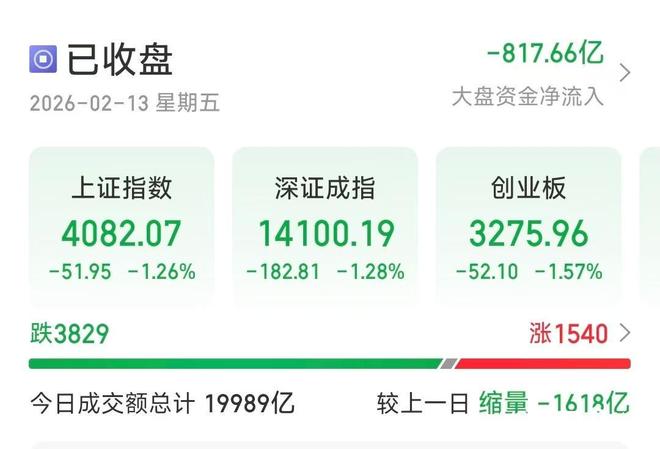
Market Performance - On February 13, the last trading day of the Year of the Snake, major indices collectively declined, with the Shanghai Composite Index closing at 4082.07, down 1.26%, the Shenzhen Component Index at 14100.19, down 1.28%, and the ChiNext Index at 3275.96, down 1.57% [1] - The total trading volume reached 199.89 billion yuan, a decrease of 16.18 billion yuan compared to the previous trading day [1] - For the entire year, the Shanghai Composite Index increased by over 25%, the Shenzhen Component Index by over 38%, and the ChiNext Index by approximately 58%, indicating significant growth compared to the previous year [1] Sector Performance - The military equipment, film and television, paper, and semiconductor sectors showed strong gains, with notable performances including a 20% limit-up for Andavere in the military sector and a 15.39% increase for Light Media in the film sector [3] - The technology sector, particularly in areas such as semiconductor chips, algorithm computing, humanoid robots, solid-state batteries, commercial aerospace, and controllable nuclear fusion, is expected to continue performing well [3] Future Outlook - Looking ahead to the Year of the Horse, it is anticipated that 2026 will mark the beginning of the "14th Five-Year Plan," with technology innovation directions outlined in the plan expected to perform well [3] - The market is expected to maintain a slow bull trend, driven by an accelerated shift of household savings into the capital market, with more funds entering through direct accounts or mutual funds [3] - The current valuation of the CSI 300 index is around 15 times earnings, below historical averages, indicating that the market is still in the mid-stage of a bull market with ample investment opportunities [4] Economic Context - The overall international competitiveness of China is improving, leading to rising valuations of Chinese assets, and the economy is transitioning from investment-driven to innovation-driven [4] - The emergence of new productive forces represented by AI is expected to create more investment opportunities in the capital market [4] - The global trend of fiscal expansion and monetary easing is likely to result in favorable market performance, supported by an improving institutional environment for the stock market in China [5]
春节假期持仓报告
Yin He Qi Huo· 2026-02-12 07:58
1. Report Industry Investment Rating No relevant content provided. 2. Core Views of the Report - The stock index is expected to continue its slow - bull market. Factors such as policy support, stable market funds, and improving economic data create favorable conditions for the market. After the Spring Festival, the market is likely to perform well, especially for small - and medium - cap stocks and the ChiNext and STAR Market indices [11][12]. - The sentiment in the bond market may turn cautious after the Spring Festival. Although the central bank's monetary policy remains moderately loose, factors such as the approaching important meetings and the possible reversal of some investors' behaviors may lead to a more cautious attitude [14]. - In the agricultural and sideline products sector, different products have different trends. For example, soybean meal is expected to gradually reduce inventory, while the price of live pigs is likely to remain low. Corn and starch are expected to fluctuate at high levels, and the price of sugar is expected to be weak [18][22][25]. - In the ferrous metals sector, steel prices may face pressure after the Spring Festival. The supply - demand structure of steel is weakening, and factors such as iron - water production, inventory accumulation, and coal mine resumption need to be monitored. The coking coal and coke market is affected by factors such as coal mine shutdowns and international coal market changes, with prices showing wide - range fluctuations. Iron ore prices are expected to be weak due to the weakening fundamentals [42][44][47]. - In the non - ferrous metals sector, precious metals such as gold and silver are expected to maintain a cautious and optimistic trend. Copper prices are expected to be in a high - level consolidation in the short term but have a long - term upward trend. Aluminum prices are expected to fluctuate in the short term and may rise if the Mozal aluminum plant's production reduction plan is implemented [52][56][58]. - In the shipping innovation sector, the container shipping market has a weakening price increase expectation in March and will enter the off - season after the Spring Festival. Attention should be paid to factors such as shipping capacity deployment, geopolitical situations, and the implementation of price increase announcements [83]. - In the energy and chemical sector, crude oil prices are mainly driven by geopolitical factors in the short term, with a wide - range fluctuation. LPG prices are supported by high international costs in the short term but are restricted by weak domestic supply and demand in the long term. Other chemical products such as asphalt, natural gas, and fuel oil also have their own supply - demand and price characteristics [88][90][96]. 3. Summary by Directory 3.1 Macro Finance 3.1.1 Stock Index - **Analysis**: Policy guidance consolidates the stable and positive trend. Market risk appetite has decreased, and the enthusiasm for A - share investment has cooled, laying the foundation for a slow - bull market. Economic data is improving, which is beneficial to the performance of listed companies. After the Spring Festival, the market is likely to perform well, especially for small - and medium - cap stocks and the ChiNext and STAR Market indices. The futures market has already reduced positions in advance, and if the market improves after the Spring Festival, the basis discount may further narrow [12]. - **Trading Strategy**: Unilateral trading should be to go long on dips; for arbitrage, consider the spot - futures arbitrage of IM/IC long 2609 + short ETF; for options, use the bull spread strategy [13]. 3.1.2 Treasury Bonds - **Analysis**: The central bank's monetary policy remains moderately loose. Although inflation indicators are recovering, the impact on the bond market is limited. The market risk appetite has stabilized, but the bond market sentiment is still affected by the Spring Festival holiday. In the short term, the probability of a policy interest rate cut is low, and the bond market sentiment may turn cautious after the Spring Festival [14]. - **Trading Strategy**: Unilateral trading should be to try to short TS contracts on rallies; for arbitrage, pay attention to the phased long - T - contract inter - delivery spread trading [15]. 3.2 Agricultural and Sideline Products 3.2.1 Soybean Meal - **Analysis**: The international soybean market is strong, but the upside space is limited. The domestic soybean supply is sufficient, and the soybean meal inventory is expected to gradually decrease [18][19]. - **Trading Strategy**: It is recommended to wait and see for unilateral trading and arbitrage; for options, use the short strangle strategy [20]. 3.2.2 Live Pigs - **Analysis**: The supply pressure of live pigs is obvious, and the price is at a low level. The futures price mainly follows the spot price, and the downward space is limited [22]. - **Trading Strategy**: It is recommended to wait and see for unilateral trading and arbitrage; for options, use the short strangle strategy [23]. 3.2.3 Corn - **Analysis**: The US corn production is stable, and the import profit is high. After the Spring Festival, the supply of corn in Northeast China will increase, and the price may decline slightly. The starch price is expected to be relatively strong [25]. - **Trading Strategy**: For unilateral trading, try to buy US corn 03 below 420 cents/bu and short 03 corn on rallies; for arbitrage, widen the spread between 05 corn and starch on dips; for options, use the bear put spread strategy for 03 corn [26]. 3.2.4 Peanuts - **Analysis**: The peanut price is stable before the Spring Festival, and the 05 contract is expected to oscillate at the bottom [27]. - **Trading Strategy**: For unilateral trading, take a short - long position on dips for the 05 contract; for arbitrage, wait and see; for options, try to sell the pk603 - C - 8200 option [28]. 3.2.5 Sugar - **Analysis**: The international sugar price is expected to be weak, and the domestic sugar price is likely to follow the weak trend [29]. - **Trading Strategy**: For unilateral trading, use the high - short and low - cover strategy for the domestic Zhengzhou sugar 5 - month contract; for arbitrage, wait and see; for options, sell call options [30]. 3.2.6 Cotton - **Analysis**: The cotton price is supported, and the Zhengzhou cotton is expected to oscillate slightly stronger in the short term [31]. - **Trading Strategy**: For unilateral trading, the US cotton is expected to oscillate in a range, and the Zhengzhou cotton is expected to be slightly stronger. It is recommended to hold a light position during the Spring Festival; for arbitrage and options, wait and see [32]. 3.2.7 Eggs - **Analysis**: The egg demand is average, and the price is stable with a slight decline. It is recommended to short the 6 - month contract on rallies [33]. - **Trading Strategy**: For unilateral trading, short the 6 - month contract on rallies; for arbitrage and options, wait and see [34]. 3.2.8 Apples - **Analysis**: The apple inventory is low, and the cost of warehouse receipts is high. The price of the 5 - month contract is expected to be strong in the short term [35]. - **Trading Strategy**: For unilateral trading, go long on the 5 - month contract on dips and short the 10 - month contract on rallies; for arbitrage, go long on the 5 - month contract and short the 10 - month contract; for options, wait and see [36]. 3.2.9 Oils and Fats - **Analysis**: The palm oil inventory in Malaysia is at a high level, but the total inventory of Malaysia and Indonesia is not loose. The US biodiesel demand is expected to be good, which is beneficial to soybean oil. The domestic soybean oil inventory is gradually decreasing, and the supply is generally sufficient. The policy of Canadian rapeseed is uncertain, and the domestic rapeseed oil inventory is slightly decreasing [37]. - **Trading Strategy**: For unilateral trading, hold a light position during the holiday; for arbitrage, conduct P59 and Y59 reverse arbitrage; for options, wait and see [38]. 3.3 Ferrous Metals 3.3.1 Steel - **Analysis**: After the Spring Festival, steel mills may resume production, and the steel supply will increase. The demand is in the off - season, and the inventory is accumulating. The supply - demand structure is weakening, and the steel price may face pressure. However, the steel price valuation is low, and the decline is limited [42]. - **Trading Strategy**: For unilateral trading, the price is expected to be weak and oscillating; for arbitrage, short the hot - rolled coil - rebar spread and the rebar - coking coal ratio on rallies; for options, wait and see [43]. 3.3.2 Coking Coal and Coke - **Analysis**: Coal mines are on holiday during the Spring Festival, and the supply is reduced. The impact of the Spring Festival holiday on the Mongolian coal port is limited. The domestic coal market is affected by international and domestic factors, and the price is expected to fluctuate widely. The coking coal valuation is not high, and it is recommended to go long on dips [44][45]. - **Trading Strategy**: For unilateral trading, conduct band trading; for arbitrage, wait and see; for options, sell out - of - the - money put options [46]. 3.3.3 Iron Ore - **Analysis**: The iron ore supply is increasing, and the demand is weak. The fundamentals are weakening, and the price is expected to be weak after the Spring Festival [47]. - **Trading Strategy**: For unilateral trading, hold a small number of short positions; for arbitrage, wait and see; for options, sell out - of - the - money call options [48]. 3.3.4 Ferroalloys - **Analysis**: The supply and demand of ferrosilicon and ferromanganese are relatively stable, and the cost support is strong. It is recommended to take partial profit on long positions before the long holiday [49]. - **Trading Strategy**: For unilateral trading, take partial profit on long positions before the long holiday and go long on dips after the holiday; for arbitrage, wait and see; for options, sell put options [50]. 3.4 Non - Ferrous Metals 3.4.1 Gold and Silver - **Analysis**: The gold and silver market has stabilized and recovered after the adjustment. The trading mainline is expected to return to factors such as great - power games and the US interest - rate cycle. It is recommended to control risks during the holiday [52]. - **Trading Strategy**: For unilateral trading, conservative investors can exit long positions on rallies, and aggressive investors can hold long positions based on the 20 - day moving average with a light position. It is recommended to hold an empty position for silver; for arbitrage, wait and see; for options, switch futures long positions to buy out - of - the - money call options for gold, and use the bull call spread strategy for silver [53]. 3.4.2 Platinum and Palladium - **Analysis**: The non - farm payroll data is contradictory, and the asset volatility is high. Platinum is in a tight - balance pattern, and palladium is in a supply - surplus pattern. Platinum has a stronger upward driving force [54]. - **Trading Strategy**: For unilateral trading, be cautiously bullish and buy on dips; for arbitrage, go long on platinum and short on palladium; for options, wait and see [55]. 3.4.3 Copper - **Analysis**: The copper price has fluctuated sharply recently. After the adjustment, the fundamentals are healthier, and the long - term upward trend remains unchanged. It is recommended to control positions during the Spring Festival [56]. - **Trading Strategy**: For unilateral trading, the price is in a high - level consolidation, and it is recommended to control positions; for arbitrage, wait and see; for options, sell out - of - the - money put options [57]. 3.4.4 Aluminum - **Analysis**: The macro - economic expectations are volatile. If the Mozal aluminum plant reduces production as planned, the aluminum price will be strong; otherwise, the upward momentum will be weakened. The domestic inventory is accumulating, which suppresses the price [58]. - **Trading Strategy**: In the short term, the Shanghai aluminum is expected to oscillate between 22,800 - 24,200 yuan. In the long term, if the production - reduction plan is implemented, be bullish on dips; pay attention to the implementation of the production - reduction plan [59]. 3.4.5 Alumina - **Analysis**: The alumina supply is uncertain during the holiday. If the production reduction continues, the futures price may fluctuate; otherwise, it will be under pressure [60]. - **Trading Strategy**: In the short term, the main contract is expected to oscillate between 2,780 - 2,880 yuan. It is recommended to be cautious. If there are expectations for policies, buy a small number of call options. In the long term, be bearish on rallies in the surplus pattern; if the supply - demand situation improves, the price may rebound [61]. 3.4.6 Zinc - **Analysis**: The zinc concentrate supply shortage is expected to ease. The refined zinc production is expected to decrease. The downstream demand is affected by the Spring Festival holiday. It is recommended to control positions and hedge inventory [62]. - **Trading Strategy**: For unilateral trading, control positions and hold a light position during the holiday; for arbitrage, buy LME and sell SHFE; for options, buy one - times out - of - the - money put options and two - times out - of - the - money call options [63]. 3.4.7 Lead - **Analysis**: The lead concentrate supply is in short supply, and the production of primary lead is profitable, but the production increase is limited. The production of recycled lead is affected by losses and holidays. The downstream demand is weak. It is recommended to wait and see and control positions [66]. - **Trading Strategy**: For unilateral trading, wait and see; for arbitrage, wait and see; for options, sell out - of - the - money put options [66]. 3.4.8 Nickel - **Analysis**: Geopolitical conflicts and inflation expectations drive the inflow of funds into the non - ferrous metal sector. The nickel supply is expected to be in surplus without quota restrictions, but there may be a shortage if the quota is limited. The nickel price is supported by cost and strategic demand. It is recommended to hold a light long position during the holiday [67][68]. - **Trading Strategy**: For unilateral trading, hold a light long position based on the 5 - day moving average; for arbitrage, wait and see; for options, sell the put option of the NI2604 contract with an exercise price of 134,000 [68]. 3.4.9 Stainless Steel - **Analysis**: The stainless - steel cost is rising, and the inventory is increasing. The price is affected by nickel and the macro - economic environment. It is recommended to hold a light long position during the holiday [69]. - **Trading Strategy**: For unilateral trading, hold a light long position based on the 5 - day moving average; for arbitrage, wait and see [70]. 3.4.10 Polysilicon - **Analysis**: The polysilicon spot price is under pressure, and the market is in a state of disorderly fluctuation before the Spring Festival. After the Spring Festival, if the price drops to the previous low, it can be considered to go long or buy call options [71]. - **Trading Strategy**: For unilateral trading, wait and see and look for a good safety margin; for arbitrage, there is no opportunity; for options, buy call options when appropriate [72]. 3.4.11 Industrial Silicon - **Analysis**: The industrial - silicon production is reducing, and the basis is high. The futures price is expected to oscillate between 8,200 - 9,100 yuan. It is recommended to wait for the price to stabilize [73]. - **Trading Strategy**: For unilateral trading, wait for the price to stabilize; for arbitrage, there is no opportunity; for options, there is no opportunity [73]. 3.4.12 Lithium Carbonate - **Analysis**: The lithium - carbonate demand is improving, and the supply will increase in March, resulting in inventory accumulation. However, the market tolerance for inventory is high, and the industry trend is positive. It is recommended to hold a light long position during the holiday [74]. - **Trading Strategy**: For unilateral trading, hold a light long position based on the 5 - day moving average; for arbitrage, wait and see; for options, sell the put option of the lc2605 contract with an exercise price of 140,000 [75]. 3.4.13 Tin - **Analysis**: The tin price is relatively resilient. The tin - ore import is stable, and the production is expected to change slightly. The inventory is decreasing, and the demand is recovering marginally. It is recommended to control positions before the holiday [77][78]. - **Trading Strategy**: For unilateral trading, control positions before the holiday; for arbitrage, wait and see; for options, wait and see [79]. 3.5 Shipping Innovation 3.5.1 Container Shipping - **Analysis**: The price increase expectation in March is weakening, and the market will enter the off - season after the Spring Festival. The freight rate is under pressure, and the supply and demand are affected by factors such as shipping capacity deployment and geopolitical situations [83]. - **Trading Strategy**: For unilateral trading, wait and see before the holiday; for arbitrage, conduct 6 - 10 positive arbitrage rolling operations [84].