AI加速发展

Search documents
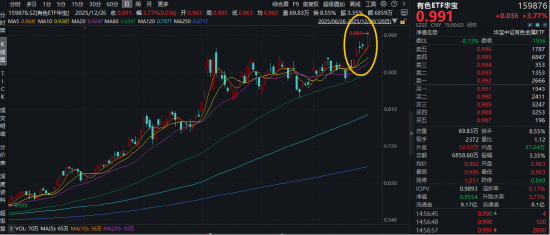
有色“超级周期”势不可挡!有色ETF华宝(159876)盘中猛拉4.19%再创新高!紫金矿业刷新历史高点
Xin Lang Cai Jing· 2025-12-26 11:58
Core Viewpoint - The non-ferrous metal sector is leading the market with a net inflow of 14.7 billion yuan, indicating strong investor confidence and interest in this sector [1][11]. Group 1: Market Performance - The non-ferrous metal ETF, Huabao (159876), saw a peak increase of 4.19% during the day, ultimately closing with a 3.77% rise, ranking seventh in the overall market ETF performance [1][11]. - The Huabao ETF has attracted a total of 56.11 million yuan in inflows over the past two days, reflecting positive sentiment towards the non-ferrous metal sector [1][11]. - The index tracked by the Huabao ETF has increased by 93.04% since its low on April 8, significantly outperforming major indices like the Shanghai Composite Index (29.75%) and the CSI 300 (28.00%) [3][14]. Group 2: Key Stocks and Their Performance - Key stocks in the sector, such as Yongxing Materials, Guocheng Mining, and Jiangxi Copper, reached their daily limit up, while Zhongkuang Resources and China Aluminum rose over 8% [3][13]. - Major stocks like Zijin Mining and Luoyang Molybdenum hit historical highs, indicating strong performance across the sector [3][13]. Group 3: Market Drivers - The recent surge in non-ferrous metals is attributed to several factors: increased geopolitical uncertainty leading to higher demand for safe-haven assets like gold, a weakening dollar encouraging investment in physical assets, rising demand due to AI development and global energy transition, and ongoing supply constraints in copper and other metals [5][17]. - Analysts predict that non-ferrous metals will be at the forefront of market trends in 2026, with gold prices potentially challenging the $5,000 per ounce mark due to central bank purchases [6][17]. Group 4: Investment Strategy - A diversified investment approach through the Huabao ETF and its associated funds is recommended to capture the overall sector performance while mitigating risks associated with individual metal investments [18].


腾讯研究院AI速递 20250612
腾讯研究院· 2025-06-11 14:31
Group 1: OpenAI and Mistral AI Developments - OpenAI released the inference model o3-pro, which is marketed as having the strongest reasoning ability but the slowest speed, with input pricing at $20 per million tokens and output at $80 per million tokens [1] - User tests indicate that o3-pro excels in complex reasoning tasks and environmental awareness but is not suitable for simple problems due to its slow inference speed, targeting professional users [1] - Mistral AI launched the strong inference model Magistral, which includes an enterprise version Medium and an open-source version Small (24B parameters), showing excellent performance in multiple tests [2] - Magistral achieves a token throughput that is 10 times faster than competitors, with a pricing strategy of $2 per million tokens for input and $5 per million tokens for output [2] Group 2: Figma and Krea AI Innovations - Figma introduced the official MCP service, allowing direct import of design file variables, components, and layouts into IDEs, achieving a higher fidelity than third-party MCPs [3] - Krea AI launched its first native model Krea 1, focusing on solving issues of AI image "homogenization" and "plasticity," providing high aesthetic control and professional-grade output [4][5] - Krea 1 supports style reference and custom training, with native support for 1.5K resolution expandable to 4K, aimed at accelerating digital art creation processes [5] Group 3: ByteDance and Tolan AI Applications - ByteDance released the Doubao large model 1.6 series, which includes multiple versions supporting 256k context and multimodal reasoning, with a 63% reduction in comprehensive costs [6] - Tolan, an alien AI companion application, has achieved 5 million downloads and $4 million ARR, emphasizing a non-romantic, non-tool-like companionship experience [7] - Tolan's design integrates companionship with gamification, allowing users to customize their alien companion's appearance and develop unique planetary environments [7] Group 4: Li Auto and Figure Robotics Strategy - Li Auto established two new departments, "Space Robotics" and "Wearable Robotics," to enhance its AI strategy, focusing on creating a smart in-car experience [8] - Figure aims to provide a complete "labor force" system with humanoid robots, emphasizing fully autonomous operation and a production line capable of producing 12,000 units annually [9] - Figure plans to deliver 100,000 units over the next four years, targeting both commercial and home markets, while utilizing a shared neural network for collective learning [9] Group 5: Altman's Predictions and OpenAI Codex Insights - Altman predicts that by 2025, AI will be capable of cognitive work, with significant productivity boosts expected by 2030 as AI becomes more affordable [10] - OpenAI Codex is shifting software development from synchronous "pair programming" to asynchronous "task delegation," anticipating a transformation in developer roles by 2025 [11] - The team envisions a future where the interaction interface merges synchronous and asynchronous experiences, potentially evolving into a "TikTok"-like information flow for developers [11]