AI扩张周期

Search documents
兴业证券:2026年关注电新、TMT、新消费等出海机会
智通财经网· 2026-02-21 07:29
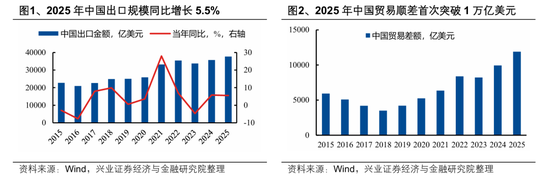
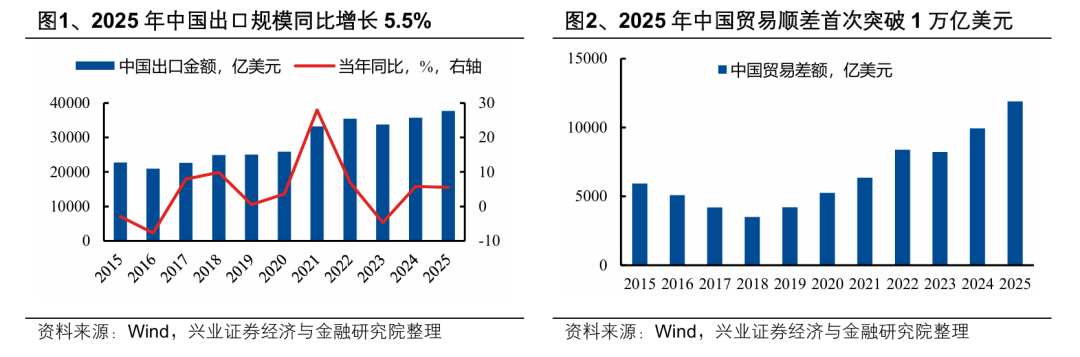
Core Viewpoint - The global industrial system is undergoing a significant paradigm shift from "efficiency first" to "security and autonomy," leading to increased demand for infrastructure and industrial construction, with China transitioning from a "final product exporter" to a "global basic industrial provider" [1][39]. Group 1: China's Foreign Trade Trends - China's foreign trade is diversifying and moving towards higher-end products, with exports reaching a historical high of $2.5 trillion in 2025, a year-on-year increase of 5.5% [2]. - The trade surplus surpassed $1 trillion for the first time, marking a significant year-on-year increase of 19.8% [2]. - Net exports contributed 1.64 percentage points to GDP growth in 2025, the second-highest level since 2007 [5]. Group 2: Regional and Product Structure - The diversification of external demand is strengthening, with emerging markets compensating for declines in the U.S. market. Exports to the U.S. fell by 19.79% year-on-year, while exports to ASEAN, Africa, and the Middle East grew by 13.64%, 25.9%, and 9.7%, respectively [8]. - High-end manufacturing products such as electrical machinery, machinery, automobiles, and ships remain the mainstay of exports, contributing 44.10%, 17.67%, 16.05%, and 6.99% to the total export scale [13]. Group 3: Opportunities for Overseas Expansion - In 2026, there are strong overseas opportunities in sectors such as electric new (batteries, grid equipment), machinery, TMT (electronics, communication, gaming), innovative pharmaceuticals, new consumption, shipbuilding, commercial vehicles, automotive parts, and chemical products [57]. - The restructuring of global supply chains is accelerating the globalization of Chinese enterprises' production capacity, with 229 companies establishing production facilities or subsidiaries in ASEAN, India, and Mexico by 2025, nearly doubling from 2024 [29]. Group 4: AI Expansion Cycle - The AI expansion cycle is a core focus in the Chinese capital market, with significant capital expenditure expected from major tech companies. For instance, capital expenditures from major cloud service providers in North America are projected to reach $598.7 billion in 2026, a 67% increase year-on-year [45][46]. - The demand for AI-related hardware is expected to drive growth in related sectors, benefiting domestic manufacturing leaders in robotics and consumer electronics [48]. Group 5: Cultural and Technological Output - Chinese enterprises are also focusing on cultural and technological exports, with significant growth in overseas revenue from IP (e.g., toys, games) and lifestyle brands (e.g., new tea drinks, e-commerce) [49][50]. - The innovative pharmaceutical sector is becoming a key player in the global market, with several new drugs commercialized in the U.S. and Europe, indicating strong potential for further overseas opportunities in 2026 [53].


【兴证策略张启尧团队】2026年出海链有哪些投资机会?
Xin Lang Cai Jing· 2026-02-21 01:42
Group 1 - In 2025, China's foreign trade showed strong resilience, with total exports reaching a historical high, growing by 5.5% year-on-year, despite a complex external environment [1][57] - China's trade surplus exceeded $1 trillion for the first time, marking a significant increase of 19.8% year-on-year [1][57] - The net export of goods and services contributed 1.64 percentage points to GDP growth, the second-highest level since 2007, only behind 2021 [3] Group 2 - The diversification of external demand has strengthened, with emerging markets compensating for the decline in exports to the US, which fell by 19.79% year-on-year [6] - Exports to ASEAN, Africa, and the Middle East saw significant growth rates of 25.9%, 13.64%, and 9.7% respectively, contributing positively to the overall export scale [6] - The share of US exports in China's total exports decreased by 3.53 percentage points to 11.15% [6] Group 3 - The product structure of China's foreign trade is shifting towards higher value chains, with high-end products like electrical machinery, machinery, automobiles, and ships being the main export drivers [8] - Traditional light industrial products such as furniture and toys have seen a decline in export scale due to tariff friction and industrial chain relocation [8] Group 4 - The restructuring of global supply chains is creating significant opportunities for Chinese companies, with a notable increase in the number of Chinese enterprises establishing production capacities abroad, reaching 229 in 2025, nearly doubling from 2024 [18] - ASEAN, Mexico, and India are the primary destinations for Chinese production capacity outflows, with ASEAN covering a wide range of industries [18] Group 5 - The AI expansion cycle is a core focus in the Chinese capital market, with significant growth expected in AI computing hardware, supported by macro investment scales and healthy balance sheets of major tech companies [29][30] - The capital expenditure of major cloud service providers is projected to increase significantly, reflecting strong demand for AI computing [35] Group 6 - Cultural and technological value output is becoming a major trend for Chinese enterprises going abroad, with significant growth in IP exports and innovative products in sectors like gaming and new dining [39][41] - The Chinese innovative pharmaceutical sector is increasingly integrated into the global supply chain, with more products commercialized in the US and Europe [41] Group 7 - Key sectors with strong overseas expansion opportunities in 2026 include new energy (batteries, grid equipment), machinery, TMT (technology, media, telecommunications), and innovative pharmaceuticals [46] - The gaming industry is also highlighted for its potential, with significant overseas revenue growth expected [49]