
AI替代论

Search documents
摩根大通交易台:“先卖再问”的美股AI抛售潮即将结束,抄底软件股的时候到了
Hua Er Jie Jian Wen· 2026-02-18 03:42
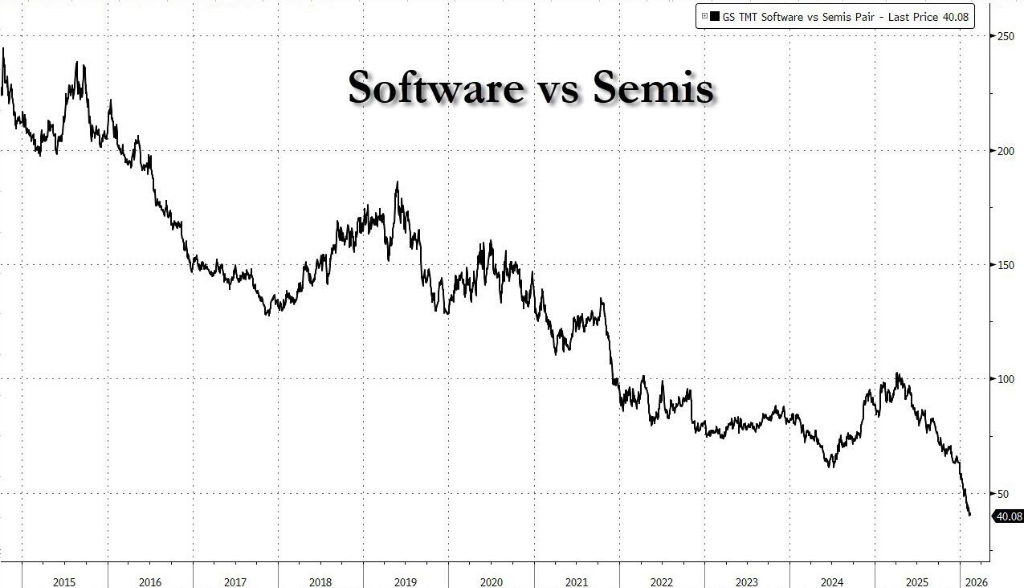
Group 1 - The core narrative in the recent U.S. stock market revolves around the "AI replacement risk," leading to significant volatility in financial and industrial sectors, with a massive influx of capital into semiconductors and indiscriminate selling of software stocks [1] - JPMorgan's trading desk reports that extreme market sentiment regarding AI replacement is nearing its end, suggesting a buying opportunity for undervalued software stocks and assets immune to AI disruption [1][8] - The semiconductor sector shows a high position concentration at +4 standard deviations, while the software sector is at a low of -3.5 standard deviations, marking a historical extreme in position differences [1] Group 2 - In the software industry, the negative narrative is difficult to disprove, as companies struggle to demonstrate that AI will not disrupt them in the coming years. Analysts recommend a "barbell strategy" to invest in top software companies with strong free cash flow while avoiding overvalued stocks [3] - The wealth management and life sciences sectors are experiencing profit expansion despite recent stock declines. Analysts believe that AI will enhance profit margins in wealth management rather than replace client relationships [4] - The logistics sector is facing significant fear due to AI advancements, particularly after a competitor's announcement of an AI platform that dramatically increases freight scheduling efficiency, leading to a 25% drop in CHRW's stock [5] Group 3 - In Japan's IT services market, the reliance on system integrators and a talent shortage means that AI is unlikely to replace outsourcing in the short term, instead serving to alleviate talent shortages and enhance profit margins for system integrators [6][7] - JPMorgan's trading team suggests a strategy to go long on a basket of severely mispriced stocks that are immune to AI disruption, indicating a potential bottoming opportunity for large tech stocks [8]

如何看待“AI替代论”
Jing Ji Ri Bao· 2026-02-12 23:09
Core Viewpoint - The launch of Anthropic's legal automation tool has triggered a panic sell-off in software stocks globally, highlighting the market's complex emotions towards technological change and the integration of AI across various industries [1] Market Impact - The sell-off has been extensive, with the S&P 500 Software and Services Index dropping for six consecutive trading days, losing approximately $830 billion in market capitalization since January 28, representing a 26% decline from its peak in October 2025 [1] - Major companies in the sector, such as Thomson Reuters, experienced significant stock price declines, with a single-day drop of nearly 16%, while other firms like the London Stock Exchange and SAP saw declines exceeding 12% [1] - The panic has spread to global markets, affecting software giants in Europe and related stocks in countries like India and Japan [1] AI Technology and Market Sentiment - The introduction of Anthropic's tool has sparked anxiety about AI's potential to replace traditional software services, particularly in the legal field, but the implications extend to finance, programming, healthcare, and gaming [2] - The market's focus has shifted from speculative interest in AI to a demand for profitability verification, with concerns that AI's impact on traditional software may precede actual profit realization, putting companies lacking core competencies at risk [2] Liquidity and Economic Outlook - Changes in liquidity expectations in the U.S. stock market have contributed to the sell-off, with economists now predicting that the Federal Reserve may not lower interest rates until June, contrary to previous expectations [3] - The potential for a "tightening" strategy from the Federal Reserve, which may include both interest rate cuts and balance sheet reductions, has further suppressed overall market valuations [3] AI and Software Relationship - The narrative that AI will completely replace software is seen as exaggerated, as it overlooks the practical realities of business operations and the inherent logic of technological development [4] - AI is viewed as a core technology that enhances and optimizes software rather than replacing it, with both AI and software expected to evolve together, driving the digital economy forward [4] Industry Challenges and Opportunities - The "AI replacement theory" serves as a wake-up call for software and other industries, emphasizing the need to adapt to the challenges and opportunities presented by AI [5] - Startups leveraging AI can rapidly scale by restructuring their organizations and business processes around AI, while traditional companies must accelerate their transformation to integrate AI deeply into their existing products and services [5]