AI认知力

Search documents
AI时代,领导者的“必修课”来了
混沌学园· 2025-05-23 12:55
Core Viewpoint - The primary crisis for enterprises in the AI era is not the inability to use AI tools, but rather the challenge of leaders applying industrial thinking to navigate the AI revolution [2] Group 1: Leadership Challenges in the AI Era - Leaders face five typical issues in the AI era, including uncertainty on where to start with AI and the struggle to integrate AI into business scenarios [1][3] - There is a need to redefine leadership in the AI era to ensure success [4] Group 2: Course Content and Value - The course aims to provide insights on the differences between AI leaders and traditional leaders, emphasizing the importance of a holistic view [4] - It includes case studies on how companies successfully address large demands in the AI era by starting with small scenarios [4] - The course is taught by Zhang Lei, a practitioner in AI business operations, and includes practical tools for immediate application [5] Group 3: Target Audience - The course is designed for founders/CEOs of companies with annual revenues over 50 million, heads of digital transformation, and decision-makers focused on building core competitiveness [6]


一定要把AI当回事
混沌学园· 2025-05-16 10:47
Core Viewpoint - The article emphasizes the necessity for companies to adapt to the AI era by defining what "good" means in the context of AI, and highlights the importance of AI innovators who create opportunities rather than compete with AI [1][6][8]. Group 1: AI Innovators and Their Role - AI innovators are defined as those who create jobs for AI rather than compete with it, positioning themselves as users who leverage AI to achieve goals and create value [6][9]. - The core task of AI innovators is to define value and ensure that AI enhances and realizes that value, rather than merely improving job skills [9][12]. - AI innovators serve as a bridge between AI productivity and commercial value, requiring skills in choice, judgment, and integration [9][16]. Group 2: Key Focus Areas in AI Application - Companies should focus on three key elements in AI application: identifying demand, producing effective outcomes, and ensuring quality, rather than solely on computational power, algorithms, and data [12][13][15]. - Quality is highlighted as the future core competitive advantage, with many AI products currently lacking stable high-quality output, leading to varied user experiences [15][18]. Group 3: Capability and Upgrade Maps - AI innovators need to possess four essential capabilities: AI leadership, AI cognitive ability, AI business acumen, and AI organizational skills [21][25]. - The career development in the AI era is categorized into four levels (L1-L4), with each level representing a significant increase in value and capability [25][26]. - The levels include: L1 - AI Supervisor, L2 - AI Manager, L3 - AI Leader, and L4 - AI Ecosystem Builder, with a clear progression in responsibilities and impact [26][28]. Group 4: Strategies for Mastering AI Capabilities - Companies are encouraged to adopt four strategies to enhance their capabilities: engaging with leading innovators, fostering team growth, achieving tangible results through practical applications, and understanding the commercial essence of AI [31][33][35]. - The essence of AI is described as a "silicon-based life" that evolves based on biological principles rather than traditional mechanistic views, emphasizing the need for personalized services over standardized products [35][41]. Group 5: Future Directions and Market Opportunities - The future of AI is expected to align more closely with human evolution, with a focus on education and collaboration to enhance capabilities [41][43]. - Companies should prepare for rapid AI development and create job opportunities for AI, recognizing the dual roles of creating and utilizing intelligence [45][48].

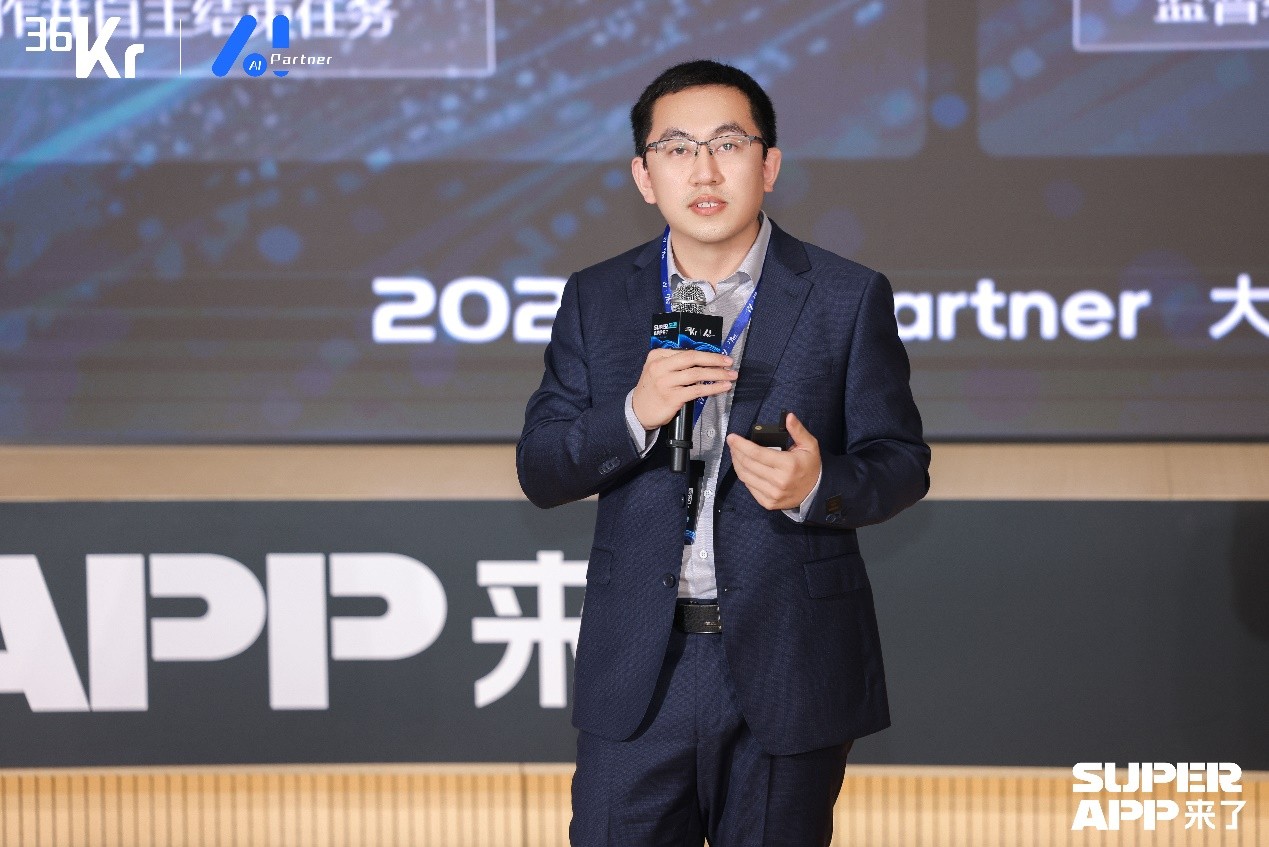
大华股份软件研发部副总裁周淼:AI技术正驱动企业数字化全面升级 | 2025 AI Partner大会
3 6 Ke· 2025-04-23 10:03
Core Insights - The year 2025 is anticipated to be a pivotal moment for AI applications, marking a significant technological transformation in various industries as the global AI race enters a "China moment" [1] - The 2025 AI Partner Conference, hosted by 36Kr, focused on the disruptive changes brought by AI applications across multiple sectors, featuring discussions on the emergence of the next groundbreaking AI super application [1] Industry Trends - The global AI industry is experiencing rapid growth, drawing parallels to the evolution of smartphones, particularly the transformative impact of the iPhone 4 in 2010 [3] - Current AI advancements are hindered by two critical conditions: cognitive ability and intelligent agents, which are essential for the next revolutionary phase in AI [3] Cognitive Ability in AI - Cognitive ability refers to AI's understanding of complex scenarios and abstract concepts, which is crucial for applications in various fields such as energy and security [4] - Enhanced cognitive capabilities allow AI to move from precise recognition to accurate understanding, enabling it to analyze dynamic behaviors and context [4] Development of AI Models - The company has introduced the Xinghan large model series, focusing on three main capabilities: - V Series for visual tasks, excelling in small target detection and complex scene recognition - M Series for multimodal tasks, integrating visual and language processing - L Series for language tasks, facilitating workflow management and task coordination [5] Intelligent Agents - The intelligent agent framework is categorized into four levels, ranging from basic Q&A support to fully autonomous agents capable of independently completing complex tasks [5][6] - These agents are designed to adapt to various industry needs, enhancing operational efficiency and decision-making processes [6] Practical Applications - In practical scenarios, intelligent agents have been integrated into management platforms to automate report generation and provide data-driven insights, significantly improving management efficiency [6] - In the energy sector, specialized intelligent agents enhance safety by monitoring worker proximity to hazardous equipment and generating incident reports [6][7] Challenges and Future Considerations - A major challenge in developing industry-specific intelligent agents is the vast differences in business logic across sectors, necessitating a flexible workflow engine for real-time adjustments [7] - As AI technology progresses towards autonomous intelligent agents, there is a need to rethink IT architecture, potentially positioning AI as a central component in information systems [7]