AI高能耗场景能源解决方案

Search documents
12月19日主题复盘 | 大消费持续活跃,核聚变、无人驾驶表现强势
Xuan Gu Bao· 2025-12-19 08:37
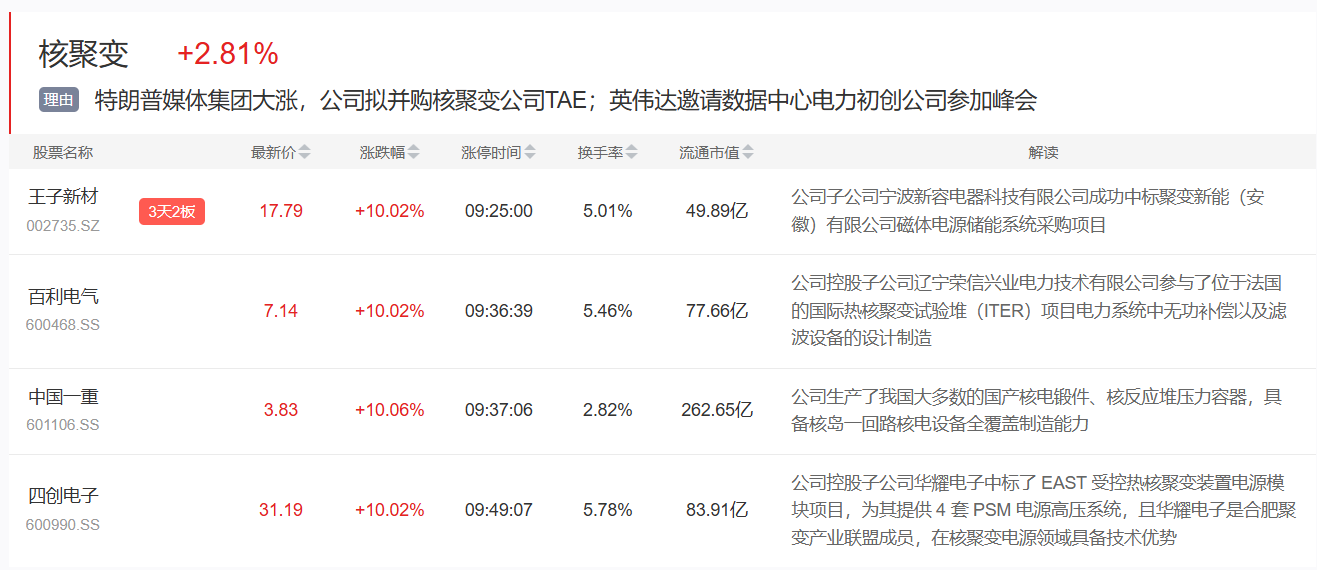
Market Overview - The Shanghai Composite Index showed a strong rebound today, while the ChiNext Index experienced a pullback. The consumer sector saw significant gains, with stocks like Dongbai Group and Zhuangyuan Pasture hitting the daily limit. The real estate sector also rose, with companies like Guangyu Group and Zhongtian Service reaching their daily limits. The total trading volume across Shanghai and Shenzhen markets was 1.75 trillion [1]. Hot Topics Consumer Sector - The consumer sector remained active, with stocks like Zhuangyuan Pasture achieving a three-day consecutive limit up, and Jiuzhou King and Shanghai Jiubai also performing well [4][5]. Nuclear Fusion - The nuclear fusion sector experienced a surge, with companies like Xue Ren Group and Wangzi New Materials hitting the daily limit. A merger agreement was announced between Trump Media Technology Group and TAE Technologies, valued at over $6 billion, aiming to build the world's first 50 MW fusion power plant by 2026 to meet the energy demands of AI data centers [7][8]. Autonomous Driving - The autonomous driving sector showed positive performance, with Zhejiang Shibao achieving a four-day consecutive limit up. The Ministry of Industry and Information Technology granted conditional approval for the first batch of L3 autonomous driving vehicles, marking a significant step towards commercialization [10][11]. Sector Analysis Consumer Sector - The consumer sector increased by 1.60%, driven by the central government's focus on expanding domestic demand as a top priority for next year. Key stocks included Jiuzhou King (+9.97% to 16.98 billion), Zhuangyuan Pasture (+9.99% to 13.65 billion), and Shanghai Jiubai (+10.02% to 11.09 billion) [5][6]. Nuclear Fusion - The nuclear fusion market is projected to reach approximately $20.35 billion between 2025 and 2035, with core components like magnetic structures and vacuum chambers accounting for over 50% of the market share. The demand for energy in AI data centers is expected to drive this growth significantly [9]. Autonomous Driving - The approval of L3 autonomous driving vehicles is anticipated to enhance the penetration of smart technologies in the automotive sector, benefiting the entire supply chain. The demand for sensors and high-performance computing chips is expected to rise significantly due to this development [11].




【大涨解读】核聚变:特朗普旗下企业拟并购+甲骨文、OpenAI项目或电力支持,核聚变再掀上涨潮,能源革命赛道迎来估值重构
Xuan Gu Bao· 2025-12-19 02:20
Market Overview - On December 19, the nuclear fusion sector opened with significant gains, with companies like Wangzi New Materials and Baili Electric hitting the daily limit, and others like Sichuang Electronics and Xue Ren Group also experiencing substantial increases [1] Key Events - On December 18, Trump Media Technology Group announced a merger agreement with nuclear fusion company TAE Technologies, valued at over $6 billion, aiming to build the world's first 50 MW utility-scale fusion power plant by 2026 to meet the energy demands of AI data centers [3] - The same day, Michigan regulators approved DTE Energy Co.'s power supply plan to support a 1.4 GW data center project in collaboration with Oracle and OpenAI, with a total planned capacity exceeding 8 GW and an investment of $450 billion over the next three years [3] Industry Insights - Nuclear fusion is emerging as the "ultimate energy" solution for high-energy consumption scenarios in AI, driven by explosive growth in electricity demand from data centers, which is expected to reach 180 TWh in 2024, accounting for 45% of global demand, and projected to grow to 420 TWh by 2030 at a CAGR of 15% [4] - The global controllable nuclear fusion market is estimated to reach approximately $20.35 billion between 2025 and 2035, with over 50% of this market attributed to core components such as magnet structures, vacuum chambers, and power systems [4] Technological and Policy Developments - The industry is transitioning from laboratory research to engineering deployment, supported by policies like the $900 million funding for small modular reactors (SMRs) in the U.S. and an executive order mandating the deployment of nuclear reactors at military bases by 2028 [4] - Major AI companies, including Microsoft, Google, and Amazon, are accelerating their investments in nuclear fusion, with OpenAI's first commercial micro-reactor expected to be operational by 2027 [5] Domestic Market Potential - Domestic companies are positioned to benefit from global energy transition trends, with collaborative efforts between research institutions and private enterprises accelerating key projects like the BEST project [5] - The nuclear fusion supply chain encompasses critical components such as magnets, power supplies, and supporting equipment, with opportunities for domestic firms to share in market growth through supply contracts and technology exports [5]