AI Capex

Search documents
《跨资产投资手册》-2026年2月 物流行业颠覆与分散化Cross-Asset Playbook – February 2026
2026-03-01 17:23
Summary of Key Points from the Conference Call Industry and Company Overview - The conference call focuses on global market trends, particularly in equities, fixed income, and commodities, with insights from Morgan Stanley Research. Core Insights and Arguments 1. **Market Volatility and Fundamentals** - Markets are expected to remain volatile due to unclear trends and policy uncertainty, but fundamentals are stable, suggesting investors should focus on known factors rather than unknown risks [1][2][3] 2. **Equity Market Outlook** - Global stocks are anticipated to continue their rally, with a focus on dispersion based on AI exposure and regional fiscal policies, particularly in Japan [2][3] - The S&P 500 is forecasted to reach 7,800, while the MSCI Europe target is raised to 2,600 from 2,430, reflecting a valuation discount breakout [10][27] 3. **Asset Allocation Recommendations** - Recommended allocations include an overweight (OW) in US and Japanese equities, while underweight (UW) in US investment-grade corporate credit due to expected issuance [4][19][20] - A slight increase in allocation to commodities is noted, with a cautious stance on Brent oil but upgrades for copper and gold due to geopolitical uncertainties [22][24] 4. **AI Capex and Economic Growth** - Rising AI-related capital expenditures are expected to drive economic growth, with a belief that the current capex cycle is just beginning [36][37] - Concerns about over-investment in AI and its disruptive potential are acknowledged, but it is suggested that investors cannot worry about both simultaneously [36] 5. **Credit Quality and Earnings Growth** - Despite concerns over credit quality, aggregate fundamentals remain strong, supported by healthy balance sheets and stable leverage [58][59] - Earnings growth is rebounding, particularly in emerging markets, which should support rich valuations [55] Other Important but Potentially Overlooked Content 1. **Regional Economic Adjustments** - Japan's GDP growth forecast for 2026 has been raised to 2.6% from 2.4%, reflecting a positive outlook influenced by US capex [25][29] - The US Federal Reserve is expected to maintain a cautious approach to rate hikes, with the RBA likely to follow up a February rate hike with another in May [29] 2. **Sector Rotation and Fund Flows** - There is a notable rotation within emerging markets and a shift towards cyclical sectors, despite overall strong allocations to US equities [66][74] - Fund flows to US stocks have stabilized, indicating that investors are not abandoning the market despite recent volatility [75][81] 3. **Data Uncertainty and Market Reactions** - The uncertainty regarding whether the US economy is experiencing a demand-side or supply-side boost is expected to create volatility, but risk asset returns may not necessarily decline [39][45] 4. **Earnings Revisions and Profitability** - While earnings revisions breadth is slowing, profitability continues to improve across all regions, particularly in emerging markets, which should support valuations [55] This summary encapsulates the key insights and recommendations from the conference call, providing a comprehensive overview of the current market landscape and future expectations.
Tim Cook 'Sleeps With One Eye Open' After CIA Taiwan Warning, But Do Prediction Markets Agree He Should Be Worried?
Yahoo Finance· 2026-02-26 22:30
Group 1: Geopolitical Concerns - Apple CEO Tim Cook attended a classified CIA briefing indicating that China could potentially move on Taiwan as early as 2027, leading him to express heightened concern about the situation [1] - Prediction markets reflect growing anxiety, with a Polymarket contract pricing the likelihood of a Chinese invasion of Taiwan by the end of 2026 at 10% and a military clash at 14% [2] Group 2: Industry Impact - Taiwan Semiconductor Manufacturing Co (TSMC) is critical to the global semiconductor supply chain, producing approximately 90% of the world's most advanced chips, which are essential for products from companies like Apple, Nvidia, and AMD [4] - A confidential report estimates that losing Taiwan's chip supply could reduce U.S. GDP by $2.5 trillion, while a Bloomberg analysis suggests that the global cost of a full conflict could exceed $10 trillion [5] Group 3: U.S. Semiconductor Landscape - Despite significant investments and subsidies amounting to $52 billion from the U.S. government aimed at boosting domestic chip manufacturing, the U.S. still only produces about 10% of the world's chips, unchanged since the CHIPS Act [6] - The dependency on Taiwan remains, as evidenced by Nvidia's need to send its first "American-made" AI chip back to Taiwan for completion, highlighting the ongoing reliance on TSMC for advanced semiconductor processes [7]


美国股票观点:AI 交易的扩散与收窄-US Equity Views_ The broadening and narrowing of the AI trade
2026-02-25 04:07
Summary of Key Points from the Conference Call Transcript Industry Overview - The focus of the conference call is on the AI industry, particularly the capital expenditure (capex) trends among hyperscalers and the implications of AI disruption risks on various sectors [1][2][3]. Core Insights and Arguments 1. **AI Capex Trends**: - Hyperscaler capex is projected to reach $667 billion in 2026, reflecting a 62% increase compared to 2025, with a notable rise of $127 billion since the start of the 4Q earnings season [2][12][16]. - Capex is expected to account for over 90% of hyperscaler cash flows in 2026, surpassing levels seen during the Dot Com Boom [19][21]. 2. **Market Volatility**: - Recent volatility in the AI trade has been driven by capex surprises and concerns over disruption risks, leading to a 55% rally in memory stocks year-to-date, while software stocks have declined by 24% [1][57]. 3. **Disruption Risks**: - The uncertainty surrounding AI disruption is expected to persist, with companies needing to demonstrate earnings stability to regain investor confidence [7][72]. - The perceived threat of AI automation on labor costs has led to a sell-off in software stocks, with a 23% decline over six weeks [57][66]. 4. **Investment Sentiment**: - Investors are currently skeptical about the long-term growth outlook for public companies in the AI space, favoring private companies perceived to be more effective in capturing AI-related revenues [3][62]. - The market is witnessing a divergence in performance among hyperscalers, with a focus on revenue growth as a key driver for stock performance [45][47]. 5. **Future Catalysts**: - Three potential catalysts for a market inflection in hyperscalers are identified: acceleration in AI-related revenues, deceleration in capex growth, and a shift in the macroeconomic backdrop [46][52]. - The need for companies to quantify productivity gains from AI is emphasized, with only 10% of S&P 500 companies having done so in recent earnings calls [8][78]. Additional Important Insights - **Valuation Concerns**: - Hyperscaler valuations are currently elevated, with a P/E ratio of 24x, ranking in the 14th percentile compared to the past decade [48][54]. - Memory stocks have seen significant price increases driven primarily by earnings growth, trading at a forward P/E of 12x, which is a discount compared to the broader market [37][40]. - **AI Adoption**: - Approximately 35% of large companies are utilizing AI, with 54% of S&P 500 firms mentioning AI in the context of productivity during the 4Q earnings season [74][75]. - **Sector Performance**: - The performance of AI infrastructure stocks (Phase 2) has been strong, while Phase 3 companies, which are expected to generate AI-enabled revenues, have faced challenges due to disruption fears [10][11]. - **Long-term Outlook**: - The transition from AI infrastructure to application layers is expected to create distinct winners and losers in the equity market, necessitating a more granular analysis of competitive positioning and pricing power [60][61]. This summary encapsulates the key points discussed in the conference call, highlighting the current state and future outlook of the AI industry and its associated investment landscape.
AI 资本开支加速:从四季度财报解读信号-The AI Capex Acceleration Reading the Signals from 4Q Earnings
2026-02-10 03:24
Summary of Key Points from Morgan Stanley Research Call Industry Overview - The focus of the call is on the **AI and technology sector**, particularly the implications of AI capital expenditures (capex) and compute demand on large-cap technology companies and the credit market [7][48]. Core Insights - **Compute Demand vs. Supply**: There is a significant mismatch expected between compute demand and supply, with forecasts indicating that demand will exceed supply substantially. For instance, Google executives predict compute needs to be approximately three times the projected compound annual growth rate (CAGR) for NVIDIA [9]. - **AI Adoption and Value Creation**: The total addressable market (TAM) for AI adoption is projected to exceed 25% of the S&P 500's adjusted pre-tax income for 2026, with a nearly even split between software-based AI and robotics [10]. - **Non-Linear Improvement in AI**: AI task complexity is increasing at a non-linear rate, with tools like Anthropic's Claude Opus 4.1 outperforming humans in 48% of tasks. This trend is expected to escalate rapidly in 2026 due to a tenfold increase in computational power for training large language models (LLMs) [14]. Financial Projections - **AI Capex Estimates**: Morgan Stanley has revised its AI-related capex estimates upward for 2026 and 2027, anticipating hyperscaler cash capex to reach over $740 billion in 2026 and exceed $900 billion in 2027 [47][48]. - **Credit Market Outlook**: Investment-grade (IG) bond issuance is expected to hit a record $2.25 trillion in 2026, driven by AI capex financing, mergers and acquisitions (M&A), and rising corporate optimism. This represents a 24% increase from the previous year [25][48]. Company-Specific Insights - **Oracle Corporation (ORCL)**: - ORCL is positioned to benefit from the increasing demand for compute, with a funding plan of approximately $50 billion for 2026. However, the company faces significant cash needs and elevated leverage, with total funding needs estimated at over $150 billion over 2.5 years [36][48]. - The credit outlook for ORCL is cautious due to cash funding needs and lease growth, with recommendations to buy five-year credit default swaps (CDS) as protection against potential credit deterioration [39][48]. Additional Considerations - **Market Dynamics**: The gap between leading technology companies and smaller players is expected to widen, as larger firms leverage their data and investment capabilities more effectively [48]. - **Cost of Intelligence**: Rapid advancements in chip technology are projected to lead to a decline in the cost of intelligence, with average token prices potentially falling by over 70% as the industry transitions from Blackwell to Rubin GPUs [16][48]. Conclusion - The call highlights a robust outlook for AI and technology sectors, with significant investment opportunities driven by increasing compute demand and advancements in AI capabilities. However, companies like Oracle face challenges related to funding and credit risk that investors should monitor closely [48].
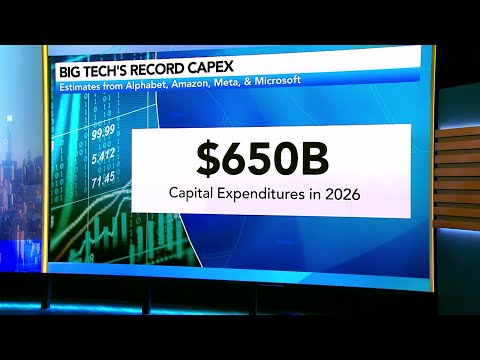
Big Tech Aims to Spend $650 Billion This Year on AI Capex
Bloomberg Television· 2026-02-06 15:06
Imagine a number, then triple it. You know, that's where I'm at right now. I just can't get my head around an old mandate.How are these companies going to spend $650 billion this year. What aren't. Yeah.Look, I mean, I think everyone highlighted supply constraints and the fact that they didn't have enough capacity, otherwise they would have grown faster. So that sort of justifies the increase in CapEx. But you're right, I think the kind of increases we are seeing, probably Google is the only one who has ear ...

AI Capex Clouds The Tech Horizon, Even As Meta And Tesla Shine
Seeking Alpha· 2026-02-02 19:05
Group 1 - The article does not provide any relevant content regarding the company or industry [1]


AI Capex At Unsustainable Levels
Seeking Alpha· 2026-02-02 17:33
Group 1 - The article does not provide any relevant content regarding the company or industry [1]

Weekend Market Report 2/1/26
UpsideTrader· 2026-02-01 23:26
Market Overview - U.S. stocks experienced a decline at the end of January, influenced by weakness in the tech sector and a significant selloff in commodities, despite solid earnings reports [3][21] - The S&P 500, Dow, and Nasdaq all closed lower on the last trading day of January, with the S&P 500 down 0.43% to 6,939.03 and the Dow down 0.36% to 48,892.47 [5][21] - The Russell 2000 index outperformed, surging 5% for the month, indicating a potential rotation towards small-cap stocks [4][18] Earnings Season Insights - Earnings season has shown solid but not exceptional results, with 74.4% of 133 S&P 500 companies beating expectations, slightly below the four-quarter average of 78% [8] - Q4 earnings are projected to grow by 10.2% year-over-year, with full-year 2026 earnings expected to increase by 15% [8] Tech Sector Performance - The tech sector faced significant pressure, particularly after Microsoft's disappointing cloud growth guidance, which led to a sector-wide selloff [7][21] - The "Magnificent Seven" tech stocks are under scrutiny, with even earnings beats being sold off if guidance is disappointing [7][17] Commodity Market Dynamics - The commodity markets experienced a dramatic reversal, with gold plunging 11.4% to $4,745 and silver crashing 31.4%, marking its worst single-day drop in modern history [9] - The selloff was triggered by profit-taking following a surge in prices earlier in the week, as investors reacted to the nomination of Kevin Warsh as Fed Chair [9][19] Federal Reserve and Economic Data - Kevin Warsh's nomination as Fed Chair has created uncertainty regarding the Fed's future path, as he is perceived as hawkish on inflation but dovish on rates [6][18] - Recent economic data indicated a rise in the Producer Price Index (PPI) for December by 0.5% month-over-month, suggesting the Fed may maintain higher rates for an extended period [13] Upcoming Events and Expectations - The upcoming week features significant earnings reports from major companies, including Palantir, Disney, Alphabet, and Amazon, which will be closely watched for insights into cloud growth and AI capital expenditures [15][17] - The January jobs report is anticipated to be pivotal, with expectations of a +70K increase in nonfarm payrolls, which could influence market expectations for Fed policy in 2026 [16][18]


SOXL’s $13.6 Billion Fund Faces Rebalancing Drag as Memory Cycle Enters Critical Phase
Yahoo Finance· 2025-12-15 14:57
Core Insights - The demand for leveraged ETFs, particularly SOXL's 3x daily exposure to semiconductors, necessitates a distinct monitoring framework compared to traditional buy-and-hold funds [2] - SOXL has $13.6 billion in assets and a high portfolio turnover rate due to daily rebalancing, which combines sector momentum with structural decay [2] Semiconductor Performance Drivers - Memory pricing power is crucial for semiconductor performance, with Micron showing a 257% year-over-year earnings growth as the memory downturn reversed, dependent on sustained AI infrastructure spending and data center buildouts [3][6] - AI chip capital expenditure cycles influence equipment makers, which make up about 10% of SOXL's holdings, with companies like Lam Research and Applied Materials indicating whether hyperscalers are expanding or pausing fab capacity [4] Rebalancing Costs and Risks - SOXL's structure includes approximately 30% in cash and treasury instruments, which creates a cash drag that reduces upside capture during market rallies [5][6] - The fund's top-ten holdings account for 40% of equity exposure, with Broadcom representing 6.1% and trading at a forward P/E ratio of 38x, indicating significant concentration risk [7]
Oracle: The AI Capex Blunder Explained (NYSE:ORCL)
Seeking Alpha· 2025-12-11 17:04
Group 1 - The article does not provide any specific company or industry insights, focusing instead on the author's personal disclosures and lack of financial positions in mentioned companies [1][2]