Buy America

Search documents
Powell Industries Highlights Record $1.6B Backlog, Data Center Wins at Sidoti Conference
Yahoo Finance· 2026-03-21 19:04
Core Insights - Powell Industries is experiencing strong demand across industrial, utility, and commercial markets, supported by a record backlog of $1.6 billion and recent investments to expand manufacturing capacity [5][10] - The company has shifted its market mix, with utility and commercial/other industrial segments growing significantly, while oil and gas/petrochemical has decreased in percentage but not in absolute terms [6] - Powell's financial performance has improved dramatically, with gross profit rising from approximately 16% in 2021 to 29.4% in fiscal 2025, and EBITDA increasing from about 2.5% to 20.4% over the same period [8] Company Overview - Powell Industries specializes in the design, manufacture, and integration of customized power control and distribution solutions, serving sectors such as oil and gas, petrochemical, refining, utility, mining, and industrial [18][19] - The company is vertically integrated, manufacturing key components like breakers, switchgear, and modular substations, and performing fabrication processes in-house [2][4] Market Position and Strategy - Powell's product range spans low to medium voltage equipment, focusing on organic product development and potential acquisitions within that range [4] - The company is primarily oriented around the ANSI electrical standard, with manufacturing facilities in the U.S., Canada, and the U.K. [3] - Powell differentiates itself from larger competitors by focusing on execution in a project-driven model and maintaining strong customer relationships [16] Financial Performance and Backlog - The company reported a backlog of $1.6 billion, with significant orders including a $100 million LNG project and a $75 million data center order [10] - For the most recent quarter, Powell achieved approximately $250 million in revenue, with a gross profit margin of 28.4% and earnings per share of $3.40 [9] Capacity Expansion and Supply Chain - Powell is expanding its manufacturing capacity, including a 50,000-square-foot addition to its breaker factory and a major offshore yard expansion expected to add 335,000 square feet [12] - The company has hedged copper prices and maintains strong supply chain partnerships, ensuring availability during price spikes [14] Recent Developments - Powell's recent acquisition of Remsdaq is part of its digital automation strategy, enhancing its market presence in North America [11] - The company is considering expanding into IEC markets as part of its acquisition pipeline, which could accelerate product adaptation [15]

Analysis-From 'buy America' to 'bye America', Wall Street exodus gathers pace
Yahoo Finance· 2026-02-20 15:14
Core Viewpoint - U.S. investors are withdrawing funds from the U.S. stock market at the fastest rate in 16 years, with $75 billion pulled in the last six months and $52 billion since the start of 2026, as they seek better-performing overseas markets [1][2]. Group 1: Investment Trends - U.S. investors have shifted their focus from domestic equities to emerging market equities, with a notable $26 billion invested in emerging markets this year, particularly in South Korea and Brazil [5]. - The trend of diversifying away from U.S. assets is gaining traction among U.S. investors, reflecting a broader shift in investment strategy [2][4]. Group 2: Market Performance - The "buy America" trade has historically rewarded investors due to strong economic performance and tech sector dominance, but recent concerns about AI risks have diminished the appeal of U.S. stocks [3][4]. - Bank of America's fund manager survey indicates a significant shift from U.S. equities to emerging market equities, marking the fastest rate of change in five years [4]. Group 3: Currency Impact - The U.S. dollar has declined by 10% against a basket of currencies since January, which, while making overseas investments more expensive, also enhances the dollar value of dividends from foreign markets [6].
Nucor Q4 Earnings Call Highlights
Yahoo Finance· 2026-01-27 19:24
Core Insights - Nucor's fourth-quarter earnings showed a decline in pretax earnings across its steel mill segment, attributed to seasonal effects and lower shipment volumes, despite some pricing improvements in specific product categories [1][3] - The company reported adjusted earnings of $1.73 per share for Q4 and $7.71 for the full year, with a significant EBITDA of $918 million for the quarter and approximately $4.2 billion for the year [3][6] - Management expects a rebound in earnings in early 2026, driven by completed projects transitioning to ramp-up and a projected 5% growth in steel mill shipments for 2026 [5][14] Financial Performance - The steel mill segment generated $516 million in pretax earnings, down about 35% from the previous quarter, primarily due to an 8% drop in shipment volumes [1] - The steel products segment reported $230 million in pretax earnings, a decrease from $319 million in the third quarter, with rebar fabrication being a significant contributor to the volume decline [6] - The raw materials segment's pretax earnings fell to approximately $24 million from $43 million, mainly due to scheduled outages [7] Capital Allocation and Cash Flow - Nucor reinvested $3.4 billion into the business in 2025 and returned $1.2 billion to shareholders, representing about 70% of net earnings, while ending the year with $2.7 billion in cash [8] - The company anticipates a reduction in capital expenditures to approximately $2.5 billion in 2026, with two-thirds allocated to growth investments [9] - Nucor generated negative free cash flow in 2025 due to aggressive growth spending but expects significantly higher free cash flow in 2026 with lower capital spending and improved market conditions [10] Market Outlook - Nucor expects continued strength in several end markets, including infrastructure and energy, with domestic steel demand anticipated to be slightly higher than in 2025 [13] - The company reported historically strong backlogs entering 2026, with steel mill segment backlogs up nearly 40% year-over-year [14] - Management guided for higher consolidated earnings in Q1 2026, driven by improved shipment volumes and pricing, particularly in the steel mill segment [15] Trade Policy and Import Levels - Enforcement actions and reinstated Section 232 tariffs have reduced the import share of the U.S. finished steel market from about 25% a year ago to an estimated 14-16% [4][16] - Nucor's management expects imports to remain at or below these levels in 2026, as the market adjusts to the impact of trade policies [16] - The company is focused on preventing illegally dumped and subsidized steel from entering the U.S. market, with a supportive environment from U.S. trade authorities [17]
Is it Time to "Sell America"?
Yahoo Finance· 2026-01-20 10:51
Equities - Global equity markets experienced continued selling, with US stock index futures down across the board, particularly the March Nasdaq down 560 points (2.2%) and the March S&P down 125 points (1.8%) [1] - European markets showed more vigorous selling, with France's CAC 40 down 1.4% in early trade [1] - The S&P 500 is showing a bearish technical pattern, indicating an intermediate-term downtrend, raising concerns about the potential impact on global investors [1] Metals - The global silver market is climbing, with Shanghai silver prices exceeding $100 for the first time, and the Cash Index for silver hitting a high of $95.50 [3] - The March futures contract for silver reached a new all-time high of $95.41, indicating characteristics of both short supply and sustained demand [3] - The Cash Index for gold climbed to a new high of $4,737.21, up $66.32 (1.4%) for the day, driven by central bank buying [3] Energies - The natural gas market saw significant gains, with the spot-month contract up 67.1 cents (21.6%) from last Friday's settlement, driven by weather forecasts predicting a winter storm [4] - The strong rally in natural gas is expected to influence funds to cover their short positions, combined with seasonal tendencies [4] - Spot-month distillates, including heating oil and diesel fuel, also posted strong rallies this week, while crude oil prices followed at a distance [4]
“FAFO” Narrative Drives the Markets in 2026
Yahoo Finance· 2026-01-13 08:40
Group 1: Market Trends and Defensive Stocks - The "buy America" narrative is evolving with the US dollar strengthening and stock indices, particularly DAX, rising due to increased military expenses and defensive stocks like Rheinmetall, which grew over 20% in 2026 and around 150% in 2025 [1] - Defensive stocks are expected to dominate in the coming weeks due to geopolitical tensions, including the US's actions against Venezuela and the seizure of a Russian oil tanker, with Lockheed Martin's stock increasing by 4.5% [2] - Demand for defensive assets such as Gold, Silver, Swiss Franc, and Japanese Yen is rising, despite some downward pressure from carry trade operations [2] Group 2: Economic Indicators and Interest Rates - The latest Non-Farm Payroll (NFP) report showed a weaker-than-expected growth of 50,000 jobs compared to the anticipated 70,000, which initially pressured the US dollar but later stabilized [3][4] - Despite the weaker NFP report, expectations for interest rates to remain unchanged during the upcoming FOMC meetings in January and March have increased, as indicated by the FEDwatch tool [4][6] - The upcoming US CPI publication is anticipated to show a cooling trend, but this is already priced in, and traders do not foresee further interest rate declines due to global monetary policy stabilization [6] Group 3: Gold Market Analysis - Gold is currently in a strong seasonal growth window, with historical data indicating a high probability of price increases in the first two weeks of January [8] - Technically, Gold has bounced off the 20-day moving average, suggesting a potential upswing, as recent price actions indicate bullish trends for XAU/USD [9]
“报复税”撤销,“Buy America”口号回归! 澳大利亚超2万亿美元资金松了口气
智通财经网· 2025-06-27 07:03
Group 1 - The Australian pension industry, valued at AUD 4.1 trillion (approximately USD 2.7 trillion), expressed relief over the U.S. government's decision to cancel the proposed "retaliatory tax," which would have increased tax burdens on foreign investors' asset income [1] - The cancellation of the retaliatory tax is expected to reignite investment enthusiasm among Australian pension funds and global institutional investors in the U.S. market, particularly in U.S. equities, leading to a renewed "Buy America" trend [1] - Australian pension funds have already invested approximately USD 450 billion in the U.S., covering various asset classes including infrastructure, equities, U.S. Treasuries, and corporate bonds [1] Group 2 - The U.S. Treasury's announcement of an agreement with G7 allies, which excludes U.S. companies from certain taxes in other countries, is seen as a positive outcome for large institutional investors from countries like Australia [2] - Australian Treasurer Jim Chalmers expressed concerns directly to U.S. Treasury Secretary Scott Behnke, highlighting the importance of resolving tax uncertainties for Australian pension funds seeking deeper investment opportunities in the U.S. [2] - The potential tax reform had previously caused Australian pension funds to reassess their investment positions in the U.S. due to rising uncertainties [2] Group 3 - The original proposal for the retaliatory tax led to caution among Australian institutional investors, with some, like Cbus Super, refraining from U.S. infrastructure transactions this year [3] - The Australian Superannuation Funds Association (ASFA) welcomed the recent developments but noted that further legislative action is required in the U.S. Congress to finalize the changes [3] - ASFA's Chief Policy and Advocacy Officer indicated that the potential legislative changes could alter the risk-return profile of U.S. investments for Australian funds, which would be detrimental to all parties involved [3]
中美贸易缓和,全球股市狂飙!“Buy America”风潮再起
贝塔投资智库· 2025-05-13 04:02
Group 1 - The core viewpoint of the articles highlights a significant rebound in U.S. stock markets driven by a renewed "Buy America" sentiment following positive developments in U.S.-China trade talks, leading to a bullish outlook for global markets [1][3][4] - The S&P 500 index surged by 3.3%, marking its first close above the 200-day moving average in over 30 trading days, indicating a potential shift towards a bullish market trend [7][5] - The "Magnificent 7" tech giants, including Apple, Amazon, Nvidia, and Tesla, experienced substantial stock price increases, contributing to the overall market rally [4][5] Group 2 - The easing of U.S.-China trade tensions has provided a clearer bullish signal for global investors, with expectations that the U.S. economy can avoid stagnation and recession [3][4] - Market participants have adjusted their expectations for Federal Reserve interest rate cuts, now anticipating only two cuts by 2025 instead of four, reflecting a more optimistic economic outlook [3][9] - The recent trade consensus suggests a significant reduction in tariffs on Chinese goods, with new tariffs dropping from 145% to 30%, which could alleviate pressure on U.S. companies reliant on Chinese markets [9][10][13] Group 3 - The articles indicate a collective retreat from risk aversion, with safe-haven assets like gold and the Japanese yen experiencing declines, while the euro also saw its worst single-day performance of the year [9][12] - Despite the positive market sentiment, some investors remain cautious due to the lack of detailed agreements and the potential for renewed trade tensions between the U.S. and China [10][11] - Companies like UPS, Ford, and Mattel have retracted their 2025 earnings guidance due to uncertainties surrounding tariffs, highlighting the ongoing impact of trade policies on corporate performance [13][14]


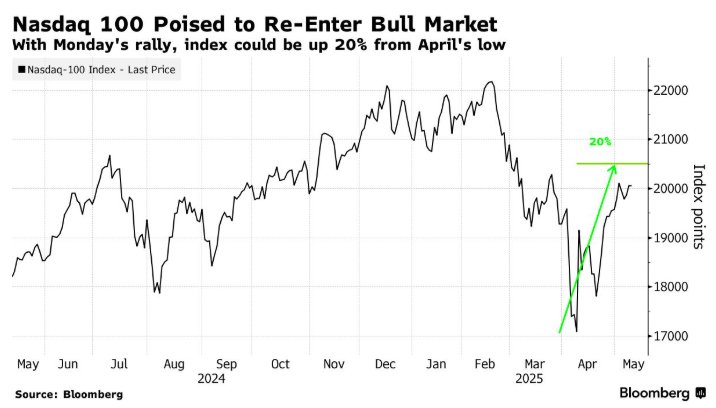
中美贸易共识点燃股市看涨狂潮! 纳斯达克重返牛市 “Buy America”再度席卷全球
Zhi Tong Cai Jing· 2025-05-13 00:15
Group 1 - The easing of US-China trade tensions has provided a clear bullish signal for global investors, indicating a shift towards a more moderate approach from the Trump administration regarding tariffs [3][11] - The S&P 500 index surged by 3.3% to close at 5844.19 points, breaking above the critical 200-day moving average for the first time in over 30 trading days [7][10] - The "Magnificent 7" tech giants, including Apple, Amazon, Nvidia, and Tesla, saw significant stock price increases following the positive trade consensus, leading the market rally [3][4] Group 2 - Market expectations for Federal Reserve interest rate cuts have shifted, with traders now anticipating only two cuts by 2025, down from four previously expected [3][10] - The recent trade consensus is projected to reduce the effective tariff rate on Chinese goods from 145% to approximately 30%, significantly impacting US-China trade dynamics [10][11] - Major US companies, including UPS and Ford, have withdrawn their 2025 earnings guidance due to uncertainties surrounding tariffs and economic conditions [16] Group 3 - The bullish sentiment in the US stock market has led to a collective decline in safe-haven assets such as gold, yen, and Swiss franc, indicating a shift in investor sentiment [10] - The performance of the S&P 500 index historically shows positive returns after similar technical patterns, with a median increase of 4.1% over the next three months [7][9] - The market's current rally is characterized by a significant shift in sentiment, with many investors feeling the pressure of missing out on the rebound [17]