
Economic Security

Search documents
Alberta Courts Asian Capital for 1M bpd Pipeline to Break U.S. Dependence
Yahoo Finance· 2026-03-26 00:00
Asian and Middle Eastern capital is lining up behind Alberta’s latest export push. Premier Danielle Smith says investors, including sovereign wealth funds, are prepared to take 15% to 30% minority stakes in a proposed 1-million-barrel-per-day pipeline aimed at Asian markets. The plan centers on moving oil sands crude to the northwest coast of British Columbia, with Prince Rupert now favored over Kitimat as the terminal site. The objective is straightforward: break Canada’s near-total dependence on the U.S ...
Collapse of U.S. shipbuilding poses national and economic security risks | 60 Minutes
60 Minutes· 2026-03-23 03:09
The war in Iran is highlighting the importance of ships, not just warships, but cargo vessels like those carrying oil or gas trapped near the straight of Hormuz. But American ship building is in shambles due to decades of short-sighted policies and neglect. Our submarine building program is sluggish and our commercial ship building is nearly extinct. China makes roughly a thousand cargo ships a year. The US maybe three. The Trump administration has called this a national security crisis. But can this ship b ...


X @The Wall Street Journal
The Wall Street Journal· 2026-03-17 14:24
From @WSJopinion: The outcome of the Iran war will determine whether the region remains anchored to the U.S. and its allies or gradually shifts into China’s economic and security orbit, writes @Doranimatedhttps://t.co/aRGrHHF6t8 ...
Japan mines Pacific seabed to loosen China's grip on rare earths | FT #shorts
Financial Times· 2026-03-16 05:00
Japan is embarking on an ambitious push to extract rare earth elements from the ocean floor, betting that deep sea resources could strengthen its economic security. The effort is expected to accelerate under Prime Minister Sai Takayichi, who describes deep sea mining as the first step towards domestically industrializing rare earths. In 2011, Japan discovered resources near Minami Toishima, an atal 1,900 km southeast of Tokyo that is part of the country's exclusive economic zone.Following her landslide elec ...

How AI Is Pushing More Women Into Blue-Collar Careers
CNBC· 2026-03-15 15:00
Corporate America has seen historic rounds of layoffs recently in what some experts warn could be the beginning of an AI-driven, white collar recession, But jobs in the skilled trades are seen as AI proof. A robot's never going to be able to do what we do. Trade jobs are never going to be technology based. They're going to be human based.At the same time, blue collar industries are facing a shortage of skilled tradespeople as workers age out of the field. You have major industry in this country which cannot ...

X @Investopedia
Investopedia· 2026-01-26 14:57
The National and Economic Security Portfolio https://t.co/8uh4CCopp2 ...
US Tries to Rely Less on China for Critical Minerals
Bloomberg Television· 2025-12-16 20:44
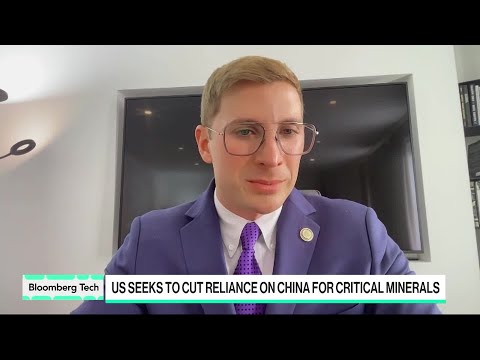
Supply Chain Security & AI Race - The US government is prioritizing securing supply chains, particularly for AI, viewing economic security as national security [2][4][6] - The US aims to win the AI race through innovation and diffusion, expanding compute capacity domestically and exporting technology globally [26][27] - Pax Silica Initiative fosters collaboration with allies (Korea, Japan, Australia, UK, Singapore, Israel) to secure supply chains and co-invest in fabs, data centers, and refining projects [4][6][7] - The US government utilizes various resources like the Development Finance Corporation, Department of War, and Office of Strategic Capital to support supply chain initiatives [8] - The Department of War is investing in domestic mineral supply chains to ensure a reliable ecosystem for weapon production in both peace and wartime [10][11] - A $400 million investment for 15% of MP Materials is highlighted as an example of government support for securing critical mineral supplies [8] International Relations & Trade - The US seeks a constructive, stable, and positive relationship with China while prioritizing American interests [25] - The US acknowledges a growing economic security consensus with Europe, particularly regarding global imbalances and unfair trade practices [17][18] - The US sees Europe as an important partner in addressing economic and supply chain challenges, despite disagreements on technology regulation [19][22][23] - The US National Security Strategy was intended as a diagnosis of the challenges facing Europe, not an insult [20][21] - The US is engaging with countries like India to expand the Pax Silica Initiative and address specific supply chain security challenges [13][14]
US Tries to Rely Less on China for Critical Minerals
Bloomberg Technology· 2025-12-16 19:16
Supply Chain Resiliency and Economic Security - The US government is focused on ensuring supply chain resiliency and preventing over-reliance on specific countries [1] - The economic security strategy is based on rebalancing trade, stabilizing conflict zones, industrializing America, and securing supply chains [2][3][4] - PAX Silica provides a framework for securing supply chains with allies and partners to lead future industries [4] - Economic security is considered national security, making economic policy a prerequisite for national survival [7] - The US government is leveraging various investment vehicles and collaborating with allies and the private sector to strengthen economic security [7][8] Public-Private Partnerships and Investments - Public-private partnerships are being utilized to support specific smelters and initiatives [5] - The US government is investing in domestic mineral production to ensure a reliable supply for national defense [9][10] - An example investment is $400 million for 50% of empty materials, framed as an investment in America's defense capabilities [8] International Collaboration - The US is collaborating with countries like Korea, Japan, Australia, the UK, Singapore, and Israel to address global supply chain challenges [6] - The inaugural PAX Silica summit included allies and guests like Taiwan and the OECD, with expectations for more countries, including India, to join [11][12] - The US is engaging with Europe on economic security, noting a growing consensus and opportunities for collaboration [17][24] US-China Relationship - The US aims for a constructive, stable, and positive relationship with China while prioritizing American interests [26] - The US seeks to win the "air race" through innovation and diffusion, expanding compute capacity domestically and exporting technology globally [27][28]
EU's Sefcovic on China, Licenses for Rare Earths
Bloomberg Television· 2025-12-15 19:36
EU-China Trade Relations - EU is in close contact with China's Foreign Trade Minister regarding general licenses [1] - Initial reports suggest EU industry is receiving general licenses from China, but more granular information is needed for full evaluation [2] - China was receptive to EU arguments that the initial licensing process (set up in April) was too intrusive, requiring excessive information about supply chains [2] - A "hotline" has been established with Minister Wang Wentao for priority cases [3] Supply Chain Concerns & Mitigation - Worried CEOs of EU companies expressed concerns about the lack of permanent magnets and legacy chips [3] - The instability in global supply chains is a challenge [4] - European industry should prepare to pay a "security premium," stockpile, and diversify [4][5] - Dependencies are costly, and this is included in the new communication on economic security [5]

日本 2026 年展望:2026 年股市观点与优选标的 -Moriy a2026 年股市观点与优选标的-Japan Outlook 2026 _2026 Equity Market View and Top Picks_ Moriya_ 2026 Equity Market View and Top Picks
2025-12-08 00:41
Summary of Japan Equity Market Outlook 2026 Industry Overview - The report focuses on the Japanese equity market and its outlook for 2026, highlighting significant structural changes and geopolitical factors impacting the market [1][2][3]. Core Insights and Arguments 1. **Economic Normalization**: The Japanese economy is expected to continue its normalization process, overcoming previous shocks such as US tariffs, with an estimated annual upside of +8% for Japanese equities [2][3]. 2. **Inflation and Corporate Reforms**: Key drivers include an upswing in inflation, corporate reforms (involving shareholder returns, business restructuring, and growth investments), and investments focused on economic security [2][3]. 3. **AI and Geopolitical Factors**: Stock selection will be influenced by global AI expectations, with a widening performance gap among sectors due to operational resource allocation in response to inflation and geopolitical changes [3][35]. 4. **Sector Preferences**: Preferred sectors include banks and consumption-related sectors at the beginning of 2026, transitioning to AI-related sectors as the global economy accelerates [3][35]. 5. **Top Stock Picks**: Notable stock picks include: - **Technology Sector**: Tokyo Electron, Murata Manufacturing, Daikin - **Real Estate and Retail**: Mitsubishi Estate, FOOD & LIFE - **Corporate Reforms**: Toyota, Sumitomo Corporation, Panasonic, Kirin [3][4]. Important but Overlooked Content 1. **Fiscal Policy Impact**: The fiscal deficit is projected to widen from -0.8% of GDP in 2025 to -2.9% in 2026, which may boost GDP by approximately 0.7 percentage points [14][15]. 2. **Wage Growth and Inflation**: Wage growth is expected to persist, with base pay hikes projected to be slightly above 3%, contributing to a shift from deflation to sustained inflation [36][37]. 3. **Corporate Governance Reforms**: The Financial Services Agency (FSA) plans to revise the Corporate Governance Code, which may lead to improved balance sheet efficiency and resource reallocation among Japanese companies [37][38]. 4. **Geopolitical Risks**: The minority status of the new administration raises concerns about policy execution, with potential risks of a "Japan sell-off" if fiscal expansion is not managed effectively [15][39]. Economic Projections - **GDP Growth**: Real GDP growth is expected to accelerate from 0.9% in FY2025 to 1.2% in FY2026, with a nominal growth rate of about 3% over the next three years [11][12]. - **Inflation Rates**: Core CPI is projected to slow from 3.1% in 2025 to 1.7% in 2026, but inflation expectations may sustain around 2% beyond 2027 [12][13]. Conclusion - The Japanese equity market is poised for growth driven by structural reforms, inflationary trends, and strategic investments in key sectors. However, geopolitical risks and fiscal policy execution remain critical factors to monitor as 2026 approaches [1][2][3][4].