H-1B签证

Search documents
美国签证审查严重拖长
Xin Lang Cai Jing· 2025-12-21 21:43
Group 1 - The U.S. government has introduced new social media scrutiny requirements for certain visa applicants, leading to significant delays in the visa processing at U.S. embassies and consulates abroad, with some appointments being postponed for up to a year [1][2] - Google and Apple have advised their foreign employees holding relevant work visas to avoid international travel to prevent potential long-term stays outside the U.S. due to these delays [1][3] - The delays in visa processing are attributed to the expansion of social media review requirements to all H-1B visa applicants and their families, which necessitates applicants to make their social media profiles public for consular officers to review [2][3] Group 2 - The memo sent to Google employees indicated that the delays affect multiple visa types, including H-1B, H-4, F, J, and M visas, with the H-1B visa being a temporary work visa that allows U.S. companies to hire foreign professionals to fill skill gaps [3] - The annual cap for H-1B visas is set at 85,000, and the Trump administration previously increased the fees for H-1B visa applications to $100,000, aiming to ensure that only high-skilled talent not replaceable by U.S. workers is brought into the country [3]


沃尔玛暂停向需要H-1B签证的候选人发放录用通知
Sou Hu Cai Jing· 2025-10-21 20:03
Core Viewpoint - Walmart has suspended job offers to candidates requiring H-1B visas, primarily affecting its headquarters employees, following a new fee imposed by the Trump administration on H-1B visa applications [1] Group 1: Company Impact - The new policy significantly impacts Walmart, which is the largest user of H-1B visas among major U.S. retail chains, employing approximately 2,390 H-1B visa holders [1] Group 2: Industry Context - The Trump administration's recent announcement of a $100,000 fee on new H-1B visa applications has triggered a chain reaction in industries that heavily rely on foreign professional talent, including technology [1]

全球都在抢的三哥,为何老美往外赶了?
Hu Xiu· 2025-10-12 04:00
Core Viewpoint - The U.S. has significantly increased the application fee for H-1B visas to $100,000, causing a strong reaction from Indian tech workers and raising concerns about the impact on the tech industry [1] Group 1 - The H-1B visa application fee has surged to $100,000, which is a substantial increase from previous levels [1] - Indian tech workers are particularly affected by this change, leading to widespread discontent and frustration within the community [1] - The increase in fees is seen as a direct challenge to the tech workforce, prompting strong reactions from those reliant on these visas [1]
Restrictive immigration policies will hinder the US tech sector
Yahoo Finance· 2025-09-29 16:33
Core Insights - The Trump administration's announcement on September 20, 2025, introduced a $100,000 annual fee per H-1B visa application, causing significant disruption in the US tech sector [1][2] - Major tech companies like Amazon, Microsoft, and Google have responded by urging their employees abroad to return to the US immediately, indicating the urgency and potential impact of the new regulation [1] H-1B Visa Overview - The H-1B visa program is the largest non-immigrant temporary work visa program in the US, allowing companies to sponsor foreign employees in specialized fields, with a cap of 65,000 visas per fiscal year [3] - As of January 2025, there are approximately 730,000 H-1B holders in the US, along with around 550,000 dependents [3] Impact on the Tech Sector - The new fee contradicts the administration's goal of boosting US tech manufacturing, as restrictive immigration policies may hinder innovation and increase costs for companies attempting to reshore production [2] - The majority of H-1B visa recipients are from India (70%), with significant numbers also from China (10%), highlighting the reliance of US tech companies on foreign talent [4] - Amazon leads in H-1B visa approvals, with over 10,000 applications in the first half of 2025, followed by Tata Consultancy Services, Microsoft, and Meta, each with more than 5,000 approvals [4] Political Context - The Trump administration's introduction of the $100,000 fee is framed as a response to perceived abuse of the H-1B visa program, aimed at protecting US wages and jobs [5] - The administration's economic policy focuses on reindustrializing the US manufacturing sector, particularly in advanced industries like tech and automotive [5]
特朗普将H-1B签证费用升至10万美元
Chang Jiang Shang Bao· 2025-09-22 23:59
Core Points - The article discusses a significant reform to the H-1B visa program signed by President Trump on September 19, which mandates a fee of $100,000 per year for applicants to enter the U.S. [1] - The new regulation aims to ensure that foreign labor brought into the U.S. possesses high-level skills and is irreplaceable, while encouraging companies to prioritize training local talent [1] - The H-1B visa is primarily utilized by U.S. tech companies to hire highly educated foreign professionals to fill specialized job vacancies that are hard to fill domestically [1] Supporters and Critics - Supporters argue that the H-1B visa program is crucial for attracting global talent, maintaining economic vitality, and ensuring U.S. technological innovation, especially in the context of artificial intelligence and national security [1] - Critics contend that U.S. tech companies have historically abused the H-1B visa program to import cheap foreign labor, which hinders job opportunities and advancement for local talent, including minorities [1]
白宫:医生H-1B签证费用或可以免除
Yang Shi Xin Wen Ke Hu Duan· 2025-09-22 15:20
Core Points - The U.S. White House announced on September 22 that certain individuals may be exempt from H-1B visa fees, potentially including doctors and residents [1] - On September 19, President Trump signed an announcement increasing the fees that companies must pay for H-1B visa applicants to $100,000, aiming to ensure that the U.S. attracts high-skilled talent that cannot be replaced by American workers [1] - Previously, companies typically paid several thousand dollars for H-1B visa applications [1]
美国H-1B签证新政引恐慌
Bei Jing Shang Bao· 2025-09-21 15:57
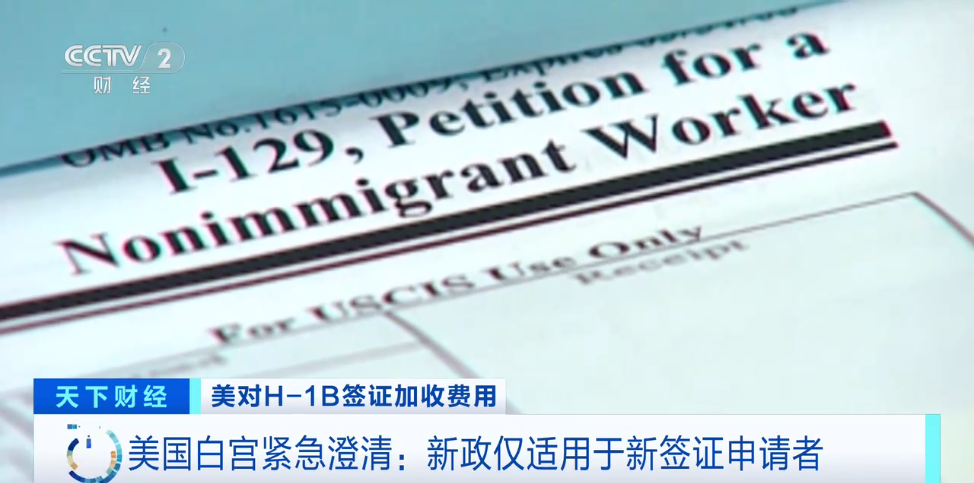
Core Points - The new policy significantly increases the application fee for H-1B visa applicants to $100,000, which may heavily impact the U.S. tech industry that relies on foreign skilled workers [1][2][3] - The policy aims to incentivize companies to hire American workers instead of foreign talent, as stated by President Trump and Commerce Secretary Ross [2][4] - The new fee structure applies only to new applicants and does not affect current H-1B visa holders or their renewals [1][4] Group 1: Impact on Companies - Major tech companies like Amazon, Microsoft, and Google, which depend on H-1B visas for hiring foreign employees, are likely to be adversely affected by the increased costs [2][3] - In the first half of 2025, Amazon alone received over 10,000 H-1B visas, while Microsoft and Meta each received over 5,000 [2] - The new fee may lead companies to reconsider their hiring strategies, potentially shifting jobs overseas, particularly in research and development [2][3] Group 2: Visa Application Details - The H-1B visa application fee has increased to over 60 times the previous amount, which was only a few thousand dollars [1][2] - The annual cap for new H-1B visas is set at 85,000, with 65,000 available for general applicants and 20,000 reserved for those with U.S. graduate degrees [5] - The new "Golden Card" program allows foreign individuals with extraordinary abilities to expedite their visa process by paying $1 million or having a company sponsor them for $2 million [3]


特朗普已签字,印度人“陷入恐慌”……印度返美机票价格暴涨110%,销售火爆!印度外交部:将带来人道主义后果
Mei Ri Jing Ji Xin Wen· 2025-09-21 15:53
Core Points - The new regulation signed by President Trump increases the annual fee for H-1B visa applicants from several thousand dollars to $100,000, effective from September 21 [1][4][6] - Major tech companies and universities in the U.S. have advised H-1B visa holders to remain in the country and avoid travel due to concerns about the new policy [2][4] - The White House clarified that the new fee applies only to future applicants and does not affect current visa holders or those already in the application process [4][6] Group 1: Impact on Tech Companies - Tech giants like Amazon, Google, Microsoft, and Meta rely heavily on the H-1B visa program to hire foreign employees, with Amazon alone having over 14,000 approved H-1B visas in the first three quarters of the fiscal year [2][7] - Companies have expressed concern that the increased fees may deter them from hiring foreign talent, potentially leading to a shift towards hiring domestic workers instead [6][7] Group 2: Reaction from India - India is the largest beneficiary of the H-1B visa program, with 71%-72% of the visas issued to Indian nationals, leading to significant concern within India's tech industry following the announcement [8] - The Indian government is assessing the full impact of the new fee structure and has urged the U.S. to consider the humanitarian consequences of the policy [8] Group 3: Broader Economic Context - The increase in H-1B visa fees and the introduction of a "golden card" program for wealthy immigrants are seen as attempts to address the U.S. government's fiscal challenges, with the national debt exceeding $37 trillion [15][16] - Analysts suggest that these measures may face legal challenges, as only Congress has the authority to set new visa fees [15][16]



美科技巨头紧急提醒!“暂停任何离境计划”→
Huan Qiu Wang· 2025-09-21 09:56
Group 1 - The new regulation signed by President Trump increases the fee for H-1B visa applicants from several thousand dollars to $100,000 per year, effective September 21 [1][3] - Major tech companies like Microsoft, Amazon, and Apple have advised their H-1B visa holders to remain in the U.S. and avoid international travel to prevent complications due to the new policy [1][3] - The H-1B visa program is crucial for U.S. companies to hire skilled foreign professionals, particularly in STEM fields, with an annual cap of 85,000 new visas [5] Group 2 - The significant increase in H-1B visa fees may lead to a sharp rise in labor costs for large tech companies, while small tech firms and startups may find the $100,000 annual cost prohibitive, potentially hindering their ability to recruit overseas talent [6]