
HPC(高性能计算)

Search documents
TSMC(TSM) - 2025 Q4 - Earnings Call Transcript
2026-01-15 07:02
Financial Highlights - Fourth quarter revenue increased by 5.7% sequentially in NT$ and by 1.9% in U.S. dollar terms to $33.7 billion, slightly exceeding guidance [3] - Gross margin rose by 2.8 percentage points sequentially to 62.3%, driven by cost improvements and favorable foreign exchange rates [3] - Operating margin increased by 3.4 percentage points to 54%, with operating expenses at 8.4% of net revenue [3] - Full year 2025 revenue increased by 35.9% in U.S. dollar terms to $122 billion, with gross margin at 59.9% [9] Business Line Performance - 3 nm process technology contributed 28% of wafer revenue in Q4, while 5 nm and 7 nm accounted for 35% and 14% respectively [4] - High-Performance Computing (HPC) revenue increased by 48% year-over-year, accounting for 58% of total revenue in 2025 [6] - Smartphone revenue increased by 11% year-over-year, contributing 29% to total revenue [6] Market Data - HPC accounted for 55% of Q4 revenue, with smartphone at 32% and IoT at 5% [5] - Advanced technologies (7 nm and below) accounted for 77% of wafer revenue for the full year [4] Company Strategy and Industry Competition - TSMC plans to invest $52 billion to $56 billion in capital expenditures in 2026 to support growth in AI and other advanced technologies [14] - The company aims to maintain a long-term gross margin of 56% and higher through strategic pricing and operational excellence [17] - TSMC is expanding its global manufacturing footprint, including new fabs in Arizona and Japan, to meet increasing demand [26][27] Management Comments on Operating Environment and Future Outlook - Management expressed confidence in the sustainability of AI demand, indicating it is a megatrend that will drive growth [20][22] - The company anticipates a 14% growth in the Foundry 2.0 industry in 2026, with TSMC expected to outperform this growth [20] - Concerns about potential tariff policies and rising component prices were acknowledged, but management remains focused on fundamentals [19] Other Important Information - TSMC's effective tax rate for 2025 was 16%, expected to rise to between 17% and 18% in 2026 [10] - The company generated TWD 2.3 trillion in operating cash flow in 2025 and paid TWD 467 billion in cash dividends, up 28.6% year-over-year [9] Q&A Session Summary Question: Customer Demand and AI Bubble Concerns - Management confirmed strong customer demand for AI, with evidence of business growth from cloud service providers [36][38] - Concerns about a potential AI bubble were acknowledged, but management remains confident in the long-term growth of AI [39] Question: U.S. Expansion Plans - TSMC is accelerating its fab expansion in Arizona due to strong demand from AI customers, with plans for additional fabs [42][43] - The company aims to achieve 20% to 30% of its 2 nm capacity in the U.S. as part of its long-term strategy [40] Question: Power Supply for Data Centers - Management is actively evaluating power supply considerations for AI infrastructure, ensuring that silicon supply remains the primary bottleneck [48][49] Question: Non-AI Market Outlook - Management expects minimal unit growth in PC and smartphone markets due to rising memory costs, but demand for high-end products remains strong [56][68] Question: Competition from Intel Foundry - Management does not view Intel's foundry competition as a significant threat, citing the complexity and time required to develop advanced technologies [60]

TSMC(TSM) - 2025 Q4 - Earnings Call Transcript
2026-01-15 07:02
Financial Data and Key Metrics Changes - Fourth quarter revenue increased by 5.7% sequentially in NT$ and by 1.9% in U.S. dollar terms to $33.7 billion, slightly exceeding guidance [3] - Gross margin rose by 2.8 percentage points sequentially to 62.3%, driven by cost improvements and favorable foreign exchange rates [3] - Operating margin increased by 3.4 percentage points sequentially to 54% due to lower operating expenses [3] - Full year 2025 revenue increased by 35.9% in U.S. dollar terms to $1 billion, with gross margin up 3.8 percentage points to 59.9% [6][7] - Full year EPS increased by 46.4% to TWD 66.25 and ROE increased by 5.1 percentage points to 35.4% [7] Business Line Data and Key Metrics Changes - 3 nm process technology contributed 28% of wafer revenue in Q4, while 5 nm and 7 nm accounted for 35% and 14% respectively [4] - Advanced technologies (7 nm and below) accounted for 77% of wafer revenue for the full year, up from 69% in 2024 [4] - High-Performance Computing (HPC) revenue increased by 48% year over year, accounting for 58% of total revenue in 2025 [5] Market Data and Key Metrics Changes - HPC revenue increased by 4% quarter over quarter to account for 55% of Q4 revenue, while smartphone revenue increased by 11% to account for 32% [5] - Automotive revenue decreased by 1% to account for 5%, and Data Center Equipment (DCE) revenue decreased by 22% to account for 1% [5] - Overall, smartphone, IoT, and automotive segments saw year-over-year increases of 11%, 15%, and 34% respectively in 2025 [5] Company Strategy and Development Direction - TSMC plans to invest between $52 billion and $56 billion in capital expenditures for 2026, focusing on advanced process technologies [13] - The company aims to leverage manufacturing excellence to drive productivity and optimize capacity across nodes [10][16] - TSMC is committed to supporting customer growth while maintaining a disciplined approach to capacity planning [22][24] Management's Comments on Operating Environment and Future Outlook - Management expressed confidence in the AI megatrend, forecasting a 14% growth in the Foundry 2.0 industry for 2026, supported by robust AI-related demand [19] - Concerns about potential tariff policies and rising component prices were acknowledged, with a focus on prudent business planning [18] - Management expects 2026 to be another strong growth year, with full-year revenue projected to increase by close to 30% in U.S. dollar terms [19] Other Important Information - TSMC's cash and marketable securities totaled TWD 3.1 trillion or $98 billion at the end of Q4 [5] - The company plans to pay a cash dividend of TWD 23 per share in 2026, up from TWD 18 in 2025 [8] Q&A Session Summary Question: Insights on customer demand and AI-related growth - Management confirmed strong customer demand for AI, with evidence of growth in their businesses, indicating that AI is a real and growing trend [36][37] Question: U.S. expansion plans and capacity commitments - Management is accelerating fab expansion in Arizona due to strong demand from AI customers, with plans for additional fabs [41][42] Question: Evaluation of power supply for data centers - Management is actively assessing power supply needs for AI infrastructure, ensuring that silicon supply remains the primary bottleneck [46][47] Question: Advanced packaging revenue contribution and focus areas - Advanced packaging contributed about 8% of revenue in 2025, with expectations for growth in the next five years [50][51] Question: Non-AI market outlook and competition - Management expects strong demand in non-AI segments, particularly in high-end smartphones, despite rising memory costs [55][66] Question: Engineering talent and capacity planning - Management acknowledged challenges in developing engineering talent but emphasized productivity improvements as a focus for 2026-2027 [71][72]
TSMC(TSM) - 2025 Q4 - Earnings Call Transcript
2026-01-15 07:00
Financial Highlights - In Q4 2025, revenue increased by 5.7% sequentially in NT$ and by 1.9% in U.S. dollars to $33.7 billion, slightly exceeding guidance [3] - Gross margin rose by 2.8 percentage points sequentially to 62.3%, driven by cost improvements and favorable foreign exchange rates [3][9] - Operating margin increased by 3.4 percentage points to 54% due to operating leverage [3] - Full year 2025 revenue increased by 35.9% in U.S. dollars to $1 billion, and by 31.6% in NT dollars to TWD 3.8 trillion [7] - Full year EPS increased by 46.4% to TWD 66.25, and ROE increased by 5.1 percentage points to 35.4% [7] Business Line Performance - In Q4 2025, 3 nm process technology contributed 28% of wafer revenue, while 5 nm and 7 nm accounted for 35% and 14% respectively [4] - Advanced technologies (7 nm and below) accounted for 77% of wafer revenue for the full year, up from 69% in 2024 [4] - High-Performance Computing (HPC) revenue increased by 48% year-over-year, accounting for 58% of total revenue in 2025 [5] Market Performance - HPC revenue increased by 4% quarter-over-quarter to account for 55% of Q4 revenue, while smartphone revenue increased by 11% to account for 32% [5] - Automotive revenue decreased by 1% to account for 5%, and Data Center Equipment (DCE) revenue decreased by 22% to account for 1% [5] - Overall, HPC accounted for 58% of 2025 revenue, with smartphone at 29%, IoT at 5%, automotive at 5%, and DCE at 1% [5] Company Strategy and Industry Competition - TSMC plans to increase capital expenditures to $52 billion-$56 billion in 2026 to support growth in advanced process technologies [12] - The company aims to maintain a long-term gross margin of 56% and higher through the cycle, despite challenges from overseas expansion and rising manufacturing costs [15] - TSMC is focused on leveraging manufacturing excellence and optimizing capacity across nodes to support profitability [15] Management Commentary on Operating Environment and Future Outlook - Management expressed confidence in the AI megatrend, forecasting a 14% growth in the Foundry 2.0 industry in 2026, supported by robust AI-related demand [18] - TSMC expects full-year revenue to increase by close to 30% in U.S. dollar terms in 2026 [18] - The company is committed to supporting customer growth and addressing the structural increase in long-term market demand [19] Other Important Information - TSMC's cash and marketable securities reached TWD 3.1 trillion ($98 billion) at the end of Q4 2025 [5] - The company generated TWD 726 billion in cash from operations and spent TWD 357 billion on capital expenditures in Q4 2025 [6] - TSMC plans to pay a cash dividend of TWD 23 per share in 2026, up from TWD 18 in 2025 [8] Q&A Session Summary Question: Customer Demand and AI Bubble Concerns - Management reassured that customer demand for AI is real, with evidence of growth and financial returns from cloud service providers [33][34] - Concerns about a potential AI bubble were acknowledged, but management remains confident in the long-term growth driven by AI [35] Question: U.S. Expansion Plans - TSMC is accelerating its fab expansion in Arizona to meet strong AI demand, with plans for multiple fabs and a Gigafab cluster [39][40] Question: Power Supply for Data Centers - Management confirmed that power supply considerations are factored into planning, and customers have been proactive in addressing power needs for AI infrastructure [44][46] Question: Non-AI Market Outlook - Management expects strong demand in high-end smartphones and PCs, which are less sensitive to memory price increases [52][68] Question: Competition from Intel Foundry - Management expressed confidence in TSMC's competitive position, noting that technology complexity and time to market are significant barriers for new entrants [60]
卢伟冰确认小米17Ultra涨价,内存成本持续上涨至2027年
Cai Jing Wang· 2025-12-22 05:53
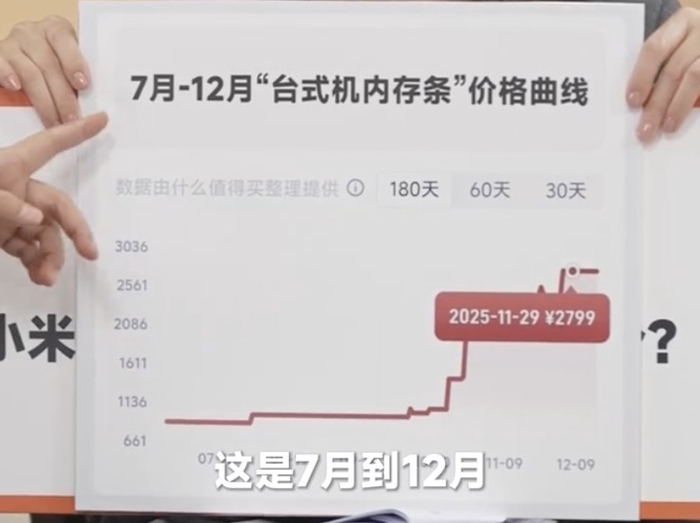
Group 1 - The core point of the article is that Xiaomi's President Lu Weibing confirmed that the new flagship model, Xiaomi 17 Ultra, will see a price increase due to rising memory costs [1] - Lu Weibing expressed concerns about the impact of skyrocketing memory prices on the Xiaomi 17 Ultra, indicating that this has been a significant issue for him recently [1] - He noted that the demand for high-performance computing (HPC) has surpassed that of mobile phones, which were previously the main demand driver for memory [1] Group 2 - Lu Weibing mentioned that there has been no new memory production capacity added in recent years, with new capacity expected only by the end of 2027 [1] - He predicted that the years 2025 to 2027 will see continued increases in memory costs [1] - During the live stream, he highlighted the price increase of desktop memory modules from around 1,000 yuan to over 3,000 yuan, representing an increase of nearly three times [1]


台积电20250718
2025-07-19 14:02
Summary of TSMC Conference Call Company Overview - **Company**: TSMC (Taiwan Semiconductor Manufacturing Company) - **Industry**: Semiconductor Manufacturing Key Points Revenue Growth and Capital Expenditure - TSMC expects a revenue growth rate of approximately 25% over the next five years, driven by technological barriers [2][3] - Capital expenditure guidance for 2025 is set between $35 billion and $42 billion, representing a year-on-year increase of 34% [2][3] Profit Margin Risks - The company faces risks from the appreciation of the New Taiwan Dollar and the migration of manufacturing to the U.S., which could lead to a decline in gross margins by about 1% annually [2][4] - Despite these risks, TSMC anticipates that its gross margin will only decline by 1% per year, which is a relatively optimistic forecast [4][5] AI and HPC Revenue Growth - TSMC is positioned as a key player in the AI computing supply chain, with AI-related revenue expected to double from 2024 to 2025 and maintain a growth rate of around 45% from 2025 to 2029 [2][6] - High-Performance Computing (HPC) accounts for 60% of TSMC's revenue, with quarterly revenues ranging from $14 billion to $15 billion, showing a year-on-year growth of nearly 80% [4][14] Product Pricing and Margins - The average selling price (ASP) of TSMC's products increased by 3% to $8,088, significantly higher than competitors like SMIC [2][8] - The gross margin for Q2 was reported at 58.6%, with only a slight decline of 0.2 percentage points due to increased capacity utilization and ASP growth [2][8] Capacity Expansion and Technology Transition - TSMC plans to expand its 5nm capacity in the second half of 2025 to meet growing customer demand, transitioning some 7nm capacity to 5nm and further to 4nm [4][10] - The company confirmed that its 5nm capacity is currently very tight, which is a core issue for expansion [7][9] Market Dynamics and Competitor Analysis - Despite ASML's weaker performance and subdued EUV equipment investments, TSMC's end-user demand remains strong, indicating potential for upward adjustments in capital expenditures [2][7] - TSMC's wafer prices are projected to increase by 19% in 2025, followed by 12% in 2026 and 7% in 2027 [11] Industry Valuation and Investment Sentiment - TSMC's valuation is aligned with its profit growth, maintaining a price-to-earnings ratio of around 25 times, with a target price-to-book ratio of approximately 7 times [13][25] - Investors are attracted to TSMC due to its expected 25% revenue growth over the next five years and high visibility within the hardware cycle [25] Currency Impact - The recent appreciation of the New Taiwan Dollar by approximately 10% could impact TSMC's gross margins and stock price, necessitating close monitoring of this risk [22] Semiconductor Industry Trends - The global semiconductor industry has been experiencing growth since mid-2023, with a long-term growth rate of around 20%, although most sectors are in cyclical fluctuations [23] - The data center segment is expected to grow by 30% to 40% annually, contributing significantly to the overall industry growth [23][24] Conclusion - TSMC is well-positioned for future growth, particularly in AI and HPC sectors, despite facing some risks related to currency fluctuations and manufacturing shifts. The company's strategic focus on advanced technologies and capacity expansion is expected to drive revenue and maintain competitive advantages in the semiconductor industry.