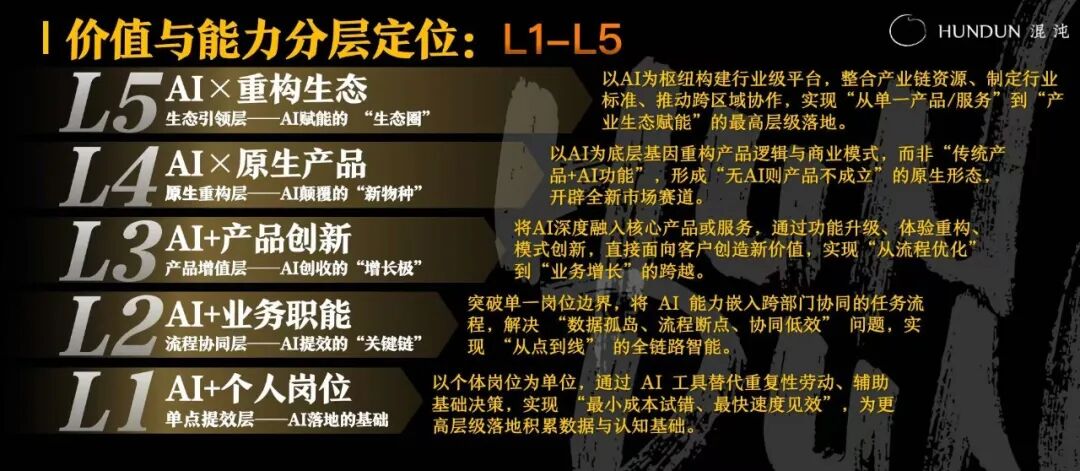
L1-L5五级落地体系

Search documents
AI是泡沫?50家企业实战证明:真正的机会藏在“落地体系”里
3 6 Ke· 2025-11-18 12:31
Core Insights - The article discusses the cyclical nature of AI investment, highlighting a pattern where enthusiasm peaks at the beginning of the year but wanes by year-end due to a lack of tangible returns [1][3] - It emphasizes that AI is not merely a short-term bubble or a tool exclusive to large companies, but rather a technology that requires a strategic approach to integrate with business operations for effective implementation [3][4] Group 1: AI Investment Trends - Many companies experience a cycle of initial excitement followed by project stagnation due to unmet expectations and a disconnect between technology and business needs [1][2] - A significant number of enterprises abandon AI initiatives midway, with only about 300 out of thousands achieving real results [2] Group 2: Identifying Opportunities and Pitfalls - Companies that successfully leverage AI focus on the "middle ground" of integrating AI with their specific business needs, avoiding the extremes of macro-level concepts and micro-level techniques [3][4] - Common pitfalls include investing in flashy AI projects without addressing real business problems, leading to low usage rates and increased customer complaints [5][6] Group 3: Effective AI Implementation Strategies - Successful AI applications often target high-frequency, repetitive tasks, yielding quick returns on investment and building confidence in AI's value [7][12] - Companies that integrate AI into their core products or services can create new revenue streams and enhance operational efficiency [15][16] Group 4: The Five-Level Implementation Framework - The article introduces a "L1-L5" framework for AI implementation, which helps businesses systematically approach AI integration based on their specific industry needs [9][11] - Levels L1 and L2 focus on validating AI's value with minimal investment and optimizing core processes, while levels L3 to L5 emphasize transforming AI into a revenue-generating engine and building industry-wide ecosystems [14][18] Group 5: Recommendations for Different Business Sizes - Small and medium-sized enterprises are advised to start with low-cost, high-impact AI applications to achieve quick wins [21] - Mature companies should focus on breaking down data silos and embedding AI into their core operations to gain a competitive edge [22] - Leading firms are encouraged to develop AI-native products and build ecosystems to capitalize on long-term market opportunities [23]

AI是泡沫?50家企业实战证明:真正的机会藏在“落地体系”里
混沌学园· 2025-11-18 11:58
Core Insights - The article discusses the cyclical nature of AI investment, highlighting the trend of initial enthusiasm followed by disillusionment as projects fail to deliver returns [2][3] - It emphasizes the importance of a "mid-level landing" approach, where businesses must align AI technology with their specific operational needs to achieve profitability [7][16] Group 1: AI Investment Trends - Many companies experience a cycle of "initial hype and year-end cooling," leading to project abandonment due to lack of visible returns [2] - The AI landscape is characterized by a divide between grand narratives of large models and practical applications that fail to connect with business needs [2][3] - A significant number of enterprises abandon AI initiatives due to various challenges, with only a small fraction achieving tangible results [3] Group 2: Successful AI Implementation - Companies that successfully monetize AI have identified the "AI + business" mid-level integration path, focusing on practical applications rather than abstract concepts [4][7] - The "Chaos AI Commercial Landing Application White Paper" aims to bridge the gap between macro concepts and micro techniques, providing actionable insights for businesses [4][16] - Successful AI applications are characterized by their ability to enhance operational efficiency and generate revenue, rather than merely serving as technological novelties [10][21] Group 3: Common Pitfalls - Companies often fall into the trap of "showy investments" that do not address real business needs, leading to low usage rates and increased customer complaints [8] - There is a tendency for businesses to become overly focused on minor technical details, neglecting the core business objectives that drive profitability [9] Group 4: Identifying Real Opportunities - The article outlines a framework for identifying genuine opportunities in AI by focusing on mid-level integration that aligns technology with specific business scenarios [10][21] - Successful case studies demonstrate that AI can significantly improve efficiency in repetitive tasks, leading to quick returns on investment [10][19] Group 5: L1-L5 Implementation Framework - The L1-L5 framework provides a structured approach for businesses to implement AI, starting from low-cost, high-impact initiatives to more complex, ecosystem-level integrations [15][18] - Each level of the framework is tailored to different business needs, ensuring that companies can find suitable entry points for AI adoption [16][24] Group 6: Practical Recommendations - Small and medium-sized enterprises are encouraged to start with L1 initiatives, focusing on easily implementable tasks that yield quick results [28] - Mature companies should aim for L2-L3 breakthroughs by optimizing cross-departmental processes and embedding AI into core products [29] - Leading enterprises are advised to pursue L4-L5 strategies, developing AI-native products and building ecosystems to capture long-term value [31]