STEM领域

Search documents
法媒:中国科研机构凭借国际学术声望吸引大批人才
Huan Qiu Wang Zi Xun· 2026-01-08 22:46
Core Insights - China's increasing international academic reputation is attracting more overseas scholars, particularly in STEM fields, as the government invests heavily in research areas like artificial intelligence and quantum technology [1][2] - The rapid development of industries within China is seen as a significant draw for researchers, who recognize the opportunities for applied research in a fast-growing market [1] - Chinese institutions are now recognized for their academic strength, with four out of the top five positions in the Nature Index 2025 Research Leaders list occupied by Chinese organizations, contrasting with the previous dominance of Western institutions [1] Group 1 - The Chinese government has implemented measures to attract top-tier researchers in STEM fields to achieve its goal of becoming a leader in global technology and innovation [1] - Scholars report that the quality of research papers published by top Chinese universities is competitive with those from leading universities in the US and Europe, with some areas even leading [1] - The availability of superior research resources and support in China has changed the perception of many researchers, making it an attractive destination for academic work [2] Group 2 - Despite the opportunities, some researchers face challenges such as cultural differences and the need to adapt to the social dynamics in China [2] - Young faculty members seeking to initiate research projects find China to be a reasonable and appealing choice for their academic careers [2]
应届生月薪4万,去吗?
Guan Cha Zhe Wang· 2025-12-25 00:14
Core Viewpoint - The article highlights the increasing scrutiny faced by international students in the U.S., leading to a significant decline in new international student enrollments, particularly from China, as families reconsider their study abroad plans due to visa uncertainties and changing policies [1][3][6]. Group 1: Impact of U.S. Visa Policies - The number of new international students in U.S. colleges dropped by 17% this fall compared to last year, marking the largest decline since the COVID-19 pandemic [1]. - The U.S. Department of State has revoked 85,000 visas since January, with over 8,000 being student visas, doubling the number from the previous year [3]. - Increased scrutiny includes detailed questioning at customs and the requirement for visa applicants to make their social media accounts public [4]. Group 2: Shifts in International Education Landscape - High-income countries like the U.S. and the U.K. remain primary destinations for international students, but emerging regions such as Northern Europe and Southeast Asia are gaining popularity due to their unique advantages [2]. - The trend shows a dual expansion of traditional centers and emerging regions in international education [2]. - Countries like Germany, the Netherlands, and Sweden are attracting more STEM students due to fewer restrictions compared to the U.S. [7]. Group 3: Changing Preferences Among Chinese Students - Chinese students are increasingly considering alternative destinations like Singapore, Malaysia, and European countries due to the uncertainties surrounding U.S. visa policies [5][20]. - Malaysia has seen a 38.8% increase in Chinese students, becoming a notable option due to its affordable education and proximity to home [20][21]. - The trend indicates a shift towards more diverse and cost-effective study destinations, with students prioritizing job opportunities and cultural experiences [12][13][22]. Group 4: Future of International Education - The article suggests that the future of international education will be more globalized, with an emphasis on maintaining international perspectives and adapting to changing geopolitical landscapes [28]. - There is a call for better data collection and emergency mechanisms to address the challenges faced by international students [27][28]. - The evolving motivations for studying abroad reflect a shift from purely educational investments to more multifaceted value pursuits, indicating a broader democratization of international education [25].


美国拟减40%国际生,留学风向要变?Nature曝全球高校大洗牌
3 6 Ke· 2025-10-21 01:34
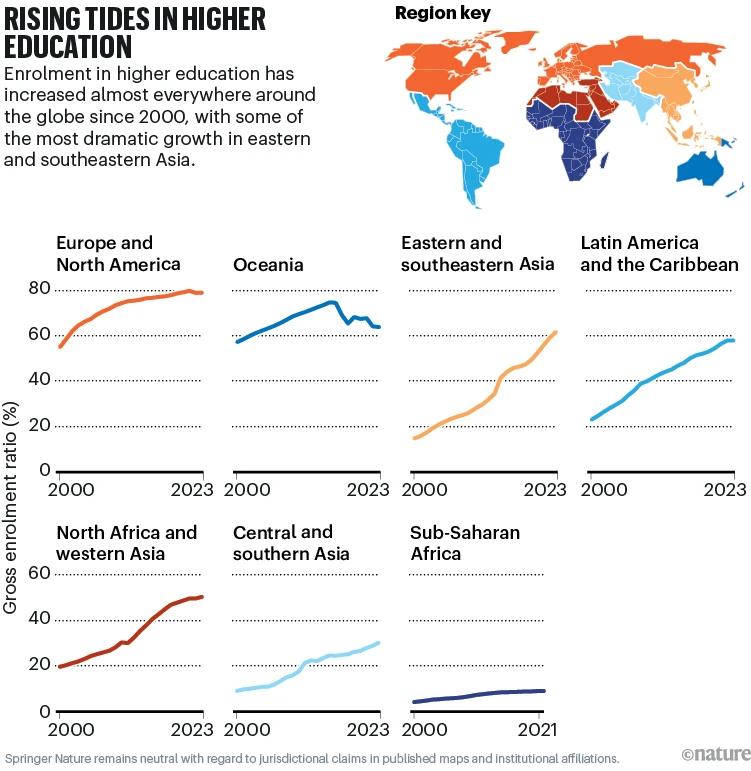
Group 1 - The core point of the article highlights a significant transformation in global higher education, with the number of university students reaching 264 million, making it equivalent to the world's fifth-largest population [1][2] - The article discusses the rapid increase in global university enrollment, which has more than doubled since 2000, and the number of international students has surged nearly threefold to approximately 7 million [2][18] - The article notes that the traditional flow of students studying abroad is changing, with wealthier Western countries no longer being the primary destinations for international students [4][20] Group 2 - The article emphasizes the growing trend of "internationalization" in higher education, where students can obtain foreign degrees without leaving their home countries, exemplified by overseas campuses [17][21] - It mentions that the Gross Enrollment Ratio (GER) in various regions has seen significant growth, with Europe and North America reaching 80% by 2024, while East Asia and Southeast Asia's GER increased from 15% to 62% from 2000 to 2023 [10][14] - The article raises concerns about the quality and value of education as access expands, leading to potential issues such as degree devaluation and increased job market competition [16][4] Group 3 - The article discusses the impact of geopolitical factors on international student mobility, with countries like the UK, Canada, and Australia tightening immigration policies, which may affect international student admissions [20][21] - It highlights the increasing popularity of private universities, particularly in regions like Southeast Asia and Africa, while also noting the challenges they face in terms of quality compared to public institutions [32][34] - The article concludes with a prediction that the trend of internationalization in higher education will continue, with an estimated 10 million "student immigrants" expected in the next decade [34]