
高等教育国际化

Search documents
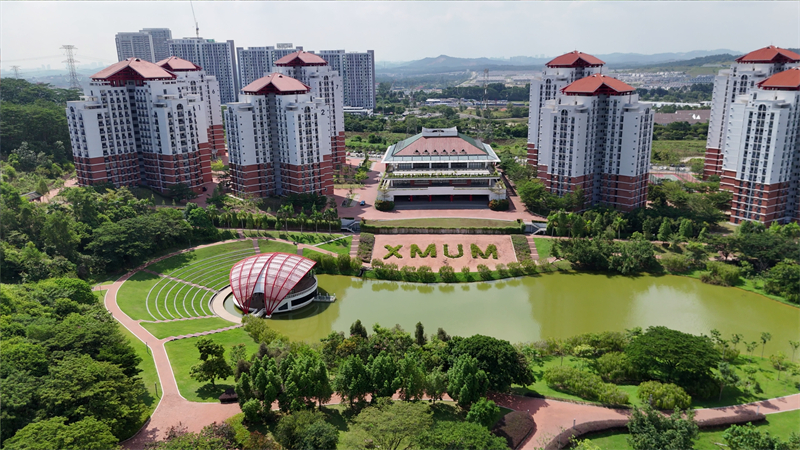
逐梦厦门大学马来西亚分校:跨国友谊在这自然生长
人民网-国际频道 原创稿· 2025-12-01 02:38
Core Insights - Xiamen University Malaysia Campus (XUMC) is the first overseas campus established by a Chinese "Double First-Class" university, marking a significant step in Sino-Malaysian educational cooperation and the internationalization of Chinese higher education [2][4][6] Group 1: Cultural Exchange - The campus fosters cross-cultural friendships through activities like basketball and local food, creating a vibrant community among students from diverse backgrounds [2][3] - Since its establishment in February 2016, XUMC has enrolled 7,741 graduates from 52 countries and regions, with student numbers expected to exceed 10,000 by 2025 [2][4] Group 2: Academic Integration - XUMC aligns its curriculum with international standards, encouraging students to explore and engage in a multicultural environment, enhancing cross-cultural understanding [3][6] - The university has established a comprehensive student support system, including international student affairs, bilingual counseling, and mentorship programs to aid integration [3][4] Group 3: Industry Collaboration - XUMC has deepened its integration of industry and academia, securing 45 research projects from Malaysian government departments and collaborating with leading companies in fields like green energy and nanomaterials, with over 25 million Malaysian Ringgit in funding [4][6] - The introduction of a new undergraduate program in Robotics and Automation Engineering aims to meet the demands of the AI wave and enhance the university's academic offerings [6][4] Group 4: Sustainable Educational Model - The campus has developed a replicable and sustainable overseas education model, contributing valuable experience to the internationalization of Chinese higher education and supporting the Belt and Road Initiative through cultural and educational exchanges [6][4]

印媒:英国高校扎堆在印度开分校,谁最受益?
Huan Qiu Shi Bao· 2025-10-30 22:44
Group 1 - The UK and India signed a historic Comprehensive Economic and Trade Agreement (CETA) during Prime Minister Starmer's visit, with higher education as a key focus area [1] - The UK plans to establish nine university campuses in India, including Southampton University, York University, and others, allowing Indian students to obtain UK degrees without leaving the country [1][2] - The UK government aims to generate an additional £50 million in revenue from the Indian higher education market, which is a significant part of its export industry, contributing £32 billion to the UK economy in 2022 [2] Group 2 - The Indian government initiated the National Education Policy (NEP2020) to improve education quality and internationalize higher education, raising concerns about how this will affect local public institutions [3] - The entry of international universities may squeeze the survival space of local public universities, which are already underfunded and overlooked by the government, leading to increased competition and higher tuition fees [3][4] - There are concerns that the commercialization of higher education will exclude lower caste individuals and marginalized groups, as the cost of attending these foreign institutions may be unaffordable for the majority [4]
美国拟减40%国际生,留学风向要变?Nature曝全球高校大洗牌
3 6 Ke· 2025-10-21 01:34
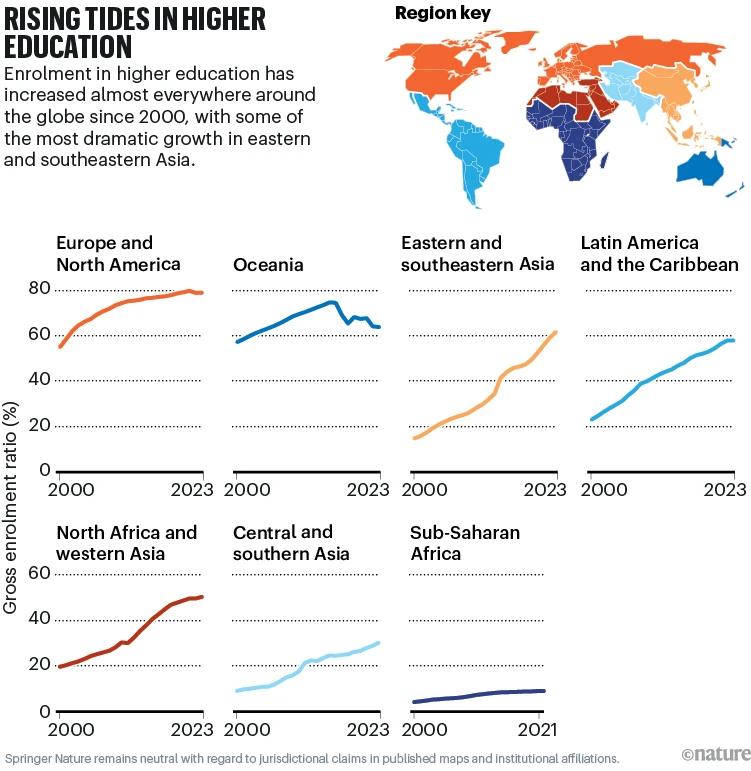
Group 1 - The core point of the article highlights a significant transformation in global higher education, with the number of university students reaching 264 million, making it equivalent to the world's fifth-largest population [1][2] - The article discusses the rapid increase in global university enrollment, which has more than doubled since 2000, and the number of international students has surged nearly threefold to approximately 7 million [2][18] - The article notes that the traditional flow of students studying abroad is changing, with wealthier Western countries no longer being the primary destinations for international students [4][20] Group 2 - The article emphasizes the growing trend of "internationalization" in higher education, where students can obtain foreign degrees without leaving their home countries, exemplified by overseas campuses [17][21] - It mentions that the Gross Enrollment Ratio (GER) in various regions has seen significant growth, with Europe and North America reaching 80% by 2024, while East Asia and Southeast Asia's GER increased from 15% to 62% from 2000 to 2023 [10][14] - The article raises concerns about the quality and value of education as access expands, leading to potential issues such as degree devaluation and increased job market competition [16][4] Group 3 - The article discusses the impact of geopolitical factors on international student mobility, with countries like the UK, Canada, and Australia tightening immigration policies, which may affect international student admissions [20][21] - It highlights the increasing popularity of private universities, particularly in regions like Southeast Asia and Africa, while also noting the challenges they face in terms of quality compared to public institutions [32][34] - The article concludes with a prediction that the trend of internationalization in higher education will continue, with an estimated 10 million "student immigrants" expected in the next decade [34]
韩媒:韩国想成为全球技能人才“首选地”
Huan Qiu Shi Bao· 2025-09-18 22:40
Core Viewpoint - The South Korean government is focusing on enhancing the global competitiveness of its universities and accelerating the internationalization of higher education to attract top international STEM talent as a national strategic priority [1] Group 1: Government Initiatives - The South Korean Ministry of Education aims to increase the number of foreign students to 300,000 by 2027 as part of the "Study in Korea 300,000" initiative [1] - The government plans to collaborate with other departments to position South Korea as one of the top ten study destinations globally [1] Group 2: Current Status and Challenges - According to Quacquarelli Symonds (QS), 43 South Korean universities are ranked in the 2026 World University Rankings, with two in the global top 50 [1] - The number of foreign students in South Korea surpassed 200,000 for the first time in 2024 [1] - South Korea's international research collaboration has only increased by 29% since 2022, lagging behind major East Asian competitors, with China's growth exceeding 100% in the same period [1] - 32% of South Korea's international research output is concentrated in the United States, China, and India, indicating a lack of diversification in its international research network [1] Group 3: Expert Opinions - Experts suggest that South Korean universities need to expand international enrollment, strengthen industry-academic cooperation, and establish multiple international education centers nationwide to improve their global standing [2]
高等教育国际化工作能力提升工作坊举办
Ren Min Ri Bao· 2025-08-19 21:11
Core Viewpoint - The workshop aimed to enhance the capabilities of higher education institutions in cultivating high-level, high-quality teachers with international competencies, thereby improving faculty development [1] Group 1: Workshop Overview - The workshop was organized by the Center for International Cultural Exchange of the Ministry of Education and held at the University of International Business and Economics [1] - Over 170 participants from educational administrative departments, various schools, and related organizations attended the discussions and exchanges [1] Group 2: Expert Contributions - Experts and scholars provided practical insights on the core issues of internationalization in higher education, sharing interdisciplinary content and discussing pathways for enhancing educational work [1] - During the roundtable discussions, participants were divided into two groups to explore themes such as "how to introduce quality teaching and research resources from foreign universities" and "how to disseminate mature talent cultivation models and excellent teaching outcomes overseas" [1] Group 3: Participant Feedback - Representatives from participating schools expressed that the workshop updated their concepts and methods, with international experts providing actionable suggestions for future planning [1]
加强跨文化交流合作,推动高等教育国际化
Xin Hua Ri Bao· 2025-07-17 20:20
Core Viewpoint - The internationalization of higher education is essential for fostering cross-cultural dialogue and collaboration, but it faces challenges such as communication barriers, unequal distribution of educational resources, and the tension between localization and globalization [1] Group 1: Enhancing International Exchange Mechanisms - Improving international exchange mechanisms is fundamental for promoting cross-cultural collaboration and the internationalization of higher education [2] - Establishing a "university-institution-national" three-tier cooperation system to enhance strategic partnerships and resource sharing [3] Group 2: Innovative Cooperation Models - Utilizing digital platforms and technologies to facilitate online cooperation and international collaboration in higher education [4] - Implementing mixed-mode exchange programs that combine short-term and long-term initiatives to deepen cross-cultural engagement [4] Group 3: Strengthening Cultural Education - Developing an immersive multicultural curriculum to enhance students' understanding of diverse cultures and values [5] - Creating a borderless campus culture that encourages interaction among students from different cultural backgrounds [6] Group 4: Cultivating Cross-Cultural Competence - Designing a systematic training framework for students to develop cross-cultural abilities at various educational stages [8] - Establishing a standardized assessment system to evaluate cross-cultural competencies among students [9] Group 5: Enhancing Teacher Cross-Cultural Competence - Implementing programs to improve teachers' international capabilities, enabling them to better guide students in cross-cultural interactions [10] - Establishing a cross-cultural teaching research fund to support educators in developing and sharing teaching resources [10] Group 6: Future Outlook - The journey of internationalizing higher education will continue, with a focus on cultivating talents capable of addressing global challenges and contributing to a shared future [11]
澳门教青局:鼓励澳门高校协助在美有转校需要的学生来澳升学
news flash· 2025-05-24 01:52
Core Viewpoint - The Macau government is closely monitoring the situation regarding the U.S. government's ban on Harvard University admitting international students, and is taking steps to support affected students [1] Group 1: Government Response - The Education and Youth Development Bureau of Macau has encouraged local universities to pay attention to the latest developments and provide transfer assistance to affected students [1] - The Bureau has already contacted Macau students currently enrolled at Harvard to offer consultation and support [1] Group 2: Strategic Initiatives - To enhance Macau's position as an international hub for high-end talent, the Bureau will continue to promote diverse admission pathways and support measures for local universities to attract outstanding students from various regions [1] - The Bureau aims to advance the internationalization of higher education in Macau through these initiatives [1]