Shor算法

Search documents
当量子计算遇上人工智能
Xin Lang Cai Jing· 2026-02-06 21:01
Core Insights - The emergence of the "CES Foundry" at the 2026 International Consumer Electronics Show highlights a new focus on AI agents capable of complex problem-solving and autonomous decision-making, powered by quantum computing [1] - Quantum computing is seen as the "nuclear power" for AI agents, facilitating a significant transition from passive to active AI capabilities [1] Quantum Computing and AI - Quantum computing is essential for AI agents to operate in dynamic and complex real-world scenarios, as classical computing cannot provide the necessary computational power [2] - Quantum bits (qubits) allow quantum computers to process vast amounts of data simultaneously, unlike classical bits which operate sequentially [3] Applications in Security and Data Processing - Quantum computing can significantly enhance cybersecurity by developing post-quantum cryptography defenses, countering threats posed by algorithms like Shor's that can undermine current internet security protocols [3] - In data processing, quantum computing enables AI agents to efficiently analyze vast datasets, leading to breakthroughs in various fields such as life sciences, finance, and logistics [4] Future Implications - The synergy between AI and quantum computing is expected to accelerate technological advancements, potentially leading to capabilities beyond current expectations [5]
为什么物理学界对量子计算的争议持续存在
Guan Cha Zhe Wang· 2026-01-16 06:01
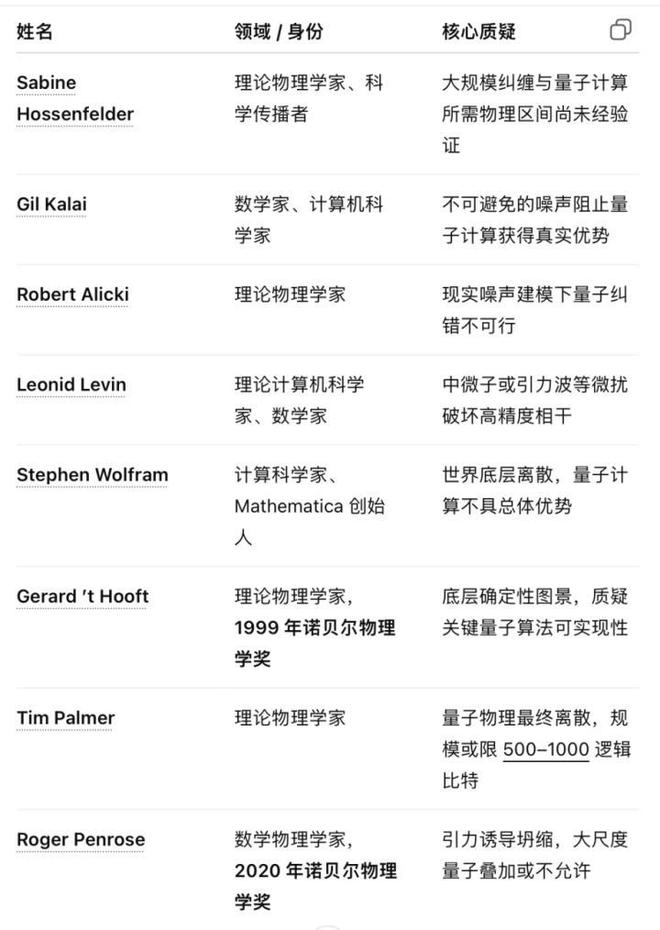
Core Viewpoint - The article discusses the skepticism surrounding quantum computing, emphasizing the need for rational criticism and reflection on its potential and limitations [1][2]. Group 1: Criticism from Experts - The skepticism towards quantum computing primarily comes from experts in physics, who question the qualifications of those discussing the topic [2]. - The video referenced in the article is not merely the personal opinion of the presenter but a synthesis of existing academic debates, presenting views from top scholars, including Nobel laureates [2][3]. - A table lists key critics and their main points, highlighting concerns about large-scale entanglement, noise interference, and the feasibility of quantum algorithms [3]. Group 2: Domestic Critiques - Chinese physicists express a consensus that current quantum computing efforts are primarily focused on quantum simulation rather than achieving the grand goals of universal quantum computing [5]. - The return to quantum simulation aligns with Richard Feynman's original vision from 1980, indicating a shift in expectations rather than a failure [5]. - Concerns are raised about whether the quantum systems required for ideal quantum computing can exist in the real physical world, emphasizing structural constraints rather than engineering challenges [6]. Group 3: Practical Standards - The article stresses that practical applications are the ultimate test for quantum computing, noting a significant gap between theoretical promises and actual achievements over the past 30 years [7]. - Historical milestones in quantum computing are outlined, showing limited success in implementing Shor's algorithm and the challenges faced in scaling up [8][9][10]. - The current quantum devices still fall short in terms of task execution, stability, and reliability compared to classical computers from decades ago, indicating a substantial gap that is not merely an engineering issue [10]. Group 4: Broader Implications - The discussion around quantum computing has shifted from theoretical debates to empirical validation, with concerns about potential "quantum winters" if substantial progress is not made in the next 5 to 10 years [11]. - Even if quantum computing ultimately fails, it could lead to significant scientific advancements by revealing gaps in our understanding of quantum mechanics [11]. - The article concludes that skepticism serves as a necessary counterbalance to overhyped narratives, urging a reevaluation of the foundational assumptions behind quantum computing's promises [12][13].