Smart glasses

Search documents
Prada layers winter jackets over light dresses at Milan show as Zuckerberg's presence fuels smart glasses talk
Reuters· 2026-02-26 18:29
Core Viewpoint - Prada's autumn/winter show in Milan showcased a variety of fashion items, including embroidered satin dresses, sheer skirts, and wool sweaters, indicating a strong seasonal collection that may attract consumer interest [1] Group 1: Fashion Show Highlights - The collection featured embroidered satin dresses, which suggest a focus on luxury and craftsmanship [1] - Sheer skirts were also part of the lineup, reflecting current trends in fashion that emphasize layering and transparency [1] - Wool sweaters were included, indicating a balance between elegance and practicality for the autumn/winter season [1] Group 2: Notable Attendees - Mark Zuckerberg's presence in the front row generated speculation about potential collaborations or endorsements, highlighting the intersection of fashion and technology [1]



Qualcomm CEO Cristiano Amon: Future Of AI Devices, AI Fashion, Blending Reality and Computing
Alex Kantrowitz· 2026-01-20 17:30
What does the AI device of the future look like. Let's ask the CEO building the chips that will power it. That's coming up with Cristiano Aman right after this.Welcome to Big Technology Podcast, a show for Coolheaded and Nuance conversation of the tech world and beyond. We are here at Davos at the Qualcomm space and we have a great show for you today. We're going to talk about the future of the AI device. We're going to talk about what an AI PC is and whether anybody's going to want it. We're going to talk ...

Meta delays Ray-Ban Display glasses global rollout due to inventory limits, U.S. demand
CNBC· 2026-01-06 14:40
Core Insights - Meta Platforms is delaying the international expansion of its Ray-Ban Display glasses due to inventory constraints and unprecedented demand in the U.S. [1] - The company has reported overwhelming interest since the product's launch, leading to waitlists extending well into 2026 [2] Inventory and Demand - The limited inventory has prompted Meta to pause plans for launching the smart glasses in the U.K., France, Italy, and Canada [2] - The focus will now be on fulfilling U.S. orders while reassessing international availability [2]


The Best Stocks to Buy With $5,000 Before 2026 (Hint: Not Palantir)
The Motley Fool· 2025-11-30 06:02
Core Insights - Meta Platforms and Circle Internet Group are identified as having strong long-term growth prospects, with Meta focusing on AI and smart glasses, while Circle is expanding its fintech services [1][3]. Meta Platforms - Meta reported a 26% increase in revenue to $51 billion for Q3, with GAAP net income rising 20% to $7.25 per diluted share, despite a stock drop due to increased AI spending [4][7]. - The company is the second-largest adtech firm, leveraging AI to enhance user engagement and advertising effectiveness on platforms like Instagram and Facebook [5]. - Meta holds a 73% market share in the smart glasses industry and aims to develop a superintelligence system for augmented reality devices, which CEO Mark Zuckerberg believes will become primary computing devices [6]. - The stock is considered a compelling buy, trading at 29 times earnings, with earnings expected to grow at 16% annually over the next three years [7]. Circle Internet Group - Circle is a fintech company known for its USDC stablecoin, which is the second-largest by market value and adheres to strict regulations in the U.S. and Europe [8][9]. - The company primarily generates revenue from interest on USDC tokens, which are backed 1:1 by U.S. dollars, and is expanding into payment processing with the Circle Payments Network (CPN) [9][10]. - Circle's Q3 revenue increased by 66% to $740 million, with adjusted EBITDA rising 78% to $166 million, driven by a doubling of USDC in circulation [10]. - The company has 29 financial institutions in the CPN and is testing its Arc blockchain, designed to address gas fee issues [11]. - Circle is positioned as a preferred stablecoin issuer due to its regulatory compliance focus, with stablecoin revenue projected to grow at 54% annually through 2030, trading at 7.5 times sales [12].



Himax(HIMX) - 2025 Q3 - Earnings Call Transcript
2025-11-06 14:00
Financial Performance - Third quarter revenue was $199.2 million, representing a sequential decline of 7.3%, which outperformed the guidance range of a 12.0%-7.0% decline, primarily driven by better-than-expected sales for automotive IC and T-CON product lines [4][5] - Gross margin was 13.2%, in line with guidance of around 13% [5] - Q3 profits per diluted ADS were $0.006, substantially exceeding the guidance range of a loss of $0.02-$0.04 [5][10] - Operating loss was $0.6 million, representing a negative operating margin of 0.3%, compared to 8.4% in the previous quarter [10] - Cash balance as of September 13, 2025, was $278.2 million, down from $332.8 million in the previous quarter [11] Business Line Performance - Revenue from large display driver ICs was $19.0 million, a decline of 23.6% from the previous quarter, accounting for 9.5% of total revenues [5][6] - Revenue from small and medium-sized display driver segments totaled $141.0 million, reflecting a slight decline of 2.4% [5][6] - Automotive driver sales increased single-digit quarter-over-quarter, indicating resilient underlying demand despite global softness in automotive sales [6][15] - Non-driver sales reached $39.2 million, a 13.7% decrease from the previous quarter [7][8] Market Data - The automotive display IC business accounted for over 50% of total revenues, with demand visibility remaining low as customers maintain lean inventory levels [15][25] - Himax holds a solid 40% market share in traditional DDIC and remains a key supplier for both legacy and next-generation automotive display applications [26][28] Company Strategy and Industry Competition - Himax is focusing on expanding into emerging areas beyond display ICs, including ultra-low-power AI, CPO, and smart glasses, which are expected to become new growth drivers [15][18] - The company maintains a leadership position in automotive display ICs, with a strong pipeline of design wins and ongoing innovation in display technologies [16][26] Management Comments on Operating Environment and Future Outlook - Management expressed optimism about the automotive business outlook for the next few years, backed by leading technology offerings and comprehensive customer coverage [15][16] - The automotive market is showing signs of bottoming out, but a strong recovery is not anticipated next year, with expectations of a mild recovery [50][51] - Management highlighted the importance of diversifying the supply chain in response to customer requests for geographical diversification [51] Other Important Information - Third quarter operating expenses increased by 34.2% from the previous quarter, primarily due to annual bonus compensation [8][9] - The company is actively engaged in R&D for new technologies, including WiseEye AI and CPO, with expectations for significant revenue contributions starting in 2027 [18][49] Q&A Session Summary Question: Why is the EPS guidance for Q4 conservative despite better revenue and gross margin guidance? - Management explained that the conservative EPS guidance is due to an income tax adjustment and higher R&D expenses scheduled for Q4 [42][43] Question: What is the timeline for meaningful revenue from the CPO business? - Management indicated that while they expect to be ready for volume production in 2026, significant revenue contributions are anticipated starting in 2027 [46][49] Question: What is the outlook for automotive market products in 2026? - Management believes the automotive market is showing signs of bottoming out but does not anticipate a strong recovery next year, budgeting for a mild recovery [50][51]

Ray-Ban maker EssilorLuxottica says Meta smart glasses are boosting growth
CNBC· 2025-10-16 19:42
Core Insights - EssilorLuxottica's revenue growth in Q3 was significantly driven by its partnership with Meta, particularly through the Ray-Ban brand smart glasses [1][2] - The company reported a year-over-year sales increase of 11.7%, reaching 6.9 billion euros (approximately $8 billion), with over 4 percentage points of this growth attributed to wearables, including Meta products [2] Company Developments - The partnership between Meta and Luxottica began in 2019 with the Ray-Ban Meta branded smart glasses, and has recently expanded to include Oakley and Prada brands [3] - Luxottica is actively promoting internet-connected glasses that integrate with Meta's AI-powered digital assistant, enabling functionalities similar to smartphones [4] Market Outlook - The CFO of EssilorLuxottica expressed optimism about the wearables business, stating that glasses will replace many smartphone functions and are already profitable [5] - The company anticipates reaching its target of 10 million units sold earlier than the original deadline of 2026, primarily due to the success of Ray-Ban Meta glasses [6] Industry Trends - The wearables ecosystem is expected to generate revenue not only from hardware sales but also from lenses and AI-related services over time [7] - Other tech giants, including Alphabet and Alibaba, are also entering the smart glasses market, indicating a growing competitive landscape [8]

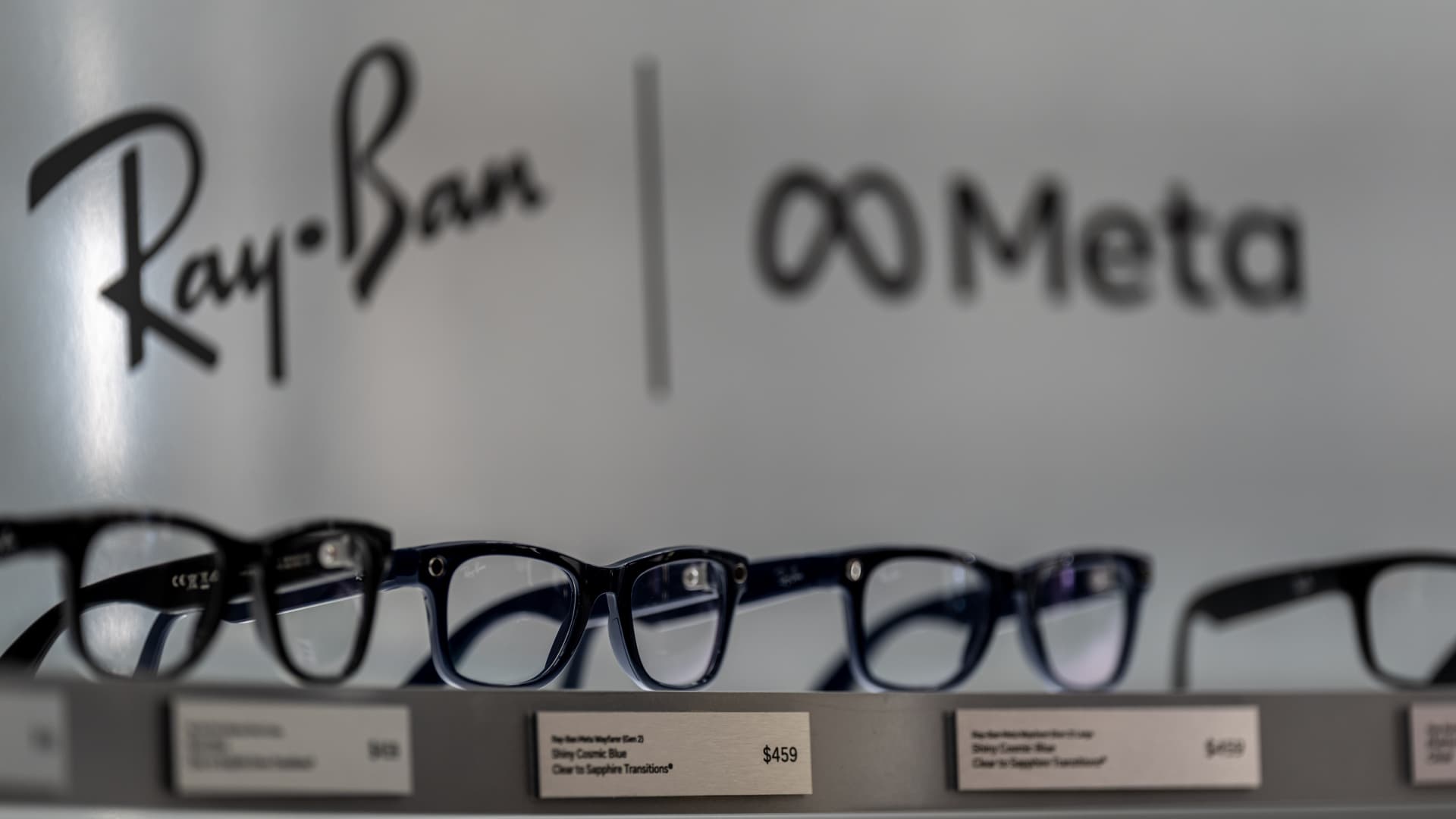
Apple reportedly shelves headset plan in favor of smart glasses to compete with Meta
Youtube· 2025-10-02 15:18
Core Perspective - Apple is reportedly shifting focus from updating the Vision Pro headset to developing smart glasses to compete with Meta's products [1][2][3] Group 1: Product Strategy - Apple is prioritizing the development of smart glasses that may include features like Siri and a camera, rather than a new version of the Vision Pro headset [2][4] - The Vision Pro has not achieved the expected market success and has not significantly impacted the computing paradigm as initially anticipated [3][4] Group 2: Market Context - The smart glasses market remains niche, with Meta selling only 2 million pairs of Ray-Ban glasses from 2023 to early 2025, compared to Apple's annual iPhone sales of approximately 225 million units [5] - Despite the niche status, the smart glasses category is experiencing rapid growth [5]


Mark Zuckerberg unveils $799 Meta Ray-Ban Display glasses
CNBC· 2025-09-18 00:28
Product Launches - Meta unveiled the $799 Meta Ray-Ban Display glasses, the first consumer-ready smart glasses with a built-in display [1][2] - The Oakley Meta Vanguard smart glasses, designed for high-intensity sports, will launch at $499 on October 21, 2023 [5] - The Ray-Ban Meta (Gen 2) is priced at $379, an increase from $299 for the previous version, and features improved battery life and camera capabilities [8] Technology Features - The Meta Ray-Ban Display glasses include a small digital display controlled by hand gestures via a wristband powered by neural technology [2] - The Oakley Meta Vanguard glasses offer up to nine hours of battery life, can capture 3K video, and feature enhanced speakers [7] - The Ray-Ban Meta (Gen 2) has double the battery life of its predecessor, lasting 8 hours, and includes a more powerful camera for 3K Ultra HD video [8] Partnerships and Development - Meta has been collaborating with eyewear giant EssilorLuxottica since 2019 to develop its smart glasses and renewed a long-term partnership agreement last year [4] - The new smart glasses serve as a bridge between the audio-only Ray-Ban Meta smart glasses and the experimental Orion augmented reality glasses [3]

Meta to unveil $800 smart glasses at Connect event - report
Seeking Alpha· 2025-09-16 12:31
Group 1 - Meta Platforms is set to launch new smart glasses with a built-in display at its annual Connect event [3] - The retail price for the new glasses, codenamed "Hypernova," is expected to be $800 [3]
Meta Connect 2025: AI-powered smart glasses take center stage
CNBC· 2025-09-16 11:00
Core Insights - Meta is shifting its focus from virtual reality (VR) to smart glasses, with significant investments in the development of consumer hardware products [4][5][6] - The company is set to unveil its advanced smart glasses, codenamed Hypernova, which will feature a small display and be controlled via hand gestures [2][3] - Investors are closely monitoring Meta's spending in its Reality Labs division, which has incurred substantial losses but is expected to yield potential returns in the future [4][5] Group 1: Product Development - Meta's upcoming smart glasses, Hypernova, will be priced at $800 and represent the first consumer product with a display [3][7] - The glasses are developed in partnership with EssilorLuxottica, building on previous models like the Ray-Ban Meta smart glasses [3] - Hypernova aims to bridge the gap between existing smart glasses and more experimental augmented reality devices [7] Group 2: Financial Performance - Meta's Reality Labs division reported an operating loss of $4.53 billion in Q2, contributing to nearly $70 billion in total losses since late 2020 [4] - Despite the losses, analysts believe that smart glasses may offer a more viable investment opportunity compared to VR headsets, which remain niche products [5][6] - Investors are looking for signs of progress in Meta's hardware development to justify ongoing expenditures [5]