Sound

Search documents
SPLICED FRAGMENTS: HOW I FOUND HEALING IN STORYTELLING AND FILMMAKING | Tran Quang Ham | TEDxBUV
TEDx Talks· 2026-02-02 17:52
Thank you so much. This is my first TED talk, so I'm really nervous. [applause] [laughter] Uh because if I were to speak, I would be so nervous.I can't say anything. Anyways, so to get this thing started, um I think it's really interesting that the the theme is mono poly one and many. And I think that if you look at all of my films, you know, they can come there so many different kind of genres, but it all has one theme in common and that's healing and that's the secret I wanted to share with you guys today ...

Rhythm Moves The World | Swapathyatri . | TEDxYouth@AUS
TEDx Talks· 2025-11-25 16:50
Ho ho ho. Ho. Yahoo.Hoyo. Ho. Yahoo.Ho. Yahoo. Ho.Yahoo. When was the last time you made such kind of sounds which is not making any sense to anyone, not to even you. And when was the last time you are playing whistle. When was the last time. When was the last time you were clapping for no reason.And when was the last time you are playing with your laps like sam randomly on bur stand or railway stand like when was the last time. You were singing a song of a language that you don't understand, you don't know ...
The only Question to Answer | Gaurav Chintamani | TEDxAshokaUniversity
TEDx Talks· 2025-07-31 15:22
Core Idea - The speaker reflects on the challenges of maintaining authenticity and finding personal meaning in music and sound creation, amidst external pressures and internal conflicts [1][2][3][4] - The speaker emphasizes the importance of focusing on personal feelings and experiences as the foundation for creating genuine and impactful music [3][4] - The speaker advocates for continuous self-questioning and embracing discomfort to break through emotional barriers and achieve artistic expression [4] Musical Journey & Evolution - The speaker recounts early musical experiences in Agartala, India, and the pivotal moment of discovering a profound connection to sound [1] - The speaker describes the transition from playing popular music to pursuing original compositions, despite initial challenges and lack of recognition [1] - The speaker details the experience of studying sound engineering in Chennai and realizing the subjective nature of musical perception [1] - The speaker discusses the competitive nature of the music industry and the struggle to maintain artistic integrity amidst client expectations and peer comparisons [1] Artistic Philosophy & Creative Process - The speaker highlights the significance of an "Agartala moment" – a personal and transformative experience with sound that shapes one's artistic path [1] - The speaker shares an anecdote about his son's art, illustrating the power of naming and defining one's creative vision [3] - The speaker asserts that there are no inherently "bad" sounds or songs, only inappropriate ways of presenting them [4]
Keeping sound in mind | Jacilyn Ledford | TEDxSavannah
TEDx Talks· 2025-07-25 15:10
[Applause] What sound is always playing but only you can hear it. For each of us, this is the voice within our own inner dialogue. As humans, we move throughout our days with this internal conversation that stays rambling.Sometimes it's quiet. Other times it is maddening for as loud as it gets. Science tells us these internal conversations are a part of our brain waves which we have simplified to call the thinking mind.These are the rhythms of our thoughts as we navigate the world around us. For me, a human ...
Comunicare è dare voce all'anima | Malika Ayane | TEDxCagliari
TEDx Talks· 2025-07-09 16:33
Technology & Communication - The industry observes the development of real-time translation earpieces for smartphones, questioning their impact on understanding nuances and intentions in communication [1][2] - The industry acknowledges that language, while valuable, can be used to mislead or harm, highlighting the complexities of communication [3][4] - The industry notes that while technology facilitates language exchange, it may inadvertently lead to separation by hindering the assimilation of different cultures [6] Linguistics & Semiotics - The industry emphasizes the importance of sound as a richer and more universally understood form of communication than language alone, appealing to emotions and senses [6][7] - The industry suggests exploring the translation of emotional and linguistic expressions into sounds to enhance understanding [8] - The industry recognizes that songs, through the combination of words and sound, can evoke deep emotions and memories that language alone cannot fully capture [8][9]
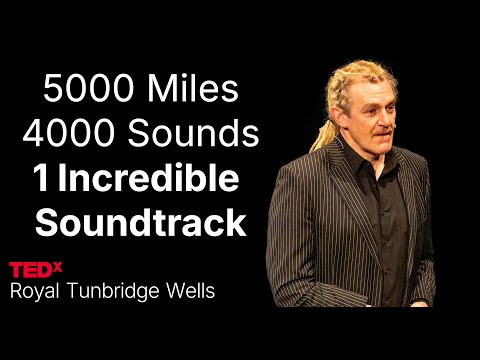
The sounds I recorded on a 5000 mile bike trip | Paul Cheese | TEDxRoyal Tunbridge Wells
TEDx Talks· 2025-07-06 17:00
Project Overview - The project involved cycling over 5,000 miles across the UK to collect over 11,000 sounds [1] - The goal was to create a piece of music using only the collected everyday sounds [1] Sound Analysis & Categorization - Sounds were categorized by nearest note and tempo [1] - Common tempos were identified, such as 98 beats per minute [1] - Examples of sounds at 98 bpm include a motorbike idling, a fireman retracting a ladder, and a section of a Blackbird call [1] Musical Composition - Everyday sounds were used to create various musical elements, such as bass drums, high hat symbols, and snare drums [2] - Electric substations were found to produce the note of G, used for bass lines [5] - Melodies and chords were created by combining different notes and tones collected from various locations [8] Community Engagement - The project involved interactions with local people, who often provided assistance and suggestions for sound sources [2][3] - The kindness and involvement of people were a significant aspect of the journey [2] Key Findings - Common sounds and tempos exist across nature, industry, people, and places [1] - Everyday sounds can be transformed into musical elements [1][2]
How to listen like a fish | Dr. Heather Spence | TEDxGeorgeMasonU
TEDx Talks· 2025-06-20 17:00
Core Argument - The presentation advocates for heightened awareness of the surrounding soundscape, emphasizing its informative, emotional, and participatory nature [1][4][21] - It suggests that tuning into sounds broadens perspective and provides key information for control and understanding of one's environment [18][19] - The presentation proposes practical exercises, drawing from neuroscience, ecology, and music, to improve sound awareness and interaction [14][15][16][17] Sensory Perception & Environment - Humans often limit themselves by not paying attention to the world of sound, contrasting the limited visual field with the expansive auditory field [6] - Sound conveys information about danger, time, cues, and food, and the ability to recognize and interpret sounds can be practiced [9][10] - Sounds evoke emotions and personal associations, influencing behavior and reactions, even subconsciously [11][12][13] Practical Application - The presentation encourages incorporating sound awareness into daily routines, such as in elevators or during walks, to discover surprising sounds [19][20] - It suggests interacting with annoying noises through humming, clapping, or tapping to better understand and harmonize with them [20] - The presentation promotes "soundscape tourism," encouraging the recording of sounds in new environments to create sound memories [21] Impact & Control - By tuning into the world of sound, individuals can thoughtfully curate their personal space, emphasizing healthy and happy sounds while masking or harmonizing negative ones [22] - Increased sound awareness allows individuals to anticipate bodily reactions and be mindful of the sonic impact on others [23] - The presentation concludes that tuning into the world of sound empowers individuals to shape it, emphasizing the constant presence of sounds and the choice to engage with them [23]