Vision-Language-Action(VLA)

Search documents
在看完近50篇VLA+RL工作之后......
具身智能之心· 2025-12-13 16:02
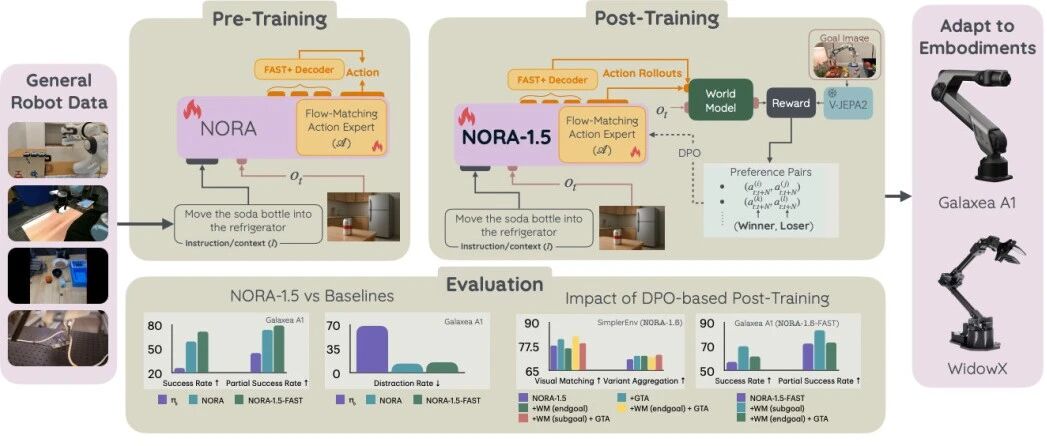
Core Insights - The article discusses advancements in Vision-Language-Action (VLA) models and their integration with reinforcement learning (RL) techniques, highlighting various research papers and projects that contribute to this field [2][4][5]. Group 1: Offline RL-VLA - NORA-1.5 is introduced as a vision-language-action model trained using world model- and action-based preference rewards, showcasing its potential in offline reinforcement learning [2][4]. - The paper "Balancing Signal and Variance: Adaptive Offline RL Post-Training for VLA Flow Models" emphasizes the importance of balancing signal and variance in offline RL applications [7]. - CO-RFT presents an efficient fine-tuning method for VLA models through chunked offline reinforcement learning, indicating a trend towards optimizing model performance post-training [9]. Group 2: Online RL-VLA - The concept of reinforcing action policies by prophesying is explored, suggesting a novel approach to enhance online reinforcement learning for VLA models [22]. - WMPO focuses on world model-based policy optimization for VLA models, indicating a shift towards utilizing world models for better policy learning [24]. - RobustVLA emphasizes robustness-aware reinforcement post-training, highlighting the need for models to maintain performance under varying conditions [27]. Group 3: Hybrid Approaches - GR-RL aims to improve dexterity and precision in long-horizon robotic manipulation by combining offline and online reinforcement learning strategies [100]. - The paper "Discover, Learn, and Reinforce" discusses scaling VLA pretraining with diverse RL-generated trajectories, indicating a comprehensive approach to model training [104]. - SRPO introduces self-referential policy optimization for VLA models, showcasing innovative methods to enhance model adaptability and performance [106].

具身智能机器人:2025商业元年底色兑现,2026量产元年基色明晰
Ge Long Hui· 2025-11-28 02:07
Core Insights - The commercialization of embodied intelligence is expected to reach a critical milestone in 2025, with significant orders already secured by leading manufacturers, although challenges remain in scaling applications across various industries [1][2] Group 1: Industry Progress and Developments - Several leading manufacturers have secured orders exceeding 1 billion yuan, with applications primarily in research, education, cultural entertainment, and data collection sectors. As of November 2025, companies like UBTECH and Zhiyuan Robotics have received over 800 million yuan and 520 million yuan in orders, respectively [1] - The supply chain is becoming clearer as manufacturers approach mass production, with Chinese suppliers actively establishing production capabilities in overseas hubs like Thailand to support Tesla's 2026 production plans [2] - Chinese tech giants are diversifying their investments in the embodied intelligence sector, with companies like Huawei focusing on foundational infrastructure such as chips and computing power, while others like Meituan and JD.com are integrating Physical AI into their existing business models [2] Group 2: Future Directions and Market Outlook - The industry is expected to continue its long-term progress despite short-term fluctuations, with Tesla planning to release the Optimus V3 in Q1 2026, aiming for a target of 1 million units sold [3] - The Hong Kong stock market is becoming a hub for new players in the embodied intelligence sector, with companies like UBTECH and Yuejiang successfully listing, which is anticipated to stimulate further capital expansion [3] - The fundamental breakthroughs in embodied intelligence models will depend on the scale effects of data and computing power, with a focus on enhancing model performance through larger datasets [4]


VLA/VLA+触觉/VLA+RL/具身世界模型等!国内首个具身大脑+小脑算法实战教程
具身智能之心· 2025-08-14 06:00
Core Viewpoint - The exploration of Artificial General Intelligence (AGI) is increasingly focusing on embodied intelligence, which emphasizes the interaction and adaptation of intelligent agents within physical environments, enabling them to perceive, understand tasks, execute actions, and learn from feedback [1]. Industry Analysis - In the past two years, numerous star teams in the field of embodied intelligence have emerged, establishing valuable companies such as Xinghaitu, Galaxy General, and Zhujidongli, which are advancing the technology of embodied intelligence [3]. - Major domestic companies like Huawei, JD.com, Tencent, Ant Group, and Xiaomi are actively investing and collaborating to build a robust ecosystem for embodied intelligence, while international players like Tesla and investment firms are supporting companies like Wayve and Apptronik in the development of autonomous driving and warehouse robots [5]. Technological Evolution - The development of embodied intelligence has progressed through several stages: - The first stage focused on grasp pose detection, which struggled with complex tasks due to a lack of context modeling [6]. - The second stage involved behavior cloning, allowing robots to learn from expert demonstrations but revealing weaknesses in generalization and performance in multi-target scenarios [6]. - The third stage introduced Diffusion Policy methods, enhancing stability and generalization by modeling action sequences, followed by the emergence of Vision-Language-Action (VLA) models that integrate visual perception, language understanding, and action generation [7][8]. - The fourth stage, starting in 2025, aims to integrate VLA models with reinforcement learning, world models, and tactile sensing to overcome current limitations [8]. Product and Market Development - The evolution of embodied intelligence technologies has led to the emergence of various products, including humanoid robots, robotic arms, and quadrupedal robots, serving industries such as manufacturing, home services, dining, and medical rehabilitation [9]. - The demand for engineering and system capabilities is increasing as the industry shifts from research to deployment, necessitating skills in platforms like Mujoco, IsaacGym, and Pybullet for strategy training and simulation testing [24].