Farming

Search documents
中国农业:粮食安全-向宏伟目标迈进的卓越进展-China Agriculture_ China's food security - remarkable progress towards an ambitious goal
2025-12-10 02:49
Summary of Key Points from the Conference Call on China's Food Security Industry Overview - The focus is on China's agricultural sector, specifically addressing food security and self-sufficiency amidst challenges such as limited arable land, rising protein consumption, and climate change impacts [3][15][16]. Core Insights and Arguments 1. **Progress in Food Security**: China has made significant strides in reducing import dependence, with the arable land gap decreasing from an estimated 90 million hectares to 84 million hectares, with a target of narrowing it to 5 million hectares by 2035 [4][16]. 2. **Investment Opportunities**: Eight investment themes have been identified, including seeds, advanced feed additives, fertilizers, agricultural machinery, and precision farming technologies, with 24 companies highlighted for their exposure to these sectors [4][53][61]. 3. **Self-Sufficiency Goals**: The Chinese government aims for 95% self-sufficiency in staple foods by 2035, with current projections indicating a decline from 94% in 2000 to 61% in 2024, potentially improving to 80-95% by 2035 depending on technological advancements and regulatory support [10][37][41]. 4. **Technological Integration**: The integration of biotech, big data, AI, and precision technology is transforming agricultural practices, enhancing crop yields, and improving protein conversion efficiency [17][45]. 5. **Soybean Demand Management**: Efforts to manage soybean demand have led to a reduction in consumption by 15 million tons from 2021 to 2024, which is crucial for mitigating trade risks [38][43]. Additional Important Content 1. **Government Policies**: Numerous policies have been enacted to support food security, including initiatives for seed self-reliance, land quality improvement, and precision farming [23][25]. 2. **Rural Workforce Challenges**: The rural working-age population in China has halved over the past two decades, which poses a significant challenge to agricultural productivity [29]. 3. **Climate Resilience**: The need for a more resilient food supply system is emphasized, with projections indicating that an additional 8-9% food supply will be necessary to counteract yield losses due to climate change [40]. 4. **Public Sector Investment**: China's public sector spending on agricultural R&D has reached $6.6 billion annually, significantly higher than two decades ago, indicating a strong commitment to improving agricultural efficiency [50][51]. Conclusion - The conference call highlighted China's ambitious goals for food security and self-sufficiency, the progress made in reducing import dependence, and the investment opportunities arising from technological advancements in agriculture. The challenges posed by a shrinking rural workforce and climate change were also acknowledged, underscoring the need for continued innovation and policy support in the agricultural sector [4][15][37].
Trump Unveils $12 Billion in Aid for American Farmers
Bloomberg Television· 2025-12-09 18:36
I'm delighted to announce this afternoon that the United States will be taking a small portion of the hundreds of billions of dollars we receive in tariffs. We're taking a relatively small portion of that and we're going to be giving and providing it to the farmers in economic assistance. So, we're going to use that money to provide $12 billion in economic assistance to American farmers.This relief will provide much needed certainty to farmers as they get this year's harvest to market and look ahead to next ...

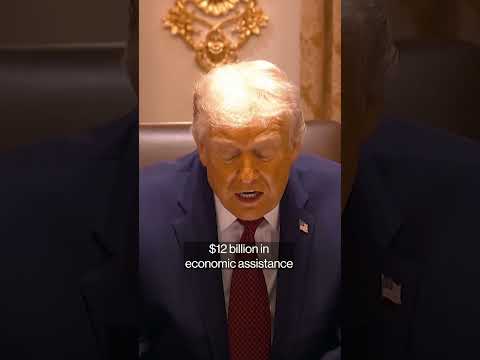
Trump’s $12 billion farmer bailout is a ‘Band-Aid on a bigger wound’ the American agriculture industry is still reeling from
Yahoo Finance· 2025-12-09 17:51
Core Viewpoint - The U.S. agriculture industry is receiving a $12 billion aid package from the Trump administration to alleviate the financial strain caused by tariffs, but concerns remain about the long-term viability and stability of the sector amidst ongoing trade tensions and market volatility [2][3]. Group 1: Aid Program Details - The announced aid program will provide $11 billion to major row-crop producers, including those growing corn, soybeans, and rice, while $1 billion is allocated for specialty-crop growers like sugar [4]. - Farmers are expected to start receiving funds by the end of February [2]. Group 2: Industry Concerns - Despite the aid, farmers and agricultural economists express skepticism, viewing the financial assistance as a temporary fix rather than a solution to deeper systemic issues within the agriculture industry [3][4]. - The aid is seen as insufficient to address the significant challenges faced by farmers, particularly in light of rising input costs and declining export opportunities due to tariffs [6][7]. Group 3: Market Conditions - The introduction of tariffs, particularly on China, has led to increased input costs for farmers while simultaneously reducing export demand and crop prices [6]. - Farmers are seeking stable markets and trade relations rather than relying on government aid packages to navigate their financial difficulties [4][5].
X @Bloomberg
Bloomberg· 2025-12-09 09:51
Greece’s farmers have been protesting delays to payments of European Union agricultural subsidies at a time when production costs are rising https://t.co/zcklJXtR0w ...
Trump's $12 Billion Aid For Farmers An 'Admission' That President's Policies Have Hurt Americans, Says This Economist - Invesco Agriculture Commodity Strategy No K-1 ETF (NASDAQ:PDBA), Teucrium Soybea
Benzinga· 2025-12-09 04:06
Core Insights - The $12 billion financial aid package for U.S. farmers is criticized by economists, analysts, and some farmers, indicating dissatisfaction with the administration's trade and tariff policies [1][5][7] Group 1: Impact of Trade Policies - U.S. farmers, a key part of Trump's political base, have suffered due to trade wars, with commodities like soybeans losing export demand as China shifted purchases [2][3] - Although China resumed buying U.S. soybeans, the recovery to pre-trade-war levels is expected to be gradual, with ongoing geopolitical and weather-related challenges affecting the farm sector [3] Group 2: Economic Perspectives - Economist Justin Wolfers argues that the bailout package acknowledges the negative impact of tariffs on Americans, questioning why consumers are not also compensated for increased costs due to tariffs [5] - Republican Senator Rand Paul criticizes the bailouts as an admission that tariffs are harmful to the agricultural economy, reinforcing the view that tariffs are detrimental [7] Group 3: Farmer Sentiment - An American soybean farmer expressed a desire for market stability rather than bailouts, suggesting that funds should be redirected to social programs, and criticized the administration for damaging market conditions [6]
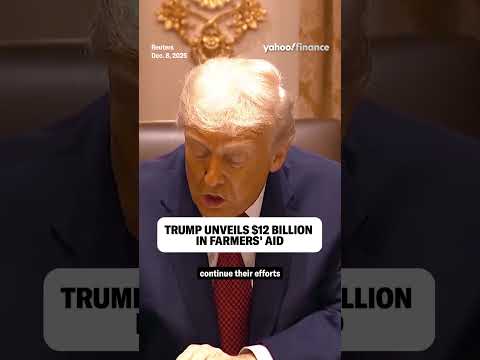
Trump unveils $12 billion in farmers' aid. 💰 🚜 🌾
Yahoo Finance· 2025-12-08 21:54
I'm delighted to announce this afternoon that the United States will be taking a small portion of the hundreds of billions of dollars we receive in tariffs. So, what we're doing is we're taking relatively small portion of that and we're going to be giving and providing it to the farmers in economic assistance. And we love our farmers and they're great people. They're the backbone of our country.So, we're going to use that money to provide 12 billion in economic assistance to American farmers. 12 billion is ...
'Far cry from what we need': Farmer reacts to Trump's $12B aid package
MSNBC· 2025-12-08 20:43
Happening right now at the White House, President Trump is hosting a roundt discussion with farmers. He announced a new 12 billion aid package to help farmers who are struggling because of his trade war with China. Joining us, Arkansas soybean farmer Scott Brown.Scott, really good to have you. Thanks for being here. >> Thanks for having me, Katie.>> 12 billion. How's that sound to you. >> Well, I appreciate the help, but um it's it's it's a far cry from what we need.Just the loss in corn this year with a re ...
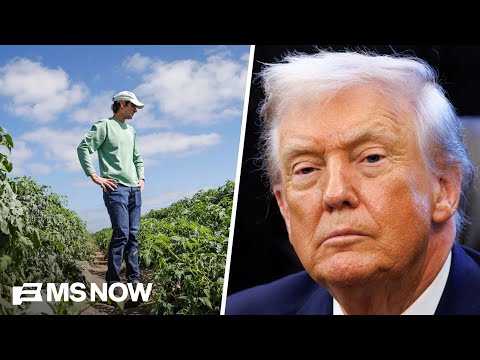
Trump Planning $12 Billion Aid Package For Farmers—Here's What We Know
Forbes· 2025-12-08 18:25
Core Viewpoint - President Trump is set to announce a $12 billion aid package aimed at providing financial assistance to farmers affected by the administration's tariff policies, particularly those producing row crops like soybeans [1][4]. Group 1: Aid Package Details - Up to $11 billion of the aid will be allocated for a Farmer Bridge Assistance program specifically for farmers of row crops, including corn, wheat, and soybeans [1][2]. - The remaining $1 billion will be designated for farmers of other crops, such as fruits, vegetables, and specialty crops [2]. - The funding will be authorized under the Commodity Credit Corporation Charter Act, allowing the administration to utilize tariff revenue without needing congressional approval [2]. Group 2: Background Context - Soybean farmers have been significantly impacted by Trump's tariff policies, particularly after China ceased U.S. soybean purchases amid a trade dispute [4]. - China was previously the largest buyer of American soybeans, purchasing approximately half of the U.S.'s $24.5 billion soybean crop in 2024 [4]. - Although China resumed importing American soybeans in October, the actual purchases have not met the expected volume, with a reported target of 12 million tons by year-end remaining unfulfilled as of late November [4].
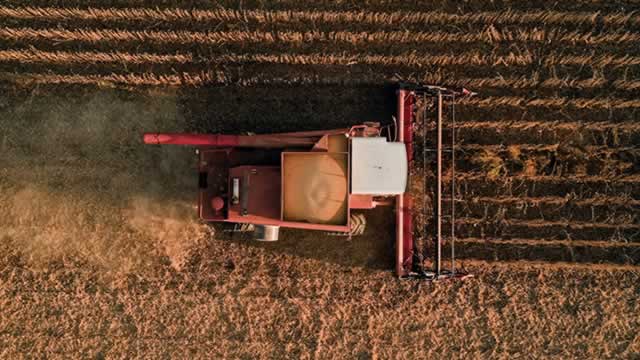
Trump to announce $12 billion aid package for farmers caught up in trade war
CNBC· 2025-12-08 17:47
Core Insights - The U.S. government is providing a $12 billion aid package to farmers affected by the trade war with China, with a significant portion allocated to support agricultural businesses [1][2]. Group 1: Aid Package Details - Up to $11 billion of the aid will be directed to the U.S. Agriculture Department's Farmer Bridge Assistance program, offering one-time payments to row crop farmers [2]. - The remaining $1 billion will be held by the USDA for evaluation of changing market conditions [2]. Group 2: Impact of Trade War - The agricultural industry is facing challenges due to the trade war, particularly from the halt of U.S. soybean purchases by China during critical harvest periods [4]. - Although China resumed some soybean purchases in late October, imports have not returned to previous levels, and stockpiles have reached recent highs [5]. Group 3: Future Projections - The U.S. administration maintains that China is expected to meet its projected purchase of 12 million metric tons of U.S. soybeans by the end of February, with a commitment to buy at least 25 million tons annually over the next three years [6].