Artificial Intelligence

Search documents
港股异动 | “图模融合第一股”海致科技(02706)上市次日涨超30% 产业级AI智能体赛道增长潜力巨大
智通财经网· 2026-02-16 01:49
Company Overview - Haizhi Technology (02706) experienced a significant stock price increase of over 30% on its second day of trading, reaching a high of 123.3 HKD, which is more than 3.5 times its IPO price of 27.06 HKD [1] - As of the latest report, the stock is up 30.67%, trading at 121 HKD with a transaction volume of 1.23 million HKD [1] Product and Technology - Haizhi Technology is a leading provider of industrial-grade artificial intelligence solutions in China, focusing on graph-model integration technology [1] - The company has developed two core product matrices: the Atlas Graph Solution and the Atlas Intelligent Agent [1] - The Atlas Graph Solution includes the DMC Data Intelligence Platform, Atlas Knowledge Graph Platform, and AtlasGraph Database, enabling multi-source data integration, knowledge graph construction, and complex relationship analysis [1] - The Atlas Intelligent Agent combines large language model reasoning capabilities with the accuracy of knowledge graphs, empowering enterprises with intelligent automation and scenario-based reasoning [1] Market Growth and Potential - The industrial-grade AI solution market in China is in a rapid expansion phase, with a projected compound annual growth rate (CAGR) of 44.6% from 2025 to 2029, increasing from 65.4 billion CNY to 286.1 billion CNY [2] - The segment of integrated knowledge graph industrial-grade AI agents is expected to see even higher demand, with a CAGR of 140.0% from 2024 to 2029, growing from 200 million CNY to 13.2 billion CNY [2] - Haizhi Technology is positioned in a high-growth segment with significant barriers to entry in the graph-model integration technology field, indicating strong long-term development support [2]
全球用户涌入中国AI视频生成模型 AI“技术平权”加速: 1人剧组时代或将来临
Xin Lang Cai Jing· 2026-02-16 01:30
Group 1 - The core viewpoint of the article highlights the rapid adoption of ByteDance's new video generation model Seedance 2.0, which is revolutionizing video creation by allowing users to generate videos from simple text, images, or video materials [1] - Seedance 2.0 has gained popularity for its realistic visual effects and ease of use, attracting many users, including international ones who are eager to learn how to utilize the technology [1] - The model incorporates a significant amount of Eastern aesthetic materials during its training phase and demonstrates strong capabilities in controlling camera language and complex interactions [1] Group 2 - Industry experts believe that the advancements in AI video generation technology are accelerating "technological equality," enabling individuals to potentially create a 90-minute film in a single day [1] - The upgrade of AI video generation models is expected to further drive the growth of niche markets such as AI comic dramas, short dramas, and interactive films, with the comic drama market anticipated to experience rapid expansion [1] - The trend of "one-person companies" or "one-person crews" is expected to become increasingly popular as a result of these technological advancements [1]
突发,OpenClaw之父宣布加入OpenAI,小扎抢人失败
3 6 Ke· 2026-02-16 01:26
就在刚刚,OpenClaw 开发者 Peter Steinberger 在 X 平台官宣加入 OpenAI。 他还发了一篇长文解释自己的选择。 用他自己的话说:「我将加入 OpenAI,致力于把智能体带给每一个人。OpenClaw 将转为基金会形式运作,并保持开源和独立。」 这个结局,某种程度上也算是意料之中。 此前就有消息称,OpenAI 不仅想把 Peter 本人挖过来,连带着维护这款开源 Agent(智能体)项目的几位核心成员也要一锅端。 谈判的条件相当诱人——让他们在 OpenAI 负责个人智能体相关工作,顺便参与其他产品开发,甚至还在讨论成立一个基金会专门运营 OpenClaw 开源项 目。 不过在最终拍板之前,除了 OpenAI,Meta 同样在疯狂发力。毕竟现在 AI 人才争夺战打得火热,而个人智能体又被各家列为重点方向,谁都不想落后。 上周 Peter Steinberger 就在 Lex Fridman 的播客时爆料,现在每个月自掏腰包 1 万到 2 万美元维持 OpenClaw 运营,同时正在跟好几家大型 AI 实验室谈合 作。 这场争夺战到底有多激烈呢?当时 Peter 还在播客里还透露 ...

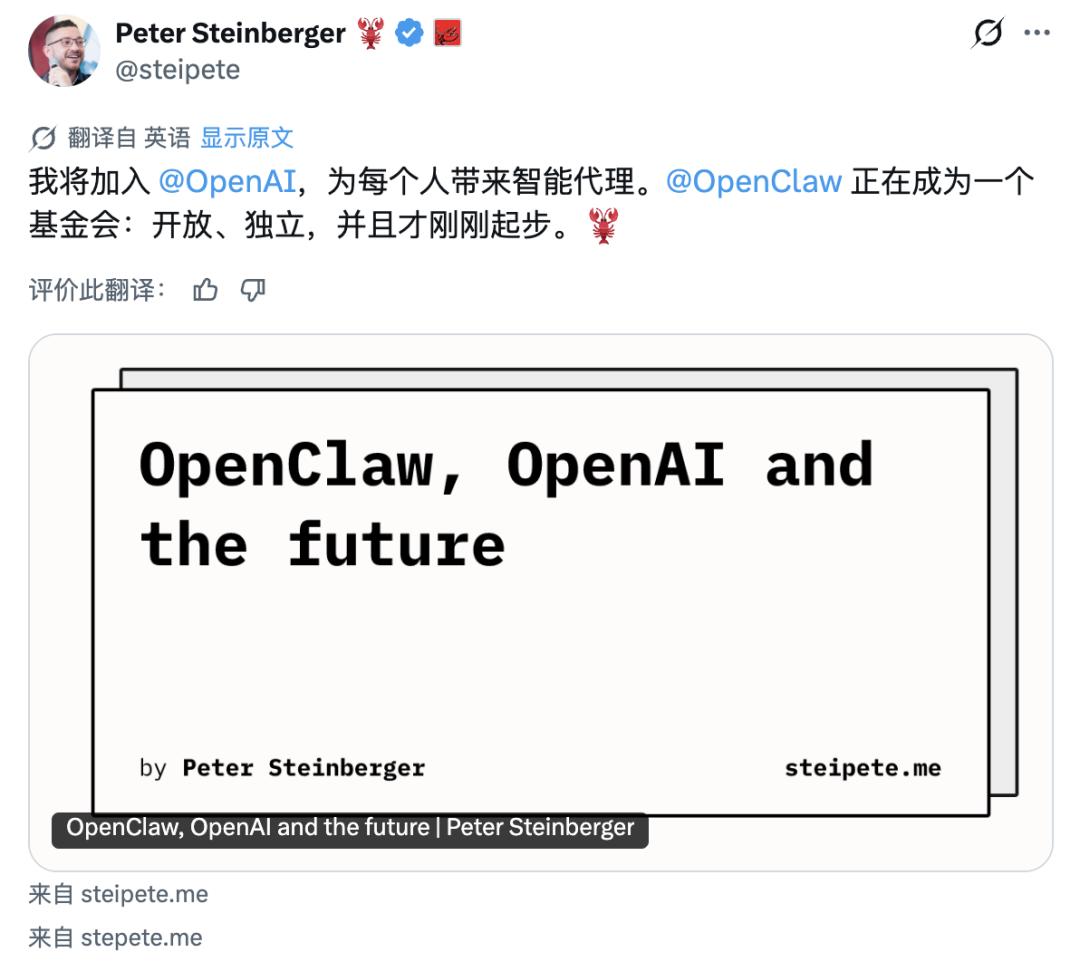
OpenClaw创始人加入OpenAI,目标“开发一款连我妈妈都能用的AI助手”
Hua Er Jie Jian Wen· 2026-02-16 01:17
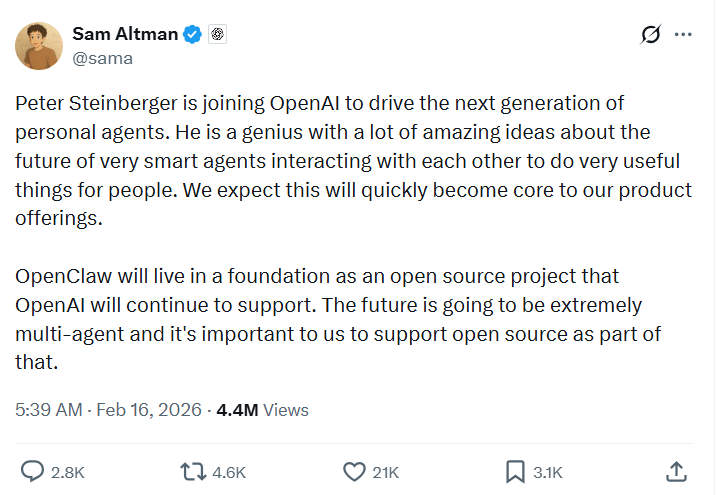
Core Insights - The competition for AI talent intensifies as OpenAI's CEO Sam Altman confirms the acquisition of OpenClaw's creator, Peter Steinberger, who aims to transition AI from being "fun" to "useful" [1][2] Group 1: Strategic Direction - Steinberger's primary mission at OpenAI is to enhance AI usability, targeting a user-friendly experience that even non-technical users can navigate [4] - OpenAI's strategic focus is shifting from large model capabilities to more complex agent interactions, with Steinberger's expertise expected to drive the development of next-generation personal agents [2][4] Group 2: Competitive Landscape - The recruitment of Steinberger highlights a broader competition between Meta and OpenAI, with Meta attempting to attract him through direct engagement from CEO Mark Zuckerberg, while OpenAI leveraged its computational power and model access [6] - The outcome signals that in the race for top AI talent, cutting-edge model access and computational resources are becoming more critical than salary or personal attention from executives [6] Group 3: Market Implications - Steinberger warns of a potential future where 80% of apps may disappear, replaced by APIs managed by intelligent agents, which could disrupt existing app distribution and advertising models [7] - The challenge for OpenAI will be to balance AI autonomy with safety, particularly in light of OpenClaw's previous issues with excessive permissions leading to spam [7]
摩尔线程完成MiniMax M2.5模型极速适配;马斯克:Grok 4.20版本将于下周正式发布丨AIGC日报
创业邦· 2026-02-16 01:15
Group 1 - Moore Threads has successfully achieved Day-0 rapid adaptation of the MiniMax M2.5 model on its flagship AI training and inference GPU, the MTT S5000 [2] - Elon Musk predicts that by the end of 2026, AI will bypass traditional programming and directly generate binary programs, claiming that AI-generated binaries will outperform any compiler-generated results [2] - Spotify's CEO stated that some of the company's top developers have not written any code this year, as all code has been generated by AI, indicating a significant shift in the development process [2] Group 2 - Elon Musk announced that the Grok 4.20 version will be officially released next week, featuring significant improvements compared to version 4.1 [2]

刚刚,OpenClaw之父加入OpenAI,奥特曼抢到手了
Xin Lang Cai Jing· 2026-02-16 00:07
来源|机器之心 编辑|sia OpenAI 的 Sam Altman 也在 X 上宣布,Peter Steinberger 加入后,将致力于下一代个人助手智能体。 春节是个好日子,AI Agent 圈迎来一则重磅人事变动。 没想到吧,OpenClaw(前身 Clawdbot / Moltbot)从爆火到加入 OpenAI,仅仅过去了一个月的时间。 就在刚刚,OpenClaw之父Peter Steinberger宣布,他加入了OpenAI,而OpenClaw 将成为一个开放、独立 的基金会。 对于此次加入 OpenAI,Steinberger 在博客中强调了一个核心立场:OpenClaw 保持开源并拥有自由发展 空间,对我一直很重要。 他表示,最终选择 OpenAI,是因为这里最有机会把个人智能体愿景推向更大规模。 以下为 OpenClaw 官宣加入 OpenAI 的全文: 我将加入 OpenAI,致力于把智能体带给每一个人。OpenClaw 将转入一个基金会,并保持开放和独立。 过去一个月简直像一场旋风。我从未想到这个原本只是自己玩玩的项目会掀起这么大的波澜。互联网又 一次变得疯狂,而看到我的工作激励了世界各 ...
单个LLM已不够?华盛顿大学开源多模型协同框架MoCo
机器之心· 2026-02-16 00:06
在训练与开发单个通用大语言模型 (LLM) 之外,越来越多的研究开始关注 多模型协同 (model collaboration):由不同群体、基于不同数据、以不同目的训练的多个 大语言模型,通过多样化的协同算法与系统架构,形成组合式人工智能系统。 多个模型可以通过路由算法而因材施用,通过生成文本相互沟通协作,或是在概率分布或模型参数空间做协同运算…… 各种各样的多模型协同研究共同揭示了一 种 AI 新未来的可能:由去中心化训练的多样化小模型通过协同算法构建模块化、组合式的 AI 系统,使得人人都能参与共建一种不为任何人单独所有的公共人工 智能系统。 为了支持多模型协同研究并加速这一未来愿景的实现,华盛顿大学 (University of Washington) 冯尚彬团队联合斯坦福大学、哈佛大学等研究人员提出 MoCo —— 一 个针对多模型协同研究的 Python 框架。MoCo 支持 26 种在不同层级实现多模型交互的算法,研究者可以灵活自定义数据集、模型以及硬件配置,比较不同算法, 优化自身算法,以此构建组合式人工智能系统。MoCo 为设计、评估与分享新的模型协同算法、组合式智能以及协同开发策略提供了重 ...

刚刚,OpenClaw之父加入OpenAI,奥特曼抢到手了
机器之心· 2026-02-16 00:06
Core Insights - OpenClaw's founder Peter Steinberger has joined OpenAI, transitioning OpenClaw into an open and independent foundation, emphasizing the importance of maintaining open-source and developmental freedom [1][3][6] - Steinberger's decision to join OpenAI is driven by the potential to scale personal assistant agents, aiming to create a user-friendly AI that can be utilized by everyone [4][5] - The rapid growth of OpenClaw, with over 100,000 stars on GitHub and weekly visits reaching 2 million, indicates a strong market interest in agentic AI, which is seen as a significant shift from traditional chatbots to more autonomous personal assistants [9] Company Transition - OpenClaw will become a foundation, allowing it to maintain its open-source ethos while expanding its community and influence [6] - OpenAI has made strong commitments to support the OpenClaw project, indicating a collaborative effort to push the boundaries of AI research and development [6] Industry Trends - The AI industry is evolving from chatbot functionalities in 2023 to more advanced tools like Copilot in 2024, and moving towards autonomous agents by 2025-2026 [9] - The entry of OpenClaw into OpenAI signals a competitive shift towards personal agents capable of executing tasks, suggesting a potential influx of startups targeting this emerging market [9]

Huang and Pichai among tech CEOs heading to India for major AI summit in a key market
CNBC· 2026-02-15 23:15
Core Insights - The AI Impact Summit in India is attracting major technology executives, highlighting India's potential as a critical growth market for AI development [2][4] - India's government is actively promoting the country as a tech superpower, with significant investments in semiconductor projects and incentives for multinational companies to manufacture locally [5][6] Group 1: Market Potential - The summit is seen as a validation of India's market potential, with tech leaders recognizing the importance of establishing a presence in the country [4] - India is viewed as a lucrative market with a young, tech-savvy consumer base and a large pool of talent essential for AI development [3][8] Group 2: Investment and Infrastructure - Major infrastructure investments in AI data centers are anticipated, driven by increasing demand for computing power [7] - Venture capital is flowing into Indian startups, and the stock exchanges are experiencing a rise in initial public offerings, indicating a robust investment climate [6] Group 3: Talent and Leadership - India is emerging as a hub for AI talent, with a significant number of Global Capability Centers (GCCs) focusing on AI and related fields [10] - The creation of senior leadership roles, such as "chief AI officer," is becoming more common in India, reflecting the growing importance of AI expertise [11]


Why IREN Has A Big Advantage Over Cipher Mining
247Wallst· 2026-02-15 23:13
Core Insights - IREN has a significant advantage over Cipher Mining due to its operational capacity, contract terms, and strategic site development, making it a more attractive option for long-term investors [1] Group 1: Operational Capacity - IREN has 4.5 gigawatts of total power capacity compared to Cipher Mining's 3.4 gigawatts, with 810 megawatts of operating data centers versus Cipher Mining's 477 megawatts [1] - IREN has 460 megawatts specifically energized for AI, while Cipher Mining has a lower number, and IREN is projected to energize its 1.4 gigawatt Sweetwater 1 facility in April [1] - IREN is expected to close the year with two gigawatts of energized power for AI, while Cipher Mining's significant milestone will not occur until 2028 when it is expected to energize 2.5 gigawatts [1] Group 2: Contract Terms - IREN secured a five-year deal with Microsoft valued at $9.7 billion, translating to $1.94 billion per year, with a 20% prepayment to assist in financing additional AI data centers [1] - Cipher Mining's 15-year agreement with Amazon is worth $5.5 billion, equating to $367 million per year, indicating that IREN's contract terms are more favorable [1] - IREN's strategy of owning and maintaining Nvidia GPUs allows for potential appreciation, while Cipher Mining's model resembles a landlord arrangement, which may limit revenue growth [1] Group 3: Strategic Site Development - IREN announced a 1.6 gigawatt site in Oklahoma, enhancing its gigawatt pipeline lead over Cipher Mining [1] - IREN focuses on large-scale sites that can support at least one gigawatt, making maintenance and cost-effectiveness more manageable compared to Cipher Mining's smaller, dispersed sites [1] - The concentration of capacity in fewer, larger sites is likened to real estate investing, where larger complexes are easier to manage than multiple smaller properties [1]