
Robotics

Search documents
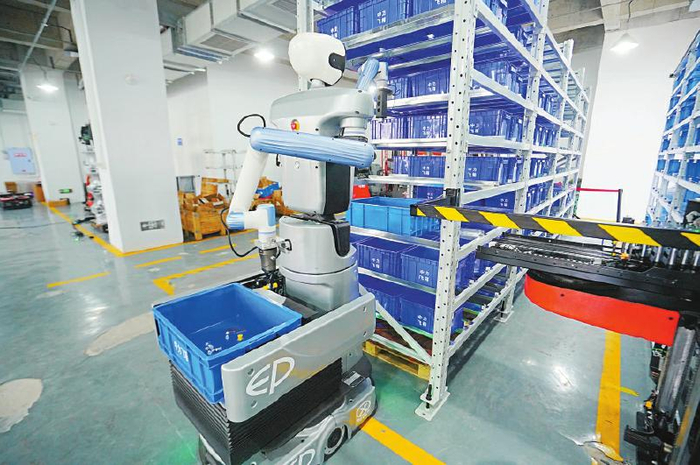
这款机器人,开箱即可“上岗”
Si Chuan Ri Bao· 2026-01-12 21:40
Core Insights - The article highlights the launch of the world's first "no training" industrial embodied picking robot series by Chengdu Ruixinxing Technology Co., Ltd. in collaboration with Zhejiang Zhongli Machinery Co., Ltd. This innovation significantly reduces operational costs and has received positive feedback from various well-known companies both domestically and internationally [2][3]. Group 1: Product Features - The embodied picking robots developed by Ruixinxing utilize the ADA-Grasp technology, which combines a visual-language-action model with adaptive learning capabilities, allowing them to operate without the need for extensive training when new parts are introduced [4]. - The robots are designed to be "deployable, easy to use, and affordable," addressing the high costs and time associated with traditional robotic training processes [3]. Group 2: Operational Efficiency - Ruixinxing has introduced an integrated flexible solution for warehouse picking, which includes three models of industrial embodied picking robots and a comprehensive picking solution. This system allows for efficient and accurate operations, with robots capable of moving items and selecting parts in a matter of seconds [5]. - The company has developed a cluster robot scheduling system that enables thousands of robots to operate in a coordinated manner, optimizing task distribution and real-time path planning to enhance operational efficiency in complex environments [6].


期待“具身智能”长大成“人”
Xin Lang Cai Jing· 2026-01-12 21:04
Core Insights - The article highlights the rapid growth and commercialization of humanoid robots, marking a significant shift towards integrating robotics into everyday consumer markets [1] - The development of embodied intelligence is driven by continuous advancements in technology and the cultivation of specialized talent in educational institutions [3][4] - The future of the robotics industry is characterized by the emergence of new job roles and the need for innovative talent to address the challenges of technology implementation [4] Group 1: Industry Developments - Humanoid robots have gained popularity since their debut at the CCTV Spring Festival Gala, with the first offline store of Yuzhu Technology opening in 2025, showcasing robots to consumers [1] - Research at Nanjing University of Science and Technology focuses on enhancing the movement capabilities of robots, including bipedal and quadrupedal designs, to improve their computer vision and motion control [1][2] - The Jiangsu region is witnessing a surge in the development of various advanced technologies, including brain-computer interfaces and quantum technology, alongside embodied intelligence [4] Group 2: Talent Development - Universities in Jiangsu are actively cultivating talent in embodied intelligence, with programs integrating various disciplines such as artificial intelligence, robotics, and biomedical engineering [3] - The establishment of new academic programs, such as the "Embodied Intelligence Engineering Technology" undergraduate major, reflects a systematic approach to building a skilled workforce [3] - Companies are seeking creative and responsible talent, including roles like "embodied intelligence architect" and "interaction designer," to drive innovation in the robotics sector [4] Group 3: Future Perspectives - The article emphasizes that while humanoid robots can enhance human capabilities, they are not merely replacements for human labor but partners in expanding human potential [5] - The ongoing evolution of embodied intelligence is expected to reshape daily life, with engineers and robots evolving together to create a more integrated future [5]
Ondas Holdings Inc. Announces Closing of $1 Billion Offering
Accessnewswire· 2026-01-12 19:35
Core Viewpoint - Ondas Holdings Inc. has successfully closed a registered direct offering of 19,000,000 shares of its common stock and pre-funded warrants to purchase up to 41,790,274 shares of common stock to an institutional investor [1] Group 1 - The offering included Common Stock Equivalents, which were sold with a common stock warrant to purchase two shares of common stock for each Common Stock Equivalent [1]


Robotphoenix Intelligent Technology Co., Ltd.(H0307) - OC Announcement - Appointment
2026-01-12 16:00
The Stock Exchange of Hong Kong Limited and the Securities and Futures Commission take no responsibility for the contents of this announcement, make no representation as to its accuracy or completeness and expressly disclaim any liability whatsoever for any loss howsoever arising from or in reliance upon the whole or any part of the contents of this announcement. ROBOTPHOENIX INTELLIGENT TECHNOLOGY CO., LTD. 浙江翼菲智能科技股份有限公司 (A joint stock company incorporated in the People's Republic of China with limited li ...
Multiply Labs to Bring “Physical AI” Robotics Technology to Advanced Biomanufacturing With NVIDIA
Businesswire· 2026-01-12 15:30
Core Insights - Multiply Labs has achieved a significant milestone in scaling the production of cell and gene therapies by utilizing NVIDIA's open Isaac and GR00T technologies, which include advanced robotics simulation and perception [1] Company Developments - The company is recognized as a leader in robotic biomanufacturing, indicating its strong position in the industry [1] - The adoption of advanced technologies marks a pivotal shift from traditional manual processes to more automated and efficient methods in the production of cell and gene therapies [1] Industry Impact - The integration of robotics in biomanufacturing is expected to transform the cell and gene therapy landscape, which has historically depended on artisanal production methods [1] - Cell and gene therapies are highlighted as life-changing treatments, emphasizing their potential impact on healthcare [1]


EndoQuest to Bring AI-Powered Vision and Precision to Endoluminal Robotic Surgery with NVIDIA IGX Thor
Businesswire· 2026-01-12 15:05
Core Insights - EndoQuest Robotics, Inc. is collaborating with NVIDIA to integrate NVIDIA IGX Thor into its next-generation robotic system [1] Group 1: Collaboration Details - The partnership focuses on integrating EndoQuest's visualization system, robotic control, and secure cloud services [1] - The integration will utilize NVIDIA's Physical AI software stack [1]

Kraken Robotics Hires Terra Penrose as Chief People Officer
Globenewswire· 2026-01-12 11:30
Core Insights - Kraken Robotics Inc. has appointed Terra Penrose as Chief People Officer, based in Nova Scotia, to enhance team performance and support systems [1][2] - Terra Penrose brings over 20 years of experience in human resources across various industries, including defense, aerospace, and oil and gas [2][3] - The company aims to leverage Penrose's expertise to foster a strong organizational culture and support its growth during a period of momentum [2][3] Company Overview - Kraken Robotics is focused on transforming subsea intelligence through advanced technologies such as 3D imaging sensors and robotic systems [5][6] - The company provides solutions that address challenges in ocean safety, infrastructure, and geology, utilizing best-in-class sonar and imaging systems [6] - Kraken Robotics operates globally, with a presence in North America, South America, and Europe, serving clients in over 30 countries [6]

Kraken Robotics Hires Terra Penrose as Chief People Officer
Globenewswire· 2026-01-12 11:30
Core Insights - Kraken Robotics Inc. has appointed Terra Penrose as Chief People Officer, based in Nova Scotia, to enhance team performance and support systems [1][2] - Terra Penrose brings over 20 years of experience in human resources across various industries, including defense, aerospace, and oil and gas [2][3] - The company aims to leverage Penrose's expertise to foster a strong organizational culture and support its growth during a period of momentum [2][3] Company Overview - Kraken Robotics is focused on transforming subsea intelligence through advanced technologies such as 3D imaging sensors and robotic systems [5][6] - The company provides solutions that address challenges in ocean safety, infrastructure, and geology, utilizing best-in-class sonar and imaging systems [6] - Kraken Robotics operates globally, with a presence in North America, South America, and Europe, serving clients in over 30 countries [6]

6540台订单的背后,消费级具身智能正迎来产业化拐点
机器人大讲堂· 2026-01-12 11:12
Core Viewpoint - The definition of "consumer-grade" in the robotics field is undergoing a significant recalibration, evolving from merely low-cost toy robots to a new category that provides a complete user experience, functioning reliably in unstructured home environments, and meeting safety and aesthetic requirements [1] Group 1: Challenges in Consumer Robotics - The journey of consumer-grade robots entering homes has faced numerous challenges over the past decade, with many products failing to meet user expectations due to their limited functionality and interaction capabilities [4] - The complexity and emotional dimensions of home environments have led to fragmented and implicit demands, causing the industry to struggle with finding effective entry points for consumer-grade robots [4][5] - The industry has seen a shift since the end of 2025, with companies like Songyan, Lexiang, and others making attempts to break into the consumer market from various dimensions [4] Group 2: Vbot's Market Impact - Vbot has emerged as a leading company in bringing consumer-grade products into homes, achieving record sales and engagement metrics, including over 10.5 million live viewers during its launch and sales exceeding 10 million yuan within 19 days [7][8] - The Vbot phenomenon reflects a significant shift in the industry, marking a transition from technology showcases to actual commercial orders, driven by a focus on user needs and real-life applications [11][12][17] Group 3: Technological and Market Trends - The success of Vbot is attributed to the convergence of technological advancements, market readiness, and supply chain capabilities, allowing for the integration of AI and robotics into everyday life [12][14] - The Vbot team, comprising over 60% members from the consumer electronics and automotive sectors, has successfully combined user experience with safety and reliability standards in its product development [16] Group 4: Vbot's Competitive Advantages - Vbot's core selling points include its intelligent features, robust hardware performance, safety and emotional design, and its role as a physical space AI assistant, which collectively create a strong competitive barrier [19][20][22][24] - The product's design prioritizes safety and user interaction, ensuring it is perceived as a trustworthy family member rather than just a tool [22][24] Group 5: User Engagement and Operational Strategy - Vbot's pre-sale success is not only due to its innovative product definition but also its comprehensive user engagement strategy, which includes building a transparent and iterative user feedback loop [26][27][28] - This approach emphasizes long-term user relationships and operational service, moving beyond merely selling hardware to creating a sustainable ecosystem around the product [26][28] Group 6: Industry Outlook - The year 2026 is anticipated to be a pivotal point for consumer-grade embodied intelligence, transitioning from diverse explorations to large-scale commercialization, driven by technological maturity and improved user perceptions [30][31] - Vbot's achievements have set a new benchmark for the industry, highlighting the importance of user experience and clear value propositions in achieving widespread adoption [31][32]

前掌门教育CEO创办,未来不远完成2亿元天使轮融资、聚焦家庭场景机器人
Sou Hu Cai Jing· 2026-01-12 10:44
本轮融资由真格基金领投,联新资本、源来资本及掌门部分老股东跟投,累计融资额2亿元。资金将主 要用于家庭通用机器人产品迭代、核心算法与系统能力提升,以及更大规模的真实家庭场景部署。 瑞财经 吴文婷1月12日,据真格基金发布,国内首个聚焦C端家庭场景的通用机器人公司未来不远 (Futuring Robot)宣布完成2亿元的天使轮融资。 自2025年下半年启动实测以来,未来不远已进入200余个真实家庭,累计提供超过21000小时的家庭服 务,成为国内率先实现C端付费试用的家务机器人产品。 公开资料显示,未来不远自2022年成立起即明确聚焦C端家庭场景,围绕真实用户需求推进产品设计与 技术迭代,持续探索通用机器人在家庭环境中的商业化可行性。 而公司创始人兼CEO张翼毕业于上海交通大学,是知名上市教育公司掌门教育的创始人兼前CEO,未来 不远机器人是其二次创业项目。 ...