
信托

Search documents
又一信托公司将破产重整?华信信托启动兑付方案,国资重组方浮出水面
Di Yi Cai Jing· 2025-08-14 11:26
Core Viewpoint - Huaxin Trust is moving towards a restructuring plan, with personal investors set to receive compensation through the acquisition of trust beneficiary rights by Dalian Anding, a newly established state-owned platform [1][2][6]. Group 1: Restructuring and Compensation Plan - Huaxin Trust announced that Dalian Anding will acquire eligible personal investors' trust beneficiary rights by September 25, 2023 [2]. - The compensation plan allows investors holding multiple trust products to sign a single transfer contract, and the minimum compensation ratio is set at 90% of the investors' holding amounts [3][6]. - The restructuring plan is contingent upon Huaxin Trust's application for bankruptcy reorganization, which, if successful, would allow the company to continue operating [4][6]. Group 2: Background and Financial Status - Huaxin Trust, established in 1981, is the only trust company in Liaoning Province, with a registered capital of 6.6 billion [7]. - The company was classified as one of the six high-risk trust companies by the former China Banking and Insurance Regulatory Commission in 2019, leading to a halt in its "pooling funds" business [7][8]. - As of the end of 2019, Huaxin Trust reported total assets of 12.376 billion, with trust assets under management amounting to 61.58 billion, primarily in real estate and financial institutions [9].
恒银科技(603106.SH):子公司智筑空间拟受让“国民信托·慧金87号集合资金信托计划”贷款债权
Ge Long Hui A P P· 2025-08-14 09:28
Core Viewpoint - Hengyin Technology (603106.SH) announced that its subsidiary, Zhizhu Space, plans to acquire loan receivables from Guomin Trust for RMB 199.99 million, involving the "Guomin Trust · Huijin No. 87 Collective Fund Trust Plan" [1][2] Group 1 - The acquisition involves the transfer of all receivables related to specific civil judgments and execution cases held by Guomin Trust, after deducting amounts owed to the borrower from the trust's guarantee fund [1][2] - The funding for the acquisition will be provided by Hengyin Technology and Mr. Jiang Haoran based on their equity contribution ratios [1] - Guomin Trust and Zhizhu Space have reached an agreement for the transfer, with plans for Zhizhu Space to become the executor of the loan receivables to enhance asset management and decision-making processes [2] Group 2 - Following the signing of the debt transfer agreement, Zhizhu Space will pay the transfer amount to Guomin Trust, which will then distribute the principal of the trust investment to Hengyin Technology and Mr. Jiang Haoran within five working days [2]

国资出手!华信信托最新公告
Zhong Guo Ji Jin Bao· 2025-08-14 09:18
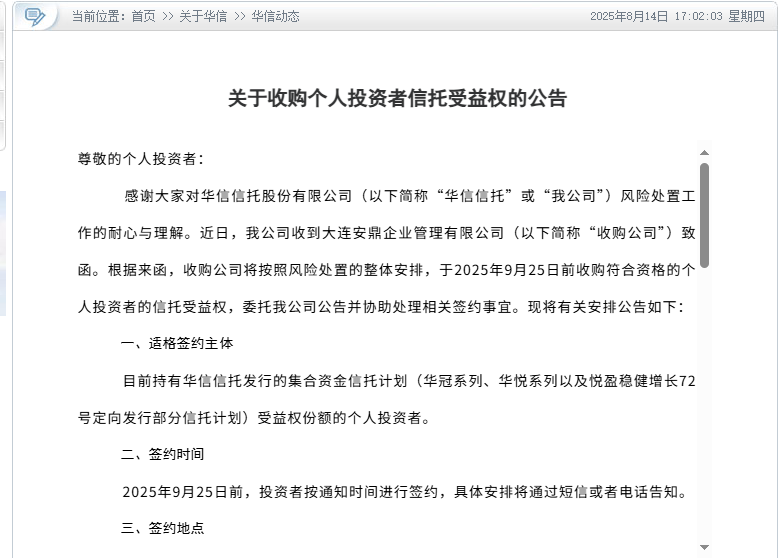
Core Viewpoint - After five years of waiting and three partial payments, personal investors of Huaxin Trust have finally received a risk resolution plan involving a state-owned platform [1] Group 1: Risk Resolution Plan - On August 14, Huaxin Trust announced the acquisition of personal investors' trust beneficiary rights by Dalian Anding Enterprise Management Co., Ltd. [2] - Dalian Anding will acquire eligible personal investors' trust beneficiary rights by September 25, 2025, focusing on specific trust plans [4] - The acquisition is limited to personal investors holding "Huaguan Series," "Huayue Series," and "Yueying Stable Growth No. 72" trust plans, excluding institutional investors [4] Group 2: Company Structure and Strategy - Dalian Anding was established on July 31, 2025, with a registered capital of 1 million yuan, fully controlled by Dalian Jin Yun, which has a registered capital of 10 billion yuan [4] - The establishment of Dalian Anding is seen as a strategic move for risk isolation and operational flexibility, ensuring that the parent company remains unaffected by potential legal disputes [5] - This structure allows for focused asset acquisition and contract negotiation, enhancing efficiency in risk resolution [5] Group 3: Background of Huaxin Trust - Huaxin Trust was listed among six high-risk trust companies by the former China Banking and Insurance Regulatory Commission at the end of 2019 due to issues like "fund pool" operations and asset misappropriation [6] - The company had a registered capital of 6.6 billion yuan and a complex shareholder structure with 20 shareholders [6] - In April 2020, regulatory authorities halted Huaxin Trust's "fund pool" business, leading to a public disclosure of risks involving 7.078 billion yuan of principal from social investors [7][8]

国资出手!华信信托最新公告
中国基金报· 2025-08-14 09:17
Core Viewpoint - The article discusses the establishment of a risk resolution platform by the state-owned enterprise Dalian Jinyun to acquire the trust rights of individual investors in Huaxin Trust, aiming to mitigate risks after a prolonged period of waiting and partial repayments [1][2]. Summary by Sections Risk Resolution Platform Established - Dalian Anding Enterprise Management Co., Ltd. will acquire eligible individual investors' trust rights by September 25, 2025, as part of a risk disposal arrangement [4][5]. - The acquisition is limited to individual investors holding specific trust plans, excluding institutional investors [5]. Background of Dalian Jinyun - Dalian Anding was established on July 31, 2025, with a registered capital of 1 million yuan, fully owned by Dalian Jinyun, which was founded in 2022 with a registered capital of 10 billion yuan [5]. Legal and Operational Considerations - The establishment of Dalian Anding is seen as a strategic move for risk isolation and operational flexibility, allowing for focused asset acquisition and contract negotiations [6]. - This structure aligns with local government responsibilities for risk management and provides a model for future financial institution risk resolution [6]. History of Huaxin Trust - Huaxin Trust was listed among six high-risk trust companies by the former China Banking and Insurance Regulatory Commission at the end of 2019 due to issues like "fund pools" and related party transactions [8]. - The company faced significant liquidity challenges after the suspension of its "fund pool" business in April 2020, leading to the public disclosure of risks involving 7.078 billion yuan of social investor principal [8][10].

千红制药: 关于公司与建元信托股份有限公司签署和解协议暨诉讼进展的公告
Zheng Quan Zhi Xing· 2025-08-14 08:19
证券代码:002550 证券简称:千红制药 公告编号:2025-023 常州千红生化制药股份有限公司 关于与建元信托股份有限公司签署和解协议 暨诉讼进展的公告 本公司及董事会全体成员保证信息披露的内容真实、准确、 年年度报告》、《2020 年年度报告》 完整,没有虚假记载、误导性陈述或重大遗漏。 特别提示: 常州千红生化制药股份有限公司(以下简称"公司"或"本公司")2018 年 购买了安信创赢 51 号·特定资产收益权集合资金信托计划(以下简称"创赢 51 号信托计划")理财产品,到期时间为 2019 年 12 月 29 日。自 2019 年 12 月起, 该笔理财产品出现逾期未兑付,逾期本金 17,000 万元。公司就创赢 51 号信托计 划项下与建元信托股份有限公司(以下简称"建元信托")的受益权转让协议纠 纷向上海金融法院提起诉讼,案号为(2020)沪 74 民初 3 号,法院受理时的涉 诉金额为 17,786.94 万元。具体情况详见公司披露的《2018 年年度报告》、 《2019 、《2021 年年度报告》、《2022 年年度报告》、 《2023 年年度报告》与《诉讼公告》(公告编号:2020-0 ...


华信信托风险处置进展:地方国资收购个人投资者信托受益权
2 1 Shi Ji Jing Ji Bao Dao· 2025-08-14 07:34
Group 1 - The core point of the news is that Huaxin Trust announced the acquisition of trust beneficiary rights from individual investors by Dalian Anding, with a deadline set for September 25, 2025 [1][2] - Dalian Anding, established on July 31, 2025, is fully controlled by Dalian State-owned Financial Capital Management and Operation Co., Ltd., which is under the Dalian Municipal Finance Bureau [1] - Huaxin Trust has been under risk exposure for a long time and has not disclosed annual reports for five consecutive years, being listed as one of the six high-risk trust companies by the China Banking and Insurance Regulatory Commission at the end of 2019 [1][2] Group 2 - In September 2020, Huaxin Trust issued 27 announcements regarding the delay in the redemption of collective fund trust products, and in November 2020, it sought strategic investors to raise funds between 3.4 billion to 6.8 billion yuan [2] - As of February 2021, Huaxin Trust reported that the total principal of trust plans that had not been redeemed was 7.078 billion yuan, which included the Huaguan series, Huayue series, and the designated issuance of the 72nd steady growth plan [2] - Huaxin Trust was established in 1981 and was originally known as the Dalian Trust Investment Company of Industrial and Commercial Bank of China, with a total share capital of 6.6 billion yuan and 20 corporate shareholders [2]
非标信托单一融资模式自9月起终结,行业竞争格局将重塑?
Guo Ji Jin Rong Bao· 2025-08-14 05:40
Core Viewpoint - The new trust pre-registration review standards issued by China Trust Registration Co., Ltd. will take effect on September 1, 2025, marking a shift from the traditional single financing model of non-standard trusts to a diversified, standardized, and net value-oriented asset management approach [1][2][5]. Summary by Relevant Sections New Guidelines - The updated "Trust Registration Business Guidelines (V3.0)" will enforce new pre-registration review standards, requiring trust companies to implement portfolio investment requirements for asset management trusts and prohibiting the provision of financing that effectively serves a single financing party [2][5]. - Trust funds must disclose comprehensive information about the transaction chain, including details on special purpose vehicles (SPVs) and the final underlying assets [2][3]. Transition from Single Financing Model - The traditional single financing model of non-standard trusts is seen as a product of specific historical conditions, characterized by high efficiency in meeting funding needs but leading to passive risk management and high concentration of risk [3][4][6]. - The transition to portfolio investment is already underway, with previous notifications emphasizing that asset management trusts should operate through collective funding trust plans [5][6]. Impacts on the Industry - The shift to portfolio investment will transform trust companies' business models, requiring them to diversify investments across multiple assets and reduce reliance on single financing parties [7]. - Enhanced risk management practices will be necessary, as portfolio investment can mitigate non-systematic risks through diversification of underlying asset types and counterparties [7]. - The restructuring of the industry ecosystem will encourage innovation in business models, pushing trust companies to return to their core asset management functions [7].
69.92%!中海信托2025上半年营收激增 挂牌转让国联期货股权
Jing Ji Guan Cha Bao· 2025-08-14 03:23
Company Overview - Zhonghai Trust achieved operating revenue of 459 million yuan in the first half of 2025, representing a year-on-year increase of 69.92% [2] - The company was established in July 1988 and is a non-deposit financial institution jointly invested by China National Offshore Oil Corporation and CITIC Group, with a registered capital of 2.5 billion yuan [2] Share Transfer - Zhonghai Trust is transferring its 39% stake in Guolian Futures Co., Ltd., corresponding to 175.5 million shares, with a minimum transfer price of 422 million yuan [1] - This is not the first attempt to sell this stake; the initial attempt in 2023 had a minimum price of 411 million yuan but failed due to lack of market interest [1] - The transfer aims to help Zhonghai Trust focus its business and optimize its asset structure [1] Industry Context - The overall trust industry showed a slight decline in key profitability indicators, with operating revenue down by 1.98%, total profit down by 3.72%, and net profit down by 2.83% year-on-year [2] - The industry is characterized by "overall slight decline, structural differentiation" according to research from Yunnan Trust [2]
建元信托上半年营收大增超八成 信托规模破3300亿涉诉超85亿
Jing Ji Guan Cha Wang· 2025-08-14 03:14
公司动态 日前,建元信托最新发布的2025年半年报显示,公司在营业收入、利润以及信托规模等方面均取得显著增长,不过在存量风险化解和涉诉方面仍面临一定挑 战。 2025年上半年,建元信托经营业绩表现出色。营业总收入达1.5亿元,同比增长84.89%;实现归母净利润0.4亿元,同比增长13.36%。截至2025年6月末,公 司受托管理信托规模3378.91亿元,较年初增长33.44%。 其中,信托业务增速较快,1-6月建元信托实现信托业务收入1.13亿元,新增设立信托项目117个,对应新增信托规模1080.01亿元,同比增长785%。 尽管业绩向好,但建元信托在存量风险化解和涉诉方面仍面临诸多问题。 在保底承诺方面,截至2020年12月31日,建元信托存在尚未了结的提供保底承诺等事项金额共计752.76亿元。公司通过收回兜底文件、达成和解、兑付信托 利益等方式积极解决,截至本财务报表批准日,尚余保底承诺金额13.43亿元。 建元信托在半年报中表示,公司在解决保底承诺等事项过程中,全面深入自查后确认不存在未披露的保底承诺等事项,并已与控股股东上海砥安投资管理有 限公司就未能解决/尚未发现的保底承诺/原股东侵占影响达 ...

一份特殊的“信托契约”
Jin Rong Shi Bao· 2025-08-14 02:54
Core Viewpoint - The article highlights an innovative community service trust program in Chengdu, aimed at providing long-term care for individuals with mental health issues, specifically focusing on a woman suffering from schizophrenia who faced isolation after the loss of her family [1][2][3]. Group 1: Trust Program Implementation - The Yulin East Road community committee acts as the trustee, managing the assets left by the woman and her father through Huabao Trust [2]. - The Wuhou Community Development Foundation serves as the supervisor, ensuring compliance and effective use of the trust funds [2]. - Professional social and medical institutions, such as Chengnan Jinhua Hospital and Renhuai Social Work, are responsible for the daily care and medical rehabilitation of the woman [2]. Group 2: Innovation and Community Involvement - This initiative marks several "firsts," including the community committee as the trustee and the inclusion of mental health patients' asset management in the trust contract [2]. - The involvement of community residents in the decision-making and supervision of the trust service reflects a deep integration of trust tools with grassroots governance [2][3]. - The program aims to transform the care of special groups from short-term emergency responses to long-term institutional support, addressing the challenges of social governance for vulnerable populations [2][3]. Group 3: Broader Implications for Social Governance - The introduction of trust mechanisms and collaborative governance among government, community, market, and society is seen as a new approach to enhance social governance [3]. - The "Mulin Guardian" trust program symbolizes a blend of legal, financial, and humanistic care, providing a safety net for vulnerable individuals [3].