Insurance

Search documents
Farm Bureau car insurance review 2026: 4.4 out of 5 stars
Yahoo Finance· 2026-01-23 15:52
Core Insights - Farm Bureau Financial Services (FBFS) is recognized for strong customer satisfaction, fair pricing, and good repair ratings, with an overall rating of 4.4 out of 5 stars [1] - The average monthly cost for full coverage is $151, which is competitive compared to national averages [11][28] - FBFS has a low NAIC complaint ratio of 0.137, significantly below the national benchmark of 1.082, indicating high customer satisfaction [3] Pricing and Coverage - Farm Bureau offers full coverage at an average cost of $151 per month and basic liability insurance at $90 per month, both below national averages [11][15][28] - Coverage options vary by state, with many branches offering six core types of car insurance along with additional options [8][12] - Specific coverage features such as accident forgiveness and emergency roadside assistance depend on the state chapter [9][10] Customer Satisfaction and Ratings - Several Farm Bureau chapters rank above average in customer satisfaction according to J.D. Power, particularly in regions like Kentucky, Michigan, North Carolina, Tennessee, and Texas [6] - Farm Bureau's auto insurance consistently receives strong CRASH Network repair scores and low complaint ratios, contributing to its reputation for good customer service [22] Discounts and Additional Features - Farm Bureau offers a variety of discounts, including a members choice bundling discount, claim-free discount, good student discount, and multi-car discount [17] - An annual "SuperCheck" is performed to identify additional discounts that customers may qualify for [16] Claims Process - The claims process may vary by chapter, but generally includes steps such as reviewing coverage, gathering information, and reporting the claim through various channels [18][24] - Average processing times for claims can range from 2 days for roadside assistance to 7 business days for total loss claims [25]
中国保险 2026 年展望:寿险迎来历史性机遇;产险受益于持续监管红利-China Insurance 2026E Outlook Life Embarking on a Historic Opportunity PC Riding on Continued Regulatory Tailwinds
2026-01-23 15:35
Summary of the Conference Call Transcript on China Insurance Industry Overview - The report focuses on the **China Insurance** industry, specifically the **life insurance** and **property & casualty (P&C)** sectors, with an outlook for 2026E highlighting significant opportunities and challenges ahead [1][3]. Key Insights Life Insurance Sector - The life insurance sector is expected to experience **historic opportunities** due to a **wealth reallocation** as retail investors seek higher reinvestment yields from maturing bank deposits [3]. - **Margin stability** is anticipated, as a pricing rate reduction in September 2025 may counterbalance margin erosion from a shift towards participating policies [3]. - Preference is given to industry leaders such as **China Life** and **Ping An**, with expectations of a **K-shaped growth divergence** between larger and smaller insurers amid ongoing regulatory tightening [3]. Property & Casualty (P&C) Sector - The P&C sector is projected to achieve **4% industry premium growth**, with potential for further **cost of risk (CoR) enhancements** due to favorable regulatory conditions [3]. - Key factors contributing to this growth include: - **Expense rationalization** in non-auto lines - Strengthened regulatory oversight on auto insurance expense management - Gradual relaxation of pricing policies for new energy vehicles (NEVs) [3]. - **PICC P&C** is identified as the top player likely to deliver superior results, although the P&C sector is generally less favored in a bullish equity market [3]. Companies Mentioned - **China Life Insurance** (2628.HK; HK$31.72; 601628.SS; Rmb46.9) - **China Pacific Insurance** (2601.HK; HK$37.92; 601601.SS; Rmb43.1) - **China Taiping Insurance** (0966.HK; HK$23.0) - **New China Life** (1336.HK; HK$58.95; 601336.SS; Rmb77.83) - **PICC P&C** (2328.HK; HK$15.74) - **Ping An Insurance** (2318.HK; HK$66.9; 601318.SS; Rmb64.8) [4][5]. Additional Important Points - The report emphasizes the **regulatory environment** as a significant factor influencing both sectors, with ongoing oversight expected to shape market dynamics [3]. - The analysis suggests that investors should consider the **K-shaped growth** trend when making investment decisions, as larger firms may outperform smaller competitors due to their ability to adapt to regulatory changes [3]. - The report also highlights potential **conflicts of interest** due to Citigroup's business relationships with the companies mentioned, advising investors to take this into account when evaluating the report [4][9][10].
日本股票策略:长期利率上行背景下的日本投资策略指南-Japan Equity Strategy-Investment Strategy Playbook for Japan Amid Rising Long-Term Interest Rates
2026-01-23 15:35
Summary of the Japan Equity Strategy Conference Call Industry Overview - The focus is on the Japanese equity market amid rising long-term interest rates, particularly the implications for stock selection and investment strategies in Japan [1][6][15]. Core Insights - **Negative Real Interest Rates**: Despite rising long-term interest rates, Japan's real interest rates remain negative, which is supportive of equity valuations [6][15][16]. - **Equity Valuations**: Japanese equities are considered inexpensive in a global context, with a higher yield spread compared to the US and Europe, indicating that rising rates do not necessarily lead to a bearish outlook for Japanese stocks [17][36]. - **Leverage Metrics**: Leverage-related metrics are not expected to be significant drivers of stock selection in the current environment, with a shift towards value factors becoming more effective [6][22][32]. Market Dynamics - **Long-Term Interest Rates**: The Bank of Japan (BoJ) faces challenges with rising yields, particularly in the super-long segment of the Japanese Government Bonds (JGB) market, which has seen a lack of buyers and increased selling pressure [7][8][11]. - **Fiscal Concerns**: There are concerns regarding fiscal dominance as the government considers consumption tax cuts, which could impact market confidence and bond yields [11][14][35]. - **Investment Strategy**: The current environment suggests that investors should not adopt excessive pessimism towards Japanese equities, as the fundamentals remain supportive [15][36]. Key Data Points - **JGB Yields**: As of January 20, 2026, 10-year JGB yields exceeded 2.3%, marking a significant rise [38]. - **Dividend Yields**: For over 20 years, long-term yields have remained below dividend yields, but recent trends show a slight inversion, indicating changing market dynamics [39][41]. - **Value Factor Performance**: A 1% increase in Japanese long-term rates is estimated to raise composite value factor returns by 23.83%, significantly higher than the impact of US long-term rates [33][62]. Additional Considerations - **Market Liquidity**: The lack of buyers in the super-long JGB market has led to a self-reinforcing negative cycle, raising concerns about fiscal stability and market liquidity [8][10]. - **Equity Growth Expectations**: In rising rate environments, companies with higher leverage may outperform due to enhanced growth expectations, countering the typical profit pressure from increased interest expenses [22][25][28]. - **Inflation Dynamics**: Historical data suggests that moderate inflation levels are beneficial for equities, indicating potential for improved returns if Japan transitions from deflation to a stable inflationary environment [57]. Conclusion - The Japanese equity market is positioned to navigate rising long-term interest rates without significant adverse effects, supported by negative real interest rates and attractive equity valuations. Investors are encouraged to focus on value factors and remain optimistic about the potential for growth in the Japanese market [15][36].
Will Brown & Brown's Beat Streak Continue This Earnings Season?
ZACKS· 2026-01-23 15:20
Core Insights - Brown & Brown, Inc. (BRO) is anticipated to show growth in both revenue and earnings for the fourth quarter of 2025, with revenues expected to reach $1.64 billion, reflecting a 38.7% increase year-over-year, and earnings estimated at 89 cents per share, indicating a 3.4% rise from the previous year [1] Earnings Predictions - The Zacks model indicates a likely earnings beat for BRO, supported by a positive Earnings ESP of +7.71% and a Zacks Rank of 3 (Hold), which enhances the probability of exceeding earnings expectations [2][3] Revenue Drivers - Core commissions and fees are projected to benefit from new and renewal business, acquisitions, and favorable foreign currency translation effects [4] - Profit-sharing contingent commissions are expected to rise due to improved underwriting results, increased premium volume, and qualifying for certain profit-sharing commissions that were not applicable in the prior year [4] - Net investment income is forecasted to increase, driven by interest income from the company's follow-on common stock offering, with a consensus estimate of $30.1 million [5] - Organic revenue growth in the Retail segment is anticipated from net new business and renewals, while the Wholesale Brokerage segment is expected to see similar benefits from new business and exposure unit increases [5] Expense Outlook - Expenses are likely to rise due to higher employee compensation and benefits, increased operating costs, and higher amortization, depreciation, and interest expenses [6]



Progressive (PGR) Q4 Earnings Preview: What You Should Know Beyond the Headline Estimates
ZACKS· 2026-01-23 15:15
Core Insights - Analysts expect Progressive (PGR) to report quarterly earnings of $4.44 per share, reflecting an 8.8% year-over-year increase, with revenues projected at $21.94 billion, up 7.9% from the previous year [1] - There has been a downward revision of 0.4% in the consensus EPS estimate over the past 30 days, indicating a reappraisal of projections by analysts [1][2] Earnings Estimates - The consensus estimate for 'Net premiums earned' is $20.93 billion, indicating a 9.3% year-over-year increase [4] - The 'Companywide Total - Combined ratio' is expected to be 88.6%, compared to 87.9% in the same quarter last year [4] - Analysts estimate 'Policies in force - Companywide Total' to be 38.60 million, up from 34.95 million year-over-year [4] Policies in Force - 'Policies in force - Total special lines' is projected to reach 7.01 million, compared to 6.52 million last year [5] - 'Policies in force - Total personal auto' is expected to be 26.72 million, up from 23.77 million year-over-year [5] - 'Policies in force - Personal Lines - Direct auto' is estimated at 15.94 million, compared to 14.00 million last year [6] - 'Policies in force - Personal Lines - Agency auto' is projected to reach 10.78 million, up from 9.78 million [6] - 'Policies in force - Total Personal Lines' is expected to be 37.40 million, compared to 33.81 million last year [7] - 'Policies in force - Total Commercial Lines' is estimated at 1.20 million, up from 1.14 million year-over-year [7] - 'Policies in force - Total Property business' is projected to reach 3.68 million, compared to 3.52 million last year [8] Stock Performance - Over the past month, shares of Progressive have declined by 9.1%, while the Zacks S&P 500 composite has increased by 0.6% [8] - Currently, PGR holds a Zacks Rank 4 (Sell), indicating potential underperformance relative to the overall market in the near future [8]


Prudential Japan Pledges Reforms After Widespread Misconduct
Insurance Journal· 2026-01-23 15:10
Core Viewpoint - Prudential Financial Inc.'s Japan insurance unit is facing governance challenges after improper actions by over 100 employees resulted in a loss of approximately $20 million for customers [1][2]. Group 1: Governance and Management Response - The CEO of Prudential Life Insurance Co., Kan Mabara, has publicly apologized for the inappropriate actions and announced his resignation effective February 1 [2]. - The company acknowledged that its commission-heavy pay structure contributed to distorted employee incentives, leading to rule violations [2]. Group 2: Nature of Impropriety - An internal investigation revealed that around 106 current and former employees solicited approximately 500 customers for unapproved investment products, including cryptocurrencies [4]. - Mabara admitted that the company attracted employees with an excessive desire to make money, indicating a lack of adequate risk management [3]. Group 3: Broader Implications - The issues at Prudential Life Insurance could undermine efforts by Japanese policymakers to encourage individual investment activity, which is crucial given the country's aging population and financial pressures [3].


《2025保险数字信任蓝皮书》:“消费者关注点全景地图”发布,蚂蚁保等入选优秀行业案例
Zhong Guo Xin Wen Wang· 2026-01-23 14:50
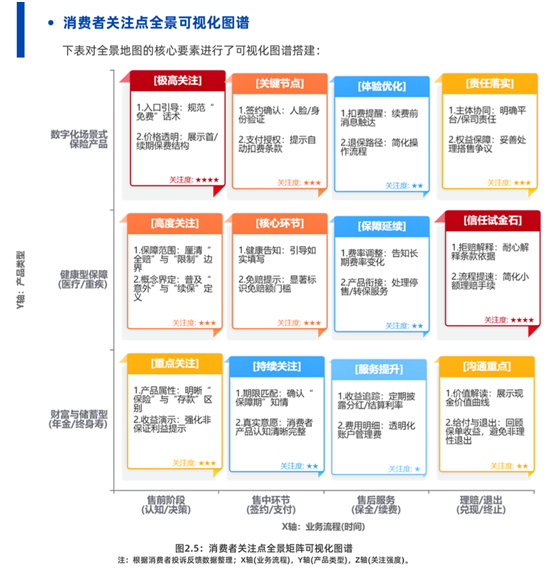
Core Insights - The "2025 Insurance Digital Trust Blue Book" released by Fudan University highlights the importance of consumer rights protection and information disclosure in the rapidly growing internet insurance sector [1][2] Group 1: Consumer Focus and Service Comparison - The Blue Book presents a "Consumer Attention Panorama" that systematically analyzes consumer concerns across various insurance stages, identifying key issues in sales, claims, and service [1] - Ant Financial's insurance platform, Ant Insurance, is recognized as an exemplary service case, showcasing effective pre-sale and post-sale management techniques [2] Group 2: Technological Advancements and Consumer Trust - The report indicates that advancements in AI and technology are breaking down traditional barriers in the insurance market, enhancing transparency and consumer understanding [2] - Ant Insurance's traceable management technology ensures that the information consumers view is accurate and consistent, achieving a traceability success rate of over 99.8% in 2024 [2] Group 3: Regulatory Trends and Industry Growth - The frequency of keywords like "compliance," "traceability," and "consumer rights" in regulatory documents has increased over the past five years, indicating a shift from encouraging innovation to promoting regulated development [4] - The internet insurance sector is expected to experience an average annual growth rate of 15% to 20% over the next five years, with total premiums projected to exceed one trillion [4] Group 4: Ecosystem Development and Digital Transformation - Internet insurance platforms are evolving into crucial connectors and amplifiers within the insurance ecosystem, contributing to digital upgrades across the industry [4] - Ant Insurance is leading the way in driving digital transformation, benefiting both large and small insurance companies, and enhancing market transparency and inclusive finance [4]
Primerica Canada Celebrates 40 Years of Supporting Families with Financial Services
Businesswire· 2026-01-23 14:00
Group 1 - Primerica Life Insurance Company of Canada was named a finalist for two categories in an award event [1] - The winner of the awards was announced in November 2025 [1] - Primerica, Inc., the parent company of Primerica Financial Services (Canada) Ltd., received the Best Employer recognition [1]


Hanover Insurance: Solid Q4 2025 Earnings Expectations Overshadowed By Severe Winter Weather
Seeking Alpha· 2026-01-23 13:45
Core Viewpoint - Hanover Insurance Group (THG) shares are experiencing a slow start to 2026, likely due to severe winter weather in the U.S. impacting Q1 2026 results, although THG stock is outperforming the market overall [1] Group 1 - THG stock is affected by adverse weather conditions, which may lead to a negative impact on financial performance in the first quarter of 2026 [1] - Despite the challenges posed by winter weather, THG stock is noted to be outperforming its peers in the market [1]


What Makes Ryan Specialty Holdings (RYAN) a Good Investment Opportunity?
Yahoo Finance· 2026-01-23 13:38
Group 1: Investment Performance - Vulcan Value Partners' strategies delivered positive results in 2025, with the Large Cap Composite returning -1.5% in Q4 and 7.9% YTD, and the Small Cap Composite gaining 3.2% in Q4 and 9.5% YTD [1] - The Focus Composite and Focus Plus Composite both returned 0.1% in Q4, with YTD returns of 7.1% and 6.2% respectively, while the All-Cap Composite returned 1.3% in Q4 and 10.7% YTD [1] Group 2: Market Context and Strategy - Despite overvalued markets, the firm improved its price-to-value ratios, prioritizing safety and long-term gains over short-term performance, reminiscent of the late 1990s dot-com bubble [1] - The firm is maintaining its investment discipline in light of potential overvaluation in AI-related businesses [1] Group 3: Company Focus - Ryan Specialty Holdings, Inc. - Ryan Specialty Holdings, Inc. is a specialty products and solutions provider for insurance brokers, with shares trading between $48.90 and $77.16 over the past 52 weeks, closing at $50.40 on January 22, 2026 [2] - The company generates approximately 55% of its revenue from brokerage and 45% from delegated authority businesses, with the excess and surplus brokerage market representing 26% of commercial property and casualty premiums [3] - The excess and surplus market has grown at an 11% CAGR over the past 25 years, while the admitted market has grown at a 4% CAGR, indicating a favorable growth outlook for Ryan Specialty [3] - Ryan Specialty's delegated authority business does not retain balance sheet risk, and the company has experienced organic growth at a double-digit rate for the past 15 years [3] - Current pricing headwinds in the commercial property sector are viewed as a short-term issue, with the stock price currently below its long-term intrinsic value, presenting an investment opportunity [3]