Steel

Search documents
新兴亚洲和中东地区有望在未来二十年内抵消中国钢铁产量峰值的影响
2025-04-22 05:42
Summary of Key Points from the Conference Call Industry Overview - The conference call focuses on the **Global Metals & Mining** industry, specifically the steel production dynamics in **Emerging Asia and the Middle East** compared to China [1][2][3]. Core Insights and Arguments - **Steel Production Growth**: Developing markets excluding China have experienced a steel production growth rate of **2.3% per annum**, resulting in a **40% increase** since the Global Financial Crisis (GFC) from 2007 to 2024. In contrast, developed markets have seen a decline of **2.2% per annum**, leading to a **30% decrease** in production over the same period [1][2]. - **Emerging Asia and Middle East Contribution**: This region has led the growth in steel production, achieving a growth rate of **5.8% per annum** over the last two decades. It now accounts for nearly **one-third** of steel output outside of China, up from **14% in 2007** [1][3][4]. - **Future Demand Projections**: If the growth rate in Emerging Asia and the Middle East continues, it could add over **500 million tonnes** of steel demand over the next two decades, potentially offsetting a projected halving of steel demand in China during the same timeframe [1][5]. Additional Important Insights - **Comparative Growth Rates**: The growth in Emerging Asia and the Middle East is comparable to China's growth rate in 2004, indicating that significant economic entities are emerging that can sustain steel production growth independently of China [4][5]. - **Regional Disparities**: While Emerging Asia (notably India, Vietnam, and Korea) and the Middle East (primarily Iran) have shown robust growth, regions like Africa, the former CIS, and Latin America have lagged behind, highlighting the uneven distribution of growth within developing markets [3][4]. This summary encapsulates the key points discussed in the conference call regarding the steel production landscape, emphasizing the potential of Emerging Asia and the Middle East to play a significant role in the global steel market moving forward.

花旗:中国材料行业 - 关税影响将很快冲击需求,偏好转向防御性和国内相关投资
花旗· 2025-04-21 05:09
CITI'S TAKE Materials demand in 1Q25 was mostly in line with our expectation, with stronger prints on steel and cement, and weaker on coal. As the trade war between the US and China escalates, we assess the impact from trade disruptions and potential RMB depreciation on materials. We believe the impact of tariffs has already kicked in for the battery supply chain (see note) and expect more to be felt through commodities in the coming months. This should call for more decisive policies from Chinese side to b ...


Insteel(IIIN) - 2025 Q2 - Earnings Call Presentation
2025-04-17 21:52
Business Overview - The company is the nation's largest manufacturer of steel wire reinforcing products, headquartered in Mount Airy, NC, and operates 11 facilities[8, 9, 15] - The company's operations are focused on manufacturing and marketing steel wire reinforcing products for concrete construction applications, consisting of Welded Wire Reinforcement (WWR) which accounts for 42% of sales, and Prestressed Concrete Strand (PC Strand) which accounts for 58% of sales[13, 15] - The company's sales are primarily to distributors (70%) and rebar fabricators, contractors, and concrete product manufacturers (30%)[17] - The company's sales are mainly for nonresidential construction (85%) with the remaining for residential construction (15%)[17] Growth Strategy - The company aims to achieve leadership positions in its markets[21] - The company focuses on operating as the lowest cost producer in the industry[23] - The company pursues growth opportunities in its core businesses to further penetrate existing markets or expand its footprint[25] - The company focuses on converting rebar users to Engineered Structural Mesh (ESM) for cast-in-place applications, leveraging manufacturing and engineering capabilities[47] Financials - As of March 29, 2025, the company was debt-free with $28.4 million of cash and no borrowings outstanding on its $100.0 million revolving credit facility[95] - Capital expenditures are expected to total approximately $17.0 million in fiscal year 2025[91] - The company is currently paying a regular quarterly cash dividend of $0.03 per share[97] - The company's current share repurchase program has $17.6 million remaining available out of the $25.0 million authorized in November 2008[101]

ArcelorMittal publishes its 2024 Sustainability Report
Newsfilter· 2025-04-17 06:30
Core Insights - ArcelorMittal published its 2024 Sustainability Report, highlighting progress in key sustainability areas such as safety, decarbonisation, and community engagement [2][4] Group 1: Sustainability Progress - The report details advancements in safety, with the implementation of dss+ safety recommendations initiated in November 2024, marking the beginning of a three-year transformation program [3] - The company has achieved a nearly 50% reduction in absolute emissions from its 2024 operating perimeter compared to 2018, supported by a $1 billion investment in decarbonisation projects [4][11] - The share of steel produced via electric arc furnace (EAF) has increased to 25% in 2024, up from 19% in 2018 [4] Group 2: ResponsibleSteel™ Certification - ArcelorMittal certified an additional nine sites in 2024, bringing the total to 42 certified facilities under the ResponsibleSteel™ initiative, which encompasses 12 environmental, social, and governance principles [3][4] Group 3: Economic Decarbonisation Challenges - The company acknowledges that achieving further decarbonisation through methods like carbon capture and green hydrogen DRI-EAF is likely to be economically viable only post-2030, contingent on supportive policies [5] Group 4: Financial Performance - In 2024, ArcelorMittal generated revenues of $62.4 billion and produced 57.9 million metric tonnes of crude steel [7]

【干货】硅钢产业链全景梳理及区域热力地图
Qian Zhan Wang· 2025-04-17 05:11
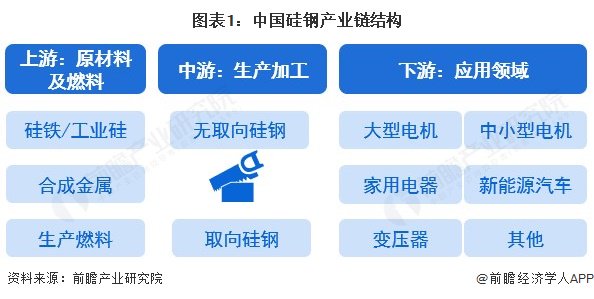
Core Insights - The article provides a comprehensive overview of the silicon steel industry chain, highlighting its upstream, midstream, and downstream components, as well as the geographical distribution of key players and the pricing structure of the industry [1][3][5]. Industry Chain Overview - Silicon steel serves as a primary raw material for various components, with a relatively simple upstream consisting of silicon iron, industrial silicon, and synthetic metals, along with production fuels [1][3]. - The midstream involves the production and processing of various types of silicon steel, with major players including Baosteel, Shougang, and Taiyuan Iron and Steel [3][4]. - The downstream applications encompass large motors, household appliances, new energy vehicles, and transformers [1][4]. Geographical Distribution - The silicon steel industry is predominantly concentrated in North China, with upstream companies located in resource-rich regions such as Inner Mongolia, Shanxi, and Hebei [5]. - The industry chain is well-developed in East China, particularly in Jiangxi, while Central China, especially Henan, has a robust industry chain as well [5]. - Key upstream players in Inner Mongolia include Junzheng Group and Ordos Metallurgy, while major midstream companies include Baotou Steel [5]. Value Chain Dynamics - The market price of the silicon steel industry is influenced by supply, manufacturing, and application sectors, with costs driven by raw materials, labor, and energy prices [7]. - The transmission of prices from the supply side to the manufacturing side creates production costs, which then affect consumer pricing based on market demand elasticity [7]. Pricing Structure Analysis - According to Mysteel data, the average cost for domestic short-process production in 2024 is projected to be 4,690 yuan per ton, with an average gross profit of 223 yuan per ton, resulting in an overall gross margin of approximately 5% [10]. - Recent trends indicate that short-process silicon steel producers are experiencing relatively low profit margins, with some firms even facing losses [10].





Nucor Invites You to Join Its First Quarter of 2025 Conference Call on the Web
Prnewswire· 2025-04-15 13:00
Core Insights - Nucor Corporation will host a live conference call to discuss its first quarter earnings for 2025 on April 29, 2025, at 10:00 a.m. Eastern Time [1][3] - The conference call will be led by Leon Topalian, Nucor's Chair, President, and CEO, and will include a review of the company's financial results followed by a Q&A session [1] Company Overview - Nucor and its affiliates are engaged in the manufacturing of steel and steel products, with operations in the United States, Canada, and Mexico [2] - The company produces a wide range of products including carbon and alloy steel in various forms such as bars, beams, sheets, and plates, as well as structural tubing and fabricated concrete reinforcing steel [2] - Nucor is recognized as North America's largest recycler and also brokers ferrous and nonferrous metals, pig iron, and hot briquetted iron [2]

Are Investors Undervaluing Nucor (NUE) Right Now?
ZACKS· 2025-04-14 14:45
Core Viewpoint - The article emphasizes the importance of value investing and highlights Nucor (NUE) as a strong candidate for value investors due to its favorable valuation metrics and earnings outlook [2][6]. Company Analysis - Nucor (NUE) has a Zacks Rank of 2 (Buy) and a Value grade of A, indicating it is a high-quality value stock [3]. - NUE's price-to-book (P/B) ratio is 1.18, which is attractive compared to the industry average of 1.41. Over the past 52 weeks, NUE's P/B has fluctuated between 1.11 and 2.21, with a median of 1.61 [4]. - The price-to-cash flow (P/CF) ratio for NUE is 7.58, significantly lower than the industry average of 12.43. In the past year, NUE's P/CF has ranged from 6.78 to 10.36, with a median of 8.28 [5]. Investment Opportunity - The metrics indicate that Nucor is likely undervalued at present, making it an attractive option for value investors [6].
中国大宗商品-关税对中国钢铁、金属及农产品的影响
2025-04-14 01:32
Summary of Conference Call on China Commodities Industry Overview - The conference call primarily discusses the impact of tariffs on the China commodities sector, particularly focusing on steel, metals, and agricultural commodities [1][2][4]. Key Points and Arguments 1. **Tariff Impact on China**: - President Trump's announcement of "reciprocal" tariffs resulted in an estimated increase of 26 percentage points in the average effective US tariff rate on China, raising the total effective tariff rate on Chinese goods to 58% [1]. - In retaliation, China imposed a 34 percentage point tariff increase on all US exports, along with an additional 10-15% increase on agricultural imports from the US [1]. 2. **Demand Elasticity and Risks**: - The analysis indicates a modest downside risk to Chinese demand for steel, aluminum, and copper due to demand elasticity in response to higher finished goods prices, with potential for deeper impacts if a recession occurs [2]. 3. **Indirect Exports and Demand Softening**: - Indirect exports of Chinese commodities to the US account for 1.3% of steel production, 0.7% of aluminum, and 1.5% of copper. A 30% reduction in exports to the US could lead to a 0.2-0.5% softening in Chinese demand [3]. - The potential for a global recession could further reduce demand by an additional 0.7-1.5% [3]. 4. **Agricultural Commodities and Inflation**: - The higher tariffs imposed by China on US goods are expected to add inflationary pressure to major grains. US agricultural imports account for 21% of China's total soybean imports and 15% of corn imports [4]. - However, inflation levels may be modest due to a strong harvest year in Brazil and weak domestic demand for animal protein [4]. 5. **Export Reliance and Production**: - Direct exports of hard commodities from China to the US are minimal, with estimates of only 0.1% for steel and 0.6% for fabricated aluminum products in 2024 [11]. - The exposure of Chinese commodities to US exports is significant, translating to related demand for copper, steel, and aluminum at 1.5%, 1.3%, and 0.7% respectively [18]. 6. **Future Projections**: - The soybean import into China is projected to reach 95.8 million tons in 2024/25, which is 9 million tons lower than the previous year, reflecting weak domestic protein demand [19]. - Brazil's soybean output is expected to reach record levels, potentially offsetting some inflationary pressures from tariffs [19]. Additional Important Insights - The conference highlights the importance of monitoring supply discipline in oversupplied sectors, particularly steel, and the need for potential stimulus on demand [3]. - The analysis suggests that while tariffs have a significant impact, alternative supply factors and domestic demand trends will also play crucial roles in shaping the market dynamics [19]. This summary encapsulates the critical insights from the conference call regarding the implications of tariffs on the China commodities market, focusing on both immediate impacts and longer-term projections.
Steel Dynamics Announces First Quarter 2025 Earnings Conference Call and Webcast
Prnewswire· 2025-04-10 15:45
Core Viewpoint - Steel Dynamics, Inc. plans to release its First Quarter 2025 financial results on April 22, 2025, after market close [1] Group 1: Financial Results Announcement - The financial results will be announced after market close on April 22, 2025 [1] - A teleconference to discuss the results is scheduled for April 23, 2025, at 11:00 a.m. Eastern Daylight Time [1] - Key executives participating in the call include Mark D. Millett (Chairman and CEO), Theresa E. Wagler (Executive Vice President and CFO), and Barry Schneider (President and COO) [1] Group 2: Teleconference Participation - Participants can join the teleconference by dialing +1.973.528.0011 at least ten minutes before the start time [2] - The teleconference will also be available in listen-only mode on the company's website [2] - An audio replay of the teleconference will be accessible by dialing +1.919.882.2331 and entering conference ID number 52251, with the replay available until April 30, 2025 [2]

Nucor: Ignoring Short-Term Noise Is Important
Seeking Alpha· 2025-04-08 22:11
Core Insights - The U.S. Steel sector is experiencing increased attention due to recently implemented tariffs on steel and aluminum products [1] - The U.S. is becoming a significant growth market for steel, with expectations of more production being on-shored [1] Industry Summary - Recent tariffs on steel and aluminum are impacting the U.S. Steel sector, potentially leading to increased domestic production [1] - The shift towards on-shoring production is likely to enhance the growth prospects for the U.S. Steel market [1] Company Summary - No specific companies are mentioned in the provided content, focusing instead on the broader industry trends and implications [1]