
Trucking

Search documents
Knight-Swift Transportation Posts Softer Revenue On Lower Truckload Volumes
WSJ· 2026-01-21 22:12
Core Insights - The trucking company reported a significant fourth-quarter loss of $6.8 million, contrasting sharply with a profit of $69.5 million in the same quarter of the previous year [1] Financial Performance - The fourth-quarter loss of $6.8 million indicates a substantial decline in financial performance compared to the previous year's profit of $69.5 million [1]



Knight-Swift Transportation (KNX) - 2025 Q4 - Earnings Call Presentation
2026-01-21 21:30
Fourth Quarter 2025 Earnings Non-GAAP Financial Data Disclosure This presentation, including documents incorporated herein by reference, will contain forward-looking statements within the meaning of Section 27A of the Securities Act of 1933, as amended and Section 21E of the Securities Exchange Act of 1934, as amended. Such forward-looking statements are made pursuant to the safe harbor provisions of the Private Securities Litigation Reform Act of 1995. Forward-looking statements are subject to risks and un ...
Stock Market Today, Jan. 21: U.S. stocks jump after President Trump relaxes Greenland threats in Davos
Yahoo Finance· 2026-01-21 11:58
Market Overview - The U.S. stock market experienced significant declines, with over 70.7% of U.S. issues falling on Tuesday, while only 26.4% advanced [2] - The Nasdaq Composite and S&P 500 dropped by 2.39% and 2.06% respectively, with the Dow and Russell 2000 also showing losses of 1.76% and 1.20% [3] Earnings Reports - Major earnings reports expected today include Johnson & Johnson, Charles Schwab, and Prologis, with a focus on regional banks reporting in both premarket and aftermarket sessions [5] - The S&P Regional Bank ETF ($KRE) is anticipated to be particularly responsive to these reports, having risen over 14% since its lows in November 2025 [6]



Insurance Was Trucking’s Last Real Barrier to Entry. It Collapsed.
Yahoo Finance· 2026-01-20 13:45
Core Insights - The trucking insurance industry is experiencing a significant shift towards instant-issue policies that lack proper risk assessment and verification, leading to increased risks on the highways [7][12][14] - Traditional underwriting practices are being undermined, allowing unqualified operators to enter the market with minimal oversight, which poses a threat to public safety [11][17][43] Group 1: Current State of Trucking Insurance - Instant-issue commercial trucking insurance allows individuals to obtain coverage quickly without thorough verification, raising concerns about the qualifications of operators on the road [7][12] - Major insurers like GEICO and Progressive are adopting models that prioritize quick issuance over comprehensive risk assessment, which deviates from traditional underwriting standards [11][12][13] - The existence of subprime insurance carriers has blurred the lines between standard and high-risk coverage, making it easier for unfit operators to obtain insurance [15][17] Group 2: Financial Implications of Insurance Practices - The average verdict in truck crash lawsuits has dramatically increased, with the average exceeding $1 million rising from $2.3 million in 2010 to $22.3 million by 2018, a 967% increase [18] - In 2023, there were 27 cases resulting in verdicts over $100 million, highlighting the financial risks associated with inadequate insurance coverage [19] - Many legitimate carriers are facing bankruptcy due to soaring insurance costs, while high-risk operators can still obtain coverage with minimal scrutiny [20] Group 3: Accountability and Regulatory Concerns - The concept of "chameleon carriers" allows operators to evade accountability by changing names and policies after causing accidents, further complicating regulatory oversight [22][25] - The federal minimum liability coverage for trucking operations has remained stagnant at $750,000 since the 1980s, which is insufficient given modern crash costs [27][31] - There is a pressing need for reforms in underwriting practices and coverage limits to ensure that insurance effectively protects the motoring public [43][44][47]
Mullen Group Ltd. Announces 2026 Business Plan and 2025 Update
Globenewswire· 2026-01-19 11:00
Core Viewpoint - Mullen Group Ltd. anticipates 2026 will be a record year, driven by a comprehensive analysis of supply and demand fundamentals across its business segments and a focus on cost management and technology investment [2][3]. 2025 Update - The year 2025 was challenging due to trade disputes and tariff issues, leading to a soft private sector capital investment environment and minimal growth in the Canadian economy. Mullen Group's consolidated revenues for 2025 are expected to be around $2.1 billion, with an adjusted OIBDA of approximately $323 million, lower than planned due to various market pressures [3][6]. 2026 Business Plan - Mullen Group aims to achieve consolidated revenues between $2.3 billion and $2.4 billion in 2026, with an adjusted OIBDA target of $365 million, representing 15.7% of consolidated revenues. The business plan includes capital expenditures of $85 million [7][8]. Segment Highlights - The business segments are projected to perform as follows: - Less-Than-Truckload: Revenue of $800 million, adjusted OIBDA of $140 million, operating margin of 17.5%, and capital expenditures of $30 million - Logistics & Warehousing: Revenue of $840 million, adjusted OIBDA of $145 million, operating margin of 17.3%, and capital expenditures of $20 million - Specialized & Industrial Services: Revenue of $450 million, adjusted OIBDA of $85 million, operating margin of 18.9%, and capital expenditures of $20 million - U.S. & International Logistics: Revenue of $230 million, adjusted OIBDA of $15 million, operating margin of 6.5%, with no capital expenditures planned [8]. Balance Sheet and Liquidity Highlights - Mullen Group ended 2025 with $144.6 million in cash and $525 million in undrawn bank lines, positioning the company well for future growth. The 2026 plan includes generating cash in excess of operating needs, with expected cash commitments totaling approximately $235 million [12][13]. Strategic Priorities - The company has established key priorities for 2026, including: 1. Prioritizing margin over market share 2. Pursuing acquisitions to enhance growth 3. Investing in technology to improve operational efficiency [9][11].

Mullen Group Ltd. Announces 2026 Business Plan and 2025 Update
Globenewswire· 2026-01-19 11:00
Core Viewpoint - Mullen Group Ltd. anticipates 2026 will be a record year, driven by improved economic conditions and strategic investments in technology and acquisitions [2][5]. 2025 Update - 2025 was challenging due to trade disputes and tariff issues, leading to a stagnant Canadian economy with no growth [3]. - Mullen Group's preliminary consolidated revenues for 2025 are expected to be around $2.1 billion, with an adjusted operating income (OIBDA) of approximately $323 million, lower than planned due to various market pressures [3]. 2026 Business Plan - The company aims to achieve consolidated revenues between $2.3 billion and $2.4 billion and generate an adjusted OIBDA of $365 million, representing 15.7% of consolidated revenues [6][7]. - The trucking industry is expected to experience a tightening cycle, improving freight demand and pricing due to changes in supply and demand fundamentals [5][22]. - Mullen Group is well-positioned to benefit from government infrastructure projects once they transition from planning to execution [5][22]. Segment Highlights - The 42 business units within Mullen Group's portfolio are expected to outperform last year's results, particularly after accounting for acquisitions made in 2025 [5]. - Specific revenue and adjusted OIBDA targets for various segments include: - Less-Than-Truckload: $800 million revenue, $140 million OIBDA - Logistics & Warehousing: $840 million revenue, $145 million OIBDA - Specialized & Industrial: $450 million revenue, $85 million OIBDA - U.S. & International Logistics: $230 million revenue, $15 million OIBDA [7]. Financial Priorities - The company plans to prioritize margin over market share, focusing on generating cash in excess of operating needs [8][10]. - Expected cash commitments for 2026 include approximately $50 million for interest payments, $50 million for cash taxes, $55 million for lease payments, $85 million for capital expenditures, and $80 million for dividends [10][22]. Investment Strategy - Mullen Group intends to invest $85 million in new operating assets and pursue strategic acquisitions to enhance profitability and expand its network [11][12]. - The focus will be on integrating robotics and improving data management tools to drive productivity [12].

Spot-contract gap collapses to near four-year low
Yahoo Finance· 2026-01-18 01:30
Core Insights - The spread between dry van truckload spot rates and contract rates has shrunk significantly, indicating increasing fragility in the trucking market [1][7] - Contract rates have historically averaged above spot rates since early 2022, with a gradual narrowing of the gap as market capacity has rebalanced [2][7] Market Dynamics - The brokerage-driven spot market structure typically results in spot rates being lower than contract rates, as freight brokerages seek to identify lower-cost carriers [3][4] - In a loose market, spot rates act as the market floor, while in tighter markets, spot rates can exceed contract rates due to increased competition for available capacity [4][6] Rate Trends - The spread between contract and spot rates was at an all-time high in 2022, averaging about 30% above spot rates, which widened to nearly 40% by spring 2023 before beginning to contract [7] - By mid-November of the previous year, the spread narrowed to approximately 15-20%, and by Christmas, the aggregate spot rate index was just 1% below the contract rate index, marking its lowest level since March 2022 [7] - The spread fell from roughly 18% in early 2024 to about 8% later in the year, and in 2023, it declined from 35% in November to around 25% during the holiday period [8]
Trucking rates have dropped 27% versus CPI
Yahoo Finance· 2026-01-17 19:58
Core Insights - The U.S. trucking industry is experiencing significant financial pressure as spot rates have not kept pace with inflation, leading to squeezed carrier margins [1][3] - National trucking spot rates have shown signs of strength, reaching approximately $2.75 per mile as of mid-January 2026, following a rally in late 2025 [1] - There is a substantial gap of about 27% between current spot rates and what they would be if they had matched the cumulative growth in the Consumer Price Index (CPI) since March 2020, which would be around $3.50 per mile [2] Industry Challenges - Owner-operators and small to mid-sized carriers are facing escalating operational costs, including fuel, maintenance, insurance, tires, driver wages, and regulatory compliance, which have all increased sharply since 2020 [3] - Many truckers are operating at breakeven or worse, leading to some exiting the industry entirely, contributing to a gradual tightening of capacity observed in late 2025 and early 2026 [3]
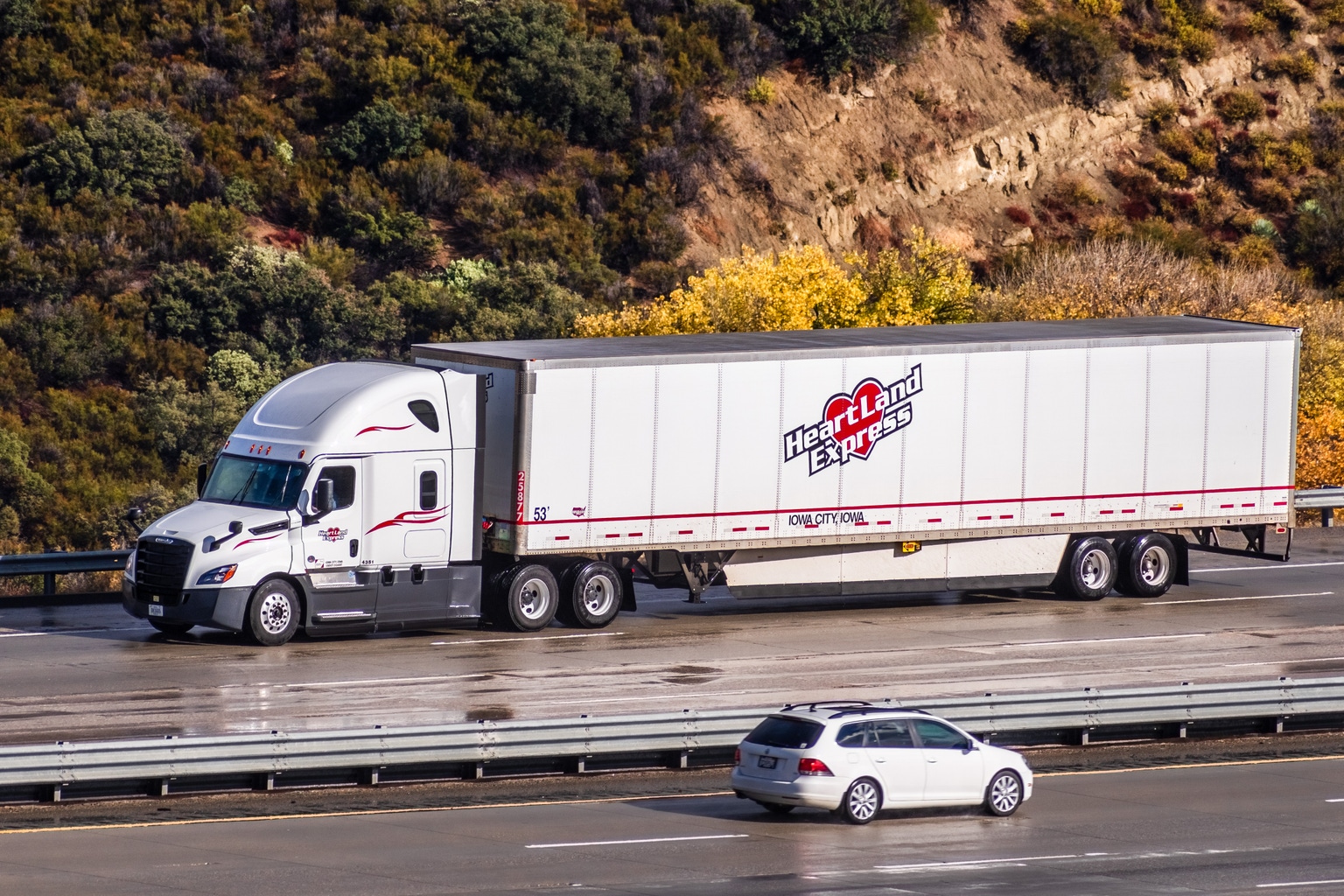
Heartland Express Has Secularly Declining Returns On Capital (NASDAQ:HTLD)
Seeking Alpha· 2026-01-17 09:23
Core Viewpoint - The company's stock has been declining for nearly a decade, but there has been a recent temporary increase, likely due to long-only investment strategies focusing on operational aspects rather than market-driven dynamics [1]. Group 1: Investment Strategy - The investment approach emphasizes evaluating companies from an operational and buy-and-hold perspective, focusing on long-term earnings potential and competitive dynamics within industries [1]. - The strategy involves holding most companies, with only a small fraction deemed suitable for purchase at any given time, promoting a healthy skepticism in a generally bullish market [1]. Group 2: Market Dynamics - The articles produced by Quipus Capital do not prioritize future price movements but rather the operational fundamentals of companies, which is intended to provide valuable insights for future investors [1].

Cass TL Linehaul Index climbs amid shipment decline
Yahoo Finance· 2026-01-16 21:52
Core Insights - December shipments reached a cycle low, with Cass' multimodal shipments index declining 7.5% year-over-year and a two-year stacked decline of 13.5% [1] - The report attributes the slowdown in volumes to winter storms, while noting that inventories have been drawn down [1][2] Shipment and Expenditure Trends - The shipments dataset fell 7.2% from November, with a seasonally adjusted decline of 3.2% [1] - Cass' expenditures index, which includes total freight spend, decreased by 0.6% year-over-year and was down 4% compared to two years ago, marking the smallest two-year decline since July 2023 [6] - The expenditures subcomponent was down 0.5% in 2025, while shipments were off 6% on average, indicating that freight rates likely increased by 7% year-over-year in December [6] Market Conditions - J.B. Hunt Transport Services reported a tightening market beginning the week before Thanksgiving, with seasonal strength observed at the start of the year without adverse weather [3] - The Van Outbound Rejection Index indicates a tightening truckload market, reflecting the number of dry van loads rejected by carriers [4] - The National Truckload Index showed an increase in spot rates through the peak season, attributed to new constraints on the driver pool [5] - The TL linehaul index increased by 1% from November, marking the fourth consecutive monthly increase, and was up 2.1% year-over-year [8]