互联网平台

Search documents
三部门联合发布《互联网平台价格行为规则》 如何保护消费者合法权益?一文解读↓
Yang Shi Wang· 2025-12-20 06:34
央视网消息:国家发展改革委、市场监管总局、国家网信办等三部门20日联合发布《互联网平台价格行为规则》,规范了价格竞争秩序, 保护经营者自主定价权与消费者合法权益。 在监管方面,《行为规则》明确了发展改革、市场监管、网信部门监管职责和措施,要求平台经营者建立健全价格行为合规管理制度、行 业协会商会充分发挥行业自律作用。 国家发展改革委、市场监管总局、国家网信办表示,将在《行为规则》正式实施前,组织主要平台经营者逐项对照监管要求进行自查,同 时将指导有关行业协会采取多种措施加强行业自律,共同抓好《行为规则》落实。 围绕维护价格竞争秩序、明确价格诚信要求等方面,此次发布的《行为规则》也对经营者提出了相应要求,包括不得实施低价倾销、价格 歧视、价格串通、哄抬价格、价格欺诈等不正当价格行为。 对于消费者,此次发布的《行为规则》主要聚焦保护消费者的知情权与自主选择权,规定经营者在提供免密支付、自动续期、自动扣款等 服务时,应当以显著方式向消费者展示相关选项,并提供便捷的取消途径。 此次印发的《互联网平台价格行为规则》实施日期定为2026年4月10日。 对于互联网平台的经营者,《行为规则》中提出,要规范平台经营者收费行为, ...


中国三部门联合发布《互联网平台价格行为规则》
Zhong Guo Xin Wen Wang· 2025-12-20 06:08
一是规范价格竞争秩序。根据现行法律法规规定,细化实化监管要求,为平台经营者、平台内经营者提 供明确的价格行为指引,推动形成优质优价、良性竞争的市场秩序。二是保护经营者自主定价权。完善 对平台内经营者自主定价权的保护规定,明确平台经营者不得对平台内经营者的价格行为进行不合理限 制或者附加不合理条件。三是保护消费者合法权益。落实明码标价制度,推动动态定价、差别定价等规 则公开,规范免密支付、自动续期、自动扣款等服务,更好保护消费者的知情权、选择权。 《行为规则》将于2026年4月10日起实施,为经营者留出必要的规范调整时间。国家发改委、国家市场 监管总局、国家网信办将组织主要平台经营者对照《行为规则》各项监管要求开展自查,自觉规范价格 行为,切实抓好政策落实。(完) 中新社北京12月20日电 (记者王恩博)据中国国家发改委20日消息,为推动平台经济创新和健康发展,近 日,国家发改委、国家市场监管总局、国家网信办联合发布《互联网平台价格行为规则》(以下简称 《行为规则》)。 国家发改委、国家市场监管总局、国家网信办于2025年8月23日至9月22日就《行为规则》公开征求社会 意见。根据各方意见,进一步修改完善《行为 ...
三部门:自动扣款应以显著方式通知
Xin Lang Cai Jing· 2025-12-20 05:45
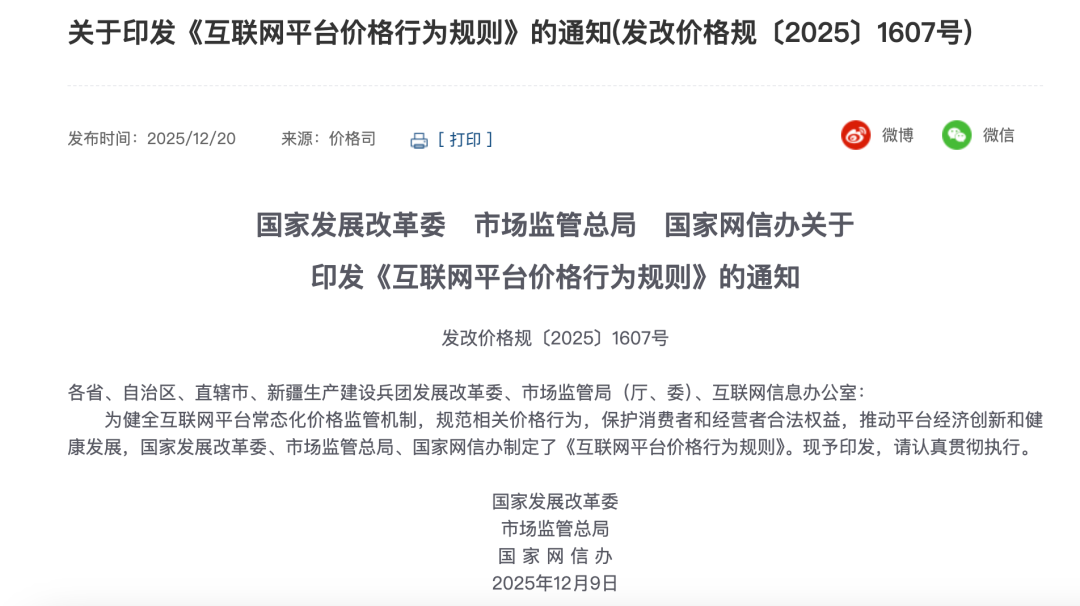
【三部门:#自动扣款应以显著方式通知#】为健全互联网平台常态化价格监管机制,规范相关价格行 为,保护消费者和经营者合法权益,推动平台经济创新和健康发展,国家发展改革委、市场监管总局、 国家网信办制定了《互联网平台价格行为规则》。其中提到,平台经营者、平台内经营者采取自动续 期、自动扣款方式收费的,每次扣款应当提前将扣款时间、金额、取消途径以显著方式提醒并通知消费 者,允许消费者随时取消自动续期、自动扣款。收费标准发生变化的,应当一并通知消费者。#互联网 平台价格行为规则全文#↓↓@人民网 ...
三部门为平台价格行为划定“底线”和“红线”
Jing Ji Guan Cha Bao· 2025-12-20 05:38
Core Viewpoint - The newly issued "Internet Platform Pricing Behavior Rules" aims to establish a regular pricing supervision mechanism for internet platforms, regulate pricing behaviors, protect the legitimate rights and interests of consumers and operators, and promote the innovative and healthy development of the platform economy [1][5]. Summary by Relevant Sections Definition and Scope - The rules define the applicable scope, including pricing behaviors of platform operators and internal operators selling goods or services through internet platforms within China [1]. - Platform operators are defined as legal or non-legal entities providing online business venues, transaction matching, and information publishing services, while internal operators are those selling goods or services through the platform [1]. Pricing Behavior Regulations - The rules cover various pricing activities, including setting or changing prices, price marking, charging fees, and implementing subsidies [1]. - Internal operators have the right to set prices independently, and platform operators are prohibited from interfering with pricing decisions through increased fees or other means [2]. Pricing Marking and Competition - Operators must clearly mark prices, including item names, prices, units, and related transportation costs [2]. - Dynamic pricing must disclose pricing rules and influencing factors, while promotional activities must clearly indicate rules and conditions to avoid false advertising [2]. - Selling below cost to eliminate competitors is prohibited, except for special cases like selling near-expiry goods [2]. Platform Responsibilities - Platforms are required to establish internal pricing management systems and supervise the pricing behaviors of internal operators [3]. - Platforms must take necessary measures against internal operators suspected of pricing violations and report to regulatory authorities [4]. Consumer Protection - The rules enforce clear pricing practices and promote transparency in dynamic and differential pricing, enhancing consumer rights [4]. - Regulatory authorities will strengthen the promotion and enforcement of these rules, encouraging industry self-regulation and consumer participation in maintaining market order [4]. Importance and Implementation - The rules address significant issues in the platform economy, such as "big data price discrimination" and false promotions, which harm consumer rights and disrupt market order [5]. - The implementation of these rules is expected to enhance fair competition, protect consumer rights, and improve the transparency and predictability of pricing behaviors [5]. - The rules will take effect on April 10, 2026, allowing operators time to adjust [7].
事关互联网平台定价、促销、收费等行为,重要新规印发!
21世纪经济报道· 2025-12-20 05:34
Core Viewpoint - The article discusses the release of the "Internet Platform Pricing Behavior Rules" aimed at promoting innovation and healthy development in the platform economy, emphasizing the protection of pricing rights for platform operators and consumers [1]. Summary by Sections Modifications After Public Consultation - The "Behavior Rules" underwent revisions based on feedback from various stakeholders during the public consultation period from August 23 to September 22, 2025. Key changes include refining regulations to protect the pricing autonomy of platform operators, clarifying pricing transparency requirements, and enhancing consumer rights protections [2]. Main Contents of the "Behavior Rules" - The "Behavior Rules" consist of 7 chapters and 29 articles, outlining the pricing conduct that platform operators and internal operators must adhere to. The first chapter establishes the legal basis and scope of the rules [2][3]. Specific Regulations - Chapter 2 focuses on protecting the pricing autonomy of operators, detailing the basic requirements for lawful pricing and regulating platform operators' charging behaviors [3]. - Chapter 3 specifies pricing display behaviors, requiring clear pricing practices, including differential pricing and promotional activities [3]. - Chapter 4 addresses pricing competition behaviors, prohibiting unfair practices such as predatory pricing and price collusion [3]. - Chapter 5 emphasizes consumer rights, mandating transparency in payment options and encouraging platforms to establish mechanisms for resolving pricing disputes [3]. - Chapter 6 outlines the supervisory mechanisms, defining the responsibilities of regulatory bodies and the need for compliance management systems among platform operators [3][4]. Implementation Timeline and Compliance - The "Behavior Rules" will take effect on April 10, 2026. In the interim, regulatory bodies will assist platform operators in aligning their internal compliance systems with the new rules, focusing on consumer rights and pricing autonomy [5]. Future Actions for Implementation - Regulatory bodies will enhance collaboration, promote industry self-regulation, and conduct market inspections to ensure compliance with the "Behavior Rules." This includes policy dissemination, encouraging industry associations to uphold standards, and monitoring pricing competition [6].

三部门发文!事关互联网平台价格行为
券商中国· 2025-12-20 05:21
三部门发布《互联网平台价格行为规则》。 据国家发展改革委网站12月20日消息,为健全互联网平台常态化价格监管机制,规范相关价格行为,保护消费者和 经营者合法权益,推动平台经济创新和健康发展,国家发展改革委、市场监管总局、国家网信办制定发布了《互联 网平台价格行为规则》(以下简称《行为规则》)。 二、正式印发的《行为规则》主要包括哪些内容? 答:《行为规则》共计7章29条,规定了平台经营者、平台内经营者实施价格行为应当遵守的规范,具体包括以下内 容。 据悉,《行为规则》将于2026年4月10日起实施,为经营者留出必要的规范调整时间。国家发展改革委、市场监管总 局、国家网信办将组织主要平台经营者对照《行为规则》各项监管要求开展自查,自觉规范价格行为,切实抓好政 策落实。 国家发展改革委有关负责同志就《互联网平台价格行为规则》答记者问 一、《行为规则》公开征求意见后,主要进行了哪些修改? 此前,国家发展改革委、市场监管总局、国家网信办于2025年8月23日至9月22日就《行为规则》公开征求社会意 见。根据各方意见,进一步修改完善《行为规则》,着力规范价格行为、推动公开透明、增强各方协同,构建良好 平台生态。 一是规 ...

事关互联网平台定价、促销、收费等行为,重要新规印发!
Huan Qiu Wang Zi Xun· 2025-12-20 05:13
Core Viewpoint - The National Development and Reform Commission, the State Administration for Market Regulation, and the National Internet Information Office jointly issued the "Internet Platform Pricing Behavior Rules," which will take effect on April 10, 2026, to promote innovation and healthy development in the platform economy [1] Group 1: Applicability of the Rules - The pricing behavior rules apply to platform operators and operators within the platform [2] - Platform operators are defined as legal or non-legal entities providing online business venues, transaction matching, and information publishing services, while operators within the platform are those selling goods or providing services through the platform [2] Group 2: Pricing Behavior Regulations - The rules specify that pricing behavior includes actions related to pricing during the sale of goods or services, such as setting or changing prices, price marking, charging fees, and implementing subsidies [2] - The rules require clear pricing, including differential pricing, dynamic pricing, and auction ranking, and mandate that all fees must be explicitly stated without additional charges [3] Group 3: Price Competition and Integrity - The rules emphasize maintaining price competition order and require operators to refrain from unfair pricing practices such as predatory pricing, price discrimination, price collusion, price gouging, and price fraud [5] - Operators are prohibited from selling goods or services below cost to eliminate competitors or monopolize the market, with exceptions for certain types of goods [5] Group 4: Consumer Rights Protection - The rules focus on protecting consumer rights, including the right to be informed and the right to choose, requiring operators to clearly present options for services like automatic payments and provide easy cancellation methods [7] - Operators must notify consumers in advance about automatic payments, including the timing, amount, and cancellation options, and must not use deceptive practices to manipulate prices [7]
3部门印发互联网平台价格行为规则
Xin Lang Cai Jing· 2025-12-20 03:38
(来源:中工网) 【#3部门印发互联网平台价格行为规则#】为健全互联网平台常态化价格监管机制,规范相关价格行 为,保护消费者和经营者合法权益,推动平台经济创新和健康发展,国家发展改革委、市场监管总局、 国家网信办制定了《互联网平台价格行为规则》。#互联网平台价格行为规则全文#↓↓ (人民日报) ...
免密支付“关不掉”!三部门出手
Xin Lang Cai Jing· 2025-12-20 03:38
Core Viewpoint - The National Development and Reform Commission, the State Administration for Market Regulation, and the National Internet Information Office have jointly issued the "Internet Platform Pricing Behavior Rules" to promote innovation and healthy development in the platform economy [3]. Group 1: Regulatory Framework - The "Behavior Rules" aim to standardize pricing behavior, enhance transparency, and foster collaboration among stakeholders to create a favorable platform ecosystem [3]. - The rules will be open for public consultation from August 23 to September 22, 2025, allowing for further modifications based on feedback [3]. Group 2: Pricing Competition and Consumer Protection - The rules specify the need to regulate pricing competition, providing clear guidelines for platform operators and internal operators to foster a market order characterized by quality and fair pricing [3]. - Protection of operators' autonomy in pricing is emphasized, prohibiting platform operators from imposing unreasonable restrictions or conditions on the pricing behavior of internal operators [3]. - Consumer rights are reinforced through the implementation of clear pricing practices, including dynamic and differential pricing, and regulations on automatic payments and renewals to safeguard consumers' rights to information and choice [3][4]. Group 3: Implementation Timeline - The "Behavior Rules" will take effect on April 10, 2026, allowing operators sufficient time to adjust to the new regulations [5]. - The regulatory bodies will conduct self-inspections among major platform operators to ensure compliance with the new pricing behavior standards [5].

周末重磅!三部门发文 事关互联网平台价格行为
Zheng Quan Shi Bao· 2025-12-20 03:27
三部门发布《互联网平台价格行为规则》。 据国家发展改革委网站12月20日消息,为健全互联网平台常态化价格监管机制,规范相关价格行为,保护消费者和经营者合法权益,推动平台经济创新和 健康发展,国家发展改革委、市场监管总局、国家网信办制定发布了《互联网平台价格行为规则》(以下简称《行为规则》)。 此前,国家发展改革委、市场监管总局、国家网信办于2025年8月23日至9月22日就《行为规则》公开征求社会意见。根据各方意见,进一步修改完善《行 为规则》,着力规范价格行为、推动公开透明、增强各方协同,构建良好平台生态。 一是规范价格竞争秩序。根据现行法律法规规定,细化实化监管要求,为平台经营者、平台内经营者提供明确的价格行为指引,推动形成优质优价、良性 竞争的市场秩序。 二是保护经营者自主定价权。完善对平台内经营者自主定价权的保护规定,明确平台经营者不得对平台内经营者的价格行为进行不合理限制或者附加不合 理条件。 三是保护消费者合法权益。落实明码标价制度,推动动态定价、差别定价等规则公开,规范免密支付、自动续期、自动扣款等服务,更好保护消费者的知 情权、选择权。 第二章经营者自主定价3条,主要是聚焦保护经营者自主定价权 ...