
医药电商

Search documents
阿里健康(00241)上涨3.05%,报5.06元/股
Jin Rong Jie· 2025-08-13 02:51
8月13日,阿里健康(00241)盘中上涨3.05%,截至10:34,报5.06元/股,成交3.05亿元。 阿里健康信息技术有限公司是阿里巴巴集团的医疗健康旗舰平台,主营业务包括医药自营业务、医药电 商平台业务、医疗健康及数字化服务业务。公司依托领先的数字技术和运营能力,为亿万家庭提供普惠 便捷、高效安全的医疗健康服务,打造出线上线下一体化的医药健康品服务平台。 截至2024年年报,阿里健康营业总收入305.98亿元、净利润14.32亿元。 本文源自:金融界 作者:行情君 ...

申万宏源证券晨会报告-20250806
Shenwan Hongyuan Securities· 2025-08-06 00:44
Group 1: JD Health - JD Health has evolved from a pharmaceutical e-commerce platform to a comprehensive service provider covering health product sales, medical services, and smart healthcare solutions since February 2014 [11] - The core driver of JD Health's performance is its self-operated pharmaceutical business, which is expected to generate revenue of 48.8 billion in 2024, growing by 6.9% year-on-year, accounting for 84% of total revenue [11] - The online retail penetration rate for pharmaceuticals is currently low at approximately 13%, but it is anticipated to accelerate due to the increasing trend of prescription drugs moving outside hospitals and the enhancement of online medical insurance coverage [11] - The competitive landscape in internet healthcare is expected to stabilize by 2025, with JD Health leveraging its supply chain, service ecosystem, and AI technology to create a competitive barrier [11] - Revenue projections for JD Health are estimated at 63.65 billion, 69.65 billion, and 76.55 billion for 2025-2027, with net profits of 4.52 billion, 5.04 billion, and 5.79 billion respectively [11] Group 2: Changjiu Logistics - Changjiu Logistics is positioned as a leading enterprise in the truck logistics transportation sector, transitioning from price competition to high-quality development amid a "de-involution" trend [10] - The implementation of new regulatory measures is expected to enhance the pricing power and market share of compliant companies, with average freight rates for Changjiu Logistics increasing by 27% from 2015 to 2018 [10] - The company has invested in 2,456 mid-axle transport vehicles, with depreciation costs expected to decline in 2025, leading to improved profitability [10] - The logistics sector is witnessing a shift towards automation, with autonomous driving technology poised to enhance operational efficiency and safety in traditional logistics [12] - Revenue projections for Changjiu Logistics are estimated at 0.88 billion, 1.29 billion, and 1.53 billion for 2025-2027, with corresponding net profit growth rates of 10.84%, 46.67%, and 18.12% [14]



阿里健康(00241)上涨2.04%,报5.01元/股
Jin Rong Jie· 2025-08-05 06:50
Group 1 - The core viewpoint of the article highlights the performance of Alibaba Health, which saw a stock price increase of 2.04% to 5.01 CNY per share, with a trading volume of 363 million CNY as of August 5 [1] - Alibaba Health is the flagship healthcare platform of Alibaba Group, focusing on self-operated pharmaceutical business, e-commerce platform business, and digital healthcare services [1] - The company leverages advanced digital technology and operational capabilities to provide accessible, efficient, and safe healthcare services to millions of families, creating an integrated online and offline pharmaceutical health service platform [1] Group 2 - As of the 2024 annual report, Alibaba Health reported total revenue of 30.598 billion CNY and a net profit of 1.432 billion CNY [2]
叮当健康发盈警 预期上半年净亏损同比收窄逾40%
Zhi Tong Cai Jing· 2025-08-01 10:57
Core Viewpoint - Dingdang Health (09886) expects a reduction of over 40% in net loss for the mid-2025 period compared to a net loss of approximately RMB 89.8 million for the same period in 2024 [1] Financial Performance - The improvement in net loss is primarily attributed to an increase in gross profit due to higher gross margins and a reduction in general and administrative expenses for the mid-2025 period [1] - The adjusted net loss (non-IFRS measure) for the mid-2025 period is expected to decrease by over RMB 20 million compared to an adjusted net loss of approximately RMB 26.4 million for the six months ending June 30, 2024 [1]
8.99亿主力资金净流入,医药电商概念涨1.51%
Zheng Quan Shi Bao Wang· 2025-08-01 09:26
Market Performance - As of August 1, the pharmaceutical e-commerce sector rose by 1.51%, ranking 9th among concept sectors, with 114 stocks increasing in value [1] - Notable gainers included Weikang Pharmaceutical with a 20% limit-up, and New Tian Pharmaceutical, Huason Pharmaceutical, and Qizheng Tibetan Medicine also hitting the limit-up [1] - The top performers in the sector were Shenzhou Pharmaceutical, Dajia Weikang, and Zhongsheng Pharmaceutical, with increases of 23.15%, 8.87%, and 7.49% respectively [1] Capital Flow - The pharmaceutical e-commerce sector saw a net inflow of 899 million yuan from main funds, with 84 stocks receiving net inflows [2] - Leading the net inflow was Zhongsheng Pharmaceutical with 533 million yuan, followed by Huason Pharmaceutical, Taiji Group, and New Tian Pharmaceutical with net inflows of 111 million yuan, 98 million yuan, and 82 million yuan respectively [2] Stock Performance - New Tian Pharmaceutical, Weikang Pharmaceutical, and Kefu Medical had the highest net inflow ratios at 43.47%, 16.51%, and 15.73% respectively [3] - The top stocks in the pharmaceutical e-commerce sector based on net inflow included Zhongsheng Pharmaceutical, Huason Pharmaceutical, and Taiji Group, with respective daily increases of 7.49%, 10.03%, and 4.09% [3] Decliners - The stocks with the largest declines included Erkang Pharmaceutical, Kangzhi Pharmaceutical, and Laimei Pharmaceutical, which fell by 9.59%, 7.15%, and 5.81% respectively [1][10] - The overall market showed mixed performance with some sectors experiencing significant losses while others gained traction [10]




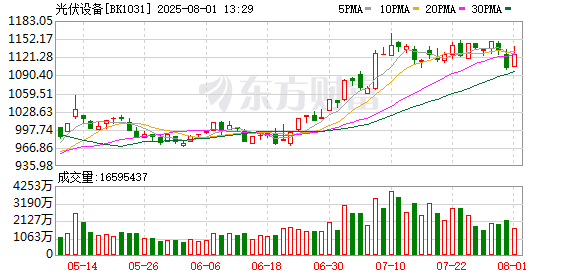
光伏设备板块大涨 三大利好突袭
Zhong Guo Zheng Quan Bao· 2025-08-01 05:28
Group 1: Pharmaceutical Sector - The pharmaceutical sector showed strong performance on the first trading day of August, with traditional Chinese medicine stocks experiencing significant gains, including companies like Weikang Pharmaceutical and Xintian Pharmaceutical reaching their daily price limits [2] - Various sub-sectors within pharmaceuticals, such as animal vaccines, pharmaceutical e-commerce, innovative drugs, chemical preparations, raw materials, and CRO, also saw increases [2] Group 2: Solar Energy Sector - Solar energy stocks rebounded, with significant gains in the solar equipment sector, including companies like Jiejia Weichuang and Haiyou New Materials [5] - Jiejia Weichuang announced a mid-year profit forecast, expecting a net profit of 1.7 billion to 1.96 billion yuan for the first half of 2025, representing a year-on-year growth of 38.65% to 59.85% [5] - The increase in silicon wafer prices continued, with average prices rising approximately 0.1 yuan per piece, driven by increased raw material costs and higher downstream orders [6] Group 3: Logistics Sector - The logistics sector experienced an uptick, with companies like Huapengfei, Shentong Express, and Yunda Holdings showing significant stock price increases [9] - Shentong Express has seen a cumulative increase of over 52% since its rebound on July 10 [9] - The logistics industry is undergoing consolidation, with Shentong Express announcing a cash acquisition of Zhejiang Dan Niao Logistics for 362 million yuan [9] - The introduction of unmanned logistics vehicles is entering a phase of large-scale commercial use, with major players like SF Express and Zhongtong expected to introduce thousands of unmanned vehicles this year [10]


港股异动|药师帮(09885)盈喜后涨超3% 预计中期股东应占利润不少于7000万元
Jin Rong Jie· 2025-08-01 02:20
Core Viewpoint - The company, YaoShibang (09885), has announced a positive earnings forecast, expecting a significant increase in profit for the upcoming half-year period, leading to a rise in its stock price by over 3% following the announcement [1]. Group 1: Earnings Forecast - YaoShibang anticipates that the profit attributable to shareholders for the half-year ending June 30, 2025, will be no less than RMB 70 million, which is more than three times the RMB 21.8 million profit for the half-year ending June 30, 2024 [1]. - The board attributes the expected increase in profit to the company's strong industry position and competitive advantages, which have allowed for steady revenue growth [1]. Group 2: Business Performance Drivers - The sustained high demand for the company's proprietary brand products, which have a high gross margin, is contributing to the growth of this business segment [1]. - The company has a solid technological foundation, and continuous improvements in digital capabilities are enhancing the operational efficiency of its core platform and self-operated businesses [1].
药师帮盈喜后涨超3% 预计中期股东应占利润不少于7000万元
Zhi Tong Cai Jing· 2025-08-01 01:44
董事会认为,集团上述预期利润增加主要得益于以下原因:(集团凭着稳固的行业领先地位及竞争优 势,持续保持收入的稳健增长;集团自有品牌产品的下游需求持续保持旺盛,该高毛利率的业务规模持 续增长,不断提升公司的毛利率水平;集团拥有扎实的科技底座,通过数字化能力的不断提升,带动核 心的平台和自营业务的运营效率不断提升。 药师帮(09885)盈喜后涨超3%,截至发稿,涨3.31%,报10.6港元,成交额1829.01万港元。 消息面上,7月31日,药师帮发布公告,预期截至2025年6月30日止半年度公司拥有人应占利润将不少于 人民币7000万元,为截至2024年6月30日止半年度公司拥有人应占利润人民币2180万元的3倍以上。 ...
港股异动 | 药师帮(09885)盈喜后涨超3% 预计中期股东应占利润不少于7000万元
智通财经网· 2025-08-01 01:40
Core Viewpoint - The company, Yaoshi Bang, has announced a significant increase in expected profits for the upcoming half-year period, projecting a profit of no less than RMB 70 million, which is more than three times the profit of RMB 21.8 million from the previous year [1] Group 1: Financial Performance - The expected profit for the half-year ending June 30, 2025, is projected to be at least RMB 70 million [1] - This represents an increase of over 3 times compared to the profit of RMB 21.8 million for the half-year ending June 30, 2024 [1] Group 2: Reasons for Profit Increase - The board attributes the increase in expected profits to the company's strong industry position and competitive advantages, which have allowed for steady revenue growth [1] - There is sustained strong demand for the company's proprietary brand products, contributing to the growth of this high-margin business and improving overall gross margin levels [1] - The company has a solid technological foundation, and continuous improvements in digital capabilities have enhanced the operational efficiency of its core platform and self-operated businesses [1]
药师帮发盈喜 预计中期股东应占利润不少于7000万元
Zhi Tong Cai Jing· 2025-07-31 11:26
董事会认为,集团上述预期利润增加主要得益于以下原因:(1)集团凭着稳固的行业领先地位及竞争优 势,持续保持收入的稳健增长;(2)集团自有品牌产品的下游需求持续保持旺盛,该高毛利率的业务规模 持续增长,不断提升公司的毛利率水平;(3)集团拥有扎实的科技底座,通过数字化能力的不断提升,带 动核心的平台和自营业务的运营效率不断提升。 药师帮(09885)发布公告,预期截至2025年6月30日止半年度公司拥有人应占利润将不少于人民币7000万 元,为截至2024年6月30日止半年度公司拥有人应占利润人民币2180万元的3倍以上。 ...