Software

Search documents
Better AI Software Stock: ServiceNow vs. Salesforce
Yahoo Finance· 2026-02-11 16:12
Group 1: Industry Overview - The technology industry is a significant investment area in 2026, driven by artificial intelligence (AI), but software stocks face challenges as some business models may be disrupted by AI [1] - Wall Street analysts predict that fears regarding AI could lead to declines in share prices across the software sector, creating potential buy opportunities for investors [2] Group 2: Salesforce Insights - Salesforce is a leader in customer relationship management (CRM) software, but the emergence of AI poses a threat to the relevance of CRM solutions [3] - In response to the AI threat, Salesforce launched its suite of AI agents under the Agentforce brand in 2024 and reported record results in its fiscal third quarter, with revenue increasing 9% year over year to $10.3 billion [4] - Agentforce's annual recurring revenue (ARR) grew 330% year over year in fiscal Q3, totaling half a billion dollars, although its revenue contribution is still in the early stages [5] Group 3: ServiceNow Insights - ServiceNow, like Salesforce, focuses on streamlining workflows and has performed well despite stock price declines, achieving $3.6 billion in sales for Q4, a 21% year-over-year increase [6] - The company has integrated AI into its platform and anticipates that AI agents will help expand its addressable market, contributing to revenue growth [6] - ServiceNow forecasts its 2026 subscription sales to reach at least $15.5 billion, up from $12.9 billion in 2025, with subscriptions making up 97% of 2025's revenue of $13.3 billion [7]


Why is US stock market down today? Dow, S&P 500 and Nasdaq see big crash today as Wall Street tumbles sharply
The Economic Times· 2026-02-11 16:11
Economic Overview - The US stock market experienced a significant downturn, with the Dow Jones Industrial Average falling below 50,000, closing at 49,999.24, down 188.90 points (0.38%), while the Nasdaq dropped 192.48 points (0.83%) to 22,909.99 [3][13] - Despite the addition of 130,000 jobs in January 2026, surpassing forecasts of 75,000, the unemployment rate decreased to 4.3%, lower than the expected 4.4% [3][13] Labor Market Insights - The Bureau of Labor Statistics revised the total jobs added in 2025 down to 181,000 from a previously reported 584,000, indicating a significant reduction in average monthly job growth from 50,000 to 15,000 [2][9] - The 2025 labor market was characterized as a "hiring recession" across most sectors, with healthcare being the only exception, leading to a "K-shaped" market where only a few sectors thrive while the broader economy struggles [4][10] Market Reactions - The immediate market reaction to the stronger-than-expected hiring data was a spike in bond yields, which negatively impacted stock valuations, particularly for the S&P 500 and Nasdaq, heavily weighted towards companies with future cash flows [3][10] - Individual stocks faced dramatic declines, with Unity Software (U) plummeting 34.16% to $19.13 due to concerns over competition from Alphabet's generative AI tool, "Project Genie 3" [6][13] - Robinhood Markets (HOOD) saw a 12.78% drop to $74.66, reflecting a broader sell-off in retail-centric platforms as the Nasdaq Crypto Index fell 3.72%, dragging Bitcoin down to $66,227 [7][13] Commodities and Investment Trends - In contrast to equities, the commodities market showed resilience, with gold rising 1.12% to $5,087.10 and silver increasing by 3.91% to $83.53, as investors sought safe havens amid economic instability [11][14] - The current economic environment is marked by erratic trade policies and a transition in Federal Reserve leadership, leading to a "wait-and-see" approach among investors until the next Consumer Price Index (CPI) report is released [12][14]






Wall Street’s New Trade Is Dumping Stocks in AI’s Crosshairs
Yahoo Finance· 2026-02-11 16:09
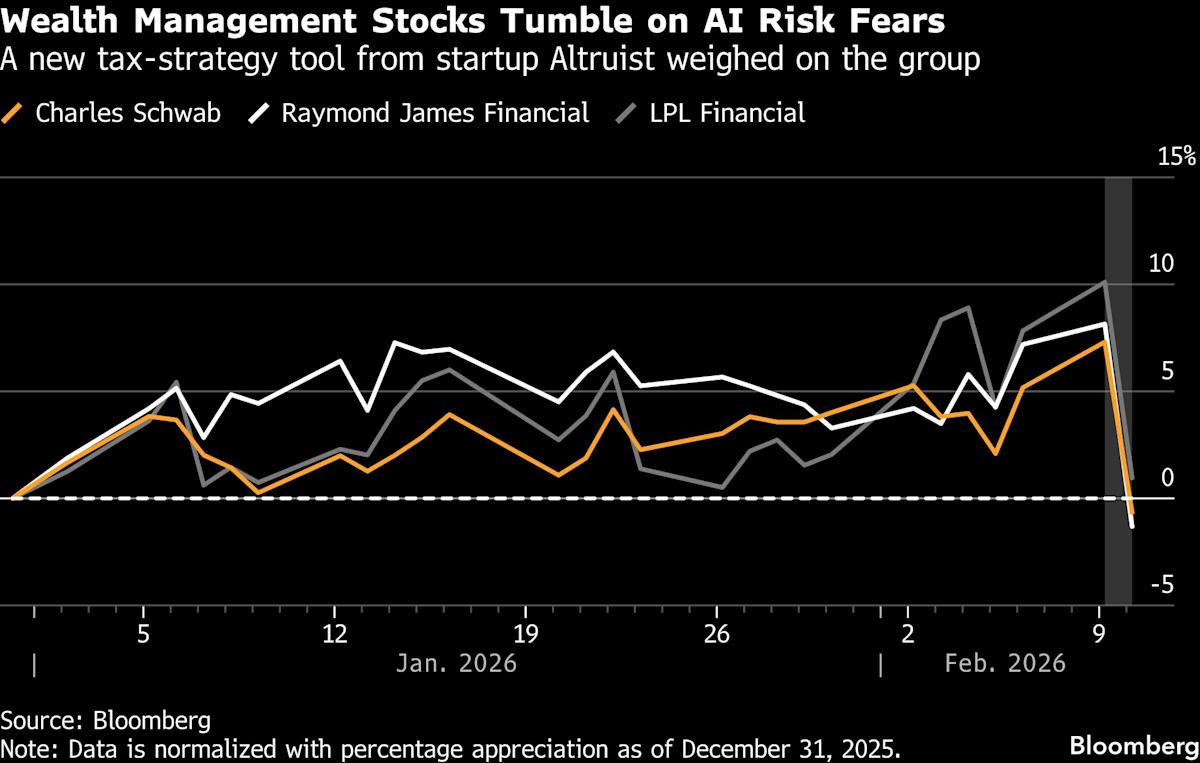
Core Viewpoint - Rising fears about artificial intelligence (AI) are negatively impacting shares of companies perceived to be at risk, leading to significant sell-offs across various sectors, particularly in software and wealth management [1][2][3]. Group 1: Market Reactions - The latest selloff was triggered by a tax-strategy tool from Altruist Corp, causing shares of Charles Schwab Corp., Raymond James Financial Inc., and LPL Financial Holdings Inc. to drop by 9% or more over two days [2]. - This decline represents the deepest slide for some stocks since the trade-war meltdown in April, reflecting a sell-first, ask-questions-later mentality among investors [3]. - The software industry has been particularly affected, with new AI tools from companies like Anthropic PBC leading to a rout in stocks across various sectors, including financial services and legal services [8]. Group 2: Investor Sentiment - Investors are shifting from identifying potential winners in the AI space to avoiding companies that may be displaced by AI advancements [6]. - The narrative has changed from believing in AI and searching for use cases to recognizing the disruptive potential of newly discovered applications [7]. - Concerns about AI's impact have spread beyond the software industry, affecting US insurance brokers and wealth-management stocks due to new applications that leverage AI technology [9].

加速新应用生态构建,国内首个低代码国家标准发布
Xuan Gu Bao· 2026-02-11 16:02
Group 1 - The first national standard for low-code development, titled "General Technical Requirements for Low-Code Development Platforms" (GB/T 46900 - 2025), has been officially approved and will be implemented on July 1, 2026, marking a new phase of standardized development in China's low-code sector [1] - Low-code development platforms (LCDP) allow for rapid application generation with minimal coding or even no coding at all. It is predicted that within the next five years, 70% of global enterprise applications will be based on low-code development [2] - The integration of artificial intelligence (AI) and machine learning into low-code platforms is expected to enhance features such as intelligent recommendations, code auto-generation, and process automation, potentially making low-code the mainstream development model and accelerating the creation of a new ecosystem of applications [2] Group 2 - Relevant A-share concept stocks in the low-code sector include Jin Modern and Puyuan Information [3]
AI-Driven Platforms Strengthen IT Foundations, ISG Says
Businesswire· 2026-02-11 16:00
Core Insights - Integrated software platforms are increasingly vital for AI-enabled modernization of hybrid, multicloud enterprise IT environments, as per ISG's research [1][2] - Platform consolidation has shifted from being an efficiency measure to a structural necessity for enterprises [1] - Enterprises are replacing fragmented toolchains with platforms that integrate AI-assisted execution and robust governance [1] Group 1: Platform Evaluation and Rankings - The 2026 ISG Buyers Guides™ evaluated 97 software providers, focusing on integration, delivery speed, automation, and governance [1] - Microsoft emerged as the top Overall Leader in the Application Platforms category, followed by ServiceNow and Salesforce, all rated Exemplary [1][2] - In the AI-Driven Development Platforms category, Microsoft also led, with Appian and Pegasystems following, all rated Exemplary [2] Group 2: AI Integration in Platforms - AI functionality is now a core component across all platform categories, enhancing efficiency and visibility in application delivery [1] - Development platforms are incorporating AI for code generation, testing, documentation, and performance tuning [1] - Organizations with mature integration practices are better positioned to adopt unified, AI-enabled platforms [1] Group 3: Intelligent Automation Platforms - ISG evaluated 37 providers in the Intelligent Automation Platforms category, with Appian, Microsoft, and Automation Anywhere leading in Process Intelligence Platforms [2] - In Intelligent Document Processing Platforms, Appian ranked first, followed by Microsoft and ServiceNow, all rated Exemplary [2] - Microsoft also led in Automation and Orchestration Platforms, with Appian and Automation Anywhere following closely [2]



11 Best Machine Learning Stocks to Buy According to Analysts
Insider Monkey· 2026-02-11 15:53
Core Insights - The future of the AI revolution is primarily in software applications, as highlighted by Daniel Ives, Global Head of Technology Research at Wedbush [1][3] - Machine learning is identified as the core technology driving advancements in AI across various sectors, including semiconductors, cloud infrastructure, and enterprise software [2] - Companies like Salesforce and ServiceNow are positioned to benefit significantly from AI, with potential revenue increases of 20% to 30% not yet reflected in their valuations [4] Company Insights - NVIDIA Corporation (NASDAQ:NVDA) is central to the AI ecosystem, with a potential upside of 32.6% and 234 hedge fund holders, indicating strong investor interest [10] - Recent reports suggest NVIDIA is nearing a $20 billion investment in OpenAI, which could have significant industry implications [11] - NVIDIA's GPUs are the standard for training and running AI models, making it a key player in machine learning [14] Financial Performance - Dynatrace Inc. (NYSE:DT) reported an 18% growth in Q3 revenue, reaching $515 million, driven by subscription revenue of $493 million, which also grew by 18% year over year [17] - The company achieved a total annual recurring revenue (ARR) growth of 20%, amounting to $1.97 billion, with an adjusted EPS of $0.44, surpassing consensus estimates [17] - Dynatrace's strong performance is attributed to its end-to-end observability platform, which has gained traction among enterprises [18][19]



1 Unstoppable Artificial Intelligence Stock to Buy With $400 Right Now
Yahoo Finance· 2026-02-11 15:50
Core Viewpoint - Investors are increasingly optimistic about artificial intelligence (AI) and its potential to positively impact financial results, leading to significant investments in the sector over the past three years [1] Group 1: Investment Opportunities - Despite some stocks experiencing price surges, there are still investment opportunities available for those with smaller amounts to invest, such as under $500 for certain AI leaders [2] - Microsoft is highlighted as a strong buy opportunity following a recent sell-off after its earnings report, attributed to rising capital expenditures related to AI data center construction [3] Group 2: Financial Performance - Microsoft reported a capital expenditure of $37.5 billion last quarter, exceeding analyst expectations, which contributed to the stock's sell-off [3] - The Azure cloud computing segment achieved a 39% growth, aligning with expectations, although investors anticipated higher revenue growth alongside increased capex [4] - Microsoft's remaining performance obligations rose to $625 billion, a 110% increase year over year, with a significant portion attributed to a new deal with OpenAI [5] Group 3: Risks and Management Insights - The increased capital expenditures are expected to impact profit margins due to rising depreciation expenses, with management indicating that two-thirds of spending is on short-lived assets [4] - OpenAI represents 45% of Microsoft's backlog, introducing customer-concentration risk, but even without this deal, Microsoft has substantial growth potential [5] - The software business remains robust, with the Productivity and Business Processes segment growing 14% year over year on a constant-currency basis, despite fears of AI displacing enterprise software applications [6] Group 4: Cash Flow and Funding - The combination of high-margin software business and increasing cloud billings generates significant cash flow, which supports funding for AI data center projects, with free cash flow reported at $5.9 billion [7]
Wednesday's Earnings Movers: NET Surges, Unity (U) Sells, TMUS Sheds Customers
Youtube· 2026-02-11 15:30
分组1: Cloudflare - Cloudflare's shares rallied over 10% following strong quarterly results, with revenue growing 34% year-over-year to $614.51 million, beating expectations [2][3] - The company reported an adjusted EPS of 28 cents, slightly above the expected 27 cents, indicating positive investor sentiment [2][3] - Cloudflare attributes its growth to increased demand for AI infrastructure, positioning itself as a core infrastructure player amid the AI boom [3][4] 分组2: Unity Software - Unity Software's stock plummeted over 28% due to weak first-quarter guidance, despite beating EPS estimates at 24 cents compared to the expected 20 cents [7][9] - Revenue for the trailing quarter was reported at $503 million, but the guidance for the next quarter is between $480 to 490 million, below the expected $494 million [8][9] - Concerns about slowing momentum and potential AI disruption have negatively impacted investor confidence in Unity Software [9] 分组3: T-Mobile - T-Mobile's stock fell 5% after a mixed fourth quarter, with adjusted EPS of 214 cents beating the expected 206 cents, but revenue growth of 24.3% was below some expectations [10][11] - The company experienced increased post-paid phone churn, rising to over 1%, indicating weaker customer retention compared to the previous year [11][12] - T-Mobile's prepaid segment saw a significant decline, dropping over 40% year-over-year, reflecting a challenging competitive landscape in the wireless carrier market [12]



Unity stock crashes on Q4 earnings: is it a ‘value trap'?
Invezz· 2026-02-11 15:10
Core Insights - Unity Software (NYSE: U) experienced a significant decline of 30% in premarket trading following the release of its Q4 earnings, which exceeded estimates but provided disappointing guidance for the current quarter [1] Financial Performance - The company reported Q4 results that were ahead of market expectations, indicating strong performance in that quarter [1] - Despite the positive Q4 results, the guidance for the upcoming quarter was described as tepid, leading to investor disappointment [1]

Understanding Adobe's Position In Software Industry Compared To Competitors - Adobe (NASDAQ:ADBE)
Benzinga· 2026-02-11 15:01
Core Insights - The article focuses on a comprehensive industry comparison of Adobe against its key competitors in the Software industry, analyzing financial metrics, market position, and growth prospects to provide insights for investors [1] Group 1: Adobe Background - The debt-to-equity (D/E) ratio is highlighted as a crucial measure for assessing a company's financial health and risk profile, aiding in informed decision-making [2] Group 2: Financial Metrics Comparison - Adobe's PE, PB, and PS ratios are low compared to its peers, suggesting potential undervaluation, while its high ROE, EBITDA, and gross profit indicate strong profitability and operational efficiency [3] - Adobe's revenue growth is noted to be low, which may raise concerns about its future performance relative to industry peers [3] Group 3: Debt-to-Equity Ratio - Among its top 4 peers, Adobe has a moderate debt-to-equity ratio of 0.57, indicating a balanced financial structure with a reasonable proportion of debt and equity [5]