
Apparel

Search documents
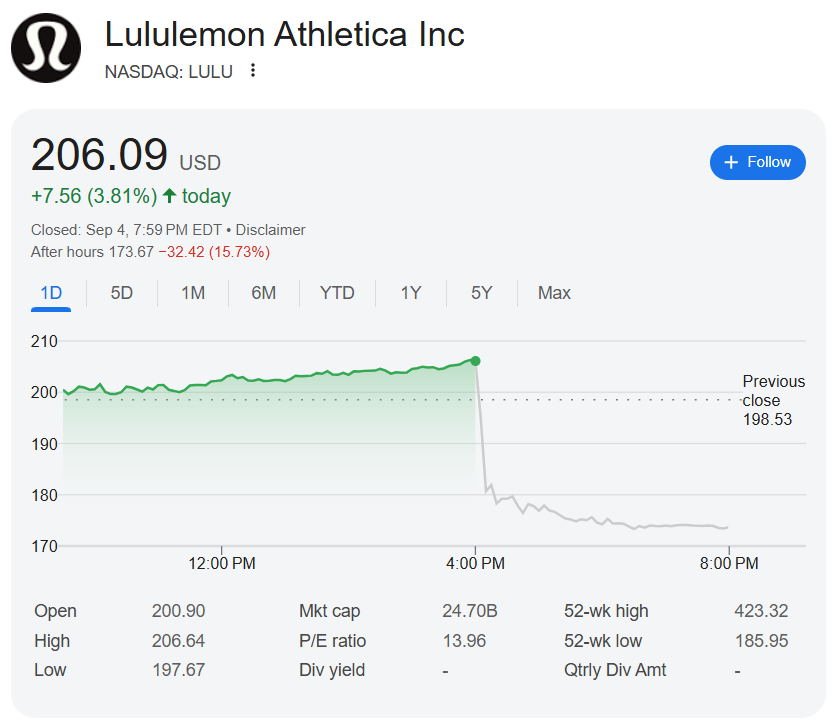
Lululemon二季度EPS超预期,下调全年业绩预期,盘后跌15% | 财报见闻
Hua Er Jie Jian Wen· 2025-09-05 04:03
Core Viewpoint - Lululemon has significantly lowered its performance expectations, disappointing investors for the third consecutive quarter, despite reporting earnings per share of $3.10, which exceeded the expected $2.87. However, this positive surprise was overshadowed by weak revenue and same-store sales growth [1][2]. Financial Performance - Q2 earnings per share were $3.10, surpassing expectations, but revenue of $2.53 billion fell slightly short of the $2.54 billion forecast. Same-store sales growth was only 1%, well below the anticipated 3.7% [2][3]. - The full-year revenue guidance was drastically reduced from $11.15-$11.3 billion to $10.85-$11 billion, indicating a decline in annual growth rate from double digits to 2-4% [2][3]. - The company anticipates that tariffs will reduce gross profit by $240 million in 2025 and operating profit by $240 million in 2026, with an additional $320 million impact in 2026 [3]. Market Dynamics - Lululemon's revenue surged by 140% over four years during the pandemic, but this growth momentum has dissipated, with emerging competitors like Alo Yoga and Vuori capturing market share [2]. - The North American market, a core area for Lululemon, saw a 4% decline in same-store sales, while the Chinese market grew by 17% and other international markets increased by 12% [3]. Brand Challenges - The brand's premium pricing power is under unprecedented threat from the "alternative culture," where lower-priced competitors are gaining traction. For instance, Costco's Kirkland yoga pants are priced at $16, significantly lower than Lululemon's Align series priced between $98 and $118 [4]. - CEO Calvin McDonald acknowledged that product innovation has stagnated, leading to a perception of the brand as "boring" and "predictable" [4]. Tariff Impact - Approximately 40% of Lululemon's products are manufactured in Vietnam, exposing the company to new tariff policies, particularly the cancellation of the "minimum threshold exemption" [5][6]. - CFO Meghan Frank indicated that this policy change would account for 1.7 percentage points of the anticipated 2.2 percentage point decline in annual tariff-related profits [6]. Financial Health - Despite the challenges, Lululemon maintains a strong financial position with $1.33 billion in cash and $1.71 billion in debt, resulting in a healthy debt-to-equity ratio of 39.8% [8]. - The company generated $2.03 billion in operating cash flow and $1.18 billion in free cash flow, providing ample resources to weather economic downturns and make strategic adjustments [9]. - Inventory has increased by 15% year-over-year, attributed to strategic stocking before tariff implementation, while profitability metrics remain robust, with a return on equity (ROE) of 42.5% and a return on assets (ROA) of 22% [10].

Lululemon Embraces AI to Accelerate Design and Go-to-Market Processes
PYMNTS.com· 2025-09-05 01:46
Core Insights - Lululemon Athletica is focusing on leveraging artificial intelligence (AI) and technology to enhance product development and market introduction [1][4] - The company is experiencing challenges in its U.S. business, prompting changes to improve performance [2][6] - Lululemon's comparable sales showed a mixed performance, with a 4% decrease in the Americas and a 15% increase internationally, resulting in an overall 1% increase year over year [5] Group 1: Leadership and Strategy - Lululemon appointed Raju Das as its first chief AI and technology officer to drive innovation and improve agility in product development [3][4] - The new role aims to expedite the product innovation process and enhance customer personalization [4] Group 2: Market Performance - The decline in the Americas market is attributed to prolonged product life cycles and a failure to create new trends, coinciding with a broader industry decline in premium athletic wear [6] - Consumer behavior is shifting, with reduced spending on apparel and a preference for new styles, making it crucial for Lululemon to meet customer expectations [7] Group 3: Future Plans - The company plans to increase the proportion of new styles in its product assortment from 23% to 35% by next spring [8] - Lululemon is also working to enhance its design capabilities and improve its go-to-market process to better align with customer demand [8]


Lululemon大幅下调2025财年全年盈利和销售预测
Zheng Quan Shi Bao Wang· 2025-09-05 00:34
Core Viewpoint - Lululemon significantly lowered its full-year profit and sales forecasts for fiscal year 2025 due to poor performance in the U.S. market, product execution issues, and rising tariff costs [1] Group 1: Financial Impact - The high tariffs and the elimination of the "minimum tax exemption" are expected to impact gross profit by approximately $240 million in fiscal year 2025 and operating profit by about $320 million in fiscal year 2026 [1] Group 2: Competitive Landscape - Analysts believe that Lululemon's innovation advantage in the athleisure sector has diminished, facing competition from luxury brands like Alo Yoga and lower-priced knockoffs [1] Group 3: Operational Challenges - The company is experiencing challenges in merchandise management, including an excessive focus on underperforming products in casual and social apparel, and failing to effectively capture seasonal trends [1] Group 4: Recent Financial Performance - For the second quarter, Lululemon reported revenue of $2.53 billion, which was in line with expectations, and earnings per share of $3.10, exceeding analyst forecasts [1] Group 5: Strategic Response - Lululemon plans to implement strategic price increases in the U.S. market to offset tariff impacts while also increasing discount promotions to clear inventory [1]
Lululemon shares tumble as weak demand, tariffs spark profit warning: ‘Lost its innovation edge'
New York Post· 2025-09-04 22:29
Core Viewpoint - Lululemon Athletica has reduced its annual revenue and profit forecasts, indicating a slowdown in consumer demand as spending decreases and tariff pressures increase [1][10]. Financial Forecast - The company now expects annual revenue between $10.85 billion and $11 billion, down from a previous forecast of $11.15 billion to $11.30 billion [10]. - The annual profit per share forecast is now between $12.77 and $12.97, compared to earlier expectations of $14.58 to $14.78 [10]. - A projected hit of about $240 million on gross profit is anticipated due to higher tariffs and the removal of the de minimis exemption, with an expected impact of about $320 million on operating margin in 2026 [4]. Market Conditions - US holiday spending is expected to see its steepest drop since the pandemic, according to a PwC survey, which aligns with Lululemon's negative outlook for the second half of the year [3][9]. - The company has struggled to generate consumer interest amid inflation and competitive pressures from luxury brands and private-label products [3]. Supply Chain and Tariff Impact - Lululemon manufactures 40% of its products in Vietnam and sources 28% of its fabrics from mainland China, both of which face heavy duties on imports to the US [9]. - The removal of the de minimis exemption, effective August 29, has added to the company's cost pressures [7]. Recent Performance - For the second quarter ended August 3, revenue rose 7% to $2.53 billion, which was largely in line with analysts' expectations, while earnings per share of $3.10 exceeded estimates of $2.88 [11].

Jefferies' Randy Konik talks why Lululemon shares are down on mixed Q2 results
CNBC Television· 2025-09-04 22:27
Financial Performance & Guidance - Lululemon missed revenue estimates, and same-store sales and full-year guidance also came in below expectations [1] - The company needs to confess that their earnings guidance was not lowered enough [2][3] - The company is trying to get the market focused on next year, but analysts believe they will have declining growth due to competition [4] - Lululemon's stock will not bottom until the company confesses to their sins of earnings power being much lower than it is today [5] Operational Challenges - Lululemon's sales per square foot is $1,550, which is four times the mall average, and operating margins are over 20%, which is well above peers, but these metrics are starting to decline [6][7] - Lululemon's capital expenditure as a percentage of sales is the highest in the sector, and they are opening stores at a double-digit clip on a square footage basis, adding fixed cost expense and compressing margins [8][10] - The company needs to shut store growth, which may need to wait until 2026 due to existing commitments [11][12] Market & Competitive Landscape - Lululemon's July sales were the worst of the quarter, while the industry had its best sales trends, indicating a loss of market share [9] - The athletic apparel market is experiencing a hangover from the COVID-19 pandemic, and fashion shifts are occurring, with denim becoming a bigger trend [14][15] - People are not looking like they're going to the gym 24 hours a day, which is a problem for Lululemon, which has depended on the athletic look for years [15][16] - Lululemon has tried to change into the Gap, which is a key issue for the company [12]

Lululemon: There's Salvage Value Here As International Growth Steps Up (Upgrade)
Seeking Alpha· 2025-09-04 22:09
Core Insights - Lululemon athletica inc. has transitioned from being a highly regarded growth stock in the retail/apparel sector to facing significant challenges, leading to its current status as a "penalty-box" stock [1] Company Overview - Lululemon's recent performance indicates a shift in market perception, highlighting the volatility and risks associated with growth stocks in the retail sector [1] Analyst Background - Gary Alexander, with extensive experience in technology and investment, has been contributing insights on platforms like Seeking Alpha since 2017, indicating a blend of expertise in both retail and technology sectors [1]

Recent Market Movements Highlight Notable Stock Performances
Financial Modeling Prep· 2025-09-04 22:00
Company Performance Highlights - Concorde International Group Ltd (CIGL) saw a stock price increase of 91.16%, reaching $2.81, with a trading volume of 124,077,569, significantly higher than its average [2][7] - Inno Holdings Inc. (INHD) experienced an 80.31% rise in stock price to $8.58, as the company expands into electronic product trading and digital transformation initiatives [3][7] - Brillia Inc (BRIA) reported a 62.51% increase in stock price to $4.16, with a trading volume of 24,795,778 and a declared cash dividend of $0.13 per Class A share, totaling nearly $3 million [4] - Duluth Holdings Inc. (DLTH) had a stock price increase of 52.31%, reaching $3.59, and reported quarterly earnings of $0.03 per share, surpassing the Zacks Consensus Estimate [5][7] Market Dynamics - The recent market movements indicate a dynamic nature of the stock market, with significant price changes across various sectors [6] - Factors contributing to these price movements may include company developments, market trends, or broader economic indicators [6]


lululemon(LULU) - 2026 Q2 - Earnings Call Transcript
2025-09-04 21:32
Financial Data and Key Metrics Changes - For Q2, total net revenue rose 7% to $2.5 billion, with comparable sales increasing 1% [26] - Gross profit was $1.48 billion, representing 58.5% of net revenue, down from 59.6% in Q2 2024 [27][28] - Net income for the quarter was $371 million, or $3.10 per diluted share, compared to $3.15 in the same period last year [30] Business Line Data and Key Metrics Changes - Men's revenue increased 6%, women's revenue increased 5%, and accessories and other grew 15% [27] - Performance apparel continues to grow, while lounge and social product offerings have become stale, impacting sales negatively [12][13] Market Data and Key Metrics Changes - In the U.S., revenue was flat, with comparable sales down 3% [26] - China revenue increased 25%, with comparable sales up 16% [27] - The rest of the world segment saw a revenue growth of 19%, with comparable sales increasing by 9% [27] Company Strategy and Development Direction - The company is focusing on increasing the number and frequency of new styles in its product assortment, aiming to raise new styles from 23% to 35% [16] - A new Chief AI and Technology Officer has been appointed to enhance product innovation and agility [18] - The company plans to navigate increased costs from tariffs through strategic pricing and supply chain initiatives [25][22] Management's Comments on Operating Environment and Future Outlook - Management expressed dissatisfaction with current U.S. results and acknowledged the need for product innovation to meet consumer expectations [6][24] - The company expects revenue growth of 4% to 6% for the year, with a decline in U.S. revenue projected at 1% to 2% [22][32] - Management remains optimistic about international growth, particularly in China, where growth is expected to be 20% to 25% [22][32] Other Important Information - The company ended the quarter with $1.16 billion in cash and cash equivalents, and inventory increased 21% to $1.7 billion [31] - Capital expenditures for the quarter were approximately $178 million, reflecting timing of store openings [31] Q&A Session Summary Question: What changes are being made in the product department? - The focus is on maintaining momentum in performance activities, introducing new styles in lounge and social, and refreshing iconic items [46] Question: How are recent tariff increases affecting pricing strategy? - Modest price increases are being instituted on a small portion of the assortment, with ongoing evaluations of pricing strategies [49] Question: What is the right mix of casual and performance products? - A 60/40 split is considered a good benchmark, with ongoing adjustments based on consumer response to new styles [53] Question: How will the company manage inventory and course corrections before 2026? - New processes are in place to improve agility and speed in responding to consumer demand [79] Question: What impact does the de minimis exemption removal have on e-commerce? - Approximately two-thirds of U.S. e-commerce orders are fulfilled through Canada, and the removal of the exemption has a significant impact [80]
lululemon(LULU) - 2026 Q2 - Earnings Call Transcript
2025-09-04 21:30
Financial Data and Key Metrics Changes - For Q2 2025, total net revenue rose 7% to $2.5 billion, with comparable sales increasing by 1% [27][28] - Gross profit was $1.48 billion, representing 58.5% of net revenue, a decrease from 59.6% in Q2 2024 [28][29] - Net income for the quarter was $371 million, or $3.10 per diluted share, compared to $3.15 in the same period last year [30] Business Line Data and Key Metrics Changes - Men's revenue increased by 6%, women's by 5%, and accessories and other grew by 15% [28] - The casual segment, which constitutes about 40% of the assortment, is experiencing fatigue, particularly in core franchises like Scuba and SoftStream [49][56] - Performance apparel continues to grow, with strong sales across key activities such as yoga, run, and train [12][20] Market Data and Key Metrics Changes - In China, total revenue increased by 25%, with comparable sales up by 16% [28][20] - The Americas saw revenue growth of 1%, with comparable sales down by 3% [27][28] - The rest of the world segment grew by 19%, with comparable sales increasing by 9% [28] Company Strategy and Development Direction - The company is focusing on increasing the number and frequency of new styles in its product assortment, aiming to raise new styles from 23% to 35% by spring 2026 [17][19] - A new Chief AI and Technology Officer has been appointed to enhance product innovation and agility [19] - The company plans to navigate increased costs from tariffs through strategic pricing and supply chain initiatives [26][22] Management's Comments on Operating Environment and Future Outlook - Management expressed dissatisfaction with current U.S. results and acknowledged the need for a reset in product offerings [6][24] - The company expects revenue growth of 4%-6% for the year, with a decline of 1%-2% in the U.S. market [23][32] - Management remains optimistic about international growth, particularly in China, where they anticipate continued strong performance [20][24] Other Important Information - The company ended Q2 with $1.16 billion in cash and cash equivalents, and inventory increased by 21% to $1.7 billion [31] - Capital expenditures for the quarter were approximately $178 million, reflecting timing of store openings [31] Q&A Session Summary Question: Insights on product department changes and impact on sales - Management highlighted a focus on performance activities and new styles in lounge and social categories, with two new items launching in the back half of the year [48] Question: Impact of recent tariff increases on pricing strategy - The company is implementing modest price increases on a small portion of its assortment and is pleased with the initial results [52] Question: Context on casual segment performance and timeline for new innovations - Management indicated that the casual segment is about 40% of the mix, with new styles expected to offset current pressures [49][63] Question: Supply chain initiatives and lead time improvements - The company is working to improve lead times and agility in its supply chain processes, with a focus on vendor partnerships [68] Question: Marketing strategy and brand engagement - Management plans to maintain current marketing spend as a percentage of revenue while focusing on grassroots community engagement [71] Question: Annualized impact of tariffs and pricing as a mitigation tool - The CFO noted that pricing will be a significant part of the mitigation strategy, alongside expense actions [76]
lululemon(LULU) - 2026 Q2 - Earnings Call Presentation
2025-09-04 20:30
Financial Performance - Total revenue reached $2.5 billion, a 7% increase[2] - Diluted EPS was $3.10, a 2% decrease[2] - Total comparable sales increased by 1%[2] Segment Performance - Women's apparel revenue increased by 5%[7] - Men's apparel revenue increased by 6%[7] - Accessories and other revenue increased by 15%[7] - Store revenue increased by 3%[8] - Digital revenue increased by 9%[8] Market Performance - Americas revenue increased by 1%[9] - International revenue increased by 22%[9] Company Strategy - The company ended Q2 with 784 company-operated stores globally[9]