
肉类加工

Search documents
光明肉业: 光明肉业关于选举产生职工代表董事的公告
Zheng Quan Zhi Xing· 2025-08-13 16:23
Core Viewpoint - The announcement details the election of a worker representative director, Ms. Fang Xia, to the Board of Directors of Shanghai Guangming Meat Industry Group Co., Ltd., highlighting the company's commitment to democratic processes in governance [1]. Group 1: Election Details - The Board of Directors consists of nine members, including one worker representative director elected by employees through democratic means [1]. - Ms. Fang Xia has been elected as the worker representative director for the 10th Board of Directors, with her term lasting until the end of the current board's tenure [1]. Group 2: Ms. Fang Xia's Background - Ms. Fang Xia, born in 1978, holds a bachelor's degree and is a member of the Communist Party of China [1]. - She has previously held significant positions, including Deputy Director of the President's Office at Shanghai Meilin Zhengguanghe Co., Ltd., Chairman of the Labor Union, and Director at Shanghai Lianhao Food Co., Ltd. [1]. - Currently, she serves as the Director of the Administrative Affairs Department at Shanghai Guangming Meat Industry Group Co., Ltd. [1].

光明肉业: 光明肉业关于董事会完成换届选举及聘任高级管理人员、证券事务代表的公告
Zheng Quan Zhi Xing· 2025-08-13 16:23
证券代码:600073 证券简称:光明肉业 编号: 2025-034 上海光明肉业集团股份有限公司 董事会完成换届选举 及聘任高级管理人员、证券事务代表的公告 本公司董事会及全体董事保证本公告内容不存在任何虚假记载、误导性陈述或者重大遗 漏,并对其内容的真实性、准确性和完整性承担个别及连带责任。 上海光明肉业集团股份有限公司(以下简称"光明肉业"或"公司")于 议案》及《关于选举独立董事的议案》,选举产生第十届董事会4名非独立董事 及4名独立董事,与公司经民主选举方式产生的1名职工代表董事共同组成第十 届董事会;并于2025年8月13日召开第十届董事会第一次会议及相关专门委员会 会议,选举产生第十届董事会董事长以及各专门委员会组成人员,并聘任高级 管理人员、证券事务代表。具体情况公告如下。 一、第十届董事会组成情况 公司第十届董事会共由9名董事组成,具体如下: (一)董事长:李俊龙先生 (二)董事:陈林国先生、汪丽丽女士、杨帆女士 (三)独立董事:郭林先生、黄继章先生、于冷先生、王捷先生 (四)职工代表董事:方霞女士 公司第十届董事会成员简历详见公司于2025年8月1日及2025年8月14日在上 海证券交易所 ...
光明肉业: 光明肉业第十届董事会第一次会议决议公告
Zheng Quan Zhi Xing· 2025-08-13 16:11
Core Points - The Shanghai Guangming Meat Industry Group Co., Ltd. held its first meeting of the 10th Board of Directors on August 13, 2025, via electronic communication, with all 9 directors present [1] - The meeting resulted in the unanimous election of Mr. Li Junlong as the Chairman of the 10th Board of Directors, with a term lasting until the board's term ends [1] - The Board also established its strategic committee, nomination committee, compensation and assessment committee, and audit committee, with all members being unanimously approved [2][3][4] Board Elections - Mr. Li Junlong was elected as the Chairman of the Board, with a unanimous vote of 9 in favor [1] - The strategic committee will consist of Mr. Li Junlong, Ms. Yang Fan, and independent director Mr. Guo Lin, with Mr. Li serving as the chair [2] - The nomination committee will include independent director Mr. Guo Lin, Mr. Li Junlong, and independent director Mr. Wang Jie [2] - The compensation and assessment committee will consist of independent director Mr. Yu Leng, Mr. Li Junlong, and independent director Mr. Wang Jie [3] - The audit committee will be composed of independent director Mr. Huang Jizhang, independent director Mr. Yu Leng, and director Mr. Chen Lingguo [4] Management Appointments - The Board approved the appointment of senior management and the securities affairs representative, with all votes in favor [4]
双汇发展2025年半年报出炉:营业收入增至284亿元,肉类外销量近160万吨
Mei Ri Jing Ji Xin Wen· 2025-08-13 12:09
Core Viewpoint - The company demonstrated resilience in its operations despite challenges in the industry, achieving steady revenue growth and maintaining a high dividend payout to shareholders [1][5]. Financial Performance - In the first half of 2025, the company reported a revenue of 28.414 billion yuan, a year-on-year increase of 2.97%, and a net profit attributable to shareholders of 2.323 billion yuan, up 1.17% [1]. - The company plans to distribute a cash dividend of 6.5 yuan per 10 shares, totaling 2.252 billion yuan, which accounts for 56.8% of the distributable profits [1][5]. Business Segments - The total external sales of meat products reached 1.57 million tons, an increase of 3.67% year-on-year [2]. - The slaughtering segment generated revenue of 13.769 billion yuan, up 3.33%, with external sales of 688,600 tons, a growth of 11.17% [2]. - Fresh poultry products emerged as a new growth point, with sales reaching 180,300 tons, a significant increase of 17.46% [2]. - The packaged meat products segment achieved revenue of 11.207 billion yuan, with a gross margin improvement of 0.61 percentage points to 36.10% [2]. Industry Position - The company has established a comprehensive meat industry chain, integrating upstream feed and breeding industries and downstream packaging and trade sectors, resulting in significant cluster benefits and synergy [3]. - The company has a robust distribution network with 21,415 distributors, an increase of 2.64% from the beginning of the year [3]. - The company has entered major e-commerce platforms, enhancing its online direct sales capabilities [3]. Market Trends - The meat industry is experiencing trends towards scale, standardization, and increased processing rates, with the company benefiting from rising industry concentration [4]. - The demand for meat products remains stable, with a shift towards processed meat products driven by changing consumer lifestyles and preferences [4]. - The company is actively expanding its product matrix to meet consumer demands for convenience and health, introducing various new products [4][5].

万洲国际(00288.HK)盘中涨逾6% 中期公司拥有人应占利润升4.5%至7.25亿美元
Jin Rong Jie· 2025-08-13 06:45
Core Viewpoint - Wan Cheng International (00288.HK) reported a significant increase in revenue and operating profit for the first half of 2025, primarily driven by growth in its pork business [1] Financial Performance - The company achieved a revenue of $13.387 billion, representing an 8.9% year-on-year increase [1] - Operating profit reached $1.259 billion, marking a 10.4% increase compared to the previous year [1] - Profit attributable to shareholders (before biological fair value adjustments) rose by 4.5% to $725 million [1] Dividend Announcement - The company declared an interim dividend of $0.2 per share [1]

肉类产品外销增长 双汇发展今年上半年营收净利同比双增长
Zheng Quan Ri Bao· 2025-08-13 06:42
Core Viewpoint - The company reported a revenue of 28.414 billion yuan for the first half of 2025, marking a year-on-year increase of 2.97%, and a net profit of 2.323 billion yuan, up 1.17% year-on-year, driven by improved profitability in tax-exempt businesses in the poultry and pig farming sectors [2][3]. Group 1: Financial Performance - The company's total external sales volume of meat products reached 1.57 million tons, an increase of 3.67% year-on-year, with significant growth in fresh pork and poultry products [2]. - The company plans to distribute a cash dividend of 6.5 yuan per 10 shares (including tax), totaling a profit distribution of 2.252 billion yuan [3]. Group 2: Strategic Initiatives - The company has established a comprehensive sales network with over 1 million outlets and is leveraging digital tools to expand its market presence [3]. - A new product incubation path has been created, focusing on online media engagement, interest-driven e-commerce, and offline channel development, which has significantly boosted new product sales [3]. - The company is enhancing its research and development efforts, with an R&D investment of 416 million yuan in the first half of the year, reflecting a year-on-year increase of 4.59% [3]. Group 3: Market Outlook - The company's performance is attributed to policy benefits, deep channel cultivation, and strategic adjustments, with a focus on long-term growth through industry chain collaboration and product structure upgrades [4]. - The company aims to strengthen customized product development in its catering sector and accelerate sales channel expansion in the second half of the year [3].

双汇发展发布2025年中报,营收净利润迎来双增长
Sou Hu Cai Jing· 2025-08-13 04:55
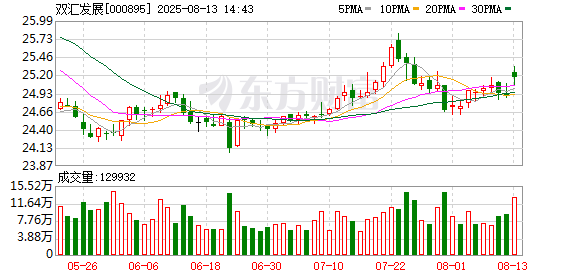
Core Viewpoint - The company, Shuanghui Development, reported steady growth in revenue and profit for the first half of 2025, demonstrating strong operational capabilities and a commitment to shareholder returns through significant dividend payouts [1][2][7]. Financial Performance - In the first half of 2025, the company achieved operating revenue of 28.41 billion yuan, a year-on-year increase of 3.0%, and a net profit attributable to shareholders of 2.32 billion yuan, up 1.2% [1]. - The second quarter saw a revenue of 14.14 billion yuan, reflecting a 6.2% increase year-on-year, while net profit rose by 15.7% to 1.19 billion yuan [2]. - Total external sales of meat products reached 1.57 million tons, marking a 3.67% increase compared to the previous year [2]. Operational Efficiency - The company improved its inventory management, reducing inventory turnover days from 62 to 51 days, and increasing inventory turnover rate from 2.9 to 3.5 times [3]. - The total assets of the company reached 38.096 billion yuan by the end of the second quarter, a 2.17% increase from the end of the previous year [2]. Cost Control - Management expenses decreased by 1.70% to 62.05 million yuan, while financial expenses dropped significantly by 28.84% to 58.18 million yuan, easing the financial burden [5]. Market Strategy - The company expanded its distributor network to 21,415, an increase of 2.64% from the beginning of the year, while also enhancing partnerships with brands and online platforms [6]. - Shuanghui is diversifying its product offerings, launching new high-end meat products and low-fat options to meet diverse consumer demands [6]. Shareholder Returns - The company plans to distribute a cash dividend of 6.5 yuan per 10 shares, totaling approximately 2.252 billion yuan, which represents 97% of its net profit for the first half of the year [7]. - Since its listing in 1998, Shuanghui has implemented 31 dividend distributions, totaling 62.243 billion yuan, reflecting its strong cash generation ability and commitment to shareholder interests [7]. Industry Outlook - The domestic meat consumption upgrade trend is evident, with increasing demand for chilled and processed meat products, indicating significant room for structural adjustment in the industry [8]. - Shuanghui's strategic focus on "industrialization, diversification, internationalization, and digitalization" positions it well to capitalize on industry changes and maintain its leading position in the meat processing sector [8].

万洲国际盘中涨超6%报8.36港元,股价创历史新高
Mei Ri Jing Ji Xin Wen· 2025-08-13 03:50
每经AI快讯,8月13日,万洲国际(00288.HK)盘中涨超6%报8.36港元,股价创历史新高,市值突破千亿 港元。 ...
万洲国际绩后涨逾5% 中期股东应占利润同比增加0.51%
Xin Lang Cai Jing· 2025-08-13 01:56
公告称,收入增加此乃由于猪肉销量及肉制品平均销价上升。经营利润亦上升10.4%至12.59亿美元,主 要原因是猪肉业务大幅增长。 来源:新浪港股 万洲国际(00288)绩后股价上涨4.96%,现报8.26港元,成交额9842.83万港元。 8月12日,万洲国际发布截至2025年6月30日止6个月业绩,生物公允价值调整后,该集团取得收入 133.87亿美元,同比增加8.9%;公司拥有人应占利润7.88亿美元,同比增加0.51%;每股基本盈利6.14美 分,拟派发中期股息每股0.2港元。 在所有经营分部中,肉制品一直是集团的核心业务。于回顾期间,肉制品占本集团83.2% 的经营利润以 及本集团49.6%的收入(比较期间:分别占99.7%及52.8%)。 ...
双汇发展: 半年报董事会决议公告
Zheng Quan Zhi Xing· 2025-08-12 16:14
证券代码:000895 证券简称:双汇发展 公告编号:2025-19 河南双汇投资发展股份有限公司 第九届董事会第八次会议决议公告 本公司及董事会全体成员保证信息披露的内容真实、准确和完整,没有虚 假记载、误导性陈述或重大遗漏。 一、 董事会会议召开情况 以公司现有总股本 3,464,661,213 股为基数,向全体股东按每 10 股派发现金 红利 6.50 元(含税),共计派发现金红利 2,252,029,788.45 元,不送红股,也不进 行资本公积金转增。 (一) 河南双汇投资发展股份有限公司(以下简称公司)于 2025 年 7 月 30 日 以电子邮件和电话方式向公司全体董事发出召开第九届董事会第八次会议的通 知。 (二) 董事会会议于 2025 年 8 月 9 日在公司会议室以现场表决结合通讯表决 的方式召开。 (三) 董事会会议应到董事 8 人,实到董事 8 人。 (四) 董事会会议由董事长万宏伟先生主持,监事和高级管理人员列席会议。 (五) 董事会会议的召集、召开程序,表决程序及表决方式符合《中华人民共 和国公司法》(以下简称《公司法》)等有关法律、行政法规、规范性文件和《河 南双汇投资发展股份 ...