
税务服务

Search documents
从事涉税服务人员个人信用积分指标体系及积分记录规则
蓝色柳林财税室· 2025-09-01 09:25
Core Viewpoint - The article outlines the credit scoring system for tax-related professionals, detailing the criteria and scoring rules for various qualifications and services provided, emphasizing the importance of maintaining accurate and complete information for credit evaluation [2][8]. Group 1: Basic Information - Real-name information that is complete and accurate scores 5 points; incomplete or inaccurate information does not score [2]. - Tax-related professional qualifications, including tax advisors, certified public accountants, and lawyers, score 5 points each, and these points can be accumulated [2]. - Membership in tax-related professional associations scores 3 points, with a maximum of 3 points for this category [2]. Group 2: Credit Level Evaluation - The credit level of the tax service institution affects scoring: TSC5 level scores 10 points, TSC4 level scores 7 points, and TSC3 level scores 3 points; other situations score no points [2]. - If the tax service institution changes, the score is calculated based on the new institution's credit level [2]. - For individuals working in multiple institutions, the score is based on the lowest credit level among them [2]. Group 3: Professional Records - The scoring for tax declaration agency services is tiered based on the number of clients served within a year, with different scoring rates for different ranges of clients [2]. - For general tax consulting, providing services to the same client more than once in a year scores 1 point, while serving multiple clients accumulates points [2]. - For tax planning and various tax verification services, points are awarded based on the number of times services are provided to clients within a year, with specific points assigned for each type of service [2]. Group 4: Credit Rating Standards - The tax authority uses a scoring system based on the completeness of tax payment information, starting from 100 points for complete records, with deductions for missing information [8]. - Direct classification as D-level occurs for entities involved in serious tax violations, such as tax evasion or fraudulent activities [10][11]. - D-level entities face strict measures, including limitations on invoice usage and increased monitoring [17][19].


别让额度拖后腿!数电票额度调整指南来了操作步骤
蓝色柳林财税室· 2025-08-31 03:13
Group 1 - The article discusses the process for adjusting invoice quotas in the national unified electronic tax bureau, highlighting the steps required for taxpayers to submit their applications [4][5][6] - Tax authorities have the discretion to adjust the invoice quotas based on various circumstances deemed necessary during daily management [5][6] - The application process includes logging into the electronic tax bureau, selecting the appropriate options, and providing necessary documentation for the adjustment request [4][5] Group 2 - Specific conditions for voiding invoices are outlined, including scenarios such as sales returns, erroneous invoicing, and service interruptions [14][15] - The article specifies that paper invoices must be marked as "void" and returned in full to be considered voided, while electronic invoices cannot be voided and must be replaced with red invoices [15] - The conditions for voiding invoices include timely return of the invoice, no tax reporting by the seller, and no certification by the buyer [15]

从事二手车经销,如何享受增值税优惠?申报表如何填写?
蓝色柳林财税室· 2025-08-29 00:49
Core Viewpoint - The article discusses the VAT preferential policy for second-hand car dealers, detailing the reduced VAT rate and the necessary procedures for tax declaration [2][5]. Group 1: VAT Policy for Second-Hand Car Dealers - From May 1, 2020, to December 31, 2027, second-hand car dealers can apply a reduced VAT rate of 0.5% instead of the standard 3% on the sale of second-hand cars [2]. - Second-hand cars are defined as vehicles that have completed registration and are sold before reaching the mandatory scrapping standard, with specific regulations outlined by the State Council [2]. Group 2: Sales Calculation and Invoicing - The sales amount for VAT calculation is determined by the formula: Sales Amount = Tax-Inclusive Sales Amount / (1 + 0.5%) [3]. - Dealers must issue a unified invoice for second-hand car sales, and if the buyer requests a special VAT invoice, it should also reflect the 0.5% VAT rate [3][4]. Group 3: Tax Declaration Procedures - General taxpayers must report the sales amount under the section for "3% tax rate goods and processing services" in the VAT declaration form, and the corresponding VAT reduction should be calculated at 2.5% of the sales amount [6]. - Small-scale taxpayers should report the sales amount in the section for "VAT-exempt sales amount (3% tax rate)" in their applicable VAT declaration form, with the VAT reduction also calculated at 2.5% [7]. Group 4: Policy References - The article references several official announcements regarding VAT policies for second-hand car sales, including the 2020 and 2023 announcements from the Ministry of Finance and the State Taxation Administration [9].

【12366问答】支持小微企业和个体工商户发展税费优惠政策
蓝色柳林财税室· 2025-08-28 14:13
Core Viewpoint - The article provides a comprehensive overview of tax relief policies aimed at supporting small and micro enterprises, as well as individual businesses, highlighting specific regulations and procedures for tax exemptions and reductions. Group 1: VAT Policies for Small-scale Taxpayers - Small-scale taxpayers with monthly sales below 100,000 yuan are exempt from VAT and can issue special VAT invoices marked with "免税" for motor vehicle sales [1] - For small-scale taxpayers whose monthly sales are around 100,000 yuan, if uncertain about exceeding this threshold, they should initially issue invoices at a 1% tax rate and can adjust during tax declaration based on actual sales [2] Group 2: Individual Income Tax Policies for Individual Businesses - From January 1, 2023, to December 31, 2027, individual businesses with annual taxable income not exceeding 2 million yuan can enjoy a 50% reduction in individual income tax [4] - The calculation for the tax reduction amount for individual businesses is based on the taxable income not exceeding 2 million yuan, adjusted for other tax relief policies [6] Group 3: Tax Procedures for Small Micro Enterprises - Small micro enterprises can enjoy corporate income tax relief by accurately filling out the tax declaration form during prepayment and annual settlement, with the system automatically calculating the tax reduction [8]

涉税专业服务执业每一课之《税务师事务所行政登记、变更、中止涉税服务、终止行政登记信息篇》
蓝色柳林财税室· 2025-08-26 08:31
Group 1 - The article discusses the procedures for tax firms to register, change, suspend, and terminate their administrative registrations in the electronic tax bureau [3][4][5][6] - It outlines the requirements for tax firms to update their basic information, including changes in name, organization form, business location, partners, and legal representatives, within 20 working days after any changes [4] - The article emphasizes the need for tax firms to log in to the electronic tax bureau using their unified social credit code and other credentials to manage their operations [3][4][5] Group 2 - The article details the process for tax firms to suspend their tax services, which requires terminating all collected commission agreements before proceeding [5] - It also explains the steps for tax firms to terminate their administrative registration, which must be done after submitting materials to the provincial tax authority [5][6] - The article provides a comprehensive guide on how to manage personnel information within the tax firm, including adding, editing, or deleting staff members [4][5] Group 3 - The article introduces a new policy aimed at supporting technological innovation and manufacturing development, specifically regarding the VAT deduction policy for advanced manufacturing enterprises [12] - It defines advanced manufacturing enterprises as high-tech enterprises that meet specific criteria set by the relevant authorities [13] - The article outlines the criteria for enterprises to qualify for the VAT deduction policy, including R&D expenditures and sales ratios [15][16] Group 4 - The article specifies the timeline for enterprises to apply for inclusion in the 2025 advanced manufacturing enterprise list, with deadlines for both existing and new applicants [16] - It clarifies the duration of policy enjoyment for high-tech enterprises based on their qualification status throughout 2025 [17] - The article explains how branch offices can apply for the policy, detailing the responsibilities of both the parent company and the branches [18]

中国政府税务部门文件加拿大翻译公证报税用
Sou Hu Cai Jing· 2025-08-23 11:47
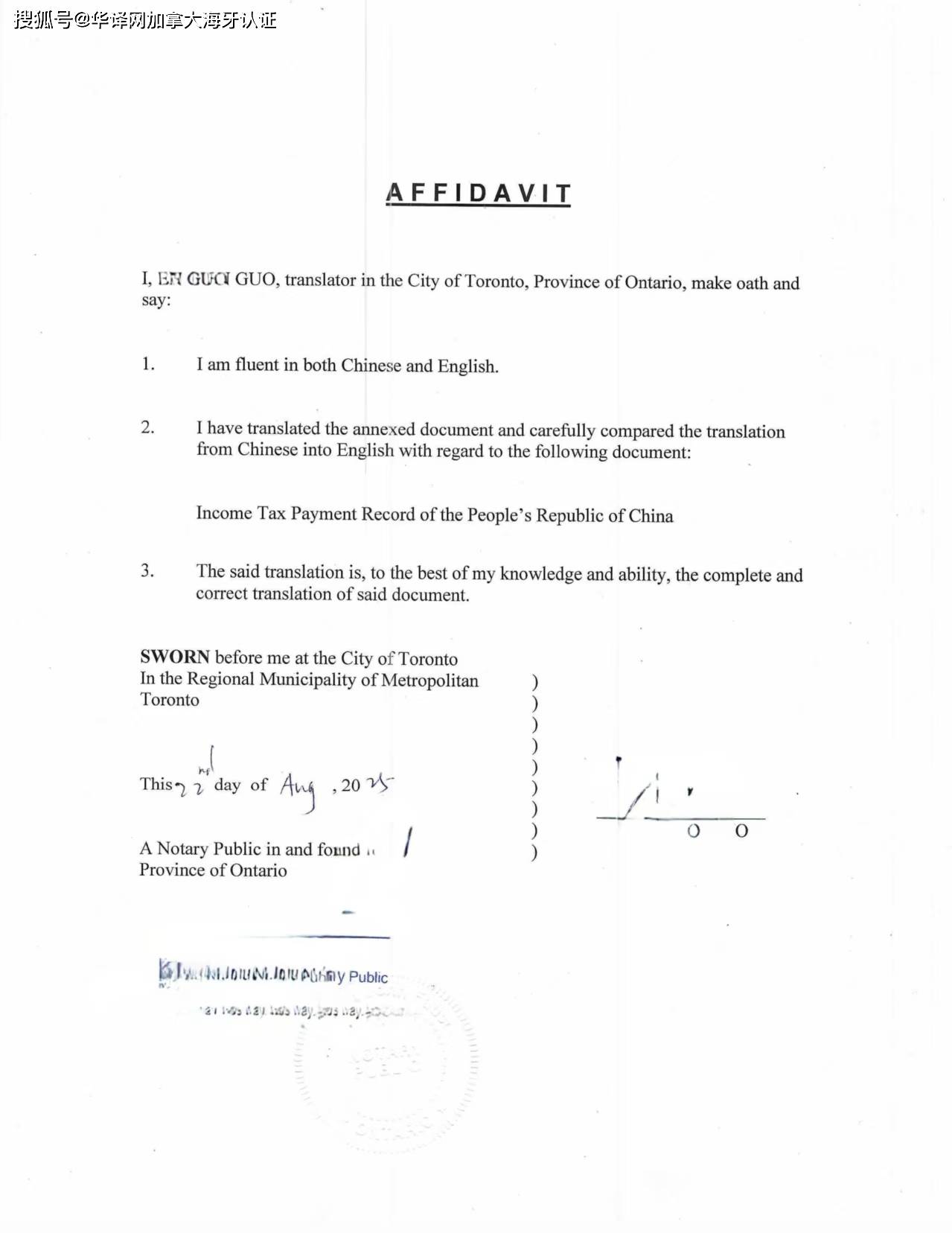
Core Points - The article discusses the process for translating and notarizing Chinese tax documents for use in Canada, emphasizing the importance of professional translation and notarization to ensure legal validity [1][2][3]. Group 1: Document Requirements - The Canada Revenue Agency (CRA) has strict requirements for translated documents, which must be accurately translated and certified by a licensed translator and notary public to be considered valid [2]. - The document provided by the taxpayer is a Personal Income Tax Payment Record issued by the Chinese tax authority, covering the period from January 2024 to December 2024, detailing monthly income and tax payments [3]. Group 2: Translation and Notarization Process - The process involves several steps, starting with document verification to confirm its authenticity and legal standing [4]. - A certified translator performs a word-for-word translation, ensuring that key financial terms are accurately translated, such as "Actual Amount Paid" for "实缴(退)金额" and "Employment Income" for "工资薪金所得" [5]. - After translation, a Certificate of Accuracy is issued by the translator, confirming the translation's fidelity to the original document [6]. - The translated document is then submitted to a licensed notary public for verification, who issues a notarization certificate to confer legal validity to the translation [7]. Group 3: Timeliness and Efficiency - The entire process can be completed within 1-2 business days, which is faster than many might expect [8]. - The successful submission of the translated and notarized document to the CRA allowed the taxpayer to complete their annual tax filing without any issues or requests for additional information [9]. Group 4: Client Feedback and Conclusion - The taxpayer expressed satisfaction with the efficiency of the process, highlighting that finding a professional agency for translation and notarization made the experience straightforward and stress-free [9]. - The case illustrates that for Chinese tax documents to be used in Canada, professional translation and notarization are essential, and the combined approach ensures acceptance by Canadian tax authorities and financial institutions [9].
加拿大税务局CRA大幅裁员6500人 工会急了
Sou Hu Cai Jing· 2025-08-23 03:40
Core Points - The federal union representing Canada Revenue Agency (CRA) employees has launched an online campaign condemning significant layoffs by the government [1] - The union claims that the reduction of approximately 3,300 call center employees last year has led to delays, long wait times, and dropped calls [1] - The union's main goal is to urge the government to stop layoffs, retain call center jobs, and rehire employees due to severely impacted service levels [1][5] Group 1 - The CRA's workforce has grown from nearly 44,000 in 2019 to about 59,000 by 2024, but is projected to decrease to approximately 52,500 by 2025 [4][6] - The union highlights that the government is attempting to reduce employee numbers to pre-pandemic levels, despite a continued shortage of staff at CRA [5] - The union is collaborating with the Public Service Alliance of Canada to encourage the public to contact their MPs regarding service complaints and share their experiences [5] Group 2 - The federal government has mandated most departments and agencies to cut project spending by 15% by 2028-29 [6] - The CRA's departmental plan for 2025-26 indicates a reduction in full-time employees from 50,804 in 2025-26 to 47,732 by 2027-28, primarily due to funding cuts [6] - The union anticipates more layoffs later this year, potentially affecting permanent employees in other CRA departments [5]

让企业告别“两地跑” 上海已实现纳税缴费“跨域办”3.64万次
Jie Fang Ri Bao· 2025-08-22 01:47
Core Viewpoint - The Shanghai Taxation Bureau has launched the "Cross-Domain Cloud Interaction Taxation" initiative to facilitate online tax services for taxpayers, achieving significant interaction volumes in 2023 [1] Group 1: Service Implementation - The "Cross-Domain Service" initiative has enabled remote identity verification, document transmission, and screen sharing, addressing the challenges of tax processing for businesses operating in different locations [1] - In 2023, Shanghai has recorded a total of 36,400 interactions for tax payment services, with 10,500 of these being cross-province interactions [1] Group 2: Service Efficiency - The Shanghai Taxation Department reported a 27% reduction in the total number of service windows compared to the same period last year, alongside a 33% decrease in window transaction volumes [1] - Despite the reduction in physical service windows, the demand for interactive services has surged, with a 209% increase in manual service interactions and stable growth in remote transactions [1]
电子税务局常见问题汇总解答
蓝色柳林财税室· 2025-08-21 15:06
Core Viewpoint - The article provides guidance on using the electronic tax bureau for various tax-related inquiries and processes, including checking the status of tax declarations, handling overdue payments, and understanding eligibility for tax exemptions. Group 1: Tax Declaration and Inquiry - Users can check the cancellation time of tax declarations through the "One-stop Query" module by selecting the type of declaration and the cancellation flag [2] - To check for overdue payments, users must log in as a business entity and navigate to the "Account Query" section [3] - The system allows users to query illegal and violation information by selecting the processing status and setting date ranges [4] Group 2: Employment Tax Exemption - According to the announcement from the Ministry of Finance, companies with fewer than 30 employees are exempt from the disability employment security fund from January 1, 2023, to December 31, 2027 [7] - The new electronic tax system determines eligibility based on taxpayer registration information, and users can verify their status through the "Taxpayer Information Query" [7][8] - Non-enterprise entities are not eligible for the exemption but may qualify for reduced payments under the same policy [9] Group 3: VAT and Additional Tax Corrections - If a VAT and additional tax declaration has already been submitted, users cannot make corrections to the prepayment declaration [10] - Users encountering issues with social credit codes during VAT prepayment must ensure their registration information is consistent with the unified social credit code [10] - For correcting stamp duty declarations, users should follow specific steps to access the correction interface and submit necessary changes [18][19][23]

天津税务上线智能新功能 申报表“自动体检”提醒纠错
Sou Hu Cai Jing· 2025-08-21 02:12
Group 1 - The core idea of the news is the introduction of the "Intelligent Self-Check" feature by the Tianjin Taxation Bureau, which helps taxpayers identify and correct errors in their tax declarations before submission, significantly reducing the risk of mistakes [1][2] - The feature has been successfully piloted in the Heping District and the China-Singapore Tianjin Eco-City Taxation Bureau, with plans for citywide implementation in the future [1] - The "Intelligent Self-Check" function automatically verifies the logical relationships between different tax declaration forms, allowing taxpayers to quickly locate and fix issues before submission [1][2] Group 2 - The self-check function currently covers seven tax types, including value-added tax, corporate income tax, property tax, and urban land use tax, supporting both general and small-scale taxpayers [2] - On the first day of launch, 324 taxpayers triggered the self-check, with three identifying and correcting issues; within the first week, the self-check was triggered 1,837 times, achieving a problem correction rate of over 80% [2] - The tax bureau plans to fully promote this feature through publicity and internal training, establishing a comprehensive declaration management mechanism that includes pre-filing guidance, in-process verification, and post-filing evaluation [2]