Solar

Search documents
通威股份_2025 年上半年亏损并不意外;所有人都关注 “反内卷” 措施的效果与实施情况
2025-08-31 16:21
Summary of Tongwei's 1H25 Earnings Call Company Overview - **Company**: Tongwei (600438.SS) - **Industry**: Polysilicon and Solar Energy Key Financial Highlights - **Net Loss**: Tongwei reported a net loss of Rmb4,955 million in 1H25, including Rmb2,363 million in 2Q25, a significant decline from a net profit of Rmb3,129 million in 1H24 [1] - **Sales Price Declines**: Average selling prices (ASPs) for polysilicon, solar cells (TOPCon), and solar modules fell by 29%, 32%, and 25% year-over-year (yoy) respectively in 1H25 [1] - **Operating Cash Flow**: Deteriorated to negative Rmb1,951 million in 1H25 from positive Rmb961 million in 1H24 [1] - **Net Debt to Equity Ratio**: Increased by 6.9 percentage points to 117% in 1H25 due to reduced equity value from net losses [1][7] - **Return on Equity (ROE)**: Worsened to negative 10.7% in 1H25 from negative 5.2% in 1H24 [1] Sales and Market Position - **Polysilicon Shipment**: Recorded a shipment volume of 161.3k tonnes, down 29.5% yoy, maintaining a 30% global market share [2] - **Solar Cell and Module Shipments**: Solar cell shipments increased by 55.9% yoy to 49.89GW, while module shipments rose by 31.3% yoy to 24.52GW [2] - **Production Capacity**: Tongwei has an annual production capacity of 900,000 tonnes of polysilicon, 150GW of solar cells, and over 90GW of modules [2] Margin Analysis - **Gross Profit Margin**: Fell to 1.5%, a decrease of 3.6 percentage points yoy, marking the worst margin performance in the last 10 years [3][9] - **Operating Profit Margin**: Reported at -11.1%, a decline of 0.9 percentage points yoy [9] Future Outlook and Strategic Measures - **Anti-Involution Measures**: The effectiveness and implementation of China's anti-involution measures are expected to significantly impact Tongwei's profitability in 2H25. These measures aim to curb low-price competition and improve pricing mechanisms [8] - **Capex Reduction**: Anticipated further cuts in capital expenditures in 2H25 due to excess production capacity and unprofitable new capacity under current pricing conditions [7] Valuation and Investment Perspective - **Target Price**: The target price for Tongwei is set at Rmb25.00 per share, reflecting an expected return of 18.9% [4][15] - **Market Capitalization**: Approximately Rmb94,677 million (US$13,212 million) [4] Risks and Considerations - **Key Risks**: Potential risks include prolonged support for less efficient solar equipment manufacturers and unexpected growth in solar installations in China [16] Conclusion - Tongwei's financial performance in 1H25 reflects significant challenges due to declining prices and increased competition in the polysilicon market. The company's future performance will heavily depend on the successful implementation of government measures aimed at stabilizing the industry.

X @Bloomberg
Bloomberg· 2025-08-28 17:42
The US government’s energy statistics agency has delayed a key uranium report and suspended an annual solar analysis as Trump administration staff cuts begin to take hold https://t.co/K3u6zIhacu ...
What Makes Shoals Technologies Group (SHLS) a Strong Momentum Stock: Buy Now?
ZACKS· 2025-08-28 17:00
Company Overview - Shoals Technologies Group (SHLS) currently holds a Momentum Style Score of B, indicating a positive outlook based on its price change and earnings estimate revisions [2] - The company has a Zacks Rank of 2 (Buy), which suggests it is expected to outperform the market [3] Price Performance - Over the past week, SHLS shares have increased by 24.86%, significantly outperforming the Zacks Solar industry, which rose by 1.56% during the same period [5] - In a longer time frame, SHLS shares have risen by 32.65% over the past quarter and 26.21% over the last year, while the S&P 500 has only moved 9.72% and 16.49%, respectively [6] Trading Volume - The average 20-day trading volume for SHLS is 6,312,327 shares, which is considered a bullish sign as it indicates strong interest in the stock [7] Earnings Estimates - In the past two months, five earnings estimates for SHLS have been revised upwards, with no downward revisions, leading to an increase in the consensus estimate from $0.35 to $0.38 [9] - For the next fiscal year, five estimates have also moved upwards without any downward revisions [9] Conclusion - Considering the positive price momentum, strong trading volume, and favorable earnings outlook, SHLS is positioned as a solid momentum pick with a 2 (Buy) rating and a Momentum Score of B [11]


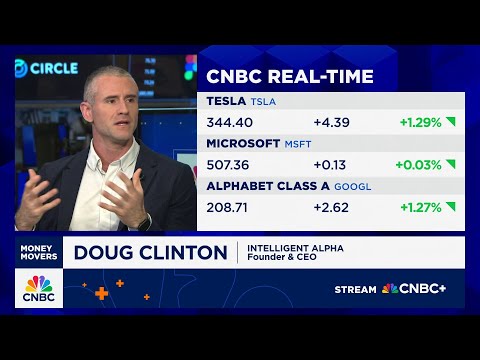
The AI bull run has a few years of legs left to run, says Intelligent Alpha's Doug Clinton
CNBC Television· 2025-08-25 16:05
Nvidia Earnings and Market Position - Nvidia is expected to beat revenue and EPS estimates, potentially alleviating concerns about AI [2] - Nvidia's valuation, with a forward earnings multiple in the low 30s, is considered reasonable compared to other tech companies [3] - The AI bull market is projected to continue for another 2-4 years [4] AI Market Dynamics - The AI market is currently considered "hot" and may experience periods of cooling off [5] - Data Dog (DDOG) is highlighted as a potentially beneficial AI-related investment due to the increasing need for observability in enterprise AI applications [6] Alternative Investment Opportunities - Solar energy is identified as a non-AI investment opportunity, potentially benefiting from increased domestic manufacturing and policy adjustments [7] - The increasing strain on the power grid supports the bullish argument for solar energy [8]

中国太阳能:反内卷 II,更清晰的信号
2025-08-25 02:04
Summary of Key Points from the Conference Call Industry Overview - The conference call focused on the **China Solar Industry**, particularly the recent developments and government initiatives aimed at stabilizing the market and addressing pricing issues [2][7]. Core Insights and Arguments 1. **Government Engagement**: The Ministry of Industry and Information Technology (MIIT) initiated a series of meetings with various government authorities and industry stakeholders, indicating a more coordinated approach to the solar sector [2][7]. 2. **Price Control Measures**: A price control mechanism was introduced, resulting in a **38% increase in polysilicon spot prices** since July. This increase is expected to gradually affect the pricing of wafers and cells, although module prices remain stable due to weak demand [3][7]. 3. **Market Sentiment**: Investor sentiment is shifting positively towards the solar sector, with a recommendation to buy shares of **GCL Technology Holdings (3800 HK)**, which is positioned as a cost leader in polysilicon production [4][7]. 4. **Regulatory Focus**: The government aims to halt irrational price wars and promote fair competition based on quality and technology rather than pricing, which could lead to a healthier market environment [7]. Financial Projections for GCL Technology 1. **Revenue Growth**: Projected revenues for GCL are expected to rise from **CNY 15,098 million in 2024** to **CNY 30,290 million by 2027**, reflecting a compound annual growth rate (CAGR) of approximately 25.7% [18][19]. 2. **Profitability Outlook**: GCL is anticipated to report a net profit of **CNY 162 million in 2025**, with further increases to **CNY 2,484 million by 2027** [18][19]. 3. **Valuation Metrics**: The target price for GCL is set at **HKD 1.65**, representing a **38.7% upside** from the current price of **HKD 1.19** [17][25]. Additional Important Insights 1. **Capacity and Shipments**: GCL's polysilicon capacity is expected to remain stable at **480,000 tons**, with shipments projected to increase from **282,000 tons in 2024** to **384,000 tons by 2027** [20]. 2. **Cost Structure**: The average selling price (ASP) of polysilicon is projected to rise from **CNY 39/kg in 2024** to **CNY 70/kg by 2027**, while the cost of goods sold (COGS) is expected to stabilize around **CNY 34/kg** [20]. 3. **Market Dynamics**: The anticipated anti-involution measures are expected to lead to a recovery in module bidding prices, which had declined in July [9][7]. This summary encapsulates the key points discussed during the conference call, highlighting the strategic direction of the China solar industry and the financial outlook for GCL Technology Holdings.

X @Bloomberg
Bloomberg· 2025-08-23 05:42
Market Trends - China's solar installation slowed in July due to developer caution [1] - Developers are awaiting details on a new policy that may impact renewable returns [1]
X @Bloomberg
Bloomberg· 2025-08-22 15:48
Financial Performance - Longi Green reported a narrower first-half loss [1] Industry Dynamics - Surge in solar panel installations helped limit the impact of industry overcapacity [1]
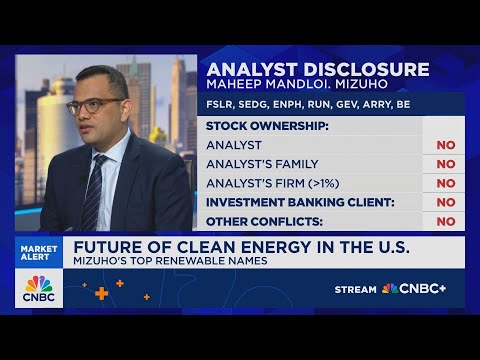
Mandloi: Solar modules are already three times more expensive in the United States
CNBC Television· 2025-08-22 11:19
Government Policy & Regulations - The US President's negative stance on solar and wind energy is noted, but the impact on investment is questioned [1] - Federal funding directly for renewable energy projects accounts for less than 5% of total projects [2] - Tax credits for the renewable energy industry are available through the end of 2030 [3] - Section 232 investigation into wind turbines and their components is underway, potentially impacting the sector [10] - Potential Section 232 tariffs on polysilicon could also affect the solar industry [10] - The Inflation Reduction Act provides more consistent long-term policy support [9] Tariffs & Manufacturing - Tariffs have been impacting the solar sector since 2012 [4] - Solar models are already three times more expensive in the US than in the rest of the world due to existing tariffs [6] - Tariffs are driving manufacturing to move to the US [6][9] - Domestic manufacturing provides an advantage when it comes to tariffs [7] - The tariff strategy is working by encouraging domestic manufacturers to increase supply [9] Company Highlights & Investment Picks - First Solar benefits from nearshoring and anti-China policies [6][8][11] - Sunrun, a residential solar company, is favored as it is not subject to federal approvals and also engages in energy storage [11] - Bloom Energy, focused on fuel cells for data centers, is also highlighted [11]