数字产品服务业

Search documents
【西安】发布重点产业紧缺人才需求目录
Shan Xi Ri Bao· 2025-11-18 23:04
Core Insights - The "2025 Xi'an Key Industry Talent Demand Directory" has been released to match talent needs with key pillar industries, digital economy sectors, and future industries in Xi'an [1][2] - The directory includes a total of 214 critical positions, with 115 in key pillar industries, 53 in the digital economy, and 46 in future industries [1] Group 1: Talent Demand by Industry - The electronic information industry has critical positions such as analog IC design engineers and algorithm engineers [1] - The high-end equipment manufacturing sector requires positions like power electronics R&D engineers and mechanical R&D engineers [1] - The automotive industry is looking for embedded development engineers and automotive project managers [1] Group 2: Shortage Position Distribution - High-end equipment manufacturing and digital product service industries have the highest proportion of critical positions, each at 10.3% [1] - The electronic information, aerospace, and new materials and renewable energy industries follow closely, each with a critical position proportion of 9.8% [1] - The automotive industry has a critical position proportion of 7.9%, while digital product manufacturing stands at 6.5%, and both food and biomedicine, as well as hydrogen and energy storage industries, are at 6.1% [1] Group 3: Educational Requirements - Key pillar industries show a broad demand for various educational levels, while future industries have a strong demand for PhD-level talent [2] - The digital economy sector has a relatively balanced educational requirement across different positions [2] - The proportion of critical positions in management, technical R&D, marketing, and professional support roles in key pillar industries is significantly higher than in digital economy and future industries [2]
去年发明专利授权量达50万件 位居全球第一 我国数字经济核心产业创新创造活跃
Ren Min Ri Bao· 2025-09-11 21:55
Group 1 - The core viewpoint of the articles highlights that China's digital economy core industry is projected to achieve 500,000 invention patent authorizations in 2024, ranking first globally with a year-on-year growth of 23.1%, significantly surpassing the global average growth rate [1] - The digital economy core industry encompasses various economic activities that rely on digital technologies, products, services, and infrastructure, including digital product manufacturing, digital product services, and digital technology applications [1] - The number of overseas invention patent authorizations in China's digital economy core industry has increased from 21,000 in 2016 to 52,000 in 2024, indicating a robust growth in international patent activity [1] Group 2 - The construction of data intellectual property systems has been steadily advancing, with a total of 58,000 data intellectual property registration applications accepted nationwide as of June this year, and nearly 30,000 registration certificates issued [2] - Over 90% of the registration entities for data intellectual property are enterprises, and the registered data covers 83 out of 97 major categories of the national economy [2] - The cumulative financing amount for data intellectual property has exceeded 10 billion yuan, with transaction licensing amounts surpassing 580 million yuan and securitization amounts exceeding 200 million yuan [2]
趋势研判!2025年中国海南省数字经济行业相关政策、产业链、营业收入、主要企业及前景展望:海南省释放数字经济澎湃动能,助力海南自贸港快速发展[图]
Chan Ye Xin Xi Wang· 2025-05-08 01:20
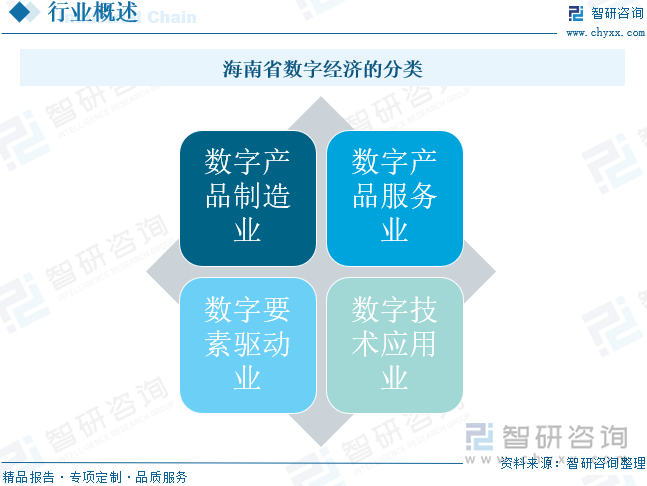
Core Viewpoint - Hainan is leveraging its unique geographical advantages to develop a robust digital economy, focusing on digital infrastructure and industry transformation, with significant growth projected in the coming years [1][12]. Group 1: Hainan's Digital Economy Overview - The digital economy in Hainan integrates advanced technologies such as the internet, big data, cloud computing, and artificial intelligence, becoming a new engine for the development of the Hainan Free Trade Port [3]. - Hainan's digital economy encompasses four core industries: digital product manufacturing, digital product services, digital technology applications, and data-driven industries [3]. Group 2: Digital Economy Policies - Hainan has implemented various policies to accelerate digital economy development, including the "Hainan Free Trade Port Digital Economy Promotion Regulations" and the "Three-Year Action Plan to Boost and Expand Consumption" [5][7]. - By 2027, the revenue from Hainan's core digital economy industries is expected to exceed 2,200 billion yuan [5]. Group 3: Digital Economy Industry Chain - The upstream of Hainan's digital economy industry chain includes hardware facilities, basic software and technology, and data elements, which are essential for data transmission and processing [8]. - The midstream focuses on the deep integration of digital technology with the real economy, promoting the digital transformation and intelligent upgrading of traditional industries [8]. Group 4: Current Development Status - Hainan has accelerated the construction of digital infrastructure, including international submarine cables, data centers, and 5G applications, with a total of 37,700 5G base stations built by 2024 [10][12]. - The revenue of Hainan's digital economy core industries is projected to exceed 2,000 billion yuan in 2024, representing a 70% increase from 2022 [12]. Group 5: Key Enterprises in the Digital Economy - Key enterprises in Hainan's digital economy include Alibaba (Hainan), ByteDance (Hainan), and various local innovative companies, which together create a vibrant industrial ecosystem [18][19]. - Alibaba (Hainan) is a leading player in information transmission and software services, while ByteDance (Hainan) leverages its parent company's resources to expand rapidly in the digital content sector [18][19]. Group 6: Future Trends - Hainan is expected to become a hub for international data flow and digital trade, driven by the continuous release of policy dividends and the expansion of cross-border data security trials [24]. - The integration of digital economy with traditional industries such as tourism, agriculture, and healthcare will create new business models and enhance the value of traditional sectors [26].