
数字产品服务业

Search documents
2025年广州经济的“稳”与“进”
Sou Hu Cai Jing· 2026-02-06 07:07
Core Insights - Guangzhou's economic performance in 2025 reflects resilience amid external challenges and internal structural adjustments, with a focus on consumption and industrial upgrades as dual engines of growth [1][6] Consumption Dynamics - The city's consumption market shows strong resilience, with daily retail sales for automobiles and communication devices reaching 375 million yuan and 132 million yuan respectively, and various goods maintaining an annual growth rate of over 6% [3] - Online retail sales of physical goods exceeded 350 billion yuan, marking a 13.1% year-on-year increase and accounting for 31.9% of total retail sales, indicating a transition from a traditional to a digital commerce hub [3] - Service consumption is becoming a new growth driver, with over 110,000 commercial performances held in a year, attracting 264 million tourists and boosting cultural and tourism consumption [3][4] Infrastructure and Investment - Baiyun Airport handled over 83 million passengers, ranking among the top ten globally, while the metro system recorded an annual ridership of 3.4 billion, showcasing robust transportation infrastructure [4] - New loans exceeded 510 billion yuan, ranking third nationally, with actual foreign investment growing by 9.1%, supporting the consumption infrastructure [4] Industrial Growth - The service sector's contribution to GDP surpassed 2.4 trillion yuan, accounting for over 80% of GDP growth, with the productive service industry making up 59% of this sector [4] - The digital economy is rapidly expanding, with core industry value-added growth at 6%, and digital product services growing by 15% [4][6] - Traditional industries are revitalizing through technological upgrades, with significant investments in industrial technology improvements during the 14th Five-Year Plan period [5][6] Emerging Industries - The "3+5" strategic emerging industries are projected to exceed 1 trillion yuan in value-added, growing by 4.2% and constituting 32.4% of GDP [6] - The automotive sector is transitioning towards new energy vehicles, with production increasing by 21.6%, and significant growth in charging stations and battery production [6] - The integration of innovation and industry is evident, with a notable increase in the number of specialized small and medium enterprises contributing significantly to industrial growth [6] Conclusion - Guangzhou's economic report illustrates a balanced approach to transitioning from old to new, with a solid foundation for current stability and a clear trajectory for future growth [6]


国家统计局:2024年全国数字经济核心产业增加值为140891亿元 占GDP比重为10.5%
智通财经网· 2025-12-30 04:08
Core Insights - The core viewpoint of the article highlights the significant contribution of the digital economy to China's GDP, with the core industries of the digital economy accounting for 10.5% of the total GDP in 2024 [1][2]. Summary by Category - **Digital Economy Core Industries**: The total value added of the digital economy core industries is 140,891 billion yuan, representing 10.5% of GDP [1][2]. - **Digital Technology Application Industry**: This sector has the highest value added at 61,928 billion yuan, making up 44.0% of the digital economy core industries [1][2]. - **Digital Product Manufacturing Industry**: The value added in this category is 48,145 billion yuan, accounting for 34.2% of the digital economy core industries [1][2]. - **Digital Factor-Driven Industry**: This industry contributes 26,519 billion yuan, which is 18.8% of the digital economy core industries [1][2]. - **Digital Product Service Industry**: The value added here is 4,298 billion yuan, representing 3.1% of the digital economy core industries [1][2].
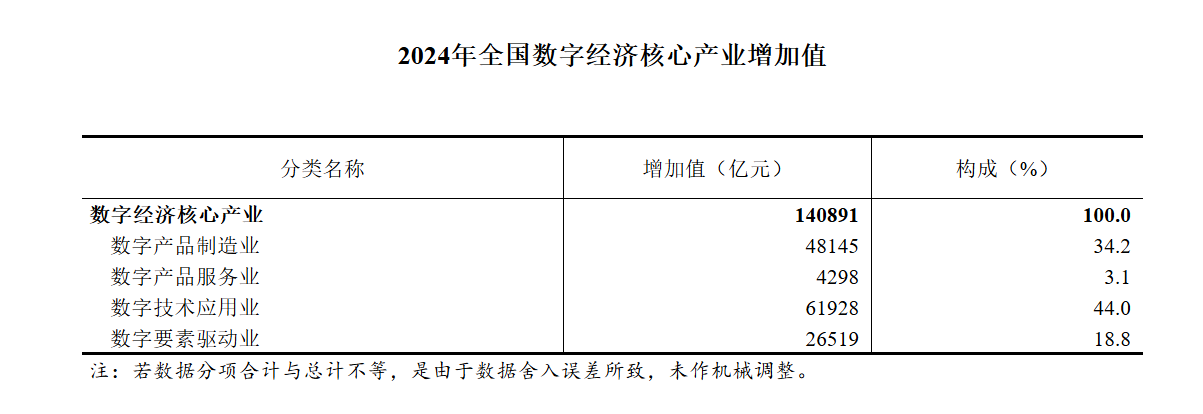
2024年全国数字经济核心产业增加值占GDP比重为10.5%
Yang Shi Wang· 2025-12-30 02:04
Core Insights - The core viewpoint of the article is that the value added by the core industries of the digital economy in China for 2024 is projected to be 140,891 billion yuan, accounting for 10.5% of the GDP [1]. Summary by Category - **Digital Economy Core Industries**: The total value added is 140,891 billion yuan, representing 100% of the digital economy core industries [3]. - **Digital Technology Application Industry**: This sector has the highest value added at 61,928 billion yuan, making up 44.0% of the digital economy core industries [1][3]. - **Digital Product Manufacturing Industry**: The value added in this category is 48,145 billion yuan, which constitutes 34.2% of the digital economy core industries [1][3]. - **Digital Factor-Driven Industry**: This industry contributes 26,519 billion yuan, accounting for 18.8% of the digital economy core industries [1][3]. - **Digital Product Service Industry**: The value added here is 4,298 billion yuan, representing 3.1% of the digital economy core industries [1][3].
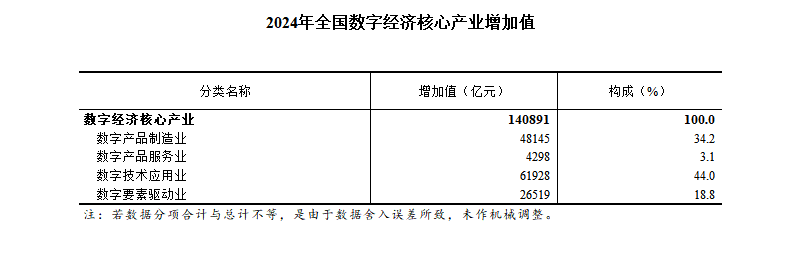
2024年全国数字经济核心产业增加值占GDP比重为10.5% - 国家统计局
Guo Jia Tong Ji Ju· 2025-12-30 01:37
Core Insights - The core value added of the national digital economy core industries in 2024 is projected to be 140,891 billion yuan, accounting for 10.5% of GDP [1][3]. Industry Composition - The digital technology application industry has the highest value added at 61,928 billion yuan, representing 44.0% of the digital economy core industries [1][3]. - The digital product manufacturing industry contributes 48,145 billion yuan, making up 34.2% of the total [1][3]. - The digital factor-driven industry adds 26,519 billion yuan, which is 18.8% of the total [1][3]. - The digital product service industry has a value added of 4,298 billion yuan, accounting for 3.1% [1][3]. Definitions and Methodology - The digital economy core industries refer to economic activities that provide digital technologies, products, services, infrastructure, and solutions for industrial digitalization, as well as those fully reliant on digital technologies and data factors [4]. - The value added of the digital economy core industries is defined as the new value created by all resident units in a certain period through production activities [4]. - The classification for the digital economy core industries is based on the "Statistical Classification of Digital Economy and Its Core Industries (2021)" and includes four main categories: digital product manufacturing, digital product services, digital technology applications, and digital factor-driven industries [5].
税收数据显示,我国新质生产力稳步发展 传统产业提质升级
Zhong Guo Xin Wen Wang· 2025-12-08 10:47
Group 1 - The core viewpoint of the articles highlights the steady development of new productive forces in China, with significant advancements in emerging industries and the upgrading of traditional industries [1][2] - From January to November, sales revenue in high-tech industries increased by 14.7% year-on-year, with high-tech service and manufacturing sectors growing by 17.2% and 11.1% respectively [1] - The sales revenue of core digital economy industries rose by 10% year-on-year, indicating ongoing progress in digital industrialization and the digitalization of industries [1] Group 2 - Traditional industries are accelerating the application of intelligent manufacturing equipment, with a 7.6% year-on-year increase in the procurement of digitalization equipment and a 9.3% increase in automation equipment [2] - There is a significant focus on energy-saving and environmental protection technologies, with a 33.2% year-on-year increase in the procurement of related services [2] - The manufacturing sector has seen a total of 16,650 billion yuan in tax reductions and refunds in the first ten months, supporting high-quality development in manufacturing [2]
10月份我国新质生产力持续壮大
Ke Ji Ri Bao· 2025-11-25 00:42
Core Insights - The latest VAT invoice data indicates that China's new quality productivity is continuously growing, with robust growth in high-end manufacturing, innovative industries, and digital-physical integration, injecting new vitality into economic development [1][2] Group 1: High-end Manufacturing - In October, the sales revenue of the equipment manufacturing industry increased by 7.3% year-on-year, consistently above the average level of the manufacturing sector, accounting for nearly half of the manufacturing share [1] - Specific sectors such as computer communication equipment manufacturing, shipbuilding and related equipment manufacturing, and battery manufacturing saw sales revenue growth of 10.1%, 24.4%, and 27.2% respectively, demonstrating strong development momentum [1] Group 2: Innovative Industries - The sales revenue of high-tech industries grew by 13.6% year-on-year in October, with high-tech service industries and high-tech manufacturing industries increasing by 16.1% and 10.1% respectively [2] - The "Artificial Intelligence +" initiative has accelerated the growth of cutting-edge industries, with sales revenue for integrated circuits, industrial robots, and drone manufacturing increasing by 32.5%, 41.7%, and 38.4% respectively [2] Group 3: Digital-Physical Integration - In October, the sales revenue of core digital economy industries rose by 8.5% year-on-year, with national enterprise procurement of digital technology increasing by 9.6%, reflecting the ongoing advancement of digital industrialization and industrial digitization [2] - The digital product service industry and digital technology application industry saw sales revenue growth of 10.2% and 13.1% respectively, while the digital content and media industry experienced a significant increase of 15.2% [2]
税收数据反映10月中国新质生产力持续发展壮大
Zhong Guo Xin Wen Wang· 2025-11-25 00:35
Core Insights - The data from the State Taxation Administration of China indicates that new productivity in high-end manufacturing, innovative industries, and digital-physical integration is showing robust growth, injecting new vitality into economic development [1][2] Group 1: Manufacturing Sector - In October, sales revenue in the equipment manufacturing sector increased by 7.3% year-on-year, consistently outperforming the average level of the manufacturing industry, now accounting for nearly half of the manufacturing sector [1] - Specific sectors such as computer and communication equipment manufacturing, shipbuilding and related device manufacturing, and battery manufacturing saw sales revenue growth of 10.1%, 24.4%, and 27.2% respectively, indicating strong development momentum [1] Group 2: High-Tech Industries - High-tech industries experienced a year-on-year sales revenue growth of 13.6%, maintaining a double-digit growth rate [1] - High-tech service industries saw a sales revenue increase of 16.1%, while high-tech manufacturing industries grew by 10.1%. The "Artificial Intelligence +" initiative has accelerated the growth of integrated circuits, industrial robots, and drone manufacturing, with sales revenue increasing by 32.5%, 41.7%, and 38.4% respectively [1] Group 3: Digital Economy - The core industries of the digital economy reported a year-on-year sales revenue growth of 8.5%, with national enterprise procurement of digital technology increasing by 9.6%, reflecting the ongoing advancement of digital industrialization and industrial digitalization [1] - Sales revenue in digital product services and digital technology application industries grew by 10.2% and 13.1% respectively, while the digital content and media industry saw a significant increase of 15.2% [1]
10月高技术产业销售收入同比增长13.6% 高端制造、创新产业、数实融合领域呈现稳健增长态势
Ren Min Ri Bao· 2025-11-24 23:02
Group 1 - The core viewpoint of the article highlights the robust growth in high-end manufacturing, innovative industries, and the integration of digital and physical economies in China, as indicated by the latest data from the National Taxation Administration [1] Group 2 - In high-end manufacturing, the sales revenue of the equipment manufacturing industry increased by 7.3% year-on-year in October, consistently outperforming the average level of the manufacturing sector this year [1] - Specific sectors such as computer and communication equipment manufacturing, shipbuilding and related equipment manufacturing, and battery manufacturing saw significant sales revenue growth of 10.1%, 24.4%, and 27.2% respectively [1] Group 3 - The innovative industries experienced accelerated growth, with high-tech industry sales revenue rising by 13.6% year-on-year in October [1] - High-tech service industry sales revenue grew by 16.1%, while high-tech manufacturing sales revenue increased by 10.1%, with notable growth in integrated circuits (32.5%), industrial robots (41.7%), and drone manufacturing (38.4%) [1] Group 4 - The digital economy's core industries reported an 8.5% year-on-year increase in sales revenue in October [1] - The digital product service industry and digital technology application industry saw sales revenue growth of 10.2% and 13.1% respectively, with the digital content and media industry experiencing a notable 15.2% increase [1]

10月高技术产业销售收入同比增长13.6%
Ren Min Ri Bao· 2025-11-24 22:32
Core Insights - The latest data from the National Taxation Administration indicates that in October, China's new productivity continued to grow, with high-end manufacturing, innovative industries, and the integration of digital and physical sectors all showing robust growth, injecting new vitality into economic development [1] Group 1: High-end Manufacturing - In October, the sales revenue of the equipment manufacturing industry increased by 7.3% year-on-year, consistently outperforming the average level of the manufacturing sector this year [1] - Specific sectors such as computer and communication equipment manufacturing, shipbuilding and related equipment manufacturing, and battery manufacturing saw sales revenue growth of 10.1%, 24.4%, and 27.2% respectively, demonstrating strong development momentum [1] Group 2: Innovative Industries - The sales revenue of high-tech industries grew by 13.6% year-on-year in October [1] - High-tech service industries experienced a sales revenue increase of 16.1%, while high-tech manufacturing saw a 10.1% rise [1] - Notable growth was observed in integrated circuits, industrial robots, and drone manufacturing, with sales revenue increasing by 32.5%, 41.7%, and 38.4% respectively [1] Group 3: Digital and Physical Integration - The sales revenue of core digital economy industries rose by 8.5% year-on-year in October [1] - Digital product services and digital technology application industries reported sales revenue growth of 10.2% and 13.1% respectively [1] - The digital content and media industry showed significant growth, with sales revenue increasing by 15.2% year-on-year [1]
税收数据反映10月份中国新质生产力持续发展壮大
Zhong Guo Xin Wen Wang· 2025-11-24 13:12
Core Insights - The tax data for October indicates the continuous growth of China's new productivity, particularly in high-end manufacturing, innovative industries, and the integration of digital and physical sectors, contributing to sustained economic vitality [1][2] Group 1: High-End Manufacturing - In October, the sales revenue of the equipment manufacturing industry increased by 7.3% year-on-year, consistently outperforming the average level of the manufacturing sector, now accounting for nearly half of the manufacturing share [1] - Specific sectors such as computer and communication equipment manufacturing, shipbuilding and related device manufacturing, and battery manufacturing saw sales revenue growth of 10.1%, 24.4%, and 27.2% respectively, indicating strong development momentum [1] Group 2: High-Tech Industries - High-tech industries experienced a year-on-year sales revenue increase of 13.6%, maintaining a double-digit growth rate [2] - High-tech service industries and high-tech manufacturing industries reported sales revenue growth of 16.1% and 10.1% respectively, with significant contributions from the "Artificial Intelligence+" initiative [2] - Sales revenue for integrated circuits, industrial robots, and drone manufacturing surged by 32.5%, 41.7%, and 38.4% year-on-year, showcasing robust growth in frontier industries [2] Group 3: Digital Economy - The core industries of the digital economy saw a year-on-year sales revenue increase of 8.5%, with national enterprise procurement of digital technologies rising by 9.6%, reflecting ongoing advancements in digital industrialization and industrial digitalization [2] - Sales revenue in digital product services and digital technology application sectors grew by 10.2% and 13.1% respectively, while the digital content and media industry experienced a notable increase of 15.2% [2]