枸杞种植与加工

Search documents
“枸杞之乡”红果丰收 特色产品走俏中亚
Zhong Guo Chan Ye Jing Ji Xin Xi Wang· 2025-07-03 22:28
Industry Overview - The goji berry industry in Xinjiang's Bozhou region is experiencing significant growth, with a current planting area of 103,100 acres and an annual production of nearly 60,000 tons, generating a value of 660 million RMB [1] - The region has developed a comprehensive model involving government support, state-owned enterprises, private enterprises, cooperatives, and farmer participation, ensuring a stable market for goji farmers [1] Company Insights - Tianshan Fruit Industry Agricultural Technology Co., Ltd. is a key player in the processing of goji berry products, focusing on product innovation and value addition, including the development of goji berry beer and functional products in collaboration with research institutions [2] - Xinjiang Qiming Star Goji Berry Industry Development Co., Ltd., established in 2022, has quickly scaled its operations, producing goji berries and original juice, with an annual output value of 85 million RMB, and exporting dried goji berries to five Central Asian countries [2]
宁夏锁鲜枸杞数字化车间二期项目在中宁投产
Zhong Guo Xin Wen Wang· 2025-06-26 16:50
Core Viewpoint - The launch of the second phase of the digital workshop for "fresh-keeping goji berries" marks a significant upgrade in technology, transitioning the industry into the 2.0 era of goji berry preservation [1][2] Group 1: Technological Advancements - The new phase features an intelligent control system that can monitor key preservation parameters in real-time, with temperature precision controlled within ±0.5℃ [2] - The production process has achieved a 30% reduction in manual labor while enhancing product quality stability to 98.7%, allowing for standardized year-round production of goji berries [2] - Compared to the first production line, energy consumption has decreased, and the retention rates of active substances like polysaccharides and carotenoids have significantly improved [2] Group 2: Quality Control and Standards - A rigorous upstream standard system has been established, covering everything from goji berry varieties to cultivation management and harvesting [2] - Goji berries are harvested at 80-90% ripeness, with a strict two-hour window from harvesting to entering the preservation process, along with over 510 pesticide residue tests [2] - The implementation of stringent raw material standards and standardized production models is driving the entire industry towards technological, standardized, and high-quality development [2]
宁夏发现枸杞新功效 加速推动科技成果转化
Huan Qiu Wang Zi Xun· 2025-05-27 10:41
Core Insights - The rapid development of the health industry and increasing consumer demand for health products present significant opportunities for the deep processing of goji berries [1][2] - Ningxia has conducted extensive research on goji berries, discovering new functional components and developing over 15 products aimed at improving brain function and treating diabetes and depression [1][2] Industry Development - Ningxia's goji berry industry is one of its "six special" industries, with goji berries recognized as a medicinal and edible plant, containing polysaccharides, betaine, flavonoids, and carotenoids [1][2] - The region has adopted a "technology+" model to enhance the development of goji berry deep processing products and promote innovation [1][3] Research and Innovation - Ningxia has established a goji berry germplasm resource bank with over 2,000 samples and developed a high-density genetic linkage map and compound database [2] - Key research areas include pest control, functional product development, and the creation of new formulations for age-related macular degeneration [2][3] Product Development - The research has led to the identification of three microbial strains with significant insecticidal effects and the development of two new plant-based formulations, achieving an 85.59% effectiveness in pest control and a 30.92% reduction in chemical pesticide use [2] - New functional products targeting depression, fatigue, and immune enhancement have been developed with clear mechanisms and mature extraction processes [2][3] Future Directions - Ningxia plans to support the breeding of new goji berry varieties with high yield, large fruit size, and rich functional components to ensure the development of diverse deep processing products [3] - The region will continue to explore the active effects of polysaccharides, peptides, alkaloids, and flavonoids in goji berries, aiming to develop innovative drugs and health products [3]
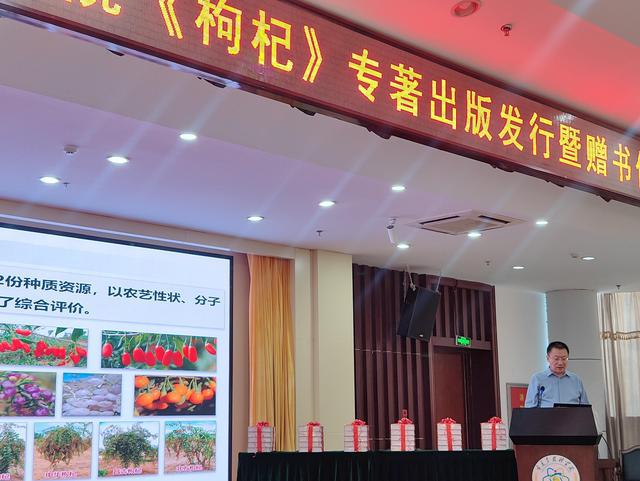
宁夏出版《枸杞》赋能科研产业升级
Huan Qiu Wang Zi Xun· 2025-05-19 09:20
Core Insights - Ningxia is a leading region in the research and marketing of goji berries, aiming for high-quality industrial development through the publication of a dedicated book on goji berries [1][3] - The goji berry industry in Ningxia has evolved from a simple dried fruit to a variety of deep-processed products, driven by technological advancements and increasing health demands [1] - Despite progress, the industry faces challenges such as low adaptability of cultivation techniques, low deep processing conversion rates, and insufficient knowledge among technical personnel [1][3] Summary by Sections - **Publication of Goji Berry Book**: The book titled "Goji Berry" was published by the Ningxia Academy of Agricultural and Forestry Sciences, involving over 30 researchers and industry experts, covering the history, current status, research achievements, cultivation techniques, and deep processing results of goji berries [3] - **Content and Structure of the Book**: The book consists of 17 chapters and approximately 1 million words, detailing various aspects of goji berries, including origin, classification, genomics, breeding, growth patterns, and pest control [3] - **Impact on Industry and Research**: The publication is seen as a significant technological achievement for the goji berry industry, aiming to enhance the connection between basic research and industrial application, and to promote educational practices, research innovation, and talent cultivation [3][4] - **Collaboration and Resource Integration**: The publication serves as a catalyst for strengthening collaboration between academia and industry, with an emphasis on converting research outcomes into practical applications [4]