
核药

Search documents
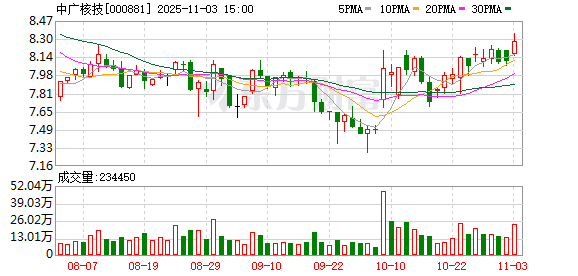
中广核技:生产的医用同位素是研发生产核药的基础原料,属于核药产业链的上游原材料环节
Zheng Quan Ri Bao· 2025-11-03 08:39
Core Insights - The company, China General Nuclear Power Technology (CGN), announced on November 3 that its medical isotope production is a fundamental raw material for the development of nuclear pharmaceuticals, positioning it in the upstream segment of the nuclear medicine industry [2] Group 1 - The core production equipment for the isotope business, including accelerator main devices and process hot rooms, has been delivered and is currently undergoing installation and debugging [2] - The company plans to commence production in 2026 [2]

港股异动 | 中国同辐(01763)盘中涨超7% 公司发布高丰度13CO气体及尿素产品 助力产业链全面自主可控
Zhi Tong Cai Jing· 2025-11-03 07:32
Core Viewpoint - China Tongru (01763) experienced a significant stock price increase of over 7% during trading, attributed to the launch of high-purity 13CO gas and urea products, marking a shift towards self-sufficiency in the medical stable isotope carbon sector [1] Company Overview - China Tongru is a specialized company under China National Nuclear Corporation, focusing on nuclear technology applications, including the development, production, and sales of nuclear medicine, radiation source products, and related services [1] - The company has established a comprehensive layout in the nuclear medicine field, with a network of 37 medical centers and 7 R&D production bases by December 31, 2024, positioning itself as a leader in China's nuclear medicine sector [1] Industry Impact - The launch of high-purity 13CO gas and urea products signifies China's ability to break free from reliance on imported materials for urea breath diagnostic agents, achieving full control over the entire industry chain from key raw materials to end products [1] - This development enhances the company's status as a leading enterprise capable of managing the complete supply chain for breath test products in the medical stable isotope carbon field [1]
中国同辐盘中涨超7% 公司发布高丰度13CO气体及尿素产品 助力产业链全面自主可控
Zhi Tong Cai Jing· 2025-11-03 07:30
Core Viewpoint - China Tongru (01763) experienced a significant stock price increase, rising over 7% during trading and closing at 20.16 HKD, with a transaction volume of 10.36 million HKD, following the launch of its high-abundance 13CO gas and urea products, marking a milestone in the domestic production of medical stable isotopes [1] Company Overview - China Tongru is a specialized company under the China National Nuclear Corporation, focusing on nuclear technology applications, including the development, production, sales, and services related to nuclear medicine, radiation source products, and nuclear medical equipment [1] - The company has established a comprehensive layout in the nuclear medicine sector, with a network of 37 medical centers and 7 R&D production bases by December 31, 2024, positioning itself as a leading enterprise in China's nuclear medicine field [1] Industry Impact - The successful launch of the high-abundance 13CO gas and urea products signifies China's achievement in breaking the long-standing reliance on imports for the raw materials used in urea breath diagnostic tests, enabling full domestic control over the entire industry chain from key raw materials to end products [1] - This development positions China Tongru as a leading enterprise that fully masters the entire industry chain of breath test products, enhancing its competitive edge in the medical stable isotope market [1]
我国核药产业全力突围
Zheng Quan Ri Bao· 2025-10-23 22:37
Core Viewpoint - The development of radiopharmaceuticals is revolutionizing cancer treatment, allowing targeted delivery of radiation to tumor cells while minimizing damage to surrounding healthy cells [1][2][3]. Industry Overview - Radiopharmaceuticals, which contain radioactive isotopes, are becoming a strategic focus in the biopharmaceutical industry globally, with major pharmaceutical companies entering the field [3][4]. - The global radiopharmaceutical market is projected to grow from $12.6 billion in 2023 to $21 billion by the end of 2029, with a compound annual growth rate (CAGR) of 8.29% from 2024 to 2029 [3]. Clinical Application - The treatment process involves imaging techniques like SPECT or PET to locate tumors and determine the appropriate dosage of radiopharmaceuticals, which are then administered to the patient [5]. - The integration of diagnosis and treatment, referred to as "diagnosis-therapy integration," is a key feature that distinguishes radiopharmaceutical therapy from existing cancer treatment methods [5]. Market Dynamics - The international market has validated the value of radiopharmaceuticals, exemplified by the approval and success of Pluvicto in the U.S. for treating metastatic castration-resistant prostate cancer, generating $271 million in its first year [6]. - In China, as of February 2024, only three innovative radiopharmaceuticals have been approved, highlighting a lag in innovation compared to international counterparts [7][8]. Challenges and Opportunities - The development of innovative radiopharmaceuticals is hindered by the need for collaboration across the supply chain, including the availability of imaging equipment and isotopes [8][9]. - Recent government initiatives aim to enhance the infrastructure for radiopharmaceuticals, including plans for comprehensive coverage of nuclear medicine departments in hospitals by 2025 [10][11]. Innovations and Developments - Companies like Shanghai United Imaging Healthcare have made significant advancements in high-end imaging equipment, contributing to the rapid proliferation of PET technology in China [11]. - Domestic production of isotopes is improving, with companies like China National Nuclear Corporation and Yuan Da Pharmaceutical achieving mass production of various isotopes [12]. Future Outlook - The Chinese radiopharmaceutical industry is expected to enter a phase of accelerated development, with over 205 innovative radiopharmaceuticals currently in clinical stages [12][18]. - Multiple companies, including Fosun Pharma and Baiyang Pharmaceutical Group, are actively expanding their presence in the radiopharmaceutical sector, indicating a robust growth trajectory [14][15][16].
创新加速 市场空间大我国核药产业全力突围
Zheng Quan Ri Bao Zhi Sheng· 2025-10-19 17:40
Core Insights - The development of radiopharmaceuticals is revolutionizing cancer treatment by allowing targeted delivery of radiation to tumor cells while minimizing damage to surrounding healthy cells [1][3] - The global radiopharmaceutical market is projected to grow from $12.6 billion in 2023 to $21 billion by the end of 2029, with a compound annual growth rate (CAGR) of 8.29% from 2024 to 2029 [2] - The integration of diagnosis and treatment in nuclear medicine, referred to as "diagnosis-therapy integration," is a key feature that distinguishes it from existing cancer treatment methods [3][4] Industry Landscape - Major global pharmaceutical companies have entered the radiopharmaceutical sector, with domestic companies like Fosun Pharma, Yanda Pharmaceutical, and China Isotope & Radiation Corporation actively positioning themselves [2] - As of February 2024, there are 205 innovative radiopharmaceuticals in clinical development in China, indicating a significant increase in research and development activity [9][10] Challenges and Solutions - The lack of domestic production capabilities for medical isotopes and imaging equipment has hindered the development of innovative radiopharmaceuticals in China [6][8] - Recent government policies aim to enhance the infrastructure for nuclear medicine, including the development of imaging equipment and stable supply of medical isotopes [7][8] Innovations and Collaborations - Companies like Yanda Pharmaceutical and Baiyang Pharmaceutical are making strides in developing innovative radiopharmaceuticals and establishing comprehensive industry chains [10][11] - The establishment of partnerships and platforms, such as Fosun Pharma's nuclear medicine platform, is expected to accelerate the development and commercialization of radiopharmaceuticals [11]
西北老字号药企 突闯“核药”赛道
Mei Ri Jing Ji Xin Wen· 2025-10-17 11:30
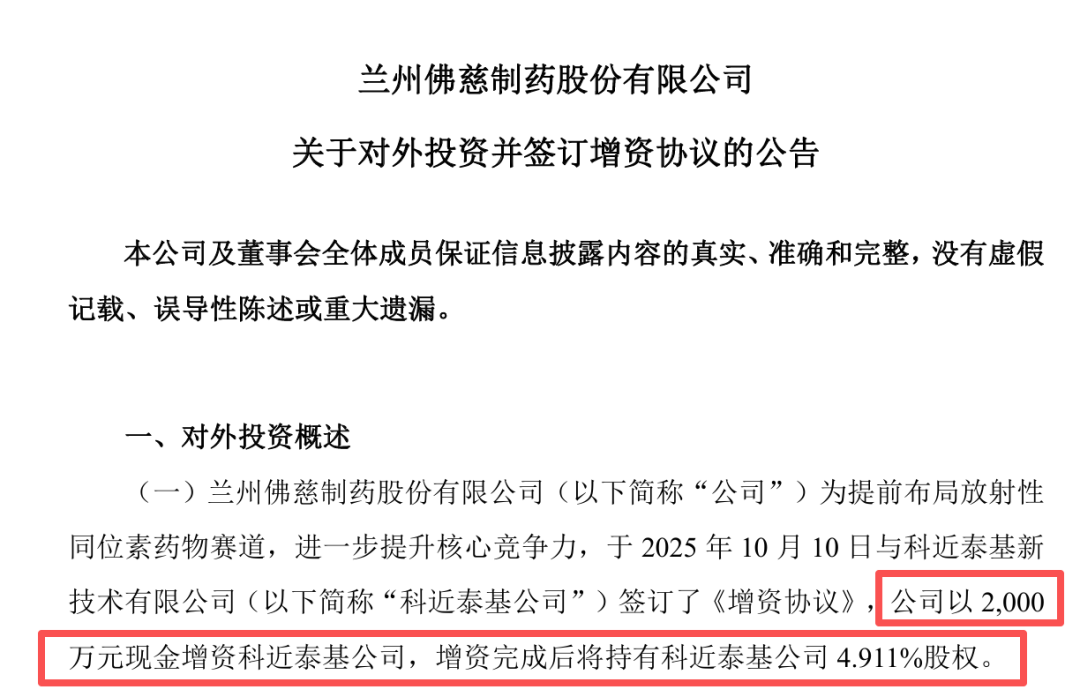
Core Viewpoint - The company, Foci Pharmaceutical, is strategically investing in the radioactive isotope drug sector by increasing its stake in Kejin Technology, aiming to enhance its core competitiveness and align with national policies and market demands [1][12][18]. Company Overview - Foci Pharmaceutical, established in 1929, has a long history as a traditional Chinese medicine manufacturer, focusing on proprietary Chinese medicine and health products [6][8]. - The company has a comprehensive product line with 467 drug approval numbers and various dosage forms, but has faced challenges in revenue growth and profitability in recent years [9][11]. Investment Details - Foci Pharmaceutical will invest 20 million yuan to acquire a 4.911% stake in Kejin Technology, which is involved in the production and research of medical isotopes [1][12]. - The total financing for this investment round reached 373 million yuan, with participation from several institutions, including the Chinese Academy of Sciences [5][12]. Market Potential - The radioactive drug market in China is projected to grow to 26 billion yuan by 2030, indicating significant potential for future revenue generation [15][14]. - The investment aligns with the company's strategy to diversify its business and enhance its resilience against market fluctuations [18]. Strategic Implications - This investment allows Foci Pharmaceutical to secure a position in the upstream segment of the radioactive drug industry, which is characterized by high technical barriers and substantial research and development requirements [18][19]. - The company aims to leverage its investment to strengthen its influence in the innovative drug sector and potentially enhance its market presence [19][21].

广药集团全面布局核药赛道 已实现锆-89高质量制备
Zheng Quan Shi Bao Wang· 2025-09-24 07:18
Core Viewpoint - Guangzhou Pharmaceutical Group is strategically entering the nuclear medicine sector by establishing a joint venture focused on radiopharmaceuticals, aiming to capitalize on the rapidly growing market and technological advancements in this field [1][2][3]. Industry Overview - Radiopharmaceuticals (RDC) are specialized drugs containing radioactive isotopes used for disease diagnosis, treatment, or research, representing a revolutionary shift in medical diagnostics and treatment [2]. - The global therapeutic radiopharmaceutical market is experiencing a compound annual growth rate (CAGR) of nearly 40%, with China's growth rate consistently exceeding 15%, projecting the overall market size to reach trillions [2]. - The Chinese government has introduced policies to support the nuclear medicine industry, including the "Medium and Long-term Development Plan for Medical Isotopes (2021-2035)," which encourages technological innovation and the establishment of special funds [2]. Company Initiatives - Guangzhou Pharmaceutical Group, in collaboration with Xiamen Rare Earth Research Institute, established Guangzhou Baiyunshan Rare Nuclear Health Pharmaceutical Co., marking its official entry into the nuclear medicine sector [1][3]. - The company has signed a strategic agreement with advanced energy laboratories and research institutes to focus on technological innovation and overcoming key technical bottlenecks in radiopharmaceutical development [3][4]. - The newly formed company has successfully developed a solid target system for the high-quality production of Zirconium-89, filling a domestic gap and establishing a foundation for future research [4]. Strategic Partnerships - The joint venture has engaged in collaborations with various top medical institutions to foster industry-academia-research cooperation, aiming to create a closed-loop system for research, production, and application [4]. - A strategic framework agreement was signed with Guangdong Cyclotron Pharmaceutical, focusing on the high-quality, large-scale domestic production of key medical isotopes, reducing reliance on imports [5]. Future Goals - The company has outlined short, medium, and long-term objectives, including the rapid industrialization of rare earth diagnostic and therapeutic isotopes, the establishment of a nuclear isotope production research base, and the development of innovative nuclear medicine solutions [5][6].
强强联合!远大医药布局全球顶尖锗镓发生器 攻破关键核素原料供应壁垒
Zhi Tong Cai Jing· 2025-07-31 10:33
Core Viewpoint - The nuclear medicine industry in China is experiencing a pivotal moment with the strategic partnership between YuanDa Pharmaceutical and IRE ELiT, enhancing the supply chain for medical-grade Ge-68/Ga-68 generators, which aligns with international standards and meets domestic regulatory requirements [1][7]. Industry Overview - The nuclear medicine sector is emerging as a new approach for cancer diagnosis and treatment, with a focus on drugs labeled with Lu-177 and Ga-68, where Ga-68 is crucial for developing next-generation PET imaging agents [2]. - The market for diagnostic and therapeutic radioactive drugs in China is projected to reach 9.3 billion yuan by 2025, growing at a compound annual growth rate (CAGR) of 22.7% to 26 billion yuan by 2030, indicating significant market potential [4]. Supply Chain Challenges - There is a current shortage in the supply of radioactive isotopes in China, primarily due to import monopolies. The short half-life of isotopes like Ga-68 necessitates a stable supply chain, making the local production of key isotopes essential for the industry's health [6]. - The collaboration with IRE ELiT aims to establish a reliable supply chain for Ga-68 generators, addressing clinical demand gaps in China [6][7]. Company Developments - YuanDa Pharmaceutical has established a comprehensive industry chain in nuclear medicine, covering research, production, sales, and regulatory qualifications, with a pipeline of 15 innovative products targeting various cancers [8][11]. - The company’s Chengdu facility, which received a Class A radiation safety license, is the world's first closed-loop platform for the entire nuclear medicine industry chain, with an investment exceeding 3 billion yuan [12]. - YuanDa's innovative product, SIR-Spheres Y-90 microspheres, has seen rapid growth, achieving nearly 500 million HKD in revenue in 2024, reflecting a year-on-year increase of over 140% [11]. Strategic Partnerships - The partnership with IRE ELiT will enable YuanDa to leverage its market capabilities to promote the registration, localization, and commercialization of Ga-68 generators in China, enhancing the availability of PET imaging technology [7][13]. - This collaboration is expected to serve as a foundation for localizing the nuclear medicine supply chain in China, improving industry resilience and safety [7][13].
20cm速递丨创业板医药ETF(159377)涨超1.8%,政策支持高端医疗器械创新发展
Mei Ri Jing Ji Xin Wen· 2025-07-11 03:26
Group 1 - Chengdu High-tech Zone Medical Device Innovation and Transformation Association facilitated Qinglan Jichuang Medical Equipment to obtain a credit line of tens of millions from Chengdu Bank, specifically for production line expansion and technology research and development [1] - Anbiping announced that its HPV nucleic acid test kit received a medical device registration certificate from the National Medical Products Administration, capable of detecting 18 high-risk HPV types and further expanding its layout in the tumor screening field [1] - In the first half of 2025, China approved 45 innovative medical devices, a year-on-year increase of 87%, reflecting the continuous policy dividends driving industry technological upgrades [1] Group 2 - The domestic nuclear medicine industry has a high dependence on imported radionuclide raw materials, but domestic technological breakthroughs and capacity releases are expected to enhance the self-supply capability of major isotopes [2] - The nuclear medicine regulatory environment is strict, creating high barriers to entry, with companies like China Radiopharmaceuticals and Dongcheng Pharmaceutical holding a first-mover advantage in the midstream production and distribution sectors [2] - The nuclear medicine market is projected to grow at a compound annual growth rate of over 20% over the next five years, reaching 26 billion yuan by 2030, driven by policy support and increasing medical resource allocation [2] Group 3 - The ChiNext Medical ETF tracks the Chuangyi Medicine Index, which can experience daily fluctuations of up to 20%, reflecting the overall performance of listed companies in the medical manufacturing, medical devices, and medical services sectors on the ChiNext market [2] - The index consists of companies with innovative characteristics and high growth potential, generally characterized by high research and development investment and industry development potential [2]

RDC引领核药行业快速崛起,开启诊疗一体化时代
China Post Securities· 2025-07-04 11:38
Industry Investment Rating - The industry investment rating is "Outperform the Market" and is maintained [1]. Core Viewpoints - The nuclear medicine market is expected to grow significantly, with a projected global market size of USD 10.65 billion in 2023, reaching USD 31.44 billion by 2033, indicating a compound annual growth rate (CAGR) of 11.45% from 2024 to 2033 [4][19]. - The rise of Radionuclide Drug Conjugates (RDC) is a key driver for the nuclear medicine industry, with notable products like Pluvicto showing strong sales performance, achieving USD 1.392 billion in revenue in 2024, a 42% increase [19][22]. - China's nuclear medicine market is expected to grow from CNY 22 billion in 2017 to CNY 93 billion by 2025, with a CAGR of 32.4%, and further to CNY 260 billion by 2030, maintaining a high growth rate of 22.7% [26][28]. Summary by Sections Industry Overview - The closing index for the industry is 7754.01, with a 52-week high of 8490.25 and a low of 6070.89 [1]. Market Dynamics - The nuclear medicine sector is characterized by high barriers to entry and strong regulatory oversight, with significant advantages for companies with a comprehensive industry chain layout [6][29]. - The domestic nuclear medicine application level is significantly lower than that of developed countries, with a market primarily composed of traditional generic nuclear drugs [5][24]. Key Companies and Financial Projections - China Isotope & Radiation Corporation (1763.HK) and East China Pharmaceutical (002675.SZ) are leading players in the market, with extensive nuclear pharmacy networks and product pipelines [49][50]. - The financial performance of key companies indicates a robust growth trajectory, with China Isotope achieving a revenue of CNY 75.75 billion in 2024, and East China Pharmaceutical reporting CNY 10.12 billion in nuclear medicine revenue [49][50]. Regulatory Environment - Recent policies have been implemented to promote the development of the nuclear medicine industry, including the "Long-term Development Plan for Medical Isotopes (2021-2035)" which aims to enhance technology research and industry growth [26][27]. Future Outlook - The increasing focus on nuclear medicine, particularly in the context of precision therapy, is expected to drive further investment and innovation in the sector, with more domestic products anticipated to enter the market [19][24].