
节水产业

Search documents
一滴水折射绿色发展底色
Xin Lang Cai Jing· 2026-01-31 04:02
Group 1 - The article emphasizes the importance of developing a water-saving industry in China, highlighting that the market size for related industries is estimated to exceed 760 billion yuan [16][22]. - It discusses the government's commitment to promoting water conservation as a key aspect of sustainable development, with a focus on integrating water resource management into urban planning and production [16][22]. - The article mentions that by 2027, the water-saving industry is expected to achieve a scale of one trillion yuan, indicating significant growth potential [22]. Group 2 - The article outlines various initiatives and policies aimed at enhancing water-saving practices, including the promotion of water-efficient appliances and the establishment of industry funds and associations [17][20]. - It highlights the role of leading enterprises in driving the development of the water-saving industry, with regions like the Beijing-Tianjin-Hebei area and the Yangtze River Delta emerging as key industrial hubs [17]. - The article notes that the adoption of water-saving technologies in traditional industries is leading to cost savings and environmental benefits, showcasing a shift towards more sustainable practices [21].

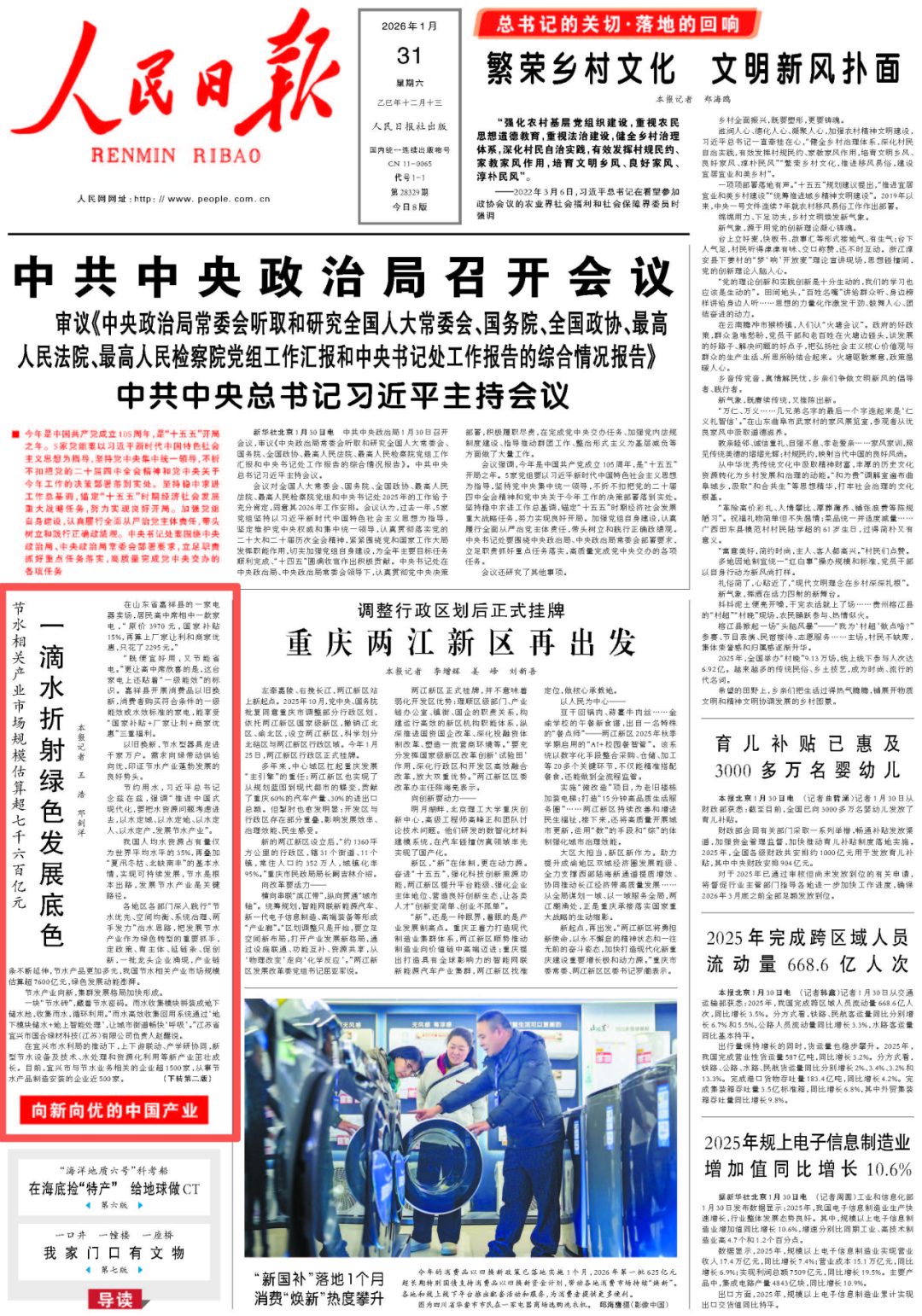
节水相关产业市场规模估算超七千六百亿元 一滴水折射绿色发展底色(向新向优的中国产业)
Ren Min Ri Bao· 2026-01-30 23:19
Group 1 - The core idea of the articles revolves around the promotion and development of water-saving products and technologies in China, emphasizing the importance of water conservation for sustainable development [2][4][5] - The water-saving industry in China is experiencing robust growth, with an estimated market size exceeding 760 billion yuan, driven by government policies and consumer demand for green products [2][4] - The government is actively promoting the replacement of old appliances with energy-efficient and water-saving models, providing subsidies and incentives to consumers [1][4] Group 2 - The development of the water-saving industry is supported by various regions and departments, which are implementing policies to encourage innovation and collaboration among enterprises [3][5] - New water-saving technologies and products are being developed, with companies like 恒洁卫浴 producing over 2 million water-saving toilets annually, showcasing the shift towards green consumption [4][5] - The water-saving industry is not only enhancing its own quality but also driving traditional industries to transform and reduce water consumption, contributing to environmental sustainability [5][6]
“十五五”时期 我国节水水平将进一步提升
Xin Lang Cai Jing· 2026-01-25 20:19
根据相关目标,"十五五"末农田灌溉水有效利用系数有望达到0.6以上,节水产业规模预计超过1.2万亿 元,非常规水利用量有望超过300亿立方米,水资源严重短缺地区和水资源超载地区再生水利用率将达 到30%以上,黄河流域矿井水利用率预计达到70%以上。 据介绍,新的一年各级水利部门将完善水资源总量管理和全面节约制度,提高水资源集约安全利用水 平,推进高质量建设节水型社会,建设现代化节水产业体系,构建非常规水配置利用新格局,推进合同 节水管理创新发展,提升全社会节水观念和意识,为"十五五"节水工作开好局、起好步。 本报讯 记者成静报道 水利部全国节约用水办公室表示,到2030年,全国万元国内生产总值用水量、万 元工业增加值用水量预计比2025年分别下降10%以上。 全国节水办相关负责人介绍,在"十五五"时期将围绕水利高质量发展、保障我国水安全总目标,坚持落 实落细节水制度政策体系。到2030年,节水制度政策体系更加完善,节水基础设施短板基本补齐,节水 精细管理能力明显提升,水资源利用效率和效益显著提高,水预算管理实现全覆盖。 (来源:中国改革报) 转自:中国改革报 ...
2025年万元国内生产总值用水量较“十三五”末下降20%
Ren Min Ri Bao· 2026-01-22 21:57
Core Insights - During the "14th Five-Year Plan" period, China's total water usage has achieved zero growth despite significant economic growth and continuous increases in grain production [1] - By 2025, water consumption per unit of GDP and per unit of industrial added value is expected to decrease by 20% and 25% respectively compared to the end of the "13th Five-Year Plan" [1] - The effective utilization coefficient of irrigation water in farmland is projected to increase from 0.565 at the end of the "13th Five-Year Plan" to 0.583 [1] - The utilization of unconventional water resources is expected to grow by over 91% compared to the end of the "13th Five-Year Plan" [1] Future Goals - By 2030, water consumption per unit of GDP and per unit of industrial added value is targeted to decrease by more than 10% compared to 2025 [1] - The effective utilization coefficient of irrigation water is aimed to reach above 0.60 [1] - The scale of the water-saving industry is expected to exceed 1.2 trillion yuan [1] - Unconventional water utilization is projected to surpass 30 billion cubic meters [1] - The reuse rate of reclaimed water in areas with severe water shortages and overloaded water resources is targeted to reach over 30% [1] - The utilization rate of mine water in the Yellow River basin is expected to reach 70% [1] - The water-saving policy system is to be further improved, addressing infrastructure gaps and enhancing water-saving management capabilities [1]
“十五五”主要节水指标明确
Ren Min Wang· 2026-01-21 13:27
Core Viewpoint - The National Water Conservation Office aims to significantly reduce water usage per unit of GDP and industrial value added by 2030, while enhancing water resource management and efficiency [1] Group 1: Water Usage Reduction Goals - By 2030, water usage per 10,000 yuan of GDP and per 10,000 yuan of industrial added value will decrease by over 10% compared to 2025 [1] - The effective utilization coefficient of farmland irrigation water is targeted to reach above 0.60 [1] Group 2: Water Conservation Industry and Resources - The scale of the water conservation industry is expected to exceed 1.2 trillion yuan [1] - The utilization of unconventional water resources is projected to surpass 30 billion cubic meters [1] Group 3: Water Resource Management in Specific Regions - In areas with severe water shortages and over-exploited water resources, the reuse rate of reclaimed water is set to reach over 30% [1] - The utilization rate of mine water in the Yellow River basin is targeted to reach 70% [1] Group 4: Overall Water Conservation Strategy - The 14th Five-Year Plan period is identified as a critical time for achieving modernization and enhancing water conservation efforts [1] - The overall goal is to improve the water conservation policy system, enhance infrastructure, and increase water resource efficiency and effectiveness by 2030 [1]
节水产业规模超过1.2万亿元 “十五五”时期主要节水指标明确了
Yang Shi Wang· 2026-01-21 02:13
Group 1 - The core objective of water conservation work is to achieve a significant reduction in water usage per unit of GDP and industrial added value by 2030, with targets set for effective irrigation and water recycling in water-scarce regions [1] - By 2030, the effective utilization coefficient of irrigation water in farmland is expected to reach above 0.60, and the scale of the water-saving industry is projected to exceed 1.2 trillion yuan [1] - The utilization rate of reclaimed water in areas with severe water shortages and overload is targeted to reach over 30%, while the utilization rate of mine water in the Yellow River basin is expected to reach 70% [1] Group 2 - In 2026, the focus will be on improving the management of total water resources and establishing a comprehensive water-saving system to enhance the efficient and safe use of water resources [2] - The development of a modern water-saving industry system and the promotion of innovative contract water-saving management will be prioritized [2] - There will be an emphasis on strengthening the awareness and concept of water conservation across society, contributing to the high-quality development of water resources and ensuring water security [2]
“十四五”时期我国用水总量实现零增长
Ke Ji Ri Bao· 2026-01-21 01:08
Core Insights - The Ministry of Water Resources held a national meeting on water conservation, highlighting significant achievements during the 14th Five-Year Plan period, including zero growth in total water usage amid economic development and stable grain production [1] - By 2025, water usage per unit of GDP and industrial added value is expected to decrease by 20% and 25% respectively compared to the end of the 13th Five-Year Plan, with effective irrigation water utilization in farmland increasing from 0.565 to 0.583 and unconventional water usage rising by over 91% [1] Summary by Categories Achievements in Water Conservation - Significant progress has been made in eight areas: policy framework construction, water budget management reform, water quota management, construction of a water-saving society, development of the water-saving industry, management of recycled water utilization, contract water-saving management, and water-saving education [1] Future Goals and Plans - By 2030, water usage per unit of GDP and industrial added value is targeted to decrease by over 10% compared to 2025, with effective irrigation water utilization reaching above 0.6 and the water-saving industry scale exceeding 1.2 trillion yuan [2] - Unconventional water usage is expected to surpass 30 billion cubic meters, with recycled water utilization rates in severely water-scarce and overloaded areas reaching over 30%, and a target of over 70% for mine water utilization in the Yellow River basin [2] Strategic Focus for the 15th Five-Year Plan - The meeting emphasized the need to enhance total water resource management and comprehensive conservation systems by 2026, improve the intensive and safe utilization of water resources, and promote the construction of a high-quality water-saving society [2]
全国万元国内生产总值用水量较“十三五”末下降20%
Ren Min Ri Bao· 2026-01-20 19:10
水利部要求,2026年全国节水工作要着力完善水资源总量管理和全面节约制度,着力提高水资源集约安 全利用水平,着力推进高质量建设节水型社会,着力建设现代化节水产业体系,着力构建非常规水配置 利用新格局,着力推进合同节水管理创新发展,着力提升全社会节水观念和意识,为"十五五"节水工作 开好局、起好步。 本报北京1月20日电(记者邓剑洋)记者从水利部获悉:水利部门全面贯彻落实"节水优先、空间均衡、系 统治理、两手发力"治水思路,加快完善水资源总量管理和全面节约制度,提高水资源集约安全利用水 平,节水工作取得新成效。"十四五"以来,在我国经济总量连跨大台阶、粮食产量连年丰收的情况下, 用水总量实现零增长,初步统计2025年全国万元国内生产总值用水量、万元工业增加值用水量较"十三 五"末分别下降20%和25%,农田灌溉水有效利用系数从"十三五"末的0.565提升到0.583,非常规水利用 量较"十三五"末增长超过91%。 围绕水利高质量发展、保障我国水安全总目标,水利部提出,坚持以水而定、量水而行,落实落细节水 制度政策体系。到2030年,全国万元国内生产总值用水量、万元工业增加值用水量较2025年分别下降 10%以上 ...
“十五五”时期我国节水水平将进一步提升
Xin Hua Wang· 2026-01-20 14:53
全国节水办相关负责人介绍,在"十五五"时期将围绕水利高质量发展、保障我国水安全总目标,坚持落 实落细节水制度政策体系。到2030年,节水制度政策体系更加完善,节水基础设施短板基本补齐,节水 精细管理能力明显提升,水资源利用效率和效益显著提高,水预算管理实现全覆盖。 根据相关目标,"十五五"末农田灌溉水有效利用系数有望达到0.6以上,节水产业规模预计超过1.2万亿 元,非常规水利用量有望超过300亿立方米,水资源严重短缺地区和水资源超载地区再生水利用率将达 到30%以上,黄河流域矿井水利用率预计达到70%以上。 据介绍,新的一年各级水利部门将完善水资源总量管理和全面节约制度,提高水资源集约安全利用水 平,推进高质量建设节水型社会,建设现代化节水产业体系,构建非常规水配置利用新格局,推进合同 节水管理创新发展,提升全社会节水观念和意识,为"十五五"节水工作开好局、起好步。 新华社北京1月20日电(记者魏弘毅)记者20日从水利部全国节约用水办公室获悉,根据全国节水办相 关目标,到2030年,全国万元国内生产总值用水量、万元工业增加值用水量预计比2025年分别下降10% 以上。 【纠错】 【责任编辑:钱中兵】 ...
广西节水工作多项指标实现新突破
Guang Xi Ri Bao· 2026-01-15 02:20
Core Viewpoint - In 2025, Guangxi's total water usage and efficiency indicators are expected to exceed control targets, marking a significant breakthrough in water conservation efforts [1][2] Group 1: Water Conservation Achievements - Guangxi aims to keep total water usage within 26 billion cubic meters, below the annual control target of 30.1 billion cubic meters, with unconventional water sources expected to exceed 450 million cubic meters [1] - The water usage per unit of GDP and industrial added value is projected to decrease by more than 16% compared to 2020, while the effective utilization coefficient of irrigation water is expected to reach 0.530 [1] Group 2: Policy and Institutional Framework - The Guangxi government is actively promoting the establishment of a comprehensive water-saving policy framework, including the issuance of the "Guangxi Planned Water Management Measures" and advancing the legislative process for the "Guangxi Water Conservation Regulations" [1][2] - A high-level inter-departmental meeting on water conservation has been convened to enhance policy implementation [1] Group 3: Market Activation and Financial Support - Guangxi has implemented a dual control system for total water usage and intensity, covering industrial and service units with annual water usage of 10,000 cubic meters or more, with a planned water allocation of 4.393 billion cubic meters [2] - Financial institutions have provided over 2.5 billion yuan in credit, with "water-saving loans" amounting to 766 million yuan issued [2] Group 4: Technological and Infrastructure Development - The establishment of the Guangxi Water-Saving Industry Alliance and the Guangxi Water Conservation and Rural Water Supply Association has led to the promotion of advanced water-saving technologies, with six items included in the national directory [2] - Modernization of irrigation districts is ongoing, with a focus on improving the effective utilization of irrigation water and establishing comprehensive agricultural water pricing reforms [2]