骨科

Search documents
国联民生证券:2025年至今医药板块迎来复苏 关注创新药、AI和左侧资产估值修复
智通财经网· 2025-06-26 05:55
Core Insights - The pharmaceutical sector is expected to recover from 2025 onwards, following a four-year adjustment period, with a cumulative increase of 4.57% in the pharmaceutical and biological industry as of May 30, 2025 [1][2] - The report suggests focusing on innovative drug companies with solid R&D foundations and competitive products for international markets, as well as traditional pharmaceutical companies with reasonable valuations [1] - AI is anticipated to empower the entire pharmaceutical supply chain, enhancing efficiency in drug development, production, and medical services [2] Group 1: Market Recovery - The pharmaceutical sector has experienced a recovery since 2025, ranking 6th among 31 primary industries in terms of performance, with a cumulative increase of 4.57% [1] - The holding of pharmaceutical stocks has increased but remains at historically low levels [1] - Multiple sub-sectors within the pharmaceutical industry are showing signs of stabilization and upward trends [1] Group 2: Growth Opportunities - Incremental opportunities are expected from innovative drugs and AI, while structural opportunities may arise from the recovery of left-side assets and valuation adjustments [2] - 2025 is projected to be a significant year for domestic innovative drugs entering international markets, with many companies transitioning from generic to innovative drugs since the "4+7" procurement policy in 2018 [2] - Some pioneering innovative drug companies are anticipated to reach breakeven and turn profitable [2] Group 3: Left-Side Assets - Left-side assets are entering a mild recovery phase, with traditional pharmaceutical companies, CXO, and consumer healthcare sectors gradually clearing existing risks [2] - The industry is expected to see a fundamental recovery as the risks associated with previous procurement policies and demand issues diminish [2]
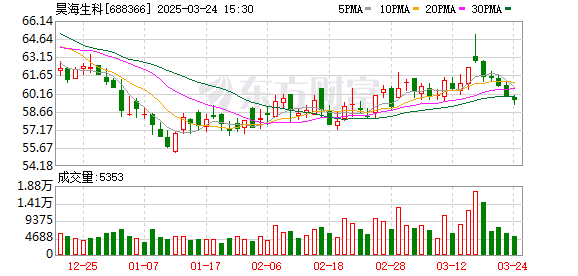
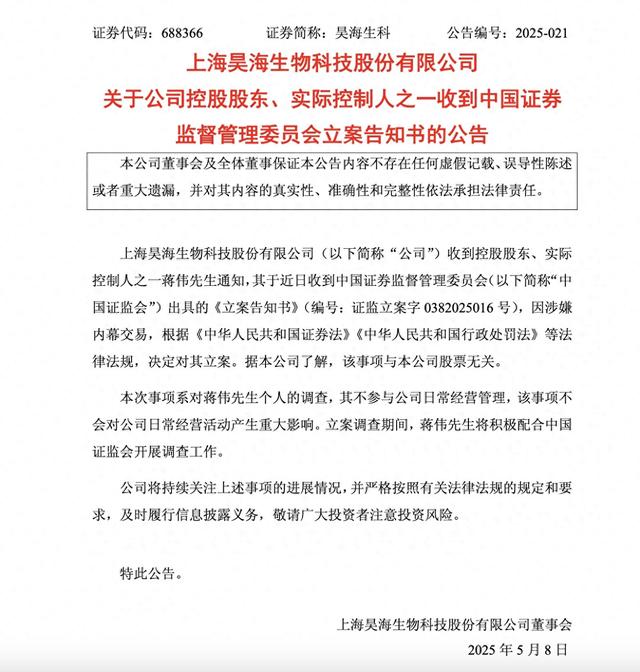
昊海生科实控人涉内幕交易遭立案,超54%净利用于分红合理吗?
Guan Cha Zhe Wang· 2025-05-11 10:04
Core Viewpoint - The company, Haohai Biological Technology (昊海生科), is facing significant challenges due to insider trading investigations involving its major shareholder, Jiang Wei, and a sharp decline in revenue growth and profitability in its core business segments, particularly in the medical aesthetics sector [1][2]. Financial Performance - In 2024, Haohai's revenue growth plummeted to 1.64%, with net profit only slightly increasing by 1.04%. In Q1 2025, both revenue and net profit further declined, with revenue decreasing by 4.25% and net profit dropping by 7.41% [1]. - The company announced a cash dividend of 231 million yuan in 2024, which accounted for 54.92% of its net profit, raising concerns about its financial sustainability amid declining performance [1][8]. Business Segments - The medical aesthetics segment, particularly the hyaluronic acid business, saw revenue of 742 million yuan in 2024, a significant slowdown from a 95.54% growth in 2023 to just 23.23% [5][6]. - The ophthalmology segment, as the second-largest supplier of artificial lenses in China, experienced a revenue decline of 7.60% in 2024, with specific product lines like artificial lenses and ophthalmic viscoelastic devices seeing drops of 14.06% and 19.53%, respectively [7][8]. Market Challenges - The hyaluronic acid market is facing intense competition, with over 400 brands and more than 50 approved Class III medical devices, leading to market saturation [5][6]. - The rise of alternative materials, such as collagen-based products, is impacting the demand for hyaluronic acid, with the retail market for collagen products projected to reach 173.8 billion yuan by 2027 [6]. - Regulatory changes have also affected the radiofrequency and laser equipment business, with new classifications requiring re-approval, leading to a 6.97% revenue decline in this segment [6]. Governance and Control - Jiang Wei and his wife, You Jie, control approximately 45.82% of the company’s shares, allowing them significant influence over corporate decisions despite Jiang not holding an official position [5][1]. - Concerns about corporate governance have been heightened due to the ongoing investigation into Jiang Wei, which may reflect deeper issues within the company's management practices [1][2].


玻尿酸带不动昊海生科了
Jie Mian Xin Wen· 2025-03-24 09:10
Core Viewpoint - Haohai Biological Technology's performance in 2024 shows stagnation in revenue and profit growth, primarily due to the declining market for hyaluronic acid and the impact of national procurement policies on its ophthalmology and orthopedics segments [3][5][16]. Revenue and Profit Summary - In 2024, Haohai Biological Technology achieved revenue of 2.698 billion yuan, a year-on-year increase of 1.64%, and a net profit of 420 million yuan, up 1.04% year-on-year [3]. - The medical beauty and wound care products contributed 1.195 billion yuan to revenue, accounting for 44.30% of total revenue, with a growth of 13.08% year-on-year [8]. Business Segment Analysis - The medical beauty segment, which includes hyaluronic acid, epidermal growth factor, and RF and laser equipment, generated 742 million yuan from hyaluronic acid, representing 62.05% of the medical beauty segment [8]. - The ophthalmology segment generated 858 million yuan, accounting for 31.79% of total revenue, showing a decline of 7.60% year-on-year [16]. Market Dynamics - The hyaluronic acid market is experiencing increased competition and a decline in growth, with high-end products facing challenges from competitors like Juvederm and Restylane [14]. - The rise of alternative products, such as hydroxyapatite, is reshaping the aesthetic market, as consumers are becoming more cautious about hyaluronic acid fillers [14]. Regulatory Impact - The regulatory changes in 2022 have affected the sales of RF and laser devices, with significant reductions in revenue from home-use and aesthetic-grade products starting in 2023 [15]. Product Performance - The revenue from cataract surgeries in 2024 was 420 million yuan, down 15.33% year-on-year, with artificial lenses and ophthalmic viscoelastic devices also showing declines [20].