替代材料

Search documents
白银暴涨背后:工业需求能否支撑起下一个黄金梦?#
Sou Hu Cai Jing· 2025-12-27 00:05
Core Insights - Silver has experienced a remarkable annual increase of 130%, outpacing gold, often referred to as "poor man's gold" [1] - The surge in silver prices is driven by industrial demand, particularly in solar panels and electric vehicles, which are consuming significant amounts of silver [3] Group 1: Industrial Demand - The silver market in 2025 is characterized by high industrial consumption, with the photovoltaic industry alone consuming 6,000 tons of silver annually, accounting for 20% of global annual production [3] - Silver's supply is inherently flawed, as 68% of silver is produced as a byproduct of copper and zinc mining, meaning reductions in primary mining can lead to immediate silver shortages [3] Group 2: Market Dynamics - Unlike gold, which is driven by safe-haven demand during turmoil, silver's price movements are tied to industrial revolutions and applications [4] - Historical parallels are drawn to the 1980 Hunt brothers' manipulation of silver prices, where prices surged from $6 to $50 before crashing, indicating potential volatility in the current market [4] - The rapid increase in ETF holdings, with a monthly rise of 1,000 tons, and the need for advance booking of physical silver in Shanghai highlight the current market dynamics [4] Group 3: Future Risks - The demand for silver in solar components is approximately 10 tons per GW installed, while each electric vehicle requires 35 grams of silver for contact points, and 5G base stations use three times the silver of 4G [5] - The potential for technological advancements to replace silver with alternative materials poses a significant risk to silver prices, which could collapse overnight if such substitutes are found [5]


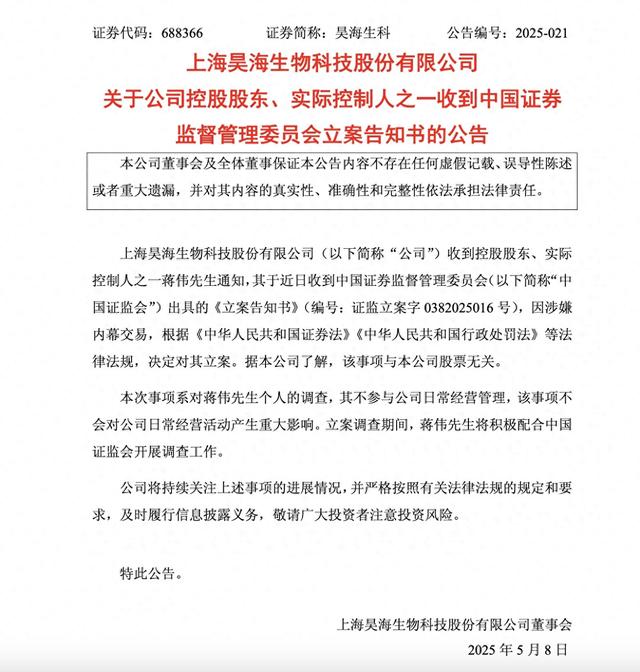
昊海生科实控人涉内幕交易遭立案,超54%净利用于分红合理吗?
Guan Cha Zhe Wang· 2025-05-11 10:04
Core Viewpoint - The company, Haohai Biological Technology (昊海生科), is facing significant challenges due to insider trading investigations involving its major shareholder, Jiang Wei, and a sharp decline in revenue growth and profitability in its core business segments, particularly in the medical aesthetics sector [1][2]. Financial Performance - In 2024, Haohai's revenue growth plummeted to 1.64%, with net profit only slightly increasing by 1.04%. In Q1 2025, both revenue and net profit further declined, with revenue decreasing by 4.25% and net profit dropping by 7.41% [1]. - The company announced a cash dividend of 231 million yuan in 2024, which accounted for 54.92% of its net profit, raising concerns about its financial sustainability amid declining performance [1][8]. Business Segments - The medical aesthetics segment, particularly the hyaluronic acid business, saw revenue of 742 million yuan in 2024, a significant slowdown from a 95.54% growth in 2023 to just 23.23% [5][6]. - The ophthalmology segment, as the second-largest supplier of artificial lenses in China, experienced a revenue decline of 7.60% in 2024, with specific product lines like artificial lenses and ophthalmic viscoelastic devices seeing drops of 14.06% and 19.53%, respectively [7][8]. Market Challenges - The hyaluronic acid market is facing intense competition, with over 400 brands and more than 50 approved Class III medical devices, leading to market saturation [5][6]. - The rise of alternative materials, such as collagen-based products, is impacting the demand for hyaluronic acid, with the retail market for collagen products projected to reach 173.8 billion yuan by 2027 [6]. - Regulatory changes have also affected the radiofrequency and laser equipment business, with new classifications requiring re-approval, leading to a 6.97% revenue decline in this segment [6]. Governance and Control - Jiang Wei and his wife, You Jie, control approximately 45.82% of the company’s shares, allowing them significant influence over corporate decisions despite Jiang not holding an official position [5][1]. - Concerns about corporate governance have been heightened due to the ongoing investigation into Jiang Wei, which may reflect deeper issues within the company's management practices [1][2].