
航天运载

Search documents
长征十号首次系留点火试验圆满成功!我国载人登月工程取得重要阶段性突破
Yang Shi Wang· 2025-08-16 03:01
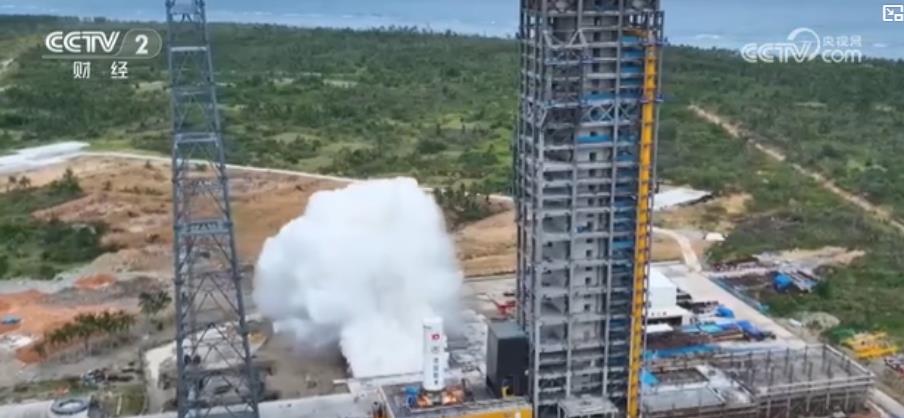
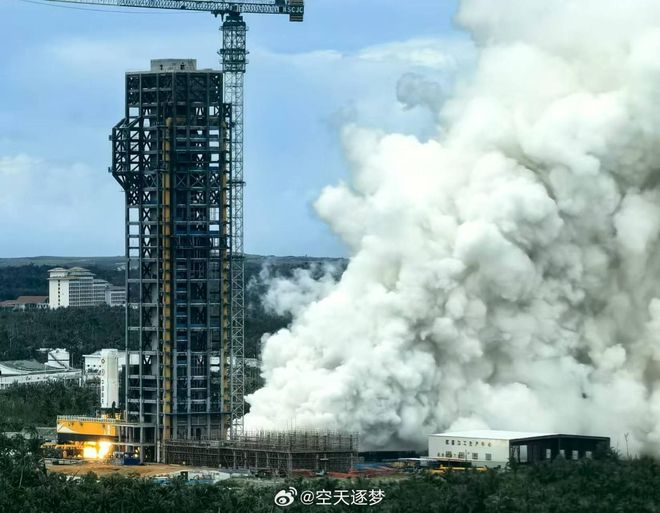
Core Viewpoint - The successful ignition test of the Long March 10 series rocket marks a significant milestone in China's manned lunar exploration program [1][3]. Group 1: Test Details - The ignition test was conducted at the Wenchang Space Launch Site in Hainan on August 15, where seven engines of the first stage of the Long March 10 rocket were ignited simultaneously [1][3]. - The test assessed the capability of the seven engines to operate under both rated and high working conditions, successfully completing multiple test procedures and obtaining comprehensive test data [3]. Group 2: Importance of the Test - According to the China Aerospace Science and Technology Corporation, the engine test is a critical step in the rocket development process, evaluating the thermal and force environment of the seven engines installed in a 5-meter diameter configuration [5]. - This test is essential for ensuring the compatibility of various systems on the rocket and is a key method for mitigating risks associated with the upcoming maiden flight [5].

“火箭的力量有多大,航天的舞台就有多大”
Guan Cha Zhe Wang· 2025-08-16 02:01
Core Viewpoint - The successful static fire test of the Long March 10 rocket marks a significant step in China's manned lunar program, validating the rocket's engine start and shutdown processes, and supporting future flight tests and missions [1][20]. Group 1: Technical Specifications - The Long March 10 rocket features a parallel configuration of three 5-meter diameter rocket bodies and utilizes seven YF-100K series liquid oxygen/kerosene engines, providing a total thrust of 892.2 tons at sea level [3][10]. - The rocket's design includes both reusable and non-reusable engines, with the reusable variant employing three YF-100N engines capable of dual-axis gimbal [3][11]. - The static fire test was conducted to assess the compatibility of various subsystems and the overall performance of the rocket under ground test conditions [4][7]. Group 2: Ground Testing Importance - Ground tests allow for extensive data collection through numerous sensors, providing a comprehensive analysis of the rocket's status post-test, which is not possible during actual flight tests [4][5]. - Although ground tests cannot fully replicate flight conditions, they can simulate certain parameters to ensure the rocket's systems are functioning correctly [5][6]. Group 3: Launch Infrastructure - The Wenchang Space Launch Site has been expanded to accommodate the Long March 10 rocket, featuring a new launch platform designed for both the Long March 10 and Long March 10A configurations [13][16]. - The launch tower for the Long March 10 does not include a rotating platform, indicating improvements in manufacturing precision and allowing for quicker launch preparations [17][20]. Group 4: Future Developments - The Long March 10 rocket is expected to play a crucial role in China's lunar exploration efforts, with plans for further tests and the first flight anticipated in 2026 [20][21]. - The associated lunar missions, including the "Dream Boat" crewed spacecraft and the "Moon Landing" lander, are progressing on schedule, contributing to the goal of a successful lunar landing by 2030 [21].
不起飞的“点火发射”怎么做到的?长征十号系列火箭需闯“四道关”
Yang Shi Wang· 2025-08-16 01:23
Core Viewpoint - The recent ground test of the Long March 10 series rocket represents a significant milestone in China's space exploration efforts, focusing on the validation of the rocket's propulsion system and its readiness for future missions [1][3]. Group 1: Test Overview - The test is described as a "tethered ignition launch," where the rocket is securely fixed to the test platform to prevent it from taking off [1]. - The Long March 10 rocket's first stage test vehicle has a diameter of 5 meters and a height of 25 meters, generating nearly 1,000 tons of thrust during the ignition test, setting a new record for China's rocket engine testing [1]. - The Long March 10 rocket consists of three modules, with a launch thrust three times that of the recent test [1]. Group 2: Technical Details - To prevent excessive thrust from causing the rocket to detach from the test platform, over 200 bolts were used to securely connect the test vehicle to the platform, ensuring a safe and controlled test [2]. - The test was conducted at the launch site due to the high requirements for the test platform, as there are currently no facilities in China capable of handling a thousand-ton class engine test [3]. - The Long March 10 series is designed for manned lunar exploration and includes two configurations, with specific missions for lunar landing and space station launches [3]. Group 3: Testing Phases - The ignition test is part of a four-step process for the Long March 10 series rocket, which is the largest thrust scale full-system test conducted in China [4]. - The propulsion system is critical for the rocket's payload capacity, flight performance, and mission reliability, with the ignition test aimed at identifying issues during the rocket's development [4]. - The recent tethered ignition test builds on the success of the first dynamic system test conducted in June 2024, which involved parallel ignition of three engines, marking the first step in the testing process [4].

新目标!我国新一代载人登月运载火箭研制再突破
Xin Hua She· 2025-08-15 14:56
Core Viewpoint - China's new generation manned lunar landing carrier rocket, the Long March 10 series, has achieved significant breakthroughs in its development, marking an important milestone in the country's lunar exploration program [1][6]. Group 1: Development and Technical Requirements - The Long March 10 series is designed to meet the complex technical requirements of manned lunar missions, which exceed those of low Earth orbit tasks [3]. - The engineering plan requires two rockets to accurately deliver the lunar lander and the new generation manned spacecraft into the translunar transfer orbit, necessitating a payload capacity of no less than 27 tons [3][4]. - Current active rockets in China, such as the Long March 2F, Long March 7, and Long March 5, do not meet this 27-ton requirement for translunar transfer [4]. Group 2: Reliability and Precision - The manned lunar exploration program adopts a "two launches, lunar rendezvous" approach, which imposes higher reliability and safety standards on the rocket systems [5]. - The design standards for the new generation carrier rocket include redundancy, escape systems, and intelligent fault diagnosis to ensure astronaut safety and mission success [5]. - High precision in launch and orbit insertion is critical, requiring the rockets to deliver their payloads into the translunar transfer orbit within strict timing sequences [5]. Group 3: Long March 10 Series Overview - The Long March 10 series consists of two configurations: Long March 10 and Long March 10A, specifically developed for manned lunar exploration [6]. - Long March 10 is a three-stage rocket with a diameter of 5 meters and a maximum height of 92.5 meters, designed to launch the manned spacecraft and lunar lander [7]. - Long March 10A is a two-stage rocket with a recoverable first stage, aimed at supporting both lunar missions and space station operations [7].
科学与健康|新目标!我国新一代载人登月运载火箭研制再突破
Xin Hua She· 2025-08-15 14:33
Core Viewpoint - The successful ignition test of the Long March 10 series rockets marks a significant milestone in China's manned lunar exploration program, following previous successful tests of the crewed spacecraft and lunar lander [2][7]. Group 1: Technical Requirements - The Long March 10 series rockets are designed to meet the high payload capacity requirements for manned lunar missions, specifically needing to deliver at least 27 tons to the translunar trajectory, which current rockets cannot achieve [3]. - Existing rockets like the Long March 2F, Long March 7, and Long March 5 have significantly lower payload capacities when adjusted for translunar missions, highlighting the necessity for a new rocket platform [3]. Group 2: Reliability and Precision - The manned lunar mission requires rockets with enhanced reliability and safety features due to the long mission duration and extreme environments, necessitating advanced designs such as redundancy systems and intelligent fault diagnosis [4]. - High precision in launch and orbital insertion is critical, as two rockets must launch in a strict sequence to ensure successful docking in lunar orbit, demanding high accuracy and flexible launch windows [5]. Group 3: Rocket Specifications - The Long March 10 series includes two configurations: Long March 10, a three-stage rocket with a height of 92.5 meters, and Long March 10A, a two-stage rocket with a height of 67 meters, designed for different mission profiles [7]. - The Long March 10A features a reusable first stage, aimed at optimizing costs and resource utilization for both lunar and space station missions [7].

“长十火箭系留点火试验成功为载人月球探测任务奠定重要技术基础”
Xin Hua She· 2025-08-15 14:01
Core Viewpoint - The successful tethered ignition test of the Long March 10 rocket series marks a significant technological milestone for China's manned lunar exploration program, aiming for a lunar landing by 2030 [1][2]. Group 1: Mission and Design - The Long March 10 rocket series is designed for both manned lunar missions and cargo transport, featuring two versions: the lunar version and the near-Earth version [2]. - The Long March 10 rocket is a three-stage rocket with a core diameter of 5 meters, while the Long March 10A is a two-stage rocket with a reusable first stage [2]. Group 2: Testing and Development - The tethered ignition test is a crucial step in the rocket development process, allowing for the verification of the propulsion system under controlled conditions [2][3]. - This test is the first of its kind conducted at the launch site for the Long March series, providing a vital technical foundation for the lunar exploration mission [2][3]. - The test achieved a thrust scale of nearly 1,000 tons, making it the largest full-system test conducted domestically [3]. Group 3: Future Plans - The Long March 10 rocket's development will proceed in four phases, with the tethered ignition test being the second phase, followed by additional ignition tests and a low-altitude flight test [4]. - Future tests will include a true orbital flight validation, further advancing the capabilities of China's manned space transportation system [4].
秀我中国|长征十号首次系留点火试验取得圆满成功
Xin Hua She· 2025-08-15 13:44
Core Viewpoint - The successful ignition test of the Long March 10 series rocket at the Wenchang Space Launch Site marks a significant milestone in China's manned lunar exploration program, following previous successful tests of the Dream Chaser spacecraft and the lunar lander [2]. Group 1 - The ignition test was conducted on August 15, demonstrating advancements in China's space capabilities [2]. - This achievement is part of the ongoing development of China's manned lunar exploration project, indicating progress in the country's space exploration efforts [2]. - The test follows the successful completion of the zero-height escape flight test of the Dream Chaser spacecraft and the comprehensive verification test of the lunar lander [2].
火箭飞行试验任务失利,蓝箭航天向客户致歉
Xin Jing Bao· 2025-08-15 11:54
Core Viewpoint - The launch of the Zhuque-2 improved model Yao-3 rocket by Blue Arrow Aerospace on August 15 was unsuccessful due to flight anomalies, and the company is currently analyzing the reasons for the failure [1] Company Summary - Blue Arrow Aerospace developed the Zhuque-2 improved model Yao-3 rocket, which experienced a flight failure during its launch from the Dongfeng Commercial Aerospace Innovation Test Zone [1] - The company has committed to a responsible approach in analyzing the failure, collaborating with relevant parties, and ensuring transparency throughout the investigation process [1] - Blue Arrow Aerospace expressed sincere apologies to the mission's clients and gratitude to supporting departments and partners involved in the launch [1] Industry Summary - The aerospace engineering sector is characterized by high complexity and challenges, with each mission serving as a critical practice for technological advancement and engineering maturity [1] - The Zhuque-2 improved model's previous successful launch in May, which successfully placed six satellites into their designated orbits, highlights the ongoing development and testing within the commercial aerospace industry [1]
火箭飞行试验任务失利 蓝箭航天回应:具体原因正在进一步分析排查
Xin Lang Cai Jing· 2025-08-15 10:18
Core Viewpoint - The launch of the upgraded Zhuque-2 rocket by Blue Arrow Aerospace on August 15 was unsuccessful due to flight anomalies, and the company is currently analyzing the specific reasons for the failure [1] Group 1: Launch Details - The Zhuque-2 upgraded version was launched from the Dongfeng Commercial Aerospace Innovation Test Area [1] - This mission was intended as another flight verification for the Zhuque-2 upgraded model [1] Group 2: Company Response - Blue Arrow Aerospace stated that they are conducting a thorough analysis and investigation into the failure [1] - The company emphasized the complexity and challenges of aerospace engineering, noting that each mission is crucial for technological advancement and engineering maturity [1] - Blue Arrow Aerospace committed to a responsible approach, collaborating with relevant parties to analyze all flight data and improve technology based on the findings [1] - The company also pledged to maintain transparency and openness during the investigation process [1]
我国载人月球探测工程研制工作取得重要阶段性突破
Xin Jing Bao· 2025-08-15 09:37
Core Points - The successful tethered ignition test of the Long March 10 series rockets marks a significant milestone in China's manned lunar exploration program [1][2] - This test is the largest ground test in China for a rocket system with nearly 1,000 tons of thrust, conducted at the Wenchang Space Launch Site [1][2] Group 1 - The tethered ignition test is considered one of the most important ground tests in the development of the Long March 10 series rockets, providing valuable experience for future large-scale ground tests and flight missions [2] - The Long March 10 series rockets are a new generation of manned launch vehicles developed by the China Academy of Launch Vehicle Technology, crucial for achieving China's goal of manned lunar landing by 2030 [2] - The Long March 10 rocket features a three-stage design with a diameter of 5 meters and a maximum height of 92.5 meters, while the Long March 10A is a two-stage rocket with a maximum height of 67 meters, designed for reuse [2]