
设备制造

Search documents
CVD(CVV) - 2025 Q1 - Earnings Call Transcript
2025-05-13 22:00
Financial Data and Key Metrics Changes - Revenue for Q1 2025 was $8.3 million, representing a 69% increase compared to Q1 2024 and a 12.2% increase from Q4 2024 [3][7] - Net income for the quarter was $360,000, compared to a net loss of $1.5 million in Q1 2024, marking the third consecutive quarter of net income [5][8] - Gross profit for Q1 2025 was $2.7 million with a gross profit margin of 32.4%, up from $800,000 and 16.2% in Q1 2024 [7][8] Business Segment Data and Key Metrics Changes - Revenue from the CVD Equipment segment was primarily driven by two contracts in industrial markets and aerospace [3] - The SDC segment experienced strong demand for gas delivery equipment, but backlog declined from $19.4 million at the end of 2024 to $13.8 million by March 30, 2025 [4] Market Data and Key Metrics Changes - The company noted a decline in backlog during the quarter, indicating potential challenges in future revenue recognition [4] - The imposition of tariffs has introduced new challenges and uncertainties affecting costs and order rates [5][10] Company Strategy and Development Direction - The company is focused on identifying opportunities in key markets such as aerospace, defense, high power electronics, and EV battery energy storage [5] - Strategic efforts are aimed at maintaining and growing order rates while managing expenses to achieve long-term profitability and positive cash flow [5][12] Management's Comments on Operating Environment and Future Outlook - Management acknowledged the impact of economic and geopolitical uncertainties, including tariffs, on financial performance and cash flows [10] - The company believes it is well-positioned for the future and is committed to evaluating demand and managing operations effectively [5][11] Other Important Information - Working capital as of March 31, 2025, was $14.5 million, an increase from $13.8 million at the end of the previous year [9] - Cash and cash equivalents decreased to $10.2 million from $12.6 million at the end of 2024, primarily due to costs incurred on contracts in progress [9] Q&A Session Summary - No questions were raised during the Q&A session, and the call concluded with closing remarks from management [13][14]

企业节省十万余元采购成本
Qi Huo Ri Bao Wang· 2025-05-06 03:00
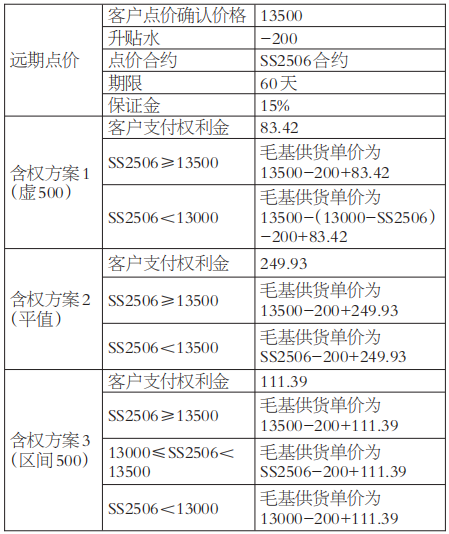
Core Viewpoint - The article discusses the implementation of a "forward pricing + option" model by a manufacturing company to manage the risks associated with raw material price fluctuations and tariffs in a challenging global trade environment [1][7]. Group 1: Company Situation - Company A, a manufacturing enterprise, faces dual exposure risks due to tariff changes and raw material price volatility, particularly for 300 series stainless steel [1]. - In mid-February, the company anticipates a significant increase in stainless steel prices due to rising nickel and chromium prices, as well as a shortage in the Wuxi stainless steel market [1]. Group 2: Implementation Process - A futures company analyzes the potential downward trend in stainless steel prices due to tariff policies and designs three "forward pricing + option" plans to help the company stabilize procurement costs while allowing for price adjustments [2][3]. - The plans enable the buyer to maintain pricing control while adapting to market conditions [2]. Group 3: Pricing Plans - The three pricing plans differ in their approach to managing price fluctuations: - Plan 1 allows for a maximum procurement cost lock while enabling price adjustments if the market drops significantly [3]. - Plan 2 provides a fixed price with adjustments for both increases and decreases in market prices [3]. - Plan 3 is similar to Plan 1 but limits the price drop adjustment to a specific range [3]. Group 4: Contract Details - The company ultimately selects Plan 1 and signs a forward pricing contract on March 18, 2025, with specific terms regarding pricing, delivery, and quantity [4]. - The company also purchases a put option to further hedge against price declines [4]. Group 5: Effectiveness Evaluation - After signing the contract, the company benefits from avoiding a significant increase in procurement costs, resulting in a total savings of 107,984 yuan compared to traditional procurement methods [5][6]. - The new pricing strategy successfully achieves the goal of stabilizing prices while reducing storage and financing costs [6]. Group 6: Industry Insights - The article highlights the increasing volatility in commodity prices and the inadequacy of traditional pricing mechanisms for manufacturing companies reliant on raw materials [7]. - The development of structured risk management tools in the domestic futures market offers manufacturing companies more effective ways to manage cost volatility risks [7].

国产乙烷大爆发,谁能从中获得最大收益?
阿尔法工场研究院· 2025-04-30 02:15
以下文章来源于Aki能量站 ,作者小奇Aki 作者 | 小奇Aki 来源 | Aki能量站 导 语:中泰股份乙烷提取设备市场占有率70%,单套设备产值1.5亿元,毛利率超40%,是国产替代的最大受益者。 本文从乙烷气体在中美关税下的国产替代逻辑出发,发觉一家受益公司,经深度研究多加机构研报后,制定相应交易策略,目前以小仓位买入。 中国2024年乙烷进口量1,100万吨,其中95%来自美国,进口成本受关税政策直接影响(2025年4月加征34%关税后累计税率达35%),到岸成本从 3,879元/吨升至5,118元/吨,国产替代的逻辑明确,且空间广阔。 中泰股份(300435)深度研究报告 公司概况 中泰股份成立于2006年,2015年于深交所上市,总部位于浙江杭州,是一家以深冷技术为核心的设备制造商及气体运营商。公司实际控制人为章有 春、章有虎兄弟,股权结构稳定。 通过"设备制造+气体运营"双引擎模式,业务覆盖天然气液化、空分装置、稀有气体生产等领域。2019年收购山东中邑燃气后,燃气运营成为主要收 入来源,2022年进一步布局稀有气体市场,形成多元化业务结构。 Aki能量站 . 普通人的投研笔记 业务范围与发展 ...
