
Food Manufacturing

Search documents
General Mills (NYSE:GIS) 2025 Investor Day Transcript
2025-10-14 14:32
Summary of General Mills Investor Day 2025 Company Overview - **Company**: General Mills - **Event**: 2025 Investor Day - **Focus**: Driving remarkability to accelerate growth across various business segments Key Industry Insights - **Market Trends**: - The food industry is experiencing significant changes due to inflation, evolving consumer preferences, and technological advancements. - There is a notable shift towards premiumization and humanization in pet food, with brands like Blue Buffalo leading this trend [12][22]. - Consumers are increasingly focused on health, wellness, and convenience, influenced by factors such as aging demographics and the rise of GLP-1 drugs [13][49]. Core Strategies and Initiatives - **Remarkability Framework**: - General Mills is implementing a "Remarkable Experience Framework" to enhance consumer engagement and brand loyalty [14][20]. - The framework focuses on improving product quality, packaging, brand communication, and omnichannel execution [14][15]. - **Investment in Digital and Technology**: - The company has doubled its investment in digital capabilities to adapt to changing consumer behaviors and improve operational efficiencies [11][19]. - A focus on AI tools is expected to enhance marketing effectiveness and content creation [37][38]. - **Product Innovation**: - New product launches are expected to contribute significantly to net sales, with projections of increasing from 3.5% to around 5% of total net sales in fiscal 2026 [15][30]. - Innovations are centered around consumer trends such as bold flavors and protein enrichment [31][32]. Financial Performance and Goals - **Sales Growth**: - The goal for fiscal 2026 is to restore organic sales growth, with a focus on delivering consistent, profitable growth [19][20]. - The North America Retail segment aims to return to consistent sales growth, leveraging its portfolio of iconic brands [22][51]. - **Cost Management**: - The Holistic Margin Management program is expected to deliver $600 million in savings, allowing for reinvestment in growth initiatives [19][51]. - Strategic Revenue Management tools are being utilized to optimize pricing strategies and address consumer price sensitivity [29][76]. Consumer Engagement and Marketing - **Targeted Marketing**: - General Mills is focusing on understanding consumer needs through real-time feedback mechanisms, including social media and AI analytics [81][84]. - Increased media investments and partnerships with creative agencies aim to enhance brand visibility and engagement [36][37]. - **Diverse Consumer Segments**: - The company is targeting specific demographics, including Hispanic households and consumers aged 55+, to drive growth [47][48]. - Tailored product offerings and marketing strategies are being developed to resonate with these groups [48][49]. Conclusion - General Mills is committed to leveraging its brand portfolio and innovative capabilities to navigate market challenges and capitalize on growth opportunities. The focus on remarkability, consumer engagement, and strategic investments positions the company for future success in a competitive landscape [52][65].

Ajinomoto Co., Inc. - Special Call
Seeking Alpha· 2025-10-14 06:36
Group 1 - Ajinomoto is conducting a business briefing meeting focused on its operations in Latin America, highlighting the importance of this region for the company's strategy [1][2] - The meeting features key executives, including the President and CEO, Mr. Nakamura, and the General Manager of Latin America, Ms. Yamamoto, who will present on regional and growth strategies [1][2][3] - The agenda includes a presentation by Mr. Nakamura on the Latin American regional strategy, followed by Ms. Yamamoto discussing the growth strategy for Ajinomoto Brazil, concluding with a Q&A session [3]


Ajinomoto (OTCPK:AJIN.Y) Earnings Call Presentation
2025-10-14 00:00
Ajinomoto Group's Latin America Strategy - The Ajinomoto Group aims to enhance corporate value in Latin America by focusing on Food and Bio & Fine Chemicals businesses, accelerating sustainability efforts with "AminoScience," and promoting organic growth and new business development[3] - The Latin America Division is structured around Brazil and Peru, with headquarters flexibly managing regional operations[4] Ajinomoto do Brasil (ABR) Overview - ABR's FY2024 sales amounted to approximately 3500 million BRL (approximately 100 billion JPY), contributing to the Ajinomoto Group's total sales of 1530 billion JPY[39] - ABR's sales composition in FY2024 was approximately 50% Food, 30% Food Ingredients & Agriculture (FI & Agri), and 20% Bio & Fine Chemicals (BF)[43] - ABR's Food business is experiencing steady expansion, with a CAGR of 9% from FY2018 to FY2024, driven by the strong growth of the Seasonings segment[53, 54] Market Presence and Growth - Tempero SAZÓN® flavor seasoning holds approximately 70% market share in Brazil, with a brand recognition rate of 96%[21, 64] - AJI-NO-MOTO® umami seasoning has approximately 98% recognition rate in Brazil[21] - Peru's Aji-no-men® instant noodles and Doña Gusta® flavor seasoning have approximately 98% and 80% market share, respectively[21] - Sales in Latin America are forecasted to reach approximately 125 billion JPY in FY2024, with CAGR from FY2018-2024 of 8% in Brazil, 14% in Peru and 18% in other neighboring countries[19] Sustainability and Innovation - ABR is participating in the "Recovery of Degraded Pasture Verification Study" to contribute to environmental and societal well-being through its Agri business[79] - AjiProTM-L initiatives in Brazil aim to reduce GHG emissions by approximately 1 t-CO2 eq per head per year and lower feed costs by approximately $100 per head per year[92] - ABR is actively engaged in Digital Transformation (DX) initiatives across all areas, including the implementation of AI, with Sales 6X YoY in FY2024[107, 108]
SunOpta's Latest Results Show It's Still On Track
Seeking Alpha· 2025-10-11 13:00
Core Insights - SunOpta Inc. is recognized for its production of plant-based beverages, particularly soy and oat milk, although the dairy industry prefers not to label them as "milks" [1] Company Overview - SunOpta Inc. operates in the health-food sector, focusing on plant-based products [1] Market Position - The company is positioned within a growing market for plant-based alternatives, catering to increasing consumer demand for healthier beverage options [1]


SunOpta Stock’s Latest Results Show It’s Still On Track (NASDAQ:STKL)
Seeking Alpha· 2025-10-11 13:00
Core Insights - SunOpta Inc. is recognized for its production of plant-based beverages, particularly soy and oat milk, although the dairy industry prefers not to label them as "milks" [1] Company Overview - SunOpta Inc. operates in the health-food sector, focusing on plant-based products [1] Market Position - The company is positioned within a growing market for plant-based alternatives, catering to increasing consumer demand for healthier beverage options [1]
The 3 Dividend Kings I'd Buy Right Now for a Lifetime of Passive Income
Yahoo Finance· 2025-10-07 13:37
Core Insights - The article emphasizes the significance of companies that consistently increase dividends over 50 years, highlighting them as reliable sources for passive income [1] Group 1: Company Analysis - Coca-Cola offers a dividend yield of approximately 3.1%, which is significantly higher than the market average of 1.2%, and its valuation metrics are slightly below their five-year averages, making it an attractive option for conservative income investors [4][6] - Despite a 10% decline in share price, Coca-Cola continues to perform well compared to its main competitor, PepsiCo, which has seen a 25% price drop and offers a higher dividend yield of 4% [5][6] - Federal Realty, a real estate investment trust (REIT), boasts a dividend yield of nearly 4.6%, which is about 50% higher than Coca-Cola's yield, and is the only REIT included in the Dividend Kings list, emphasizing its quality-focused investment strategy [7][9] Group 2: Investment Opportunities - Hormel Foods is mentioned as a food manufacturer with a historically high yield and potential for turnaround, appealing to more aggressive investors [8]


Monday's Final Thoughts: TSLA Upcoming Reveal, Truck Tariffs, Gold's Rally
Youtube· 2025-10-06 21:45
Company Insights - Tesla is expected to make a significant announcement regarding a new vehicle, potentially the next generation Roadster or a lower-cost Model Y, with shares rising over 5% on speculation [1][2][3] - AMD shares surged in double digits due to company-specific news, while Nvidia and Intel saw declines as they compete in the same space [6][7] - Constellation Brands reported better-than-expected earnings but forecasts continued declines in beer, wine, and spirits, with shares up about 1% [9][11] Industry Trends - Gold prices reached an all-time high above $3,900, climbing 50% this year, driven by expectations of a Fed rate cut and economic uncertainties [4] - Bitcoin surpassed $125,000 for the first time, gaining over 10% in the past week and showing strong historical performance in October [5] - The trucking industry is facing a new 25% tariff on medium and heavy-duty trucks starting November 1, as announced by President Trump [8][11] Consumer Behavior - McCormick is set to report on consumer demand trends for spices and seasonings, particularly as more people cook at home and become health-conscious, while also navigating higher commodity prices and inflationary pressures [11][12]


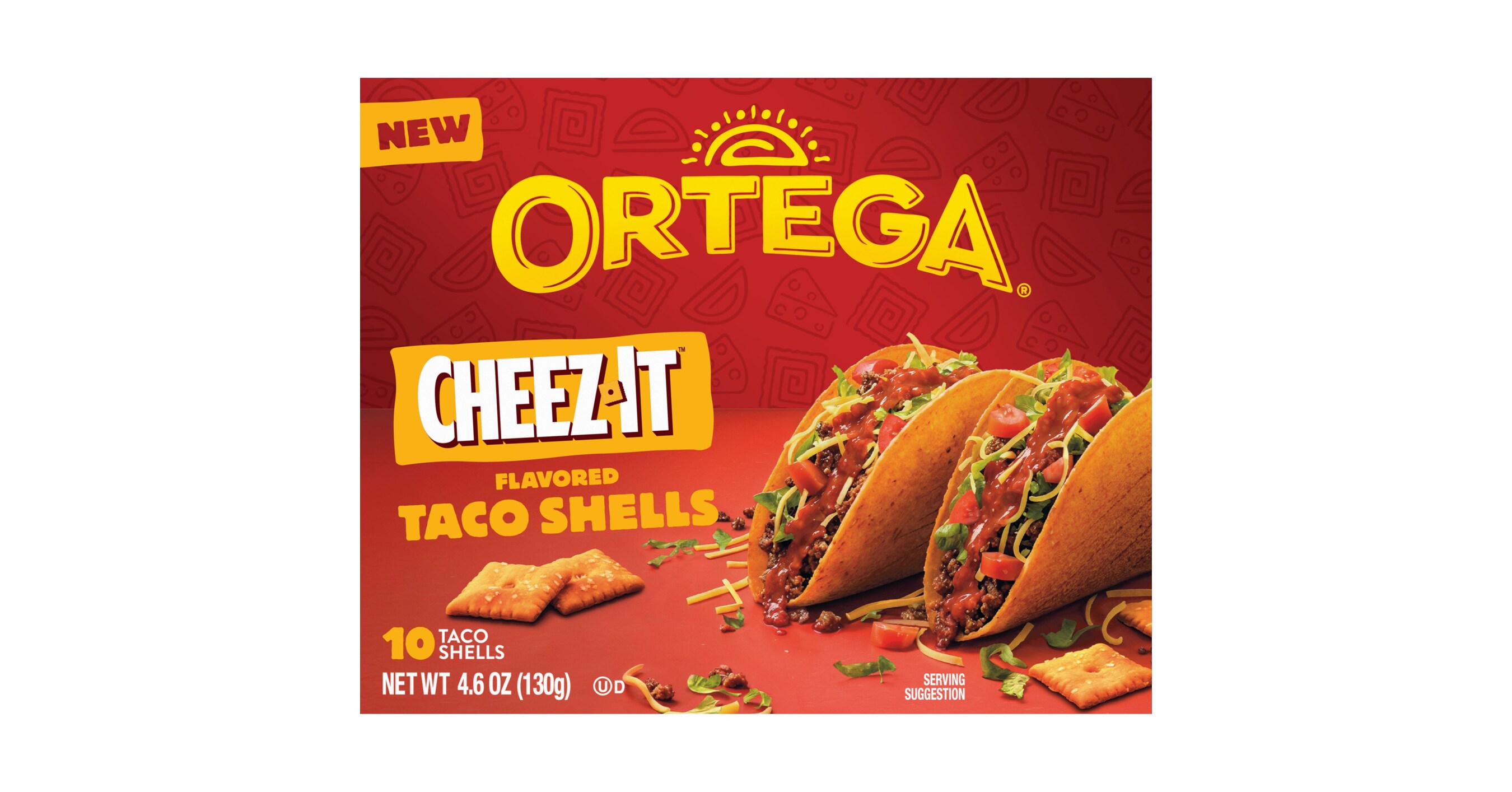
Ortega Reimagines Taco Night with Cheez-It™ Flavored Taco Shells
Prnewswire· 2025-10-06 13:02
Core Insights - Ortega has launched Cheez-It™ Flavored Taco Shells, combining the cheesy flavor of Cheez-It™ crackers with the crunch of Ortega's Hard Taco Shells, available nationwide starting September 28 [1][2]. Product Overview - The new taco shells are designed to be enjoyable both as a standalone snack and when filled, providing a bold cheesy flavor and signature crunch [2]. - The product aims to enhance the taco night experience, appealing to both taco lovers and snack enthusiasts [2]. Distribution and Availability - Ortega Cheez-It™ Flavored Taco Shells are currently available at Target and select retailers, with plans for expanded distribution to additional grocery stores in the coming months [3]. Company Background - B&G Foods, based in Parsippany, New Jersey, manufactures and distributes a diverse portfolio of over 50 food brands, including Ortega [4]. - Kellanova, a leader in global snacking and frozen foods, has a legacy of over 100 years and reported net sales of approximately $13 billion for 2024 [5].

Why TreeHouse Foods Stock Is Soaring This Week
The Motley Fool· 2025-10-03 18:35
Core Viewpoint - TreeHouse Foods is experiencing a potential acquisition interest from private equity firm Investindustrial, which is reportedly looking to acquire the company for $3 billion, leading to a significant rise in its stock price [1][2]. Company Overview - TreeHouse Foods, a leading private-label manufacturer of snacks and beverages, saw its shares increase by 31% this week, recovering from a decline from $40 to $15 over the past year [1][2]. - The company is currently valued with an EV-to-EBITDA ratio of 8, indicating it is reasonably priced despite minimal growth rates [4]. Acquisition Interest - Investindustrial has a history with TreeHouse Foods, having previously acquired a large portion of its meal preparation business for $950 million in 2022, suggesting a potential strategic interest in the company [3]. - The growth of private-label brands in the consumer-packaged goods sector, particularly among Gen Z and millennial consumers, makes a well-priced acquisition appealing for Investindustrial [5]. Market Context - The private-label category is gaining market share, which could provide a favorable environment for Investindustrial to capitalize on TreeHouse Foods' portfolio, which includes baked snacks, tea, coffee, and other products [4][5].

Branston baked beans maker cooks up £1.5bn London Stock Exchange float
Yahoo Finance· 2025-10-03 11:37
Company Overview - Princes Group, owned by Italian food conglomerate Newlat, plans a £1.5 billion listing on the London Stock Exchange, marking a significant step in its growth journey [1][2] - Founded in 1880, Princes is one of the largest food manufacturers in Britain, employing around 2,000 staff in the UK and 7,800 globally [1][2] Product Range and Market Position - Originally a tinned fish company, Princes has diversified into various food and drink categories, including juices, preserves, pasta, oils, and condiments [2] - The company sells nearly a billion cans of food annually and has a strong presence in the UK market, which is its largest [3][5] Strategic Goals - The planned listing aims to provide access to capital for mergers and acquisitions (M&A), accelerate growth, expand the product portfolio, and enhance international reach [3] - The listing is seen as a natural progression for the company, with aspirations to attract top talent and build for the future [2][3] Industry Context - The announcement comes amid a decline in IPO activity in London, which has fallen out of the top 20 global locations for initial public offerings [4] - London has raised only $248 million (£184 million) for listings in 2025, the lowest in over 35 years, compared to a peak of $51 billion in 2006 [4] Recent Developments - The announcement coincides with other positive signs in the market, such as the Beauty Tech Group's £300 million flotation and Fermi America's dual listing in London and the US [4][5] - Princes operates 23 factories across the UK, continental Europe, and Mauritius, along with 21 warehouses and distribution centers [6]