
服装与奢侈品

Search documents
望远镜系列16之VFFY2026Q1经营跟踪:收入略优于预期,Q2指引谨慎
Changjiang Securities· 2025-08-15 02:15
Investment Rating - The industry investment rating is "Positive" and maintained [6] Core Insights - For FY2026Q1 (March 30, 2025 - June 28, 2025), VF achieved revenue of $1.76 billion, a slight decline of 2% year-on-year at fixed exchange rates, which is better than market expectations and the company's prior guidance [2][4] - The gross margin increased by 2.7 percentage points to 53.9%, driven mainly by improved discounts and exchange rate factors [2][4] Revenue Breakdown - **By Brand**: - Vans continued to face pressure with a revenue decline of 15% to $500 million - The North Face grew by 5% to $560 million - Timberland increased by 9% to $260 million [5] - **By Region**: - Revenue in the Americas declined by 3% to $940 million - EMEA saw a decrease of 2% to $550 million - APAC grew by 4% to $270 million, with Greater China down by 6% [5] - **By Channel**: - Direct-to-Consumer (DTC) revenue fell by 4% to $720 million - Wholesale channel revenue remained flat at $1.04 billion [5] Inventory and Tariff Impact - At the end of FY2026Q1, the company's inventory increased by 4% year-on-year to $2.14 billion, maintaining overall healthy inventory quality [10] - Tariff expectations are projected to impact gross profit by $60-70 million in FY2026, with half of this expected to occur in FY2026 [10] Performance Guidance - For FY2026Q2, the company expects revenue to decline by 2%-4% year-on-year at fixed exchange rates, with adjusted operating profit projected between $260 million and $290 million [10]
2025年5月美国行业库存数据点评:从库存和关税因素看美铜价格波动
CMS· 2025-08-01 06:43
Overall Inventory Cycle - In May, the total inventory in the U.S. increased by 2.62% year-on-year, down from 3.15% in the previous period[12] - Sales in May rose by 3.30% year-on-year, compared to 3.68% previously[12] - The U.S. is confirmed to be entering an active destocking phase, with a significant import surge occurring from November 2024 to March 2025[12] - A brief replenishment demand is expected in June and July, after which active destocking will continue[12] Industry Inventory Cycle - Six out of fourteen major industries are in active destocking as of May, including oil, gas, chemicals, transportation, automotive parts, textiles, and food[19] - The historical percentile for overall inventory in May is 32.4%, with construction materials at 83.6% and chemicals at 69.3%[19] - The first round of excess imports is estimated at $180 billion and the second at $100 billion, totaling $280 billion, which may be exhausted by November[12] - Recent rapid declines in copper prices are attributed to a 50% tariff on copper products while exempting raw materials, disrupting supply and demand dynamics[13] Risk Factors - The potential for U.S. economic fundamentals and policies to exceed expectations poses a risk to inventory and pricing stability[8]
安踏体育(02020):短期经营承压,中长期经营稳健
Changjiang Securities· 2025-07-21 14:17
Investment Rating - The investment rating for Anta Sports (2020.HK) is "Buy" and is maintained [8]. Core Views - Anta's retail performance in Q2 2025 showed low single-digit growth for the Anta brand, while FILA brand experienced mid-single-digit growth, and other brands grew by 50%-55% year-on-year [2][6]. - The company is facing short-term operational pressure due to intensified competition and discounting, but the long-term outlook remains stable with expected healthy growth in revenue and net profit for H1 2025 [8]. - The forecast for net profit from 2025 to 2027 is projected at 134 billion, 150 billion, and 166 billion respectively, with year-on-year growth rates of 13%, 11%, and 11% [8]. Summary by Sections Retail Performance - Anta's retail performance in Q2 2025 was slightly below expectations, primarily due to adjustments in offline franchise stores and pressure from the 618 sales event [8]. - FILA's performance met expectations, with stable discounts in offline channels and a slight increase in e-commerce discounts [8]. Financial Projections - Total revenue projections for Anta are 70,826 million in 2024, 77,975 million in 2025, 85,282 million in 2026, and 92,167 million in 2027, reflecting growth rates of 13.58%, 10.09%, 9.37%, and 8.07% respectively [10]. - The projected net profit for 2025 is 13,420 million, showing a decrease of 13.95% compared to 2024, followed by increases of 11.47% and 10.93% in the subsequent years [10].

2025年4月美国行业库存数据点评:美国Q2或进入主动去库
CMS· 2025-07-01 13:33
Overall Inventory Cycle - In April, the total inventory in the U.S. increased by 3.37% year-on-year, compared to a previous value of 3.43%[1] - The total sales in April rose by 3.74% year-on-year, down from 4.04% previously[1] - The data indicates a preliminary shift towards active destocking in the U.S. inventory cycle[1] Industry Inventory Cycle - Among 14 major industries in April, 10 were in passive restocking, including construction materials, metals, and consumer goods[12] - The historical percentile for overall inventory in April was 39.2%, with chemical products at 85.7% and construction materials at 83.2%[12] - Oil and chemical sectors are likely transitioning to active destocking, while construction and metal inventories remain high[12] Future Outlook - Despite uncertainties regarding tariffs, the U.S. inventory cycle is expected to lean towards active destocking in Q2 due to previous overstocking[1] - The "panic import" demand has extended the passive restocking cycle for downstream industries[14] - Active destocking is anticipated for automotive and automotive parts as of December 2024, with a continued trend into April 2025[14]
美股,新高!
证券时报· 2025-06-27 15:09
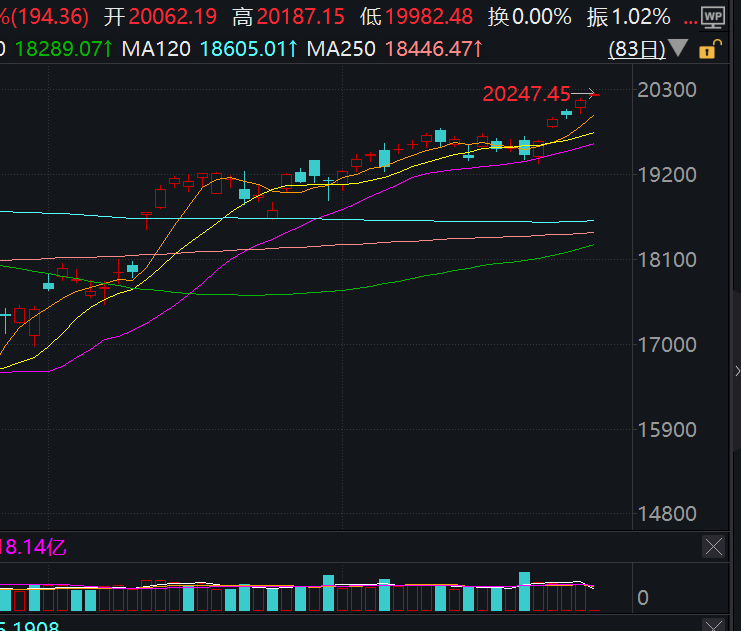
Group 1 - The U.S. stock market is experiencing a significant rally, with the S&P 500 and Nasdaq indices reaching all-time highs [1][11] - The S&P 500 index is reported at 6178.3 points, up 0.59%, while the Nasdaq index is at 20294.93 points, up 0.64% [11] - The technology sector is leading the market recovery, with the S&P 500 index rising over 20% since its low on April 8 [11][12] Group 2 - The U.S. economy is facing increasing complexity, with the PCE inflation indicator exceeding expectations [2][6] - The PCE index for May shows a year-over-year increase of 2.3%, while the core PCE index rose by 2.68%, the highest since February 2025 [7][8] - Economists predict that inflation may rise in the coming months as higher import tariffs are passed on to consumers [8] Group 3 - The U.S. Commerce Secretary announced that the White House is close to finalizing trade agreements with ten major trading partners [4][5] - The Trump administration aims to complete these trade negotiations before the Labor Day holiday on September 1 [5] - If agreements are not reached in time, Trump may issue letters to specify trade terms directly [4] Group 4 - Nike's stock surged by 14% after reporting better-than-expected fourth-quarter earnings, despite a 12% year-over-year revenue decline [13] - Nike's revenue for the quarter was $11.1 billion, exceeding market expectations of $10.72 billion [13] - The company indicated that the trend of declining annual sales is beginning to ease, suggesting the effectiveness of CEO Elliott Hill's strategic initiatives [13]



滚动更新丨美股三大股指集体高开 Cyngn涨超70%
Di Yi Cai Jing· 2025-06-27 13:43
Group 1 - US stock indices opened higher, with the Dow Jones up 0.25%, S&P 500 up 0.16%, and Nasdaq up 0.24% [3][5] - Cyngn saw a significant increase, rising over 70% [3][5] - Nike's stock rose nearly 12% after the company reported better-than-expected revenue for Q4 2025 [3][12] Group 2 - The Nasdaq index broke its previous high from December 2024, reaching a new historical peak [1] - The US personal consumption expenditures (PCE) price index increased by 0.1% month-on-month in May, while the core PCE index rose by 0.2% [9] - The year-on-year increase in the core PCE price index for May was 2.7%, up from the previous value of 2.5% [11] Group 3 - European stock indices also experienced gains, with Germany's DAX up 0.76%, UK's FTSE 100 up 0.52%, and France's CAC40 up 1.31% [7][8]
奥康国际:控股股东质押1.37亿股
news flash· 2025-06-24 13:52
Group 1 - The actual controller of Aokang International, Wang Zhentao, holds 60.5567 million shares, accounting for 15.10% of the total share capital, with a cumulative pledge of 60 million shares, representing 99.08% of his holdings [1] - The controlling shareholder, Aokang Investment, and its concerted party, Wang Zhentao, collectively hold 172 million shares, which is 42.83% of the total share capital, with a cumulative pledge of 111 million shares, accounting for 64.70% of their holdings [1] - Wang Zhentao pledged 26 million shares to Tianjin Trust on June 23, 2025, which is 42.93% of his holdings and 6.48% of the total share capital, with the pledged financing used to supplement working capital [1] Group 2 - As of the announcement date, the controlling shareholder Aokang Investment and its concerted party, Wang Zhentao, have a total pledged share of 137 million shares, which is 34.19% of the total share capital [1]

望远镜系列5之AdidasFY2025Q1经营跟踪:关税影响较小,维持全年指引
Changjiang Securities· 2025-05-18 23:30
Investment Rating - The industry investment rating is "Positive" and maintained [9] Core Insights - In FY2025Q1 (January 1, 2025 - March 31, 2025), Adidas achieved revenue of €6.15 billion, slightly above expectations (Bloomberg consensus expected €6.10 billion), with a year-on-year growth of 13% at constant exchange rates. Excluding the impact of Yeezy, Adidas brand revenue grew by 17% year-on-year [2][4] - The net profit attributable to shareholders was €430 million, representing a year-on-year increase of 151%. The gross margin improved by 0.9 percentage points to 52.1%, primarily due to lower product costs and shipping expenses, as well as improved discounts [2][4] Revenue Breakdown - **By Region**: Excluding the Yeezy business, all regions showed strong growth. Latin America and emerging markets continued robust growth, with revenues increasing by 26% and 23% year-on-year to €700 million and €870 million, respectively. Europe, Greater China, and Japan/Korea regions grew by 14%, 13%, and 13% year-on-year, respectively. North America was impacted by the cessation of Yeezy business, with a revenue growth of only 3% year-on-year, but grew by 13% when excluding this factor [5] - **By Channel**: Both DTC (Direct-to-Consumer) and wholesale channels achieved quality growth. Wholesale channel revenue increased by 18% year-on-year to €4.0 billion, benefiting from high sell-through rates and product mix adjustments. E-commerce channel revenue decreased by 3% due to the impact of Yeezy business separation, but grew by 18% when excluding this factor. DTC channel revenue grew by 6% year-on-year to €2.16 billion, driven by double-digit same-store sales growth in owned stores [5] - **By Product**: Footwear products continued to lead growth, with revenue increasing by 17% year-on-year to €3.76 billion. Apparel and equipment also showed growth, with revenues increasing by 8% and 10% year-on-year to €1.97 billion and €424 million, respectively. In FY2025Q1, footwear, apparel, and equipment accounted for 61%, 32%, and 7% of total revenue, respectively, indicating a healthy product mix [6] Inventory and Tariff Impact - Inventory remained healthy, supporting continued growth, with FY2025Q1 inventory at €5.07 billion, a year-on-year increase of 15% [12] - The impact of tariffs was relatively small due to low procurement from China, with approximately 20% of revenue from the US market, which can be compensated by strong performance in other mature markets. The procurement ratio for footwear from China is around 3%, moving towards zero, and for apparel, it is less than 2% [12] Performance Guidance - The company maintains its full-year guidance, expecting FY2025 revenue to grow at a high single-digit rate at constant exchange rates (Bloomberg expects revenue of €26.01 billion, a year-on-year increase of 9.8%). The expected operating profit for FY2025 is between €1.7 billion and €1.8 billion, representing a year-on-year increase of 27.2% to 34.6% [12]

招商宏观:美国下游或仍有“抢进口”需求 库存周期切换进程或将加速
智通财经网· 2025-05-04 02:42
Core Viewpoint - The overall inventory cycle in the U.S. is likely transitioning towards an active destocking phase by 2025, with significant implications for various industries [1][2][3]. Overall Inventory Cycle - In February, U.S. total inventory increased by 2.45% year-on-year, compared to a previous value of 2.25%. Sales increased by 3.45% year-on-year, down from 3.69% [2][3]. - The inventory cycle remains in a passive restocking phase due to "import grabbing," with Q1 net imports increasing by $359.26 billion year-on-year, of which over one-third ($129.71 billion) converted into inventory [2][3]. Industry Inventory Cycle - Among 14 major industry categories, 8 are in a passive restocking phase, including upstream chemical products, building materials, midstream electrical equipment, and downstream durable consumer goods [4]. - Historical inventory percentiles show that total inventory is at a historical percentile of 30.5%, with building materials at 71.5%, automotive parts at 67.8%, and paper and forestry products at 53.8% [4]. Upstream Inventory Status - Half of the upstream industries are in passive restocking, while the other half are in active destocking [5][6][7][8]. - Specific sectors like oil, natural gas, and consumer fuels are in active destocking as of February 2025 [5]. Midstream Inventory Status - Inventory status is mixed, with paper and forestry products in active restocking, while electrical equipment and transportation are in passive restocking [9][10]. - Mechanical manufacturing is currently in passive destocking [9]. Downstream Inventory Status - The current passive restocking phase is prolonged, indicating potential "import grabbing" demand [11]. - Automotive parts are transitioning to active destocking as of February 2025, while other sectors like household durable goods and textiles remain in passive restocking [11].
特步国际(01368):Q1主品牌中单位数增长,索康尼超40%
HUAXI Securities· 2025-04-17 05:34
Investment Rating - The investment rating for the company is "Buy" [1] Core Views - The company reported a year-on-year growth in retail sales for its main brand in Q1 2025, with a discount range of 70% to 75% and channel inventory at approximately four months [2][3] - Saucony, a brand under the company, achieved about 40% year-on-year growth in retail sales in Q1 2025, benefiting from its strong performance in professional running and outdoor segments [2][3] Summary by Sections Event Overview - The company announced its Q1 2025 operational data, highlighting a year-on-year increase in retail sales for its main brand, with discounts maintained at 70% to 75% and channel inventory around four months [2] Analysis and Judgment - In Q1 2025, the retail sales growth rate for the main brand showed a decline compared to Q4 2024, but the discount levels remained stable [3] - The company’s retail discount rates were consistent across quarters, with channel inventory turnover slightly improving compared to the previous year [3] - Saucony's growth is attributed to its strategic positioning in high-end markets and its brand promotion efforts, including celebrity endorsements and product innovation [3] Investment Recommendations - Short-term investments in the main brand's DTC strategy may negatively impact sales but are expected to enhance consumer interaction and brand loyalty in the long run [4] - The company plans to expand its product range and open approximately 30 new Saucony stores in high-end markets [4] - The financial forecasts for 2025, 2026, and 2027 predict revenues of 142.86 billion, 155.58 billion, and 172.51 billion respectively, with corresponding net profits of 13.74 billion, 15.11 billion, and 16.64 billion [4]