Streaming

Search documents
Trump says he wants a new owner for CNN as part of any sale of Warner Bros. Discovery: ‘A very dishonest group of people'
New York Post· 2025-12-10 23:56
Core Viewpoint - Donald Trump is advocating for a new owner for CNN as part of the sale of its parent company, Warner Bros. Discovery (WBD), indicating a preference for Paramount Skydance's bid over Netflix's [1][3]. Group 1: Sale Dynamics - Netflix has agreed to purchase WBD's Warner Bros. studio and HBO Max streaming service, while keeping CNN's current management in place [2]. - Paramount Skydance aims to acquire all of WBD, including CNN, and intends to place CNN under the leadership of Bari Weiss from CBS [2]. - Trump has emphasized that any deal should ensure CNN is either included or sold separately, criticizing the current management as "dishonest" [4][17]. Group 2: Trump's Influence - Trump's comments reflect his direct involvement in the review of the WBD sale, aiming to exert pressure to align the deal with his political objectives [3][12]. - He has expressed a desire for CNN's alleged anti-MAGA bias to be "neutralized," which is a reason for his support of the Ellisons in the bidding contest [13]. - Paramount's pitch to WBD shareholders includes the promise of "regulatory certainty" from the Trump administration, arguing it has less antitrust overlap with WBD compared to Netflix [13]. Group 3: Bidding War - Paramount Skydance has launched a "hostile bid" with an all-cash offer of $30 per share, which is positioned as superior to Netflix's cash-stock offer of $30.75 per share [15]. - The bidding war between Paramount Skydance and Netflix could escalate the winning price to $35 per share, valuing WBD at approximately $91 billion, compared to its pre-sale market value of around $31 billion [16].



Stock market today: Dow, S&P 500, Nasdaq futures slide as Oracle earnings reignite AI spending fears
Yahoo Finance· 2025-12-10 23:35
Market Overview - US stock futures declined after Oracle's earnings raised concerns about AI overspending, impacting the Wall Street rally following the Federal Reserve's interest-rate cut [1][2] - S&P 500 and Nasdaq 100 futures fell approximately 0.5% and 0.8%, respectively, while Dow Jones Industrial Average futures decreased by 0.1% [1] Oracle's Earnings Impact - Oracle's after-hours earnings report reignited fears regarding AI spending, leading to a significant drop in its stock by over 10% [2] - The company missed expectations for cloud sales and increased its data center spending by $15 billion, raising concerns about tech valuations and the sustainability of AI investments [2][9] Federal Reserve's Actions - The broader market had previously risen after the Federal Reserve voted to lower rates for the third time this year, bringing the federal funds target range to 3.5%–3.75% [3] - Fed Chair Jerome Powell indicated a cautious approach moving forward, suggesting that a rate hike is unlikely for January [3][4] Investor Sentiment - The abrupt shift in market sentiment following Oracle's earnings highlights ongoing concerns about an AI bubble, despite a temporary increase in risk appetite due to the Fed's easing [10] - The MSCI All Country World Index was close to its peak before Oracle's stock plunge, which also affected gold prices and Treasury yields [8][9] Novo Nordisk's Performance - Novo Nordisk's shares have dropped over 50% in 2025, reflecting a significant decline from the previous year's weight-loss drug frenzy [11][12] - The company faces challenges due to disappointing clinical trial results and increased competition in the obesity-drug market, raising concerns about future sales growth [12][13]

More Sanguine About Paramount's Warner Bros. Bid: Needham's Martin
Bloomberg Technology· 2025-12-10 21:57
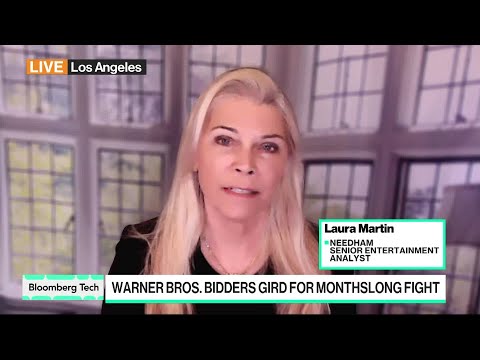
It's one of these situations where there is the Wall Street view on this deal. The structure of the deal. And then there is the.What does this mean for Hollywood. And the reason I'm so excited to have you on the program is I think we could probably talk about both. But this is the first opportunity I've had to talk to you about two competing bids.I set the stage for it on Netflix, is offer cash and stock and Paramount's offer. What is your position at this time and what is your research into the competing b ...
More Sanguine About Paramount's Warner Bros. Bid: Needham's Martin
Youtube· 2025-12-10 21:57
Core Viewpoint - The ongoing auction for Warner Brothers Discovery has generated significant interest, with competing bids from Netflix and Paramount, leading to a substantial increase in the asset's value from $12 to $30 per share, representing a 300% premium over previous trading levels [2][6]. Group 1: Auction Dynamics - David Zaslav and the Warner Brothers team are credited for effectively creating an auction environment for the asset valued at $12, which has now reached $30 per share due to competitive bids [2][3]. - Both Paramount and Netflix have indicated their willingness to increase their bids, reflecting the high stakes involved in acquiring Warner Brothers [2]. Group 2: Competitive Landscape - The Hollywood community is more concerned about a potential Netflix acquisition of Warner Brothers, viewing it as anti-competitive, especially given Netflix's stance against traditional theatrical release windows [4][10]. - Paramount's bid is perceived as more favorable due to its regulatory viability compared to Netflix, which faces skepticism from Hollywood talent regarding its competitive practices [3][4]. Group 3: Market Share and Subscriber Base - In the streaming market, Netflix boasts over 300 million global subscribers, while HBO Max has 150 million, leading to a combined market share of approximately 450 million subscribers, or 40% of the streaming market [8][9]. - In contrast, Paramount (Sky) has 75 million subscribers, which, when combined with HBO Max, results in a smaller total of 225 million subscribers, indicating a less dominant market position compared to a Netflix-Warner Brothers merger [9]. Group 4: Content Creation and Pricing Implications - The merger of Netflix and Warner Brothers would likely dampen competition for talent, potentially leading to higher prices for consumers, as both entities are major content creators with different distribution strategies [10][12]. - The argument that a merger would simplify consumer choices is countered by concerns that it would ultimately lead to increased prices, which contradicts consumer welfare principles [12][13].

Wall Street Lunch: 3rd Straight FOMC Cut, But Dissents Grow
Seeking Alpha· 2025-12-10 21:45
asbe/iStock via Getty Images Listen below or on the go on Apple Podcasts and Spotify This is an abridged transcript of the podcast: As widely expected, the Federal Open Market Committee reduced its benchmark interest rate by 25 basis points on Wednesday, its third straight cut, as the Federal Reserve's monetary policy arm sought to balance its dual mandate of full employment and price stability. It appeared to see the risk to employment as the more pressing issue. The policy easing brought the federa ...

Netflix Is Looking to Borrow Heavily Again to Fund Warner Bros. Deal
Yahoo Finance· 2025-12-10 19:00
Core Viewpoint - Netflix is planning to borrow heavily again to finance a $72 billion acquisition of Warner Bros. Discovery Inc., despite having a stronger balance sheet than before the pandemic [2][3]. Group 1: Acquisition Financing - The acquisition plan includes $59 billion of temporary debt financing from Wall Street banks, which Netflix intends to replace with $25 billion of bonds, $20 billion of delayed-draw term loans, and a $5 billion revolving credit facility [4]. - Netflix's debt load may increase further due to a competing hostile takeover bid for Warner Bros. from Paramount Skydance Corp., which values the company at over $108 billion, approximately $26 billion more than Netflix's offer [5]. Group 2: Credit Profile and Risks - Analysts note that Netflix's credit profile has improved significantly, moving away from its previous "high yield" status, with a current rating of A from S&P Global Ratings and A3 from Moody's [3][6]. - Rising debt levels pose a risk for investors, with potential for Netflix to be downgraded to the BBB tier, prompting recommendations to sell its notes due in 2034 and 2054 [6]. - The acquisition faces regulatory scrutiny, which could result in a $5.8 billion breakup fee if the deal is blocked [7]. Group 3: Market Sentiment - Despite the risks, many analysts and investors consider the situation manageable, as risk premiums on Netflix's debt have remained stable [8]. - Moody's has affirmed Netflix's A3 rating, citing strong operating performance and the potential benefits from acquiring valuable intellectual properties like Harry Potter and HBO, while adjusting the outlook to "stable" from "positive" [8].
Why This Analyst Says the Warner Bros. Deal Is Bad News for Netflix Stock
Yahoo Finance· 2025-12-10 18:46
Core Viewpoint - Netflix's potential $72 billion acquisition of Warner Bros. Discovery's studio and streaming assets is facing criticism from analysts who highlight risks associated with generative AI disruption in content creation [1][5]. Group 1: Acquisition Details - The deal combines Netflix's 300 million global subscribers with HBO Max's 128 million customers, resulting in a streaming entity that controls approximately 43% of the global subscription video market [3]. - Netflix will pay $23.25 in cash and $4.50 in stock for each Warner Bros. Discovery share, valuing the transaction at $27.75 per share [3][4]. Group 2: Analyst Perspectives - Needham analyst Laura Martin warns that Netflix risks $83 billion in additional value by acquiring Warner Bros.' traditional studio operations amid the threat of AI in content creation [1]. - Martin maintains a "Buy" rating and a $150 price target on Netflix but suggests the company would be better off without the legacy burdens of Warner Bros.' studio business [5]. Group 3: Market Reactions - Netflix's stock has declined nearly 10% over the last five trading sessions as investors consider regulatory and competitive implications of the acquisition [6]. - The deal is under scrutiny from antitrust regulators due to the combined market share, and Paramount has made a $30-per-share all-cash counteroffer to Warner Bros. shareholders [6]. Group 4: Future Plans - Netflix plans to spend around $30 billion annually on content post-merger, positioning itself as the largest entertainment spender globally [8].
Warner Bros. Discovery bidding war is not over yet, says Oakmark’s Alex Fitch
CNBC Television· 2025-12-10 17:09
Joining us now is one of those shareholders, Oakmark partner and portfolio manager, Alex Fitch. Oakmark is the fourth largest shareholder in Warner Brothers Discovery after Vanguard, State Street, and BlackRock. It's good to have you, Alex.So, which way are you leaning as far as ownership for Warner, Paramount or Netflix. >> Well, I'm not sure it's actually ever going to come to that point where we're voting on these two specific deals. Uh, I strongly suspect this bidding war is not over yet.Uh if you think ...

Netflix's Acquisition of Warner Bros. Represents a Paradigm Shift in the Streaming Industry. Here Are 6 Things Investors Should Know About the Deal.
Yahoo Finance· 2025-12-10 15:45
Core Viewpoint - Netflix's acquisition of Warner Bros. Discovery's assets represents a significant shift in the streaming and media industries, with a total enterprise value of nearly $83 billion, including $11 billion of net debt at Warner Bros. [4][5] Financial Investment - Netflix plans to utilize $10.3 billion of its cash reserves for the acquisition and intends to raise an additional $59 billion in debt instruments, although it will only use $50 billion for the deal [2][4] - At the end of the third quarter, Netflix had approximately $9.3 billion in cash and equivalents, along with $3.6 billion in other current assets [2] Comparison with Other Acquisitions - The deal is larger than Disney's $71 billion acquisition of 21st Century Fox and Disney's $27.5 billion purchase of Hulu, highlighting its significance in the industry [3][4] Regulatory Challenges - The acquisition faces potential regulatory scrutiny and antitrust concerns, with competing offers emerging, such as Paramount Skydance's hostile bid of $30 per share [6][7][8] - Netflix management is optimistic about obtaining regulatory approval within 12 to 18 months [8][9] Valuable Assets - The acquisition includes valuable franchises such as Game of Thrones, the DC superhero universe, and Harry Potter, which can generate significant revenue through various channels [10][11] - The deal is expected to be accretive to earnings by the second full year post-acquisition, with anticipated cost synergies of $2 billion to $3 billion by year three [13] Consumer Benefits - The consolidation may lead to better pricing for consumers, as a bundled Netflix and HBO Max subscription could be cheaper than purchasing both separately [16][17] - The combination of Netflix's technology and HBO's content is expected to enhance user experience and content delivery [17][18]
Netflix's Acquisition of Warner Bros. Represents a Paradigm Shift in the Streaming Industry.
The Motley Fool· 2025-12-10 15:25
Core Viewpoint - Netflix's acquisition of Warner Bros. Discovery's film and television studios, valued at approximately $83 billion, represents a significant shift in the streaming and media industries, potentially leading to further consolidation among streaming companies [1][2]. Group 1: Acquisition Details - Netflix plans to acquire Warner Bros.' assets for a total enterprise value of nearly $83 billion, which includes about $11 billion of net debt at Warner Bros. The deal values Warner Bros. at $27.75 per share, with Netflix funding 84% of the acquisition in cash and the remainder in stock [4][5]. - The acquisition is larger than Disney's purchase of Hulu, valued at $27.5 billion, and Amazon's acquisition of MGM for approximately $8.45 billion [5]. Group 2: Financial Implications - Netflix will utilize $10.3 billion of its cash reserves for the deal and plans to raise an additional $59 billion through various debt instruments, although it intends to use only $50 billion in acquisition debt [5][6]. - At the end of the third quarter, Netflix had around $9.3 billion in cash and equivalents, along with $3.6 billion in other current assets [5]. - The company had approximately $14.5 billion in long-term debt at the end of its most recent quarter and aims to maintain an investment-grade credit rating through a rapid debt reduction plan post-acquisition [6]. Group 3: Regulatory and Competitive Landscape - The acquisition faces regulatory challenges and competing offers, notably a hostile bid from Paramount Skydance at $30 per share, which is significantly higher than Netflix's offer but seeks to acquire all of Warner Bros., including cable assets [7][8]. - Netflix management is actively pursuing regulatory approval, hoping to close the deal within 12 to 18 months, although antitrust scrutiny is anticipated [9][10]. Group 4: Strategic Value of Acquired Assets - The acquisition includes valuable franchises such as Game of Thrones, the DC superhero universe, and Harry Potter, which can generate significant revenue through various channels, including merchandise and gaming products [11]. - Historical context shows that major franchises can yield substantial returns, as evidenced by Disney's Star Wars franchise generating $12 billion in value [12]. Group 5: Expected Financial Benefits - Netflix anticipates the transaction will be accretive to earnings by its second full year post-acquisition, with expected run-rate cost synergies of $2 billion to $3 billion by year three [14]. - Co-CEO Greg Peters highlighted potential benefits from bundling Netflix and HBO, which could enhance retention and engagement, leading to increased revenue [16]. Group 6: Consumer Impact - The consolidation in the streaming industry may benefit consumers by offering bundled subscription options that could be more cost-effective than purchasing individual plans [17][18]. - The combination of Netflix and HBO's resources is expected to enhance content delivery and user experience, leveraging Netflix's superior technology platform [19].