
Technology

Search documents
NetApp, Inc. (NTAP) Presents at Raymond James TMT & Consumer Conference Transcript
Seeking Alpha· 2025-12-09 19:07
Group 1 - The article does not provide any specific content related to a company or industry [1]


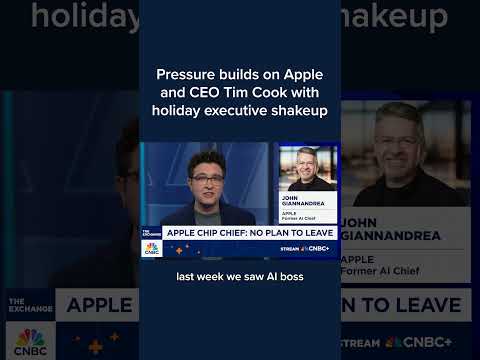
Pressure builds on Apple and CEO Tim Cook with holiday executive shakeup
CNBC Television· 2025-12-08 21:16
Yeah, it's been quite a few days over at Apple and lots of big shots out there in Certino. They're getting new careers for the holidays. Now, we saw several changes in just the last seven days on top of several departures over the last few months.Now, someone not leaving Kelly, that would be Chip boss Johnny Scroogi. Bloomberg kind of set up some red flags over the weekend with a report that said Sruji told CEO Tim Cook he wants to step down from the his position but this morning in a memo to staff told the ...

Rivalry Made us Better
20VC with Harry Stebbings· 2025-12-08 15:07
kind of what happened with Koshi in the election was a bit of a Chad GPT moment for our industry. Koshi is one of the fastest growing companies on the planet. In the last week, they announced their $1 billion raise and an 11 billion valuation.Today joins me for his only interview following these announcements. [music] >> An industry truly becomes an industry when there's a rivalry. Without Poly Market, we wouldn't have pushed our marketing and pushed our product as hard.>> Did you ever cross paths with SPF. ...

Stock Market Navigates Cautious Optimism Ahead of Pivotal Fed Decision
Stock Market News· 2025-12-08 11:07
Market Overview - U.S. equity markets are cautiously trending higher as investors prepare for the Federal Reserve's final monetary policy meeting of the year, with expectations for an interest rate cut [1][6] - Major U.S. indexes recorded solid gains last week, with the S&P 500 closing up between 0.3% and 0.4%, and the Nasdaq Composite climbing 0.9% to 0.91% [4][5] Premarket Activity - U.S. stock futures indicate a steady to slightly positive trend, with S&P 500 E-mini futures up approximately 0.1% to 0.2%, and Nasdaq 100 futures rising by about 0.18% to 0.27% [2] - Significant individual stock movements include Top Wealth Group Holding Limited surging over 125%, Paranovus Entertainment Technology Ltd. up more than 103%, and Cemtrex, Inc. gaining over 81% [3] Upcoming Economic Data - Key economic data releases this week include the delayed October Job Openings and Labor Turnover Survey (JOLTS) report on December 9, and weekly jobless claims along with September trade data on December 11 [8] - The New York Fed's consumer inflation expectations survey is also scheduled for release on December 8 [8] Corporate Announcements - Earnings season is winding down, with notable companies such as Oracle and Adobe set to report quarterly results this week, which could lead to significant stock movements [10] - Air Products and Yara International are in discussions for low-emission ammonia projects, with final investment decisions expected by mid-2026 [11] - Safran launched a new digital ethics reporting platform aimed at enhancing its ethics alert system [11] - German warship maker TKMS reported a substantial increase in financial figures for fiscal year 2024/2025, with order intake six times higher than the previous year [11]


Netflix-Warner Deal May Pose Problem, Trump Warns
Youtube· 2025-12-08 09:35
Core Viewpoint - The article discusses the potential implications of a significant deal involving Netflix and Warner Bros, highlighting concerns about regulatory approval and market share impacts. Group 1: Deal Overview - The deal is described as massive and transformative, with uncertainty surrounding the regulatory approval process and its potential challenges [2][3]. - There are concerns about how the deal could affect market share and whether asset disposals might be necessary [4][5]. Group 2: Regulatory Considerations - The article emphasizes the importance of antitrust scrutiny, with lawyers analyzing the deal's structure to make it more regulatory-friendly [5][6]. - A significant breakup fee of $5.8 billion is mentioned, which may provide some reassurance to Warner Bros in case the deal does not materialize [6]. Group 3: Industry Context - The convergence of media and technology is noted, with historical examples of telecom, media, and tech companies merging and separating over time [9][10]. - The current deal sets a precedent for future transactions in the telecom, media, and technology (TMT) space, although past mergers have had mixed success [11][12].

GoogleTitans架构再次亮相NeurIPS2025,补全Transformer的长上下文短板
Haitong Securities International· 2025-12-08 06:12
Investment Rating - The report does not explicitly provide an investment rating for the Titans architecture or related companies in the AI technology sector. Core Insights - Google has reintroduced its Titans architecture at NeurIPS 2025, which is seen as a significant evolution post-Transformer, addressing limitations in ultra-long context processing, long-term memory, and cross-document reasoning [1][11]. - Titans can handle contexts of up to 2 million tokens and introduces test-time learning, allowing models to continuously accumulate knowledge during inference [1][12]. - The architecture combines a memory-enhanced design with recursive and attention mechanisms, significantly improving the processing of long sequences and reducing computational costs compared to traditional Transformers [2][3][12]. Summary by Sections Event Overview - Google emphasized the Titans architecture and the MIRAS theoretical framework at NeurIPS 2025, positioning it as a major advancement in AI architecture [1][11]. Technical Innovations - Titans features a Neural Memory module that allows for dynamic memory writing and retrieval during inference, enhancing long-term memory capabilities [2][12]. - The architecture employs a hybrid design of recursive updates and attention mechanisms, enabling efficient processing of long sequences while maintaining essential global interactions [2][12]. - MIRAS provides guidelines for memory management, allowing Titans to effectively handle ultra-long documents and complex reasoning tasks [2][12]. Comparative Analysis - Titans' dynamic memory during inference is a key improvement over Transformers, which face significant computational challenges with long sequences due to their O(N²) complexity [3][13]. - While Titans excels in long-context understanding and multi-document reasoning, Transformers remain more efficient for short-context tasks and real-time applications [4][14][16].

Ed Yardeni Discusses Shift From Magnificent Seven Tech Stocks
Youtube· 2025-12-08 04:08
Core Viewpoint - The recommendation has shifted to underweight mega-cap tech stocks compared to the rest of the S&P 500 due to increasing competition and high market capitalization of these stocks [1][4]. Group 1: Market Dynamics - The "Magnificent Seven" tech stocks now account for 45% of the S&P 500 market cap, while their earnings share has not increased proportionately [3]. - The U.S. market represents 65% of the global stock market cap, making it challenging to recommend an overweight position in the U.S. [4]. - There is a growing competitive landscape among the Magnificent Seven, with new entrants and innovations challenging their dominance [6][7]. Group 2: Competitive Landscape - Recent advancements, such as Google's Gemini 3 and DeepSeek's new model, have intensified competition in the AI sector, prompting a reevaluation of the positions held by established players like OpenAI [6][7]. - High profit margins in the tech sector are attracting more competition, indicating a shift in market dynamics [8]. Group 3: Investment Strategy - A broader investment strategy that includes the "impressive 493" companies outside the Magnificent Seven is suggested, as these companies are leveraging technology to enhance productivity and profit margins [9].

X @Investopedia
Investopedia· 2025-12-07 23:00
A new paper by researchers at Microsoft identified 40 occupations that could be performed by artificial intelligence (AI). https://t.co/Zkhbk2UPCj ...

This 9% Dividend Profits When Gen Z Spends Their Paycheck
Forbes· 2025-12-06 18:36
Core Insights - The S&P 500 has demonstrated a long-term wealth generation capability, with a 10.6% annualized return over the last century and a 14.6% return over the past decade [3][10] - Young Americans are experiencing significant wealth growth, with those under 35 seeing a 142% increase in wealth, indicating a positive economic trend [6][10] - The Adams Diversified Equity Fund (ADX) is positioned to benefit from the rising wealth of younger generations, holding a portfolio with a significant allocation to technology stocks [11][12] Wealth Generation Trends - The narrative that young people's financial situation is worsening is challenged by data showing that their net worth has increased since 2019, with work income rising 9% year-over-year in 2023 for those aged 25 to 34 [7][9] - The increase in wealth among younger Americans is attributed to higher earnings rather than speculative investments, suggesting a healthier economic environment [8][10] Investment Opportunities - ADX, a closed-end fund with an 8% yield, has a diversified portfolio that includes major technology companies and is trading at an 8.2% discount to net asset value, making it an attractive investment option [11][13] - The fund has outperformed the S&P 500 since its addition to the portfolio in 2017, providing consistent dividends and capital appreciation [13][14]

X @Bloomberg
Bloomberg· 2025-12-06 17:10
Apple, long the model of stability in Silicon Valley, is suddenly undergoing its biggest personnel shake-up in decades, with senior executives and key engineers both hitting the exits. https://t.co/bnaC0u4f9e ...