
征信

Search documents
21专访|深圳征信张奇:让仅有10人的小微企业也能贷到款
2 1 Shi Ji Jing Ji Bao Dao· 2025-11-28 07:37
Core Insights - The Shenzhen local credit platform has successfully addressed the financing difficulties faced by small and micro enterprises, accumulating services for nearly 7 million entities and facilitating financing exceeding 24 trillion yuan by the end of 2024 [1][4] - The platform has provided credit services to over 77,000 enterprises, with more than 11,000 being first-time borrowers, resulting in over 700 billion yuan in financing, of which 70% are inclusive microloans and 80% are credit loans [1][4] Group 1: Platform Overview - The Shenzhen local credit platform, operational since early 2022, aims to enhance enterprise financing by aggregating credit information and management data from various government departments [1][4] - The platform has collected over 3.4 billion pieces of government data, covering approximately 4.5 million business entities in Shenzhen [4][6] Group 2: Product Innovation - The platform has introduced various financial products tailored to different types of small and micro enterprises, including "Technology Startup Pass," "Individual Pass," "Carbon Reduction Loan," and "Seed Loan" [4][6] - The "Technology Startup Pass" product has issued over 7.3 billion yuan in credit, serving more than 4,600 technology SMEs, with 80% of these being outside traditional qualification lists [4][6] Group 3: Unique Shenzhen Model - Shenzhen's credit platform has developed a unique "Shenzhen Model" for small and micro enterprise financing, characterized by a unified platform for public credit information services and a comprehensive data utilization authorization [6][7] - The platform integrates financing services, local credit services, and public data utilization into a cohesive system, enhancing resource efficiency compared to other regions [6][7] Group 4: Cross-Border Services - The platform has initiated cross-border credit cooperation with Hong Kong, facilitating over 2 billion yuan in financing for Hong Kong-funded enterprises through the "Northbound Pass" [7][9] - The "Southbound Pass" aims to support mainland enterprises in Hong Kong by providing authorized data for financing, with 1,384 data verifications completed [9] Group 5: Data Security Measures - The platform has established a comprehensive security system for handling sensitive data, utilizing a dual-cloud architecture and various protective measures to ensure data safety [11][12] - The platform has achieved significant security certifications and has successfully passed national security tests, demonstrating its robust data protection capabilities [11][12]
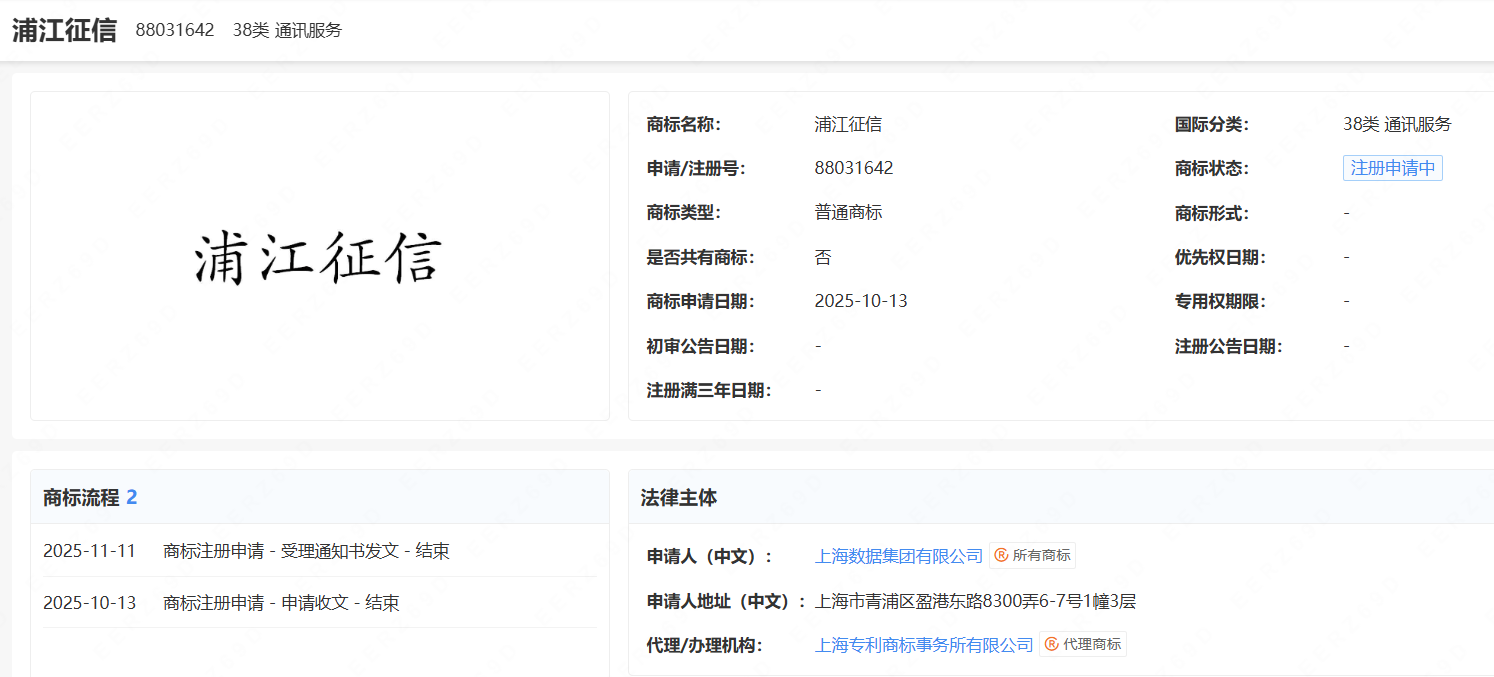
第四张个人征信牌照进程加速!上海数据集团申请注册浦江征信商标
2 1 Shi Ji Jing Ji Bao Dao· 2025-11-27 07:10
Core Viewpoint - The establishment of "Pujian Credit" marks the acceleration of the opening process for a new market-oriented personal credit institution in Shanghai, led by Shanghai Data Group, with significant participation from major internet companies [2]. Group 1: Market Developments - In June 2025, the Governor of the People's Bank of China announced eight policy measures to enhance the social credit system, including the establishment of personal credit institutions [2]. - The registration of the "Pujian Credit" trademark indicates the rapid progress of the fourth market-oriented personal credit institution in Shanghai [2]. - The three existing market-oriented personal credit institutions—Baihang Credit, Puda Credit, and Qiantang Credit—have collectively provided over 70 billion credit services in 2024 [2]. Group 2: Institutional Landscape - Qiantang Credit, established in November 2024, is the only personal credit institution in Zhejiang Province and has become a public data authorized operator in the region [2][3]. - Baihang Credit and Puda Credit hold dual qualifications for both personal and enterprise credit services, while Qiantang Credit currently only has personal credit service qualifications [2]. - The Shanghai Data Group, authorized by the Shanghai government, is a major player in public data operations and holds a 51% stake in Shanghai United Credit, which provides enterprise credit services [3]. Group 3: Economic Implications - The concept of personal credit economy revolves around using personal credit data to create a new economic model that benefits individuals, financial institutions, and businesses [3]. - The personal credit economy aims to allow individuals to benefit from the value of their data, promoting a sustainable economic ecosystem [3]. - The addition of personal credit business licenses by Shanghai Data Group is expected to enhance the social credit system in Shanghai [3].

微众信科王锦胤:从数据“深挖”到场景“深入”
2 1 Shi Ji Jing Ji Bao Dao· 2025-11-14 06:44
Core Insights - Credit reporting is becoming a key tool to address the financing difficulties faced by small and medium-sized enterprises (SMEs) in China [1] - The 2025 credit work conference emphasizes increasing support for key areas such as technological innovation, inclusive finance for small and micro enterprises, and green development [1] - Credit data helps bridge the information asymmetry between fund providers and demanders, directly influencing the possibility, cost, and efficiency of financing [1] Industry Overview - Shenzhen has a high demand for credit services due to its developed headquarters economy and a large number of SMEs, particularly in technology and e-commerce [1] - Many SMEs in Shenzhen operate with light assets and lack traditional collateral, but they possess substantial digital assets such as tax data and invoices [1] - The market for credit reporting services in Shenzhen is expanding, with companies like WeBank Credit Technology providing over 40 million credit reports, facilitating credit financing exceeding 1 trillion yuan for SMEs [1] Company Strategies - WeBank Credit Technology has focused on extracting tax-related operational data and expanding into supply chain finance based on transaction data [3] - The company is targeting high-information industries such as e-commerce and smart manufacturing to support financing needs [3] - AI technology has significantly improved the processing accuracy of unstructured data, enhancing risk identification and reducing default risks [5] Supply Chain Finance - The shift towards "decoupling" in supply chain finance is aimed at improving online and bulk customer acquisition and risk control [6] - WeBank Credit Technology has developed a model that integrates industry, supply chain, and equity relationships to identify quality clients [6] - The company has provided services to approximately 17 banks, accumulating credit limits of 40 to 50 billion yuan [6] Market Trends - The e-commerce sector shows strong credit demand and manageable risks, with transaction volumes growing faster than the national economy [7] - WeBank Credit Technology utilizes marketing service fees and transaction data to assess the creditworthiness of e-commerce platforms, maintaining a bad debt rate below 1% [7] - The cross-border logistics sector is also a focus area, leveraging operational data to support banks in providing credit [7] Future Directions - WeBank Credit Technology aims to expand its client base beyond banks to include state-owned enterprises and financial institutions [8] - The company is exploring new growth areas such as small and micro asset disposal and enterprise service markets [9] - Plans for consumer-facing services include creating an enterprise information search engine and offering reverse background checks for job seekers [9]
21专访|微众信科王锦胤:从数据“深挖”到场景“深入”
2 1 Shi Ji Jing Ji Bao Dao· 2025-11-14 06:43
Core Insights - Credit reporting is becoming a key tool to address the financing difficulties faced by small and medium-sized enterprises (SMEs) in China, particularly in Shenzhen, where there is a high demand for financing solutions [1][4] - The 2025 credit work conference emphasizes increasing support for key areas such as technological innovation, inclusive finance for small and micro enterprises, and green development [1][4] - The integration of credit data helps bridge the information asymmetry between fund providers and demanders, which is crucial for determining the feasibility, cost, and efficiency of financing [1][4] Group 1: Importance of Credit Data - Credit data is essential for solving the information asymmetry problem in financing activities, which affects repayment capability and willingness [1][4] - Shenzhen's unique economic landscape, with a large number of SMEs and tech companies, creates a significant market for credit reporting services [1][4] Group 2: Company Strategies and Innovations - The company has focused on leveraging tax-related operational data to provide horizontal credit financing services, and is now expanding into vertical fields based on transaction data [4][5] - The company is enhancing its fraud detection capabilities using AI technologies, significantly improving the accuracy of processing unstructured data from 80% to 98% [5] Group 3: Supply Chain Finance - The shift towards "decoupling" in supply chain finance is being explored by the company, which aims to provide services without relying solely on core enterprises [7][8] - The company has developed a model that integrates industry, supply chain, and equity relationships, allowing for better risk management and customer identification [7] Group 4: Industry-Specific Financing Needs - The e-commerce sector shows strong credit demand and manageable risks, with the company utilizing marketing service fees and transaction data to assess creditworthiness [8] - The cross-border logistics sector is also a focus area, with the company analyzing operational data to support banks in providing credit [8] Group 5: Future Growth Directions - The company identifies four main growth areas: deepening core business, exploring B2C marketing, expanding small asset disposal services, and extending into enterprise services [12] - Plans for B2C business include creating an enterprise information search engine and offering reverse background check services for job seekers [12]
百行征信许其捷:发挥双业务资质优势,赋能小微企业
2 1 Shi Ji Jing Ji Bao Dao· 2025-11-14 06:19
Core Insights - China is actively developing a multi-level credit reporting market to meet the diverse credit needs of society [1] - By 2024, personal credit institutions are expected to provide over 70 billion credit services, while 154 enterprise credit institutions will offer 36.5 billion services [1] - The credit system in China is driven by a "government + market" model, with Baixing Credit being a key player in both personal and enterprise credit services [1] Personal Credit Development - Baixing Credit has established a personal credit system that will include 760 million individuals by October 2025, with 240 million having credit information [2] - The company integrates various data sources, including business and judicial data, to enhance credit assessments for small and micro enterprises [2][3] Enterprise Credit Services - By October 2025, Baixing Credit aims to cover over 1 billion non-credit information subjects, ensuring comprehensive coverage of economic entities [4] - The company has signed service agreements with over 1,000 financial institutions, with a total of over 100 billion calls to various credit products [4] Cross-Border Credit Interconnectivity - Baixing Credit is involved in the pilot program for cross-border credit interconnectivity between mainland China and Hong Kong, facilitating loan activities for businesses and residents [5][6] - The company has successfully launched services that provide credit reports for Hong Kong enterprises seeking financing in mainland China [5] Data Security and Compliance - Baixing Credit emphasizes data security and compliance, adhering to personal information protection laws and enhancing customer service agreements [7] - The company has implemented a management system based on the principle of "my data, I control," ensuring rigorous data handling and monitoring [7] Future Plans and Strategic Focus - Looking ahead to the "14th Five-Year Plan," Baixing Credit aims to support inclusive finance and enhance the national credit system [8][9] - The company plans to innovate in financial services, focusing on green finance, digital finance, and international business expansion [9]
信用筑基 数据赋能——甘肃“1+3”模式打造农村信用体系建设西部样板
Zhong Guo Jin Rong Xin Xi Wang· 2025-10-31 08:14
Core Insights - The Gansu rural credit system is being upgraded through innovative credit models that leverage data from various sectors, enabling farmers and agricultural cooperatives to access credit without traditional collateral requirements [1][2][8] Group 1: Credit Models and Innovations - The "Gansu Xinyi Loan · Long Xintong" platform has created a unified credit information database for 370,000 agricultural entities, facilitating over 700 billion yuan in credit loans [1][2] - The platform has led to a 14.26% year-on-year increase in credit loan financing, with an average approval time reduction of 80% [2] - Three innovative credit models have emerged: "Whole Garden Credit," "Sheep Chain Cloud Platform," and "Postal Logistics + Whole Village Credit," integrating credit assessment into agricultural operations [3][8] Group 2: Specific Case Studies - In Baiyin, the "Whole Garden Credit" model has established a credit assessment mechanism for agricultural parks, resulting in a total credit of 2.45 billion yuan for 158 entities [4] - The "Sheep Industry Chain Cloud Platform" in Qingyang utilizes blockchain and IoT technologies to create real-time credit profiles for sheep farmers, reducing loan approval times from 10 days to 1 day and lowering financing costs by 20%-30% [5][6] - The "Postal Logistics + Whole Village Credit" model in Tianshui has enabled farmers to receive credit loans quickly, with 9112 households evaluated and 3.77 billion yuan in loans issued [7] Group 3: Future Directions - The People's Bank of China in Gansu plans to continue optimizing the credit platform, enhancing data collection for agricultural insurance, subsidies, and tax incentives to improve credit supply in rural areas [2][8]
个人征信修复新政将落地,符合条件的逾期记录不予展示
第一财经· 2025-10-30 13:06
Core Viewpoint - The People's Bank of China is set to implement a one-time personal credit relief policy in early 2026, aimed at addressing the credit repair needs of individuals affected by the pandemic, specifically those who have fully repaid loans despite having defaulted due to uncontrollable circumstances [3][6]. Summary by Sections Credit Relief Scope - The new policy will only apply to individuals who experienced defaults due to the pandemic and have fully repaid their debts, thus providing a "reset" opportunity for those with "non-malicious" defaults [7][8]. - The policy will not cover malicious defaults and will have a threshold for the amount of default, which is yet to be specified [7]. Impact on Individuals - The policy aims to help individuals restore their credit status, allowing them to regain access to housing loans, car loans, and business loans, thereby facilitating a return to normal financial activities [8][9]. - It is expected to encourage more individuals to clear their debts, as the policy emphasizes that only those who have repaid their loans will benefit from the relief [8]. Economic Implications - By improving the credit records of many consumers, the policy is anticipated to stimulate economic activity by enabling more potential homebuyers, entrepreneurs, and small business owners to access financial support [8][9]. - The initiative is seen as a positive signal for encouraging repayments, which could lead to a healthier credit environment and improved asset quality for financial institutions [9][10]. Technical Implementation - The relief will not involve the complete removal of default records but will instead use a "non-display" method for qualifying defaults, which will be implemented after necessary technical preparations by the People's Bank of China and financial institutions [9][10]. - The policy is characterized as a structured and conditional relief mechanism, rather than a blanket "credit washing" solution [10].

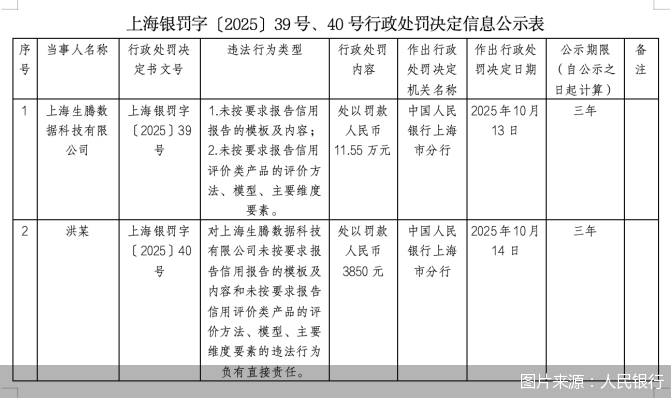
监管再出手!“启信宝”母公司领罚单,如何警示征信行业合规
Bei Jing Shang Bao· 2025-10-23 11:19
Core Viewpoint - Shanghai Shengteng Data Technology Co., Ltd. was fined for violations related to credit reporting and evaluation methods, highlighting the increasing regulatory scrutiny in the credit information industry [1][3]. Group 1: Company Specifics - Shanghai Shengteng Data Technology Co., Ltd. was fined RMB 115,500 for failing to report the required credit report templates and evaluation methods [1][2]. - The direct responsible person, Hong, was fined RMB 3,850 for the violations [1][2]. - The company, established in 2017, offers a product called "Qixinbao," which provides enterprise information retrieval services [1]. Group 2: Regulatory Environment - The penalty reflects the high standards and strict requirements imposed by the regulatory authorities, particularly the People's Bank of China [3]. - The Central Bank's 2021 regulations mandate that credit institutions report specific credit information, including templates and evaluation methods, to prevent biased evaluations [3]. - Recent penalties in the credit information sector indicate a trend of increasing regulatory demands, particularly concerning user data collection and privacy protection [4]. Group 3: Industry Implications - The fine serves as a warning for the industry, emphasizing the need for compliance over innovation in credit-related businesses [5]. - Future regulatory focus is expected to be on data sources, algorithm logic, and fairness of results, necessitating enhanced internal controls and governance structures within institutions [5]. - Companies are encouraged to invest in financial technology to improve data handling capabilities and ensure the accuracy and security of credit information [5].
钱塘征信成为信用服务领域公共数据授权运营商
Zhong Guo Jing Ji Wang· 2025-10-22 05:40
Core Viewpoint - Qiantang Credit has been designated as a public data authorization operator in the credit service sector in Zhejiang Province, marking a significant step in exploring the "personal credit economy" and unlocking the value of data elements [1] Group 1: Company Overview - Qiantang Credit aims to create a digital credit profile for individuals based on user authorization, utilizing credit evaluation and reporting tools to enhance personal credit value recognition and self-management capabilities [1] - The company is positioned as a licensed personal credit institution in China, potentially serving as a replicable model for personal credit data circulation [1] Group 2: Market Context - The personal credit economy is defined as an emerging economic form centered around personal credit data, providing new credit services to individuals, financial institutions, and businesses [1] - Qiantang Credit plans to implement its services in various scenarios such as credit services, flexible employment, and grassroots governance, aiming to reduce information asymmetry and transaction costs [2] Group 3: Comparative Analysis - The model of Qiantang Credit bears similarities to South Korea's MyData service, which allows individuals to control their data and apply it across various management scenarios [2] - South Korea's MyData service has seen significant adoption, with over 50 million users and revenue reaching 2.5 trillion KRW (approximately 13 billion RMB) in 2023 [2] Group 4: Data Integration - Qiantang Credit has integrated nearly a hundred compliant commercial data sources, showcasing a new development in the fusion of public and commercial data in the data element sector [3] - The demand for personal credit management services based on public data is substantial, given the higher level of digital governance and public data infrastructure in China compared to South Korea [3]
浙江推出全国首个面向个人的可信数据空间 探索“个人信用经济”新赛道
Zheng Quan Ri Bao Wang· 2025-10-21 13:19
Core Insights - Qiantang Credit has been designated as the public data authorized operator in the credit service sector in Zhejiang Province, aiming to create the first trustworthy data space for individuals in China [1][2] - The initiative represents an exploration of the "personal credit economy," which focuses on the circulation of personal credit data and aims to provide new economic services based on credit for individuals, financial institutions, and businesses [1] - The construction of the trustworthy data space will enable the creation of digital credit profiles for users, enhancing their ability to connect with financial, commercial, and social services [1] Group 1 - Qiantang Credit will implement its services in various fields such as credit services, flexible employment, and grassroots governance, aiming to reduce information asymmetry and transaction costs [2] - The integration of public and commercial data sources is expected to improve risk management capabilities for institutions and provide better opportunities and services for consumers [2] - Qiantang Credit has already connected with nearly 100 compliant commercial data sources, showcasing a new development in the fusion of public and commercial data [2]