核技术应用

Search documents
中国同辐自产辐照设备首次出口拉美市场
Zhi Tong Cai Jing· 2025-11-18 13:58
Core Points - China Tongfu (01763) signed a contract for an agricultural gamma irradiation project in Lima, Peru on November 17, 2025 [1] - The project aims to enhance sterilization levels and extend shelf life for Peruvian agricultural products, improving export quality and market competitiveness [1] - This project aligns with the "Atoms for Food" initiative by the International Atomic Energy Agency (IAEA), promoting food security and sustainable agricultural development [1] - The project represents a deepening of practical cooperation between China and Peru in the field of nuclear technology application [1] - It also expands new opportunities for China's nuclear technology to "go global" [1]
中国同辐(01763)自产辐照设备首次出口拉美市场
智通财经网· 2025-11-18 13:57
Core Viewpoint - China Dongfang (01763) has signed a contract for an agricultural gamma irradiation station project in Lima, Peru, aimed at enhancing the quality and market competitiveness of Peruvian agricultural products [1] Group 1: Project Details - The contract was signed on November 17, 2025, between China Dongfang and local owners in Peru [1] - China Dongfang will provide professional gamma irradiation equipment and a complete solution for the supply of irradiation cobalt sources [1] - The project will primarily be used for the irradiation treatment of agricultural products to improve sterilization levels and extend shelf life [1] Group 2: Strategic Importance - This project is part of the "Belt and Road" initiative, promoting practical cooperation in nuclear technology applications [1] - It aligns with the International Atomic Energy Agency's (IAEA) "Atoms for Food" initiative, contributing positively to food security and sustainable agricultural development [1] - The establishment of this irradiation station will deepen practical cooperation between China and Peru in the field of nuclear technology applications [1]
中国同辐(01763.HK)自产辐照设备首次出口拉美市场
Ge Long Hui· 2025-11-18 13:54
Core Viewpoint - China Zhongfu (01763.HK) has signed a contract for an agricultural gamma irradiation station project in Peru, aimed at enhancing the quality and market competitiveness of Peruvian agricultural products through irradiation treatment [1] Group 1: Project Details - The contract was signed on November 17, 2025, in Lima, Peru, where China Zhongfu will provide professional gamma irradiation equipment and a complete solution for cobalt sources [1] - The project will primarily focus on the irradiation treatment of agricultural products to improve sterilization levels and extend shelf life [1] Group 2: Strategic Importance - This project is part of the "Belt and Road" initiative, promoting practical cooperation in nuclear technology applications between China and Peru [1] - It aligns with the International Atomic Energy Agency's (IAEA) "Atoms for Food" initiative, contributing positively to food security and sustainable agricultural development [1] Group 3: Future Implications - The establishment of this irradiation station will deepen the cooperation between China and Peru in the field of nuclear technology applications [1] - It opens new avenues for China's nuclear technology to expand internationally [1]
中广核技:正积极推进铜-64、锆-89的工艺技术研究
Zheng Quan Ri Bao· 2025-11-03 08:41
Core Viewpoint - The company Zhongguang Nuclear Technology announced plans to produce various isotopes, indicating a strategic move towards expanding its product offerings in the isotope market [2] Group 1: Product Development - The isotope company plans to primarily produce germanium-gallium generators, germanium-68, and iodine-123, with the capability for mass production and stable delivery based on customer orders [2] - The company is actively advancing the research and development of copper-64 and zirconium-89 processing technologies [2] - Lutetium-177 is currently only available as an agency sales product, with no plans for independent production at this time [2]


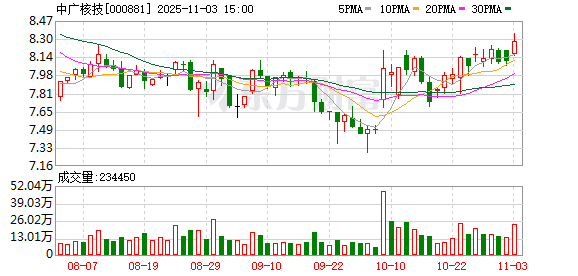
中广核技:公司正积极推进新任高级管理人员选聘工作
Zheng Quan Ri Bao· 2025-11-03 08:39
Core Viewpoint - The company is actively advancing the selection process for new senior management personnel and will fulfill information disclosure obligations in accordance with regulatory requirements [2] Group 1 - The company announced on November 3 that it is in the process of selecting new senior management [2] - The company will comply with regulatory requirements for timely information disclosure [2]
中国同辐:原子高科荣获国家级专精特新“小巨人”称号
Zhi Tong Cai Jing· 2025-10-30 02:57
Core Viewpoint - The company, 原子高科, has been recognized as a national-level "specialized, refined, and innovative" small giant enterprise, highlighting its innovation and expertise in nuclear technology applications [1] Group 1: Recognition and Standards - 原子高科 has been included in the national-level list of specialized and innovative small giant enterprises, which is a recognition of its capabilities in the field of radioactive isotope technology [1] - The evaluation criteria for this recognition include business focus, R&D investment intensity, innovation capability, and market share, indicating that 原子高科 excels in these core dimensions [1] Group 2: Implications and Future Directions - This recognition marks 原子高科's entry into the national key cultivation tier, providing an opportunity for the company to enhance its core competitiveness [1] - The company aims to uphold and promote the spirit of craftsmanship, focusing on technological innovation driven by market demand to contribute more to human health [1]
中国同辐(01763):原子高科荣获国家级专精特新“小巨人”称号
智通财经网· 2025-10-30 00:23
Core Viewpoint - China Tongfu (01763) announced that Atomic High-Tech Co., Ltd. has been recognized as a national-level "specialized, refined, distinctive, and innovative" small giant enterprise, highlighting its innovation and expertise in nuclear technology applications [1] Group 1 - The selection criteria for the national-level "small giant" enterprises include focus on main business, intensity of R&D investment, innovation capability, and market share [1] - Atomic High-Tech is acknowledged as a leader in the niche market of radioactive isotope technology, achieving a domestic leading level in specialization, refinement, distinctiveness, and innovation capability [1] - This recognition marks Atomic High-Tech's entry into the national key cultivation tier, providing an opportunity to enhance its core competitiveness through craftsmanship, technological innovation, and market demand orientation [1]
浙富控股(002266.SZ):目前已有样机处于试验验证阶段
Ge Long Hui· 2025-10-23 07:52
Core Viewpoint - The company emphasizes its commitment to the exploration and research of controllable nuclear fusion technology, positioning itself as a key supplier of liquid metal main pumps in China [1] Group 1 - The company has been focusing on the supply of main pumps for controllable nuclear fusion reactors, indicating a strategic direction in technology development and research [1] - Lithium-lead alloy is identified as an important option for the coolant in controllable nuclear fusion reactors, showcasing the company's proactive approach in this area [1] - The company has independently invested in the development of lithium-lead pumps for several years, with prototypes currently undergoing experimental validation [1]

核动力院与核理化院就医用同位素产业开展交流并签署合作协议
Zheng Quan Shi Bao Wang· 2025-10-21 12:23
Core Insights - The China National Nuclear Power Research and Design Institute (referred to as "Nuclear Power Institute") and the Nuclear Industry Radiochemistry Engineering Research Institute (referred to as "Radiochemistry Institute") have engaged in discussions regarding the development of the medical isotope industry [1] - A strategic cooperation agreement was signed between their specialized companies, Sichuan Haitong and Tianjin Yaguang, indicating a deepening collaboration in the application of nuclear technology [1] Group 1 - The collaboration focuses on the medical isotope industry, which is crucial for various medical applications [1] - The signing of the strategic cooperation agreement marks a significant step in enhancing the partnership between the two institutes [1] - This initiative reflects a broader trend of integrating nuclear technology into healthcare solutions [1]
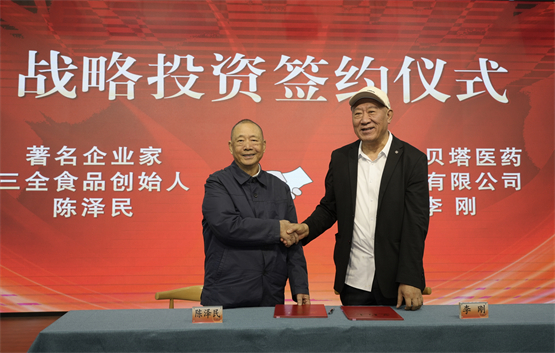
无锡贝塔融资破亿,推动碳-14全产业链建设及碳-14核电池产业化
Cai Fu Zai Xian· 2025-10-21 05:28
Group 1: Company Overview - Wuxi Beta Pharmaceutical Technology Co., Ltd. announced the completion of a strategic financing round worth hundreds of millions of yuan on October 20, with funds primarily allocated for the development of a global leading C-14 industry chain and the "Zhulong" series of C-14 nuclear batteries [1] - Founded in November 2008 by Dr. Li Gang, Wuxi Beta is the first high-tech enterprise in China specializing in the development and application of C-14 isotope technology [6] - The company aims to become a leading enterprise in the C-14 field in China and an international leader in C-14 technology, focusing on a comprehensive C-14 industry chain [6][9] Group 2: Strategic Investment - Renowned entrepreneur Chen Zemin, founder of Sanquan Foods, has joined Wuxi Beta as a strategic investor and will serve as the honorary chairman and president [1][10] - Chen Zemin's investment represents his third entrepreneurial venture, emphasizing his commitment to advancing cutting-edge technology and contributing to national strategic security and industrial upgrades [10][14] Group 3: Technological Development - Wuxi Beta has developed a complete C-14 industry chain technology system, including irradiation target materials, separation and purification, C-14 source materials, and C-14 products [6][9] - The company has successfully achieved the domestic production of C-14 source materials in collaboration with the China Nuclear Power Research and Design Institute, breaking the reliance on imports [8][9] - The "Zhulong No. 1" C-14 nuclear battery prototype was launched in March 2025, marking a significant milestone in the company's technological advancements [10] Group 4: Future Prospects - Wuxi Beta is currently progressing with the development of the "Zhulong No. 2" C-14 nuclear battery, with successful cold tests and ongoing optimization of thermal testing processes [12] - The company has established a wholly-owned subsidiary to accelerate the iteration and industrialization of C-14 nuclear batteries, while also preparing for the necessary regulatory approvals and facility constructions [12][14]