Telecoms

Search documents
Telenor and Vodafone Agree Strategic Procurement Partnership
Globenewswire· 2025-10-01 06:00
Core Insights - Telenor Group and Vodafone Group have announced a strategic partnership between their global procurement organizations to enhance procurement capabilities and leverage combined purchasing power [1][3][5] - The partnership aims to create value for customers and unlock savings through collaboration, while also strengthening supply chain resilience in a changing geopolitical landscape [3][4] - Telenor and Vodafone together serve over 550 million customers across 23 countries, with a combined annual procurement spend exceeding €26 billion (NOK 300 billion) [2] Group 1 - The partnership is designed to deepen supplier engagement and promote sustainable business practices, emphasizing high standards of environmental and social responsibility [4][5] - Telenor's Chief Procurement Officer highlighted that the collaboration will enhance competitiveness and address common challenges in the global supplier landscape [5] - Vodafone's Supply Chain Management Director expressed excitement about the collaboration, noting it will drive efficiencies and innovation while simplifying partner engagement [5] Group 2 - Telenor Group operates in the Nordics and Asia, reaching 207 million subscribers and reporting revenues of NOK 79.9 billion in 2024 [10] - Vodafone Group is a leading telecom company in Europe and Africa, serving over 355 million mobile and broadband customers and managing one of the world's largest IoT platforms with 215 million connections [12]



Energy and Financials Dominate This Week’s Value Screen
Acquirersmultiple· 2025-09-24 00:31
Group 1: Energy Sector Insights - Energy companies such as Petrobras (PBR), Equinor (EQNR), Shell (SHEL), TotalEnergies (TTE), and Ecopetrol (EC) exhibit strong cash generation capabilities, with Petrobras showing an Acquirer's Multiple (AM) of 4.1 and a free cash flow (FCF) yield of approximately 35.4% [1][2] - Equinor has an AM of 2.6 and an FCF yield of around 11.8%, while Shell and TotalEnergies have AMs of 7.6–7.8 with FCF yields of approximately 12.7% and 8.5%, respectively [2][3] - Ecopetrol rounds out the energy group with an AM of about 8.0 and an FCF yield of approximately 14.0%, indicating a market perception of declining demand [3] Group 2: Financial Sector Insights - In the financial sector, Synchrony Financial (SYF) leads with an AM of 2.4 and an FCF yield of around 35.1%, reflecting concerns over the credit cycle [3] - Bank of New York Mellon (BK) also has an AM of 2.4 with an FCF yield of approximately 3.1%, while Prudential PLC (PUK) shows an AM of 3.7 and an FCF yield of about 3.8% [3] Group 3: Broader Market Trends - The clustering of high cash returns in energy and financial sectors suggests that these industries are undervalued despite strong fundamentals, with energy being perceived as a sunset industry [4] - The current market environment, characterized by concentrated fear, may provide opportunities for patient investors seeking high cash returns, buybacks, and dividends [4][5] - The analysis indicates that energy continues to lead in deep-value opportunities, with financials closely following, presenting a favorable scenario for long-horizon investors [5]




uCloudlink Group: Macro Pressure And Regulatory Worries
Seeking Alpha· 2025-09-10 14:09
Group 1 - The Value Lab focuses on long-only value investment ideas, aiming for a portfolio yield of approximately 4% and has performed well over the last five years by engaging in international markets [1][2] - uCloudlink Group Inc (NASDAQ: UCL) operates in a complex business environment, with significant emphasis on structural changes and risks associated with the telecom industry [2] - The Valkyrie Trading Society consists of analysts who share high conviction investment ideas that are expected to yield non-correlated and outsized returns in the current economic climate [3] Group 2 - The Value Lab provides members with real-time portfolio updates, 24/7 chat support, global market news reports, feedback on stock ideas, monthly new trades, quarterly earnings write-ups, and daily macro opinions [2]


T-Mobile US, Inc. (TMUS) Presents At Citi's 2025 Global Technology, Media And Telecommunications Conference Transcript
Seeking Alpha· 2025-09-04 22:08
Group 1 - The presentation is part of Citi's 2025 Global TMT Conference, focusing on communication services and infrastructure [1] - Michael Rollins serves as the Managing Director and U.S. Telecoms Analyst for Citi [1] - Srini Gopalan, Chief Operating Officer of T-Mobile, is a guest speaker at the conference [1]


AT&T Inc. (T) Presents At Citi's 2025 Global Technology, Media And Telecommunications Conference (Transcript)
Seeking Alpha· 2025-09-04 21:07
Core Insights - The presentation is part of Citi's 2025 Global TMT Conference, focusing on communication services and infrastructure [1] Company Overview - Jen Robertson, EVP and GM of Mass Markets at AT&T, is a key speaker at the conference [1]


万国数据 - 积极因素正逐步显现-GDS Holdings Ltd-The positives are playing out
2025-08-12 02:34
Summary of GDS Holdings Ltd Conference Call Company Overview - **Company**: GDS Holdings Ltd - **Industry**: Greater China Telecoms - **Current Stock Price**: US$36.37 (as of August 8, 2025) - **Market Capitalization**: Rmb51,663 million - **Price Target**: US$52.00, indicating a 43% upside potential Key Points Positive Developments 1. **C-REIT Performance**: GDS's C-REIT gained 30% on its first trading day, establishing a new valuation benchmark with an EV/EBITDA multiple of approximately 22x, leading to a dividend yield of around 4% [2][1] 2. **MSCI China Index Inclusion**: GDS was re-added to the MSCI China Standard Index after 18 months, which is expected to attract passive and long-only investors, potentially reducing share price volatility [3][1] 3. **NV H20 Licensing**: The US Government granted a license for NV H20, with indications that new orders are being placed with TSMC, suggesting ongoing production and inventory management [4][1] Future Expectations 4. **Strong Order Growth**: Anticipation of strong new orders for DayOne's international business in the upcoming 2Q25 earnings report, supported by solid 2Q earnings from US hyperscalers and upward capex revisions [5][1] 5. **Revenue and EBITDA Growth**: Expected revenue growth of 9-10% YoY, with EBITDA growth tracking similarly, despite the deconsolidation of private REIT assets [5][1] Financial Projections 6. **2Q25 Earnings Preview**: Forecasted revenue growth of 8.7% YoY to Rmb2.8 billion and EBITDA growth of 9.5% YoY to Rmb1.4 billion [9][1] 7. **Long-term Projections**: For 2026, GDS's China business is projected to have an EV/EBITDA multiple of 15x, while the international segment is expected to have a multiple of 17.5x [12][1] Risks and Considerations 8. **Market Risks**: Potential risks include reduced capex from hyperscalers, increased competition, and a reversal of the downward trend in interest rates [12][1] Additional Insights 9. **Management's Strategy**: Management indicated readiness to inject a second batch of assets into the REIT, with a project size of Rmb2 billion and Rmb4 billion, contingent on market conditions [2][1] 10. **Analyst Ratings**: GDS is rated as "Overweight" by Morgan Stanley, reflecting a positive outlook on the company's performance relative to its peers [7][1] This summary encapsulates the critical insights and projections regarding GDS Holdings Ltd, highlighting both the positive developments and potential risks in the current market landscape.
全球信用策略_我们关注的要点-Global Credit Strategy_ What We're Watching
2025-08-08 05:01
Summary of Global Credit Strategy Conference Call Industry Overview - **Global Credit Market**: The conference call focused on the performance of various segments within the global credit market, including US Investment Grade (IG), US High Yield (HY), US Leveraged Loans, EU Investment Grade, EU High Yield, and Asia Credit. Key Points and Arguments US Investment Grade - **Spreads**: Widened by 5 basis points (bp) last week, leading to an excess return of -30 bp [2] - **Performance**: 7-10 year bonds underperformed, while basic industry, media, and telecom sectors lagged. Autos, banks, and real estate performed better [2] - **Net Inflows**: IG funds saw net inflows of $1.2 billion, totaling $30.6 billion year-to-date (YTD) [2] US High Yield - **Spreads**: Increased by 27 bp last week, resulting in an excess return of -78 bp [3] - **Sector Performance**: Consumer goods, basic industry, and media sectors delivered the weakest returns, while capital goods, utilities, and banks performed better [3] - **Net Outflows**: HY funds experienced net outflows of $167 million, with YTD inflows tracking at $11.3 billion [3] US Leveraged Loans - **Spreads**: Widened by 4 bp, with total returns dropping by 8 bp [4] - **Net Inflows**: Experienced net inflows of $255 million, with YTD flows at $6.4 billion [4] EU Investment Grade - **Spreads**: Widened by 1 bp, leading to an excess return of -5 bp [5] - **Performance**: 1-3 year bonds underperformed, with single A ratings also lagging. Tech, consumer goods, and leisure sectors had the weakest returns, while insurance, services, and real estate performed better [5] - **Net Inflows**: EU IG funds saw net inflows of $2.5 billion over the week, totaling $40.7 billion YTD [5] - **New Issues**: €4 billion of new issues lifted YTD volumes to €457 billion, a 13.9% increase year-over-year (YoY) [5] EU High Yield - **Spreads**: Widened by 6 bp last week, with CCC-rated bonds underperforming [6] - **Net Inflows**: EU HY funds saw net inflows of $314 million over the week, totaling $6.0 billion YTD [6] - **Issuance**: Reached €370 million last week, with YTD supply tracking at €96 billion, a 6.9% increase YoY [6] Asia Credit - **Spreads**: Both Asia and APAC credit spreads widened by 4 bp [6] - **Performance**: APAC IG outperformed APAC HY, with IG spreads widening by 5 bp while HY spreads remained flat [6] Additional Important Insights - **Market Sentiment**: The overall sentiment in the credit market appears cautious, with widening spreads indicating increased risk perception among investors [2][3][5][6] - **Sector Disparities**: There are notable disparities in performance across sectors, with traditional safe havens like banks and real estate showing resilience compared to more volatile sectors like consumer goods and media [2][3][5][6] - **Investment Flows**: The trends in net inflows and outflows across different credit segments suggest a shifting investor appetite, with a preference for higher quality credits in uncertain market conditions [3][4][5][6] This summary encapsulates the key takeaways from the conference call, highlighting the performance and trends within the global credit market across various segments.
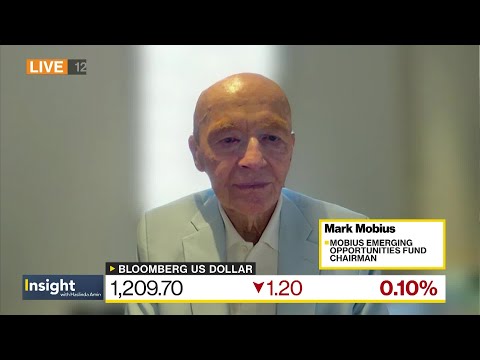
Mobius Sees Promise in Japan, India, Taiwan Markets
Bloomberg Television· 2025-08-04 16:23
Investment Strategy & Market Outlook - Initially holding 95% in cash, the portfolio is now 50% cash due to high market valuations [1][3] - Cash is considered "king" currently, with plans for aggressive buying during market corrections [2] - Holding cash provides a 4-5% interest rate from U S Treasuries, making it a safe and attractive option [3] - Emerging markets are showing promise, keeping pace with the US market in the last year [3][4] - Trade negotiations are expected to conclude in the next 4-5 months, potentially boosting emerging markets [4] Regional Investment Opportunities - Japan presents opportunities with good earnings, low price-earnings ratios, and growth, despite the Bank of Japan's policy rate of about 0 5% and inflation around 2 7% [5] - India and Taiwan are also promising markets, despite facing high tariffs from the US administration [6] - India's self-contained market and trade restrictions mitigate the impact of tariffs [7][8] - Consumer companies, airlines, and telecoms (e g Bharti Airtel) in India are attractive investment sectors [9] Risks & Uncertainties - Tariffs have negatively impacted market sentiment, raising concerns about higher inflation and poor earnings for import/export-dependent companies [14] - The ultimate impact of tariffs remains uncertain, with potential legal challenges in US federal courts [15] - Competition in the tech sector, particularly in AI, poses a significant risk to tech investments [25][26]
InterDigital(IDCC) - 2025 Q2 - Earnings Call Transcript
2025-07-31 15:00
Financial Data and Key Metrics Changes - The company reported revenue of $300 million for Q2 2025, significantly exceeding the guidance of $170 million, driven by the Samsung arbitration award and HP license agreement [14][19] - Annualized recurring revenue (ARR) reached an all-time high of $553 million, a 44% increase year over year [6][15] - Adjusted EBITDA for the quarter was $237 million, resulting in an adjusted EBITDA margin of 79%, up from 71% in Q2 last year [19] - Non-GAAP EPS reached an all-time high of $6.52, well above the guidance range of $2.67 to $2.90 [19] Business Line Data and Key Metrics Changes - The smartphone program's ARR increased 58% year over year to $465 million, with nearly 80% of the global market under license [16][19] - Revenue from the consumer electronics (CE) and IoT program increased 175% in Q2 to approximately $65 million, aided by the HP agreement [9][19] - The total contract value of licenses signed since 2021 exceeded $4 billion, indicating strong momentum in the IP as a service business model [9] Market Data and Key Metrics Changes - The company has secured licensing agreements with major Chinese OEMs, including Oppo and Vivo, contributing to the increase in smartphone market share under license [8][16] - The new Samsung agreement does not cover digital TV and display monitors, which are part of a separate license announced earlier [7] Company Strategy and Development Direction - The company aims to achieve over $1 billion in ARR across all programs by 2030, with significant growth expected in both smartphone and CE/IoT segments [17] - The development of 6G technology is a key focus, with potential monetization opportunities in new verticals such as industrial IoT, smart cities, healthcare, and automotive [10][11] - The company emphasizes the importance of its talent strategy, focusing on mentorship and leadership development to attract and retain top talent [11] Management's Comments on Operating Environment and Future Outlook - Management expressed optimism about the future growth opportunities in the wireless market, particularly with the advancements in 6G technology [35] - The company is closely monitoring potential legislative changes regarding IP tariffs but does not foresee immediate impacts on its contracts [25][26] - The updated full-year 2025 guidance reflects strong performance and continued business momentum, with revenue expected between $790 million and $850 million [20] Other Important Information - The company returned $42 million to shareholders in Q2 through buybacks and dividends, with a total return of capital nearing $90 million year to date [19] - The company has a robust cash flow, with free cash flow for 2025 expected to exceed $400 million, nearly double the 2024 levels [21] Q&A Session Summary Question: Tax rate outlook with new revenue contributions - Management indicated that the tax rate was slightly lower and is expected to remain in the mid to high teens, evaluating the impacts of new tax legislation [22][23] Question: Potential legislation on IP tariffs - Management is monitoring the situation closely and maintains open dialogue with policymakers, but no specific details are available [25][26] Question: Updated guidance assumptions regarding catch-up payments - The updated guidance considers various potential outcomes, including catch-up payments from existing contracts [27][28] Question: Long-term wireless market opportunities - Management is optimistic about future growth in wireless, particularly with 6G development and adjacent verticals [35] Question: Impact of Disney litigation on other negotiations - Management does not see the Disney litigation affecting dialogues with other potential customers and remains open to business discussions [40][42]

Bouygues: Stéphane Stoll is appointed Senior Vice-President and Chief Financial Officer of the Bouygues group
Globenewswire· 2025-07-31 07:12
Core Viewpoint - Stéphane Stoll has been appointed as Senior Vice-President and Chief Financial Officer of the Bouygues group, effective from August 1, 2025, and will join the Group Management Committee on the same date [1][4]. Group 1: Appointment Details - Stéphane Stoll, aged 55, has a long history with Bouygues, starting his career in 1994 as a project leader [2]. - His previous roles include Chief Financial Officer of Bouygues Energies & Services and Executive Vice President of Energies & Industry [3]. Group 2: Company Overview - Bouygues is a diversified services group operating in over 80 countries with 200,000 employees, focusing on construction, energies & services, telecoms, and media [5].